Public Administration as a Provider of Public Services of a Social State

Public Administration as a Provider of Public...

E-book

E-book

Stanislav Konečný

The topic of our research task of the same name VEGA 1/0757/17 was based on the question – and was likewise defined in its approved project – how public administration as one of the providers of public services can act as efficiently as possible in favour of making these services available from the aspect (place of permanent residence) of the citizen.

This can be done with a certain optimality in the structure of public administration, primarily at the local, but also at the supra-local, e.g. regional, level. If, for example, the settlement structure is too disintegrated, or conversely the regional structure is too aggregated (or even too fragmented), various alternative solutions must be sought that are rational and optimal for satisfying citizens and that will not waste public resources.

In this, it is also questionable how the system of state administration authorities and local government authorities is reflected in this structure (in the case of known differences in their operation in both these regimes, or in a regime of delegated performance of state administration), including the conditions of funding these services as public services.

Download the e-book for free (pdf)

Prípady z medzinárodného práva verejného

Prípady z medzinárodného práva verejného

E-book

E-book

Ľudmila ElbertĽubica Gregová Širicová (eds.)

In addition to acquiring theoretical knowledge, it is necessary to study and analyze the decisions of international judicial and arbitration bodies in order to fully understand the subject of the Public International Law or disciplines closely related to it.

Since the Slovak literature in the field of Public International Law does not contain any electronic textbook of selected decisions of international judicial and arbitration bodies, the authors of the submitted publication aim to eliminate this gap by elaborating the “Public International Law Casebook”, which will primarily be intended for undergraduate students of the law faculties in the Slovak republic and the Czech republic.

The proposed publication seeks to make the study of international law more attractive through a publication that will make students familiar with the decisions translated into the Slovak language in a popular electronic form.

Download the e-book for free (pdf)

Ochrana proti obmedzovaniu hospodárskej súťaže

Ochrana proti obmedzovaniu hospodárskej súťaže

E-book

E-book

Žofia Mrázová(ed.)

Proceedings from the VI. Student Symposium on Commercial Law Held on November 28, 2018, at the Faculty of Law, Pavol Jozef Šafárik University in Košice

The Department of Commercial and Economic Law at the Faculty of Law, Pavol Jozef Šafárik University in Košice, organized the sixth annual Student Symposium on Commercial Law on November 28, 2018. The event was part of the research project VEGA 1/0917/16 titled "Atypical and De Facto Relationships in Commercial Law." The symposium aims to provide a platform for discussion among students with the guidance of mentors from the department, including professors, researchers, and doctoral candidates.

This year’s symposium focused on protection against anti-competitive practices. Unchecked anti-competitive behavior could grant economic advantages to violators at the expense of other competitors and threaten the free-market system. Students explored various challenges related to competition law, analyzing Slovak and European legal frameworks as well as court rulings and decisions by other authorities. Through their research, students honed their analytical thinking, argumentation skills, and critical reasoning. The discussions generated new perspectives and encouraged active engagement among participants.

This proceedings volume presents the outcomes of students' work from this event.

Download the e-book for free(pdf)

Zákon o národnostiach a Rada vlády Slovenskej socialistickej republiky pre národnosti (predstavy a realita)

Zákon o národnostiach a Rada vlády Slovenskej...

E-book

E-book

Jana Šutajová

From January 1, 1969, the Constitutional Act on the Status of Nationalities in the Czechoslovak Socialist Republic (ČSSR) and the Constitutional Act on the Federation came into effect. The Constitutional Act on the Status of Nationalities represented at least a formal significant step forward in the legal regulation of minority rights. However, this law was intended to serve as a foundation for further legal adjustments. It was declared that additional steps and negotiations for the adoption of implementing regulations would follow and that further laws would be enacted at both the federal and national levels. Nevertheless, no additional law or government regulation related to the constitutional act on the status of nationalities in the ČSSR was ever issued.

During the normalization period, issues concerning further legislation related to national minorities were not addressed. However, in the brief period following the adoption of the constitutional act in 1968 until the end of 1969, some institutions attempted to prepare and promote such legal norms. One of these institutions was the Government Council of the Slovak Socialist Republic (SSR) for Nationalities (hereafter referred to as the Council or the Government Council for Nationalities). The monograph provides an insight into the development of additional legal norms arising from the constitutional act on the status of nationalities in the Slovak Socialist Republic, prepared by the Government Council of SSR for Nationalities. This council was one of the institutions established in Slovakia after the formation of the Czechoslovak federation and dealt with nationality issues.

In addressing further legal norms stemming from the constitutional act on nationalities in ČSSR, it was necessary to consider prior developments. Therefore, the first part of the monograph examines the status of minorities in Czechoslovakia before adopting the constitutional act, activities of nationalities preceding its adoption, and its enactment itself. Subsequent sections focus on institutional changes in SSR following federalization, the establishment of the Government Council of SSR for Nationalities, and specific actions taken by this Council and its expert bodies in drafting proposals for laws concerning nationalities in the Slovak Socialist Republic.

The motivation for writing this monograph stemmed from the fact that this topic has so far received attention only in a few studies in Slovakia, which primarily focused on the Hungarian minority during either the Prague Spring or normalization periods.

Download the e-book for free (pdf)

Právny jazyk v aplikačnej praxi

Právny jazyk v aplikačnej praxi

E-book

E-book

Marcel Dolobáč - Ľuboš Dobrovič (eds.)

Reviewed Proceedings of Contributions from a Scientific Conference

This reviewed collection of contributions from the scientific e-conference Legal Language in Application Practice, held from December 3 to 21, 2018, presents various academic contributions.

Legal language, as expressed in legal norms, is specific and should ideally be unambiguous, concise, and resistant to multiple interpretations. Is this an ideal world that does not exist but is worth striving for? Interpretative challenges and ambiguities in legal language and terminology (especially in the Labour Code) led the Department of Labour Law and Social Security Law at UPJŠ in Košice to undertake the VEGA grant project No. 1/0526/17 titled Linguistic and Sanction Mechanisms in the Creation and Operation of Labour Law Norms.

As part of this grant project, the department organized an e-conference open not only to labor law specialists but also to experts from other legal fields. Unsurprisingly, interpretative issues extend beyond labor law. The contributions in this collection are thus somewhat interdisciplinary, though with a focus on labor law. We hope this collection serves as an introduction to broader research and deeper study of legal language by experts beyond legal theory. Additionally, we trust these contributions will inspire you, the readers.

Authors

Download the e-book for free  (pdf)

The loan or usury? Compulsory enforcement of judgment - roman and law foundations and problems of application practice

The loan or usury? Compulsory enforcement of...

E-book

E-book

Terézia HišemováDarina Kmecová (eds.)

Reviewed proceedings of scientific papers of Conference of Slovak and Czech law romanists, which take place at May, 10.-11.5.2018, at Faculty of Law, UPJŠ in Košice.

The submitted reviewed proceeding of scientific papers on „The loan or usury? Compulsory enforcement of roman - law basics and problems of application practice.”  is prepared within the solution of the grant project VEGA on: „The loan or usury? Compulsory enforcement of historical - law basics and problems of application practice.”, no. p. 1/0198/17.

The authors of papers are important personalities of Roman law working in the Slovak and Czech Republic, as well as PhD students and young scientists from Slovak and foreign universities who are active in the academic environment as well as in legal practice. The main goal of the editors is to help improve the current legal situation, which is assessed as unsatisfactory, and through a historical excursion of the development of the loan institute and then the forced execution of the decision, to create de lege ferenda proposals considering all areas of research.

The Proceedings trace the interrelationships between the substantive law institute in terms of the Roman law of contractus unilaterales - mutuum in its various types, often realized by the attachment of high interest rates, which bordered on the insurrection and the procedural law of individual lawsuits enforced in the legislative, formular and cognitive process. If there was no possibility to impose certain behaviour on the obligated person (the debtor, the sentenced person), then the declared general obligation to enforce the legal norms was only a legal term. It has always been the case that every internally well-organized state, whether antique or present, has to use power tools - often with the use of gross violence - but within the limits of the law, to promote what it has declared valid law. It must protect creditors on the one hand, but it must also prevent self-help and the use of illegal, unjustified and disproportionate violence.

The loan contract as a real contract has often become an integral part and relatively the most frequent reason leading to the compulsory enforcement, especially when contracting parties often agree on the connection of interest - sometimes within the legal limit, sometimes exceeding the legal framework - and in this way the potential future creditor (the plaintiff) significantly increased the insolvency risk of the debtor (the defendant, the sentenced) and of the subsequent execution. The pronounced and deepening social stratification of the Roman population and the secondary depreciation effort, the cancellation of the debts of the poor part of the population logically culminated in social unrest and revolt against the enforcement of the enforcement law.

The proceedings capture not only the rich scientific discussion of Slovak and Czech legal Romanists, but also the opinions, experience and knowledge of experts on contemporary law dealing with this type of issues. As a result, it provides a unique interdisciplinary view of the subject and raises many stimulus points for future research. This work proves that the problems encountered by the various representatives of the Roman jurisprudence and their legal and theoretical bases and solutions are undoubtedly useful and serve as a guideline also for solving legal issues in the field of modern enforcement proceedings.

Download the e-book for free (pdf)

Ochrana (duševného) zdravia zamestnanca v informačnom veku

Ochrana (duševného) zdravia zamestnanca v...

E-book

E-book

Marcel DolobáčMonika Seilerová

The Industrial Revolution cannot be avoided or hidden from, but it is equally wrong to see it only in gray tones. Let us be optimistic. The Information Age can also mean a reduction in working hours, perhaps more time for family and interpersonal relationships, or an overall increase in individual economic luxury. The Information Age will take away many job opportunities but will put many others on the table, though mostly for the educated. Science and research will become even more important for overall economic development than they are today. Let us be prepared.

The ambition of this monograph is not, and cannot be, to provide an exhaustive answer to the above-outlined debates. Its goal is to stimulate broader scientific discussion, particularly on the issue of mental health protection in correlation with the advent of the Information Age. The subject of study is the protection of the individual—the employee—who must adapt to a new technological environment and its associated demands.

The monograph represents a comprehensive output by authors who, over the past two years, have published on similar topics within the APVV-16-0002 grant "Mental Health in the Workplace and Assessment of Employee Health Capability." The authors believe that thanks to this APVV grant, they will continue to build on this topic in the coming years. Most importantly, they hope that its content will engage you, the readers.


Marcel Dolobáč

Download the e-book for free (pdf)

Starostlivosť o zdravie zamestnancov

Starostlivosť o zdravie zamestnancov

E-book

E-book

Marcel DolobáčMonika Seilerová (eds.)

The Proceedings presents papers from international scientific conference The Employees health care held on 6th and 8th June 2018 in High Tatras and is published as a partial outcome of the implementation of the project APVV-16- 0002 - Mental Health in the Workplace and Employee Health Assessment.

Pri hodnotení informačného veku sa ťažko uhýba streľbe fráz. Moderné technológie, internet, smartfóny, komunikačná technológia, či sociálne siete zmenili rytmus života na nepoznanie a svojim dosahom prekvapili aj samotných tvorcov. Možno takéto strohé hodnotenie znie až priveľmi povedome, snáď ako mnohokrát vyslovená fráza, ale je vskutku pravdivé. Rýchlo, obratom, hneď. ASAP. Heslá dnešnej doby. Pracovný život nevynímajúc. Namiesto uľahčenia práce a možnosti zosúladenia pracovného a rodinného života, čo je stále nenaplneným snom modelu flexikurity, moderné technológie prepletajú voľný čas s tým pracovným a nedokážu ich od seba oddeliť. Zamestnávateľ prostredníctvom emailu kladie požiadavky na neustálu online zapojenosť, z jeho pohľadu odpoveď možno zaberie iba pár minút, ale pripravený máme byť takmer vždy. Výsledkom je nezdravý, nadmerný, ba neustály stres. Stres sa stal takým fenoménom nového pracovného sveta, že mladí uchádzači o prácu sa vzájomne predbiehajú v tom, že práve oni vedia pracovať pod stresom, bez obáv zvládajú stresové situácie, dokonca majú stres radi, vyhľadávajú ho a túžia v stresovom prostredí pracovať. Nuž, nevedia, nezvládajú a netúžia ... ak, iba dočasne.

Nové stresové faktory sú predmetom skúmania nielen prírodných vied, najmä medicíny, ale aj humanitných vedných odborov, vrátane psychológie a práva. Autor tohto predhovoru s potešením konštatuje, že viacerí odborníci z týchto tieto zdanlivo vzdialených odborov sa stretli na spoločnej konferencii pod gesciou grantovej úlohy APVV-16-0002 Duševné zdravie na pracovisku a posudzovanie zdravotnej spôsobilosti zamestnanca a vzájomne si vymieňali poznatky a myšlienky. Vzájomná interdisciplinárna interakcia sa stáva základom pre nové poňatie problematiky a inšpiratívne metódy skúmania.

Zborník predstavuje výsledky prednesov prezentovaných na spoločnej konferencii s názvom Starostlivosť o zdravie zamestnancov, ktorá sa konala v dňoch 6. až 8. júna 2018 v Hornom Smokovci, vo Vysokých Tatrách. Veríme, že jeho obsah zaujme a podnieti i vás, čitateľov.

JUDr. Marcel Dolobáč, PhD.

Download the e-book for free (pdf)

Miesto a význam regionálnych súdnych orgánov v kontexte súčasného regionalizmu

Miesto a význam regionálnych súdnych orgánov v...

E-book

E-book

Ján Klučka et al.

The aim of the current monograph is to provide comprehensive view of the status of regional judicial organs in current conditions of regionalism. Based on selected issues examined in individual chapters research team presents the comprehensive study focused on clarification of the status and significance of regional judicial organs in terms of new regionalism.

Research of the role of regional courts in the system of peaceful settlement of disputes demonstrates the significant role of the regional courts within the promotion of the rule of law, regional integration and also significant role of regional courts to ensure legal certainty within the system of compliance with decisions of regional courts. The result of examination of possibilities of individuals to access to regional judicial organs is comparative evaluation of regional possibilities of individual to defend his/her rights within regional courts of various regions. Particular part of this area is the right to an effective remedy and to a fair trial as basic rights within the proceedings of regional judicial organs. Within the examination of preliminary rulings of international regional courts of different regions the role of regional judicial organs in the process of effective implementation of the principle of the rule of law was the subject of examination.

For the proper functioning of the regional judicial organs as well as independence of judges and legal certainty in International law, the ethical rules of international judicial organs and tribunals, which are the subject of the last chapter, are significant.

Download the e-book for free  (pdf)

Iniciatívy EÚ pri predchádzaní daňovým únikom a daňovým podvodom a ich implementácia do vnútroštátneho právneho poriadku

Iniciatívy EÚ pri predchádzaní daňovým únikom a...

E-book

E-book

Adrián Popovič a kol.

The possibility of solving the grant project VVGS-2016-284 has provided a unique opportunity for members of the author´s team in the interdisciplinary composition to examine the issue not only from a tax-law point of view, but also from a political point of viewIn the presented monograph, the authors focused on the characterization of different aspects of the EU in order to allow the reader correctly understand its position in relation to the outside world and to its inward relations within its Member States in the context of the creation and implementation of the EU tax policy.

Particular attention is paid to the definition of the relationship between national tax legislation and EU law, the impact of the EU's tax policy on the national laws of its Member States, with reference to the identification of the harmonized areas with the approximation of their current stage of development and the final objective. This definition can be seen as a prerequisite for a correct and comprehensive understanding of the application and implementation of EU institutions' initiatives to prevent tax evasion and tax fraud and their implementation into the national legal order of the Slovak Republic. In the last part of the monograph, the authors focused on defining individual EU initiatives to combat tax evasion and tax fraud as a means of implementing its tax policy, in the area of ​​indirect taxation, in particular in the field of value added tax and in the field of direct taxation, especially with regard to corporate taxation, and to evaluate their projection into the national tax legislation of the Slovak Republic. At the same time, in these chapters, they assessed the real impact and effect of the measures admitted on the basis of the initiatives in practice.

The presented work is intended for a university student studying in the field of Tax Law and European Law, as well as the broader legal and economic community. However, in view of the scope and recency of the subject under consideration, the authors believe that the publication will find its application not only in the theoretical field but also in the practical field.

 JUDr. Adrián Popovič

Download the e-book for free (pdf)

Probácia v systéme trestnej politiky a sociálnej práce

Probácia v systéme trestnej politiky a...

E-book

E-book

Vladimír LichnerDušan Šlosár

Issues of punishment are directly linked to a state’s criminal policy, which is an inseparable part of its social policy. Historically, the state has held a unique dominant position in the realm of punishment. Once the conditions for imposing a penalty are met, the state fulfills its obligation by sentencing through independent courts. However, it does not address questions of satisfaction, which belong to the victim. The victim may be a specific physical person or legal entity that suffered harm due to the criminal act. This harm simultaneously affects civil society as a whole. The state prioritizes its duty to punish and decide on the matter over compensating the harmed individual or civil society.

By mediation in criminal cases, we mean extrajudicial facilitation of resolving disputes between the offender and the harmed party, with the assistance and personal participation of a mediator. The mediator, as an independent and impartial person, helps parties identify their interests and supports them in finding shared, practical, and realistic solutions to the points causing their conflict. Probation refers to monitoring, supervising the accused, defendant, or convicted individual, as well as providing individual assistance to the offender and encouraging them to lead a lawful life. This reduces the risk of recidivism, or repeated criminal behavior.

Download the e-book for free (pdf)

Ochrana práv veriteľov v obchodných záväzkových vzťahoch

Ochrana práv veriteľov v obchodných záväzkových...

E-book

E-book

Žofia Mrázová (ed.)

Proceedings of Contributions from the V. Student Symposium on Commercial Law

The proceedings are the result of student works presented at the fifth annual student symposium organized by the Department of Commercial Law and Economic Law, Faculty of Law, UPJŠ in Košice, which took place on November 30 – December 1, 2017, at the UPJŠ educational and training facility in Danišovce.

This year’s symposium focused on problematic issues related to creditor rights protection in commercial contractual relationships.

The purpose of these annually organized symposia is to provide students with a platform to present their own opinions and improve their analytical and argumentation skills.

Download the e-book for free (pdf)

Výzva a riziká spoločnosti v 21. storočí

Výzva a riziká spoločnosti v 21. storočí

E-book

E-book

Gabriel EštokGabriela SzabariováMatúš Béreš (eds.)

Presented publication is an outcome from the scientific conference for students and young scientists that took place on 12th and 13th May 2016 at the Department of Political science, Faculty of Arts, Pavol Jozef Šafárik University in Košice. The main aim of the presented is to bring up outcomes of research of young scientists and students from Slovakia, as well as from abroad. Many of the presented papers have become integral part of qualification theses of their authors.

This conference proceedings contains 22 papers in Slovak, Czech and English language thematically creating four different parts.

Papers regarding international relations or issues exceeding a level of state power are dealing with issues of globalization, counterculture, international terrorism, extremism and a role of the EU in the Arctic. Papers dealing with the situation in the Slovak republic and abroad cover reform of security in Slovakia and in Romania, issue of dealing with totalitarian history of the states of the Visegrad group as well as development of funding of education system in Slovakia since 1919. In case of authors focusing on the socio-political situation in Slovakia we can find papers analyzing role of a reeve in city of Košice, first great political conflict during a rule of Vladimír Mečiar in Slovakia, role of Roma population in political environment in Slovakia, but also those concerning local activist or action groups and examining attitude of nursing care students towards euthanasia. The conference proceedings contents also four papers regarding theoretical or philosophical issues.

Their authors focused on topic of social state, social equality, democratic theories and transformation of human nature in “post-human” era.

Download the e-book for free (pdf)

Ochrana (duševného) zdravia zamestnanca

Ochrana (duševného) zdravia zamestnanca

E-book

E-book

Milena Barinková (ed.)

The complex of legal norms protecting work, ensuring safety and health protection at work, is very broad in scope, extending beyond the Labour Code to include other specific legal regulations, collective agreements, executive legal regulations, and internal corporate normative acts.

Health protection of employees from hazardous workplace influences is a central requirement stemming from fundamental human rights guaranteed by the Constitution of the Slovak Republic. To ensure its universal enforcement across all employers in both private and public sectors, strict regulation through cogent norms is fully justified. The European Commission’s Communication to the European Parliament, Council, European Economic and Social Committee, and Committee of the Regions on the EU Strategic Framework on Health and Safety at Work 2014–2020 (COM(2014) 332 final) addresses the need to account for labor market changes arising from demographic shifts, aging populations, and technological advancements.

Work pace demands are intensifying, and all age categories of employees must adapt to new technologies, organizational changes, and evolving job structures. This increases requirements for maintaining health fitness throughout entire professional careers. Mental health fitness, which receives insufficient specific attention, is an inherent part of health fitness requirements. Prevention plays a critical role in mental health protection.

Download the e-book for free (pdf)

Spravodlivosť v organizáciách verejnej správy

Spravodlivosť v organizáciách verejnej správy

E-book

E-book

Eliška Župová et al.

Research into justice in public administration organizations has not yet been conducted in Slovakia, not even in the scope of respondents addressed. Therefore, we consider the project cross-sectional, current, and beneficial for deeper exploration of this area.

The project is designed as interdisciplinary, combining insights from legal perspectives in defining justice from labor law aspects, psychological and ethical evaluations of fairness levels, and knowledge from public administration management fields.

The inspiration for selecting this topic stems from its academic relevance, confirmed by both domestic and international studies, as well as its public relevance, where laypeople most intensely perceive justice/injustice in relation to remuneration and appropriate labor-law conditions – exemplified by teachers’ strikes (2003, 2006, 2016), nurses’ strikes (2003, 2006, 2012, 2016), ŽSR employees’ strikes (2003), and doctors’ strikes (2011).

Download the e-book for free  (pdf)

Verejná správa ako poskytovateľ verejných služieb sociálneho štátu

Verejná správa ako poskytovateľ verejných...

E-book

E-book

Eva Výrostová (ed.)

Proceedings of the International Scientific Seminar "Public Administration as a Provider of Public Services of a Social State - Utilising Foreign Experience for Reforms in the Slovak Republic" held at the Faculty of Public Administration, UPJŠ, Popradská 66 in Košice on 24 November 2017

Public services represent an increasingly expanding segment of the public sector. This growth can be identified primarily horizontally – from services related to general security and other forms of state functionality, through technical infrastructure, postal and telecommunications services, transportation, and information services, to increasingly emphasized healthcare, cultural, educational, and social services. Simultaneously, the entire structure of public services is expanding vertically, particularly in depth: within each area, the range of provided services is broadening.

In this context, the importance of optimizing the structure of service providers is growing, which is the focus of such reform processes as decentralization, deconcentration, privatization, or other forms of structural transformation. The outcome may vary under different conditions, resulting in diverse provider structures for public services of the social state, where the state and its bodies or organizations continue to hold a significant position.

Consequently, the significance of the public administration model as the primary state provider of these services is increasing: due to these processes, countries develop distinct and sometimes incomparable systems of public service providers, even within state bodies or organizations acting on behalf of the state. However, the varying effectiveness of public service delivery systems by public administration bodies remains a persistent reality.

Download the e-book for free (pdf)

Extrémizmus a radikalizácia v sociálnych kontextoch

Extrémizmus a radikalizácia v sociálnych...

E-book

E-book

Vladimír LichnerDušan Šlosár et al.

It is very difficult to refer to any act of extremism or action having extremist characteristics, or to exclude it unambiguously. The boundary between extremism and accepted, conformal behavior is very broad and vaguely worded. Each company tends to set certain criteria to determine what can be considered as unwanted, violent, radical or extreme, or what signs of such a manifestation do not have. Therefore, when comparing the individual countries of the European Union in this area, we come across a different definition of what is or is not considered to be radical or extremist. In essence, the level of tolerance to some of the manifestations and the setting of indicators for the evaluation of the proceedings as extremist.

The presented monograph aims to present the basic social contexts of extremism and radicalization in the form of their philosophical and theoretical backgrounds, influencing the factors, the basic directions. In the author's work, the authors focus on the target group of adolescents, which they consider to be one of the most endangered groups in society in terms of development of the radicalization process. At the conclusion of the monograph is also offered the criminal level of these phenomena, which is not unavoidable in terms of complex analysis.

Download the e-book for free  (pdf)

Aktuálne otázky teórie a praxe politiky a medzinárodných vzťahov

Aktuálne otázky teórie a praxe politiky a...

E-book

E-book

Linda Babušík AdamčíkováGabriel KoscelanskýMária Petriková (eds.)

Proceedings of the VI. Annual International Scientific Conference of Students and Young Researchers organized on May 11–12, 2017 by the Department of Political Science of the Faculty of Arts at Pavol Jozef Šafárik University in Košice, the Department of Political Sciences and Public Administration at Uzhhorod National University, the Research Institute of Central Europe, and the Res publica Association.

Presented publication is an outcome from the international scientific conference for students and young scientists that took place on 11th and 12th May 2017 at the Department of Political science, Faculty of Arts, Pavol Jozef Šafárik University in Košice. The main aim of the presented is to bring up outcomes of research of young scientists and students from Slovakia, as well as from abroad.

This conference proceedings contains 19 papers in Slovak, Czech and English language. Papers are dealing with current issues of theory and practice of politics and international relations. We can find paper analyzing globalization, international terrorism, topic of EU or development of European states. The conference proceedings contents also papers regarding the far-right parties, role of women in  politics and integration migrants in Slovak republic.

Download the e-book for free (pdf)

Mediácia v systéme sociálnej práce

Mediácia v systéme sociálnej práce

E-book

E-book

Dušan ŠlosárVladimír Lichner

This university textbook aims to provide readers with knowledge of the philosophical foundations, meaning, and purpose of mediation, based on research and analysis of mediators' activities. In countries where mediation services operate, their staff often include graduates of social work departments.

An individual approach to both the perpetrator and victim of a criminal offense requires knowledge and skills from social work, psychology, sociology, communication, and related fields tied to social work. The principles of social work apply not only in social policy and social care but also in justice. A mediator’s mission is to facilitate alternative resolutions to unlawful acts while preserving the purpose of legal proceedings as defined by valid legal norms. They fulfill this mission through specific methods of individual social work applied in the justice sector. The mediator’s focus extends beyond the current conflict to uncover related issues, activate parties to resolve disputes, and prevent new conflicts.

Special attention is devoted to the philosophical foundations of mediation in Slovakia. We provide an overview of mediators’ core activities and mediation types used to uphold justice in Slovakia. We analyze mediation goals, the roles of parties involved, and procedural steps. In applying mediation, we explore its potential and implementation in both legal and social work contexts.

As indicated, mediation cannot be understood solely as a specialized activity in criminal justice, as it has broader applications in non-judicial dispute resolution, such as family or community work, which are often overlooked by the public. The mediator’s approach to diverse target groups is grounded in theoretical frameworks. From this foundation, we derive activities expected of mediators in the future. Expanded activities arise from concrete situations encountered during mediation.

Download the e-book for free (pdf)

The place, role and significance of domestic law

The place, role and significance of domestic law

E-book

E-book

Dominika BeckováAdam Giertl (eds.)

Collection of Papers of PhD. students and young researchers

Institute of International Law and European Law offered a place to PhD. students and young researchers to publish scientific outputs of their research. Submited collection of scientific contributions is the result of that initiative. Papers deal with the implementation of international law and law of the EU into the domestic legal system.

Thematically is the collection of contributions divided into several parts, that are dedicated to contributions dealing with the issues of legal theory and international and european law.

Contributions are addressing issues of human rights protection, they aim to the roles of international and supranational judiciary, environment, criminal and public law. Collection of contributions includes also chosen problems of private law and it also dedicates space for contributions focused on foreign investments.

Download the e-book for free  (pdf)

Spracúvanie osobných údajov zamestnanca podľa GDPR

Spracúvanie osobných údajov zamestnanca podľa GDPR

E-book

E-book

Jana Žuľová a kol.

The presented publication is intended for employers, managers, and HR professionals who process employees' personal data for various employment-related purposes and need to conduct an audit of their processing in compliance with the GDPR and the new Personal Data Protection Act. The publication will also be useful for new employers who are encountering data protection for the first time and need to establish internal data protection rules, essentially starting from scratch.

The reader has the opportunity to gain a comprehensive understanding of the data protection rules applicable in the employment sector, the obligations of the employer, and the rights of the data subject, i.e., job applicants, employees, and former employees.

Download the e-book for free (pdf)

Hranice zmluvnej slobody v pracovnom práve

Hranice zmluvnej slobody v pracovnom práve

E-book

E-book

Marcel Dolobáč

The author's ambition is to build on the current and at the same time to stimulate further discussion of the anchoring of labour law in the system of private law sectors and to contribute to the variation of views in relation to freedom of contract and its limits in labour law. The broad contractual freedom of civil law does not apply to the field of labour law, and thus the penetration of standard civil law institutes into labour law relations is not always self-evident.

The above constitutes the main theses of the present monograph. The issue of freedom of contract in labour law can be grasped in several ways. The author has chosen a content structure that is built on three basic pillars. In the first part, the author assesses the position of labour law in the system of law, which is determined primarily by the actual subject of legal regulation - dependent labour and the specific method of legal regulation through cogent and relatively cogent norms. In this context, the author would like to note at the outset that the much-discussed dispositive nature of labour law norms appears to be merely presumptive. Labour law is built on minima and maxima, with relative mandatory norms being the building blocks of fixed boundaries, a fact that distinguishes labour law from other branches of private law. These considerations are followed by the author's view of autonomy of will in labour law. The limits of contractual freedom (not only) in the theoretical sense form the second pillar of the author's ideas.

Finally, the third part of the thesis is to be the one that translates the theoretical-legal considerations of the interconnection of civil law and labour law into the interpretation of selected civil law institutes and the possibility of their application and implementation in labour law relations.

Download he e-book for free (pdf)

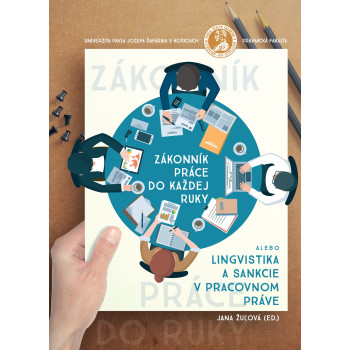
Zákonník práce do každej ruky alebo lingvistika a sankcie v pracovnom práve

Zákonník práce do každej ruky alebo lingvistika...

E-book

E-book

Jana Žuľová

Proceedings of the Second Annual Student Symposium on Labor Law held on May 12–13, 2017 in Danišovce

The presented proceedings are the result of scientific works by students of the Faculty of Law at Pavol Jozef Šafárik University in Košice and are systematically divided into two parts.

The first part presents interdisciplinary intersections of linguistics and labor law in its creation, interpretation, and application. The second part addresses the issue of targeting the addressees of labor law norms through various sanction mechanisms. The proceedings include a questionnaire compiled by the researchers of a grant project, aimed at determining whether and in which aspects the Labor Code diverges from its addressees in terms of linguistic and stylistic processing. Indeed, there is no other legal norm that is closer to the participants of labor relations, and whose understanding at the highest possible level is justified by its everyday use.

The presented proceedings thus serve as a means of expanding the horizons of our students beyond their regular studies and as a tool for popularizing scientific research. In case of interest, the completed questionnaire can be sent to: jana.zulova (@) upjs.sk.

Download the e-book for free (pdf)

Zborník príspevkov z X. ročníka študentského sympózia z medzinárodného a európskeho práva

Zborník príspevkov z X. ročníka študentského...

E-book

E-book

Adam Giertl (ed.)

Proceedings of the Student Symposium on International Law and European Law held on April 28, 2017, at the Faculty of Law of Pavol Jozef Šafárik University in Košice

The Student Symposium is regularly organized by the Institute of International Law and European Law, and in 2017, it marked the jubilee tenth edition of the symposium, which over time expanded its focus to include European law.

The tradition of holding student symposia is also associated with the good practice of preparing proceedings from each event. Understandably, the tenth edition is no exception, and thus, the tenth edition of the symposium proceedings is now available to readers. In previous years, the symposium has always focused on specific areas of international and European law. Thus, the subjects of study for symposium participants have included migration issues (2016), the protection of cultural values (2015), and the challenges of cyberspace (2013).

This year, given that it is the jubilee tenth edition, the symposium organizers have chosen to approach the symposium's focus thematically and recall some significant milestones in the development of international law that occurred in years ending with the number seven.

Download the e-book for free (pdf)

Právne postavenie spoločníka v obchodnej spoločnosti

Právne postavenie spoločníka v obchodnej...

E-book

E-book

Žofia Šuleková (ed.)

Proceedings of the Contributions from the IV. Student Symposium on Corporate Law held on November 24-25, 2016, at the Training Facility of Pavol Jozef Šafárik University in Danišovce.

The Department of Commercial Law and Economic Law at the Faculty of Law of Pavol Jozef Šafárik University in Košice organized the fourth edition of the student symposium, this time focusing on corporate law.

The event took place on November 24-25, 2016, at the training facility of Pavol Jozef Šafárik University in Danišovce. The aim of the annually organized symposiums is to create a discussion platform for students with the participation of mentors from the department, including teachers, researchers, and doctoral students. This year’s symposium focused on problematic issues related to the legal status of a partner in a commercial company. The topics were assigned to allow students to demonstrate and develop their analytical and argumentative skills while improving their ability to present and formulate their own views and perspectives.

The presented proceedings are the outcome of the students' work from this event.

Download the e-book for free (pdf)

Medzinárodné právo súkromné

Medzinárodné právo súkromné

E-book

E-book

Kristián Csach - Ľubica Širicová

Private international law has undergone dramatic changes in recent periods. The fully operational process of communitarization of this legal field has not yet – and perhaps could not have been – effectively reflected by domestic legislators. Under the current legal status, it is not uncommon for legal issues to intertwine regulations of community origin and domestic legislation (embodied primarily by Act No. 97/1963 Coll. on Private International Law and Procedure).

Questions about the obsolescence of some provisions of this, until recently, universal codified regulation of private international law arise mainly (but not exclusively) from the conflict rules contained in the so-called "Rome I" Regulation on the law applicable to contractual obligations, the "Rome II" Regulation on the law applicable to non-contractual obligations, and most recently in Council Regulation (EC) No. 4/2009 of 18 December 2008 on jurisdiction, applicable law, recognition, and enforcement of decisions and cooperation in matters relating to maintenance obligations.

Respecting the principle of the primacy of generally binding acts of the Community over domestic law, the correct application of normative texts cannot be achieved without the ability to quickly navigate through the norms and subsequently compare them.

Students and anyone else are therefore confronted with a multitude of legal regulations of substantial scope and detailed regulation. Currently, apart from systematically arranged references on the websites of the Ministry of Justice, we do not find a comprehensive material that would offer an overview of legal regulations in the field of private international law and procedure.

Download the e-book for free (pdf)

Kúpna zmluva – história a súčasnosť I.

Kúpna zmluva – história a súčasnosť I.

E-book

E-book

Erik Štenpien (ed.)

Proceedings of the International Scientific Conference held on September 27, 2013, at the Faculty of Law of UPJŠ in Košice

The Civil Code is one of the fundamental legal codifications of our time. Paradoxically, in the Slovak Republic, the 1964 Code still applies today, albeit with certain modifications brought by the modern era. Currently, recodification efforts are underway, with the goal of adopting a new Civil Code.

However, it is not possible to build something new without knowledge of the old. It is therefore a positive sign when legal historians and civil law experts come together at a conference to exchange views and insights. The Department of State and Legal History at the Faculty of Law in Košice is in its first year of working on the scientific grant project VEGA: The Historical-Legal Development of the Institute of the Sales Contract and Trends in Its Current Recodification in the Slovak Republic - No. 1/0131/13.

This project was acquired as a historical-legal initiative, but the Department of Civil Law is also participating, as Assoc. Prof. JUDr. K. Kirstová, CSc., is the deputy head of the project. Aware that this represents a completely unique connection between legal history and practice, our department organized the international scientific conference The Sales Contract - History and Present I. on September 27, 2013, which was a planned grant output but ultimately coincided with the 40th anniversary of the Faculty of Law in Košice.

This proceedings volume thus summarizes contributions from the grant project, as well as related presentations. It aims to significantly contribute to the understanding of the history and current recodification efforts of the sales contract institution both domestically and internationally.

Download the e-book for free (pdf)

Medzinárodné právo verejné (Materiály k štúdiu)

Medzinárodné právo verejné (Materiály k štúdiu)

E-book

E-book

Ľudmila Pošiváková - Adam Giertl

The presented selection of public international law documents aims to map international law from both historical and sectoral perspectives. The reader will find several historical documents in this collection, but the focus is primarily on currently valid legal sources.

The selection is guided by the publication Public International Law – General and Special Part by Prof. Ján Klučko, which is reflected in the division into general and special parts. The general part addresses the historical development of international law but primarily focuses on the protection of individuals and responsibility relationships in international law. The special part then examines the international regulation of various institutions of international law.

We acknowledge that this selection offers room for expansion, but we believe it meets basic requirements and fills a certain gap in the study of international law.

We trust that this collection of public international law materials will be beneficial for students, and not only for them, in the study of public international law and will contribute to raising awareness in this field.

Download the e-book for free (pdf)

Oslava právneho štátu (Právny štát z pohľadu teórie štátu a práva a medzinárodného práva)

Oslava právneho štátu (Právny štát z pohľadu...

E-book

E-book

Ľudmila Pošiváková Zuzana Antošová - Milan Kočan (eds.)

Proceedings from the Student Debate held on April 24, 2013, at the Faculty of Law of Pavol Jozef Šafárik University in Košice.

In the current period, the rule of law is widely debated both at the academic and political levels. This debate is not only related to the effort to establish the Rule of Law in states that have transitioned from socialist to democratic systems but also in states experiencing various unrests, whether political or religious.

However, it is not just a debate about certain characteristics of the Rule of Law that are missing in domestic law or at the level of international law, but also a debate about the very definition and meaning of the Rule of Law. The rule of law can be likened to an ideal that almost every state strives to achieve. Even in the case of the establishment of the independent Slovak Republic, the framers decided to include among the introductory provisions, which should form the core of the constitution, that the Slovak Republic is a state governed by the rule of law.

However, to achieve the ideal of the rule of law, it is necessary not only to declare it but also to adopt measures essential for an independent judiciary, democracy, the effective enforcement of human rights, the separation of powers, and many other elements that characterize a state governed by the rule of law.

Download the e-book for free (pdf)

Informačná spoločnosť a medzinárodné právo

Informačná spoločnosť a medzinárodné právo

E-book

E-book

Adam Giertl - Ľubica Gregová Širicová (eds.)

Proceedings from the 5th Student Symposium held on April 21-22, 2013

The French delegate to the Commission on Human Rights, while discussing the inclusion of the term "media" in the article on freedom of expression in the draft of the International Covenant on Civil and Political Rights, wisely urged other members of the commission to be forward-looking regarding the information media of the future.

The discussion took place in 1950, when delegates could not yet foresee the impact of the internet on social relations. Given that it is now clear that information technologies significantly influence law, including international law, the organizers of the student symposium decided to dedicate its sixth edition to the theme "Information Society and International Law."

Students of the Faculty of Law, after registering for the symposium, first focused on preparing their contributions, with each participant having access to a consultant if needed. This year, the list of consultants, in addition to members of the Institute of European Law and the Department of International Law, was expanded to include an expert in intellectual property law, Mgr. Martin Husovec, a graduate of our Faculty of Law and currently an IMPRS-CI doctoral student at the Max Planck Institute for Intellectual Property and Competition Law. We also take this opportunity to thank him for dedicating his time to the students and providing them with valuable advice in preparing their contributions. After the preparatory phase, the symposium itself took place, with the aim of presenting the prepared contributions and discussing them.

The presented contributions reflected a wide range of intersections between international law and the information society.

Download the e-book for free (pdf)

Regionalizmus: Stav, východiská, perspektívy

Regionalizmus: Stav, východiská, perspektívy

E-book

E-book

Adam Giertl (ed.)

Proceedings of Scientific Works

International law does not represent a monolithic entity of uniform legal norms. It is a legal system that is fundamentally created by the consensus of states. It reflects the collective will of multiple entities regarding what should be binding and enforceable as law among them.

From this understanding arises the fact that the needs for legal regulation will differ in various parts of the world. The consequence of this situation is the formation of regional groupings where, to some extent, specific legal rules apply. As Professor Klučka points out in his study published in this proceedings, regionalization can occur both on a contractual basis and on an institutional basis. Regionalism in law thus raises many interesting questions that legal science addresses.

This proceedings of scientific papers also aims to contribute to the knowledge in this field.

Download the e-book for free (pdf)

Tvorba a realizácia pracovného práva so zreteľom na regionálne aspekty trhu práce

Tvorba a realizácia pracovného práva so...

E-book

E-book

Milena Barinková (ed.)

The researchers of the grant task ‘Creation and implementation of labour law with regard to regional aspects of the labour market’ deal in their work with the analysis of employers' attempts for legislative changes in the level of social rights of employees justified by regional differences, the analysis of possible impacts in their implementation, as well as the assessment of their compliance with the protective function of Slovak labour law and the value character of fundamental human rights inherent in the European and legal culture.

Download the e-book for free (pdf)

This website uses cookies to ensure you get the best experience on our website