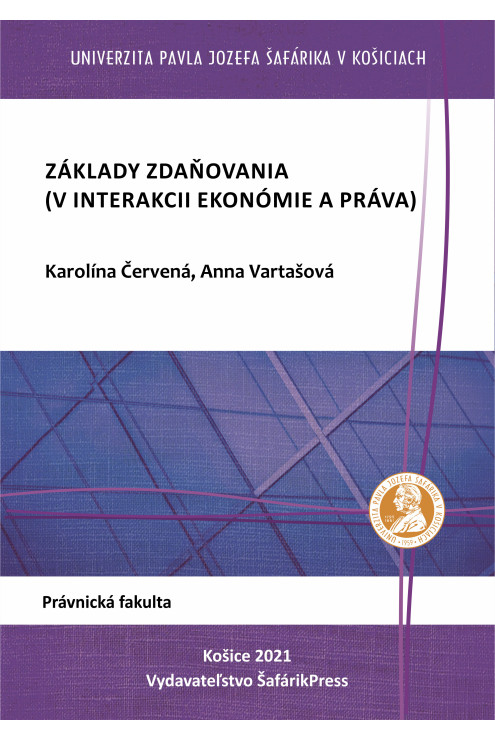
Základy zdaňovania (v interakcii ekonómie a práva)

E-book

Karolína ČervenáAnna Vartašová

The scientific textbook in the form of an electronic interactive publication is intended for university students who are interested in an interdisciplinary view of taxation in the context of linking the basic theoretical knowledge in the field of law and economics related to taxation with an emphasis on application practice. The content of the textbook primarily covers general theoretical knowledge in the field of taxation in terms of their historical creation and characteristics in the scope of the legal and economic framework of tax system in general, as well as that currently applied in the Slovak Republic.

The textbook also includes pictures and graphs (listed in the appendix), which interactively complement the text part, as well as a set of questions in (in the context of the scope of particular chapters), whose task is to contribute to the fulfilment of didactic goals of the textbook.

Download the e-book for free  (pdf)

Quantity

978-80-574-0013-4

Data sheet

Method of publication:
E-book (pdf)
Authors:
Karolína Červená - Anna Vartašová
Document type:
University Textbook
Number of pages:
125
Available from:
21.06.2021
Year of publication:
2021
Edition:
1st edition
Publication language:
Slovak
Faculty:
Faculty of Law
License:
Creative Commons BY NC - SA (Uveďte autora - Nepoužívajte komerčne - Zachovajte licenciu )
DOI:
https://doi.org/10.33542/ZZ2021-0013-4
- Free for download

16 other products in the same category:

Aktuálne problémy medzinárodného leteckého a...

E-book

E-book

Adam Giertl (ed.)

Proceedings from the VII. annual student symposium on international law held on April 11-12, 2014 at the UPJŠ training facility in Danišovce

Despite this, flying and space travel are now a common part of human civilization. What is the role of law in this process? This is the question posed by the organizers of the VII. annual student symposium on international law, aiming to evaluate the contribution of international law in the field of aviation and space flights, especially in light of current developments.

The individual topics were tackled by second, third, and higher-year students of the Faculty of Law at UPJŠ in Košice. The result of their work on the assigned topics, which the authors could consult with members of the Institute of European Law and the Department of International Law, is the presented work.

The proceedings are thematically divided into two parts. The first part acquaints the reader with selected topics related to aviation law, and the second part is dedicated to international space law.

With its focus, the proceedings also have a broader impact, as in some aspects it fits into the broader context of research conducted at the Institute of European Law and the Department of International Law, which focuses on examining the influence of regionalism on general international law and vice versa. This issue is also reflected in the topics of the individual contributions.

Download the e-book for free (pdf)

Právo - obchod - ekonomika V.

E-book

E-book

Jozef Suchoža - Ján Husár - Regina Hučková (eds.)

Collection of Scientific Works

The scientific papers presented in this Collection are primarily the result of academic research conducted by experts working within the academic environment—particularly at Faculties of Law in the Slovak Republic and the Czech Republic, as well as by foreign experts, including those from Poland, the Russian Federation, Serbia, and others. In addition to academic contributions, this Collection also includes scientific and professional articles authored by legal practitioners, especially lawyers, notaries, and judges—not only from our own jurisdiction, but also judges from the General Court of the European Union. Contributions from professionals in the field of banking have also enriched this Collection. Moreover, the Collection provides space for aspiring scholars in the field of legal science, thereby combining timelessness with dynamism.

Given the diversity of the published contributions, it can be said that this Collection represents a connection between theory and practice, private and public law, as well as various branches of law. Nevertheless, the content of this Collection aligns with and reflects the central theme of the international symposium, namely: "CORPORATIONS – CONTRACTS – CODIFICATIONS – CONTEXTS." The individual sections of the Collection are interconnected and create a coherent whole, subsumed under a publication characterized by unity.

Download the e-book for free (pdf)

ODKAZ 105. VÝROČIA PARÍŽSKEJ MIEROVEJ KONFERENCIE

E-book

E-book

Laura Gazdagová (ed.)

The topic that the students focused on in The proceedings of the XVIIIth edition of the Student Symposium on International and European Law held on November 15, 2024 was centered around the legacy of the 105th anniversary of the Paris Peace Conference. The proceedings, which contain the students' contributions, reflect the pivotal role of this conference in shaping post-war geopolitical stability and redefining relations between states. The expert analyses included in the proceedings focus on the conditions that were intended to ensure lasting peace, yet also created controversial aspects that led to disputes and laid the foundation for future tensions. The students also addressed the impact of the conference's decisions on political and social structures that significantly influenced global development in the 20th century. In addition to the declared outcomes, the students also expressed, in written form within the proceedings, the need to strengthen international cooperation and establish institutions for the prevention of military conflicts, a need that remains relevant today, as these decisions continue to shape the dynamics of contemporary international relations.

Download the e-book for free (pdf)

Medzinárodné a európske právo v kinematografii II.

E-book

E-book

Dominika Becková (ed.)

Proceedings of Contributions from the XIII. Year of the Student Symposium on International and European Law held on March 6, 2020, at the Faculty of Law of UPJŠ in Košice

The Student Symposium on International and European Law has its traditional place in the calendar of events at the Faculty of Law of Pavol Jozef Šafárik University in Košice. In the academic year 2019/2020, the Institute of International Law and European Law decided to continue this tradition and offer students an opportunity to present their professional opinions on selected topics and problematic issues of international and European law.

The XIII. edition of the student symposium continued from its previous year and once again focused students' attention on the institutions of international and European law depicted in films. The films processed by the participants of the symposium offer a wide range of institutions of international and European law.

In their contributions, participants addressed issues related to diplomatic law, terrorism, armed conflicts, the use of robots, environmental protection, and questions regarding the legal regime of outer space.

Download the e-book for free  (pdf)

PRÁVO – OBCHOD – EKONOMIKA XIV. ZBORNÍK...

E-book

E-publication

Diana Treščáková - Regina Hučková (eds.)

Publication Law Business Economy XIV. is collection of international scientific works which contains scientific contributions of wide variety of branches of law, as well as related fields of scientific expertise. Among areas of issues which were discussed in this publication are questions of civil, commercial, competition, intellectual property, arbitration and corporate law, as well as other partial areas, including scientific works dealing with business and IT law. Entire publication is significant with richness of scientific contributions from various jurisdictions, because of renowed authors from various countries. Apart from theoretical contribution and expansion of current state of the art in submitted interdisciplinary area, solutions to legal problems were formulated at de lege ferenda level.

Download the e-book for free

Pracovnoprávne elementy výkonu (závislej)...

E-book

E-book

Jana Žuľová (ed.)

Collection of Scientific Works

Article 35 of the Constitution of the Slovak Republic guarantees everyone the right to freely choose their profession and receive training for it, as well as the right to engage in entrepreneurial or other gainful activity. Everyone has the right to freely decide whether to secure their livelihood through self-employment—with all the associated consequences and risks—or through employment within labor-law relationships by performing dependent work.

The framework and rules for exercising these rights are primarily regulated by labor, commercial, and tax legislation, each with its own set of rights and obligations applicable specifically to entrepreneurs and employees. Constant competitive pressure, along with the effects of economic crises, pushes employers to seek ways to extract the most from workers while optimizing for the lowest possible insurance, administrative, and tax costs. As a result, employment contracts are being terminated, and under the pressure of losing their income, individuals are "voluntarily" shifting to commercial-law relationships.

This situation, along with other distortions in the labor market, confronts those entitled to work with unfair practices by employers, thereby undermining their ability to freely exercise this fundamental right.

Download the e-book for free (pdf)

Oslava právneho štátu (Právny štát z pohľadu...

E-book

E-book

Ľudmila Pošiváková Zuzana Antošová - Milan Kočan (eds.)

Proceedings from the Student Debate held on April 24, 2013, at the Faculty of Law of Pavol Jozef Šafárik University in Košice.

In the current period, the rule of law is widely debated both at the academic and political levels. This debate is not only related to the effort to establish the Rule of Law in states that have transitioned from socialist to democratic systems but also in states experiencing various unrests, whether political or religious.

However, it is not just a debate about certain characteristics of the Rule of Law that are missing in domestic law or at the level of international law, but also a debate about the very definition and meaning of the Rule of Law. The rule of law can be likened to an ideal that almost every state strives to achieve. Even in the case of the establishment of the independent Slovak Republic, the framers decided to include among the introductory provisions, which should form the core of the constitution, that the Slovak Republic is a state governed by the rule of law.

However, to achieve the ideal of the rule of law, it is necessary not only to declare it but also to adopt measures essential for an independent judiciary, democracy, the effective enforcement of human rights, the separation of powers, and many other elements that characterize a state governed by the rule of law.

Download the e-book for free (pdf)

Miesto a význam regionálnych súdnych orgánov v...

E-book

E-book

Ján Klučka et al.

The aim of the current monograph is to provide comprehensive view of the status of regional judicial organs in current conditions of regionalism. Based on selected issues examined in individual chapters research team presents the comprehensive study focused on clarification of the status and significance of regional judicial organs in terms of new regionalism.

Research of the role of regional courts in the system of peaceful settlement of disputes demonstrates the significant role of the regional courts within the promotion of the rule of law, regional integration and also significant role of regional courts to ensure legal certainty within the system of compliance with decisions of regional courts. The result of examination of possibilities of individuals to access to regional judicial organs is comparative evaluation of regional possibilities of individual to defend his/her rights within regional courts of various regions. Particular part of this area is the right to an effective remedy and to a fair trial as basic rights within the proceedings of regional judicial organs. Within the examination of preliminary rulings of international regional courts of different regions the role of regional judicial organs in the process of effective implementation of the principle of the rule of law was the subject of examination.

For the proper functioning of the regional judicial organs as well as independence of judges and legal certainty in International law, the ethical rules of international judicial organs and tribunals, which are the subject of the last chapter, are significant.

Download the e-book for free  (pdf)

Míľniky právneho vývoja v Európe po prvej...

E-book

E-book

Ivan SvatuškaLucia Pištejová (eds.)

Collection of Scientific Contributions from the International Scientific Conference of PhD Students and Young Researchers held on April 22, 2022, organized by the Department of State and Law History of the Faculty of Law, Pavol Jozef Šafárik University in Košice.

We recommend this collection to the attention not only of PhD students and young researchers but also to all experts working in the fields of general history and legal science. At the same time, we bring it to the attention of all lay enthusiasts interested in the issues of legal development after the First World War. After all, as one of the world-renowned foreign legal historians likes to say: "Law is the most beautiful science in the world, because everyone can find an area that interests them in it."

Download the e-book for free (pdf)

Medzinárodné právo súkromné

E-book

E-book

Kristián Csach - Ľubica Širicová

Private international law has undergone dramatic changes in recent periods. The fully operational process of communitarization of this legal field has not yet – and perhaps could not have been – effectively reflected by domestic legislators. Under the current legal status, it is not uncommon for legal issues to intertwine regulations of community origin and domestic legislation (embodied primarily by Act No. 97/1963 Coll. on Private International Law and Procedure).

Questions about the obsolescence of some provisions of this, until recently, universal codified regulation of private international law arise mainly (but not exclusively) from the conflict rules contained in the so-called "Rome I" Regulation on the law applicable to contractual obligations, the "Rome II" Regulation on the law applicable to non-contractual obligations, and most recently in Council Regulation (EC) No. 4/2009 of 18 December 2008 on jurisdiction, applicable law, recognition, and enforcement of decisions and cooperation in matters relating to maintenance obligations.

Respecting the principle of the primacy of generally binding acts of the Community over domestic law, the correct application of normative texts cannot be achieved without the ability to quickly navigate through the norms and subsequently compare them.

Students and anyone else are therefore confronted with a multitude of legal regulations of substantial scope and detailed regulation. Currently, apart from systematically arranged references on the websites of the Ministry of Justice, we do not find a comprehensive material that would offer an overview of legal regulations in the field of private international law and procedure.

Download the e-book for free (pdf)

Rozhodovacia prax súdnych autorít v súkromnom...

E-book

E-book

Žofia MrázováNatália Kalinák (eds.)

The Department of Commercial Law and Economic Law in cooperation with the Department of Labour Law and Social Security Law and the Department of International Law and European Law of the Faculty of Law of the University of Applied Sciences in Košice organized the IXth annual student symposium, this time on commercial, labour and private international law. The student symposium under the title Decision-making practice of judicial authorities in private law took place on 29 November 2024 at the premises of the Faculty of Law of UPJŠ in Košice. The symposium was prepared within the framework of the scientific projects APVV-23-0331 “Integration of the Capital Markets Union: change of corporate financing and rescue of companies in financial difficulties” and APVV-21-0336 “Analysis of judicial decisions by artificial intelligence methods.”

This year was exceptional in that the organizers of the event decided to change the usual concept of preparing and presenting a professional article on a chosen topic. This time the students chose interesting decisions of the Supreme Court, the Constitutional Court or the Court of Justice of the European Union. They concentrated on working with one particular decision, which they analysed in detail and drafted a gloss - an expert explanation or commentary on the chosen decision. Their task consisted of a brief presentation of the facts, identification of the legal questions that the judicial authorities sought to answer, a legal analysis of the problem addressed, and an assessment of the significance of the decision for the practice of application. In their analyses, the students dealt with topical issues such as the joint action of a proxy and a member of the body, the consequences of a breach of the pre-emptive right, or the repugnancy of an agreement on the division of the community of property of the spouses. In employment law, decisions were presented concerning the right of the father of a child to a breastfeeding break or the wearing of symbols at work. In the section on private international law, the case law on cross-border relocation of the seat as well as on the choice of international jurisdiction of the courts was analysed.

The present proceedings consist of written outputs of students from this event. We are delighted that the students again this year approached their task with enthusiasm and conscientiousness. Finally, our sincere thanks go to all those who contributed to the success of the symposium.

Download the e-book for free (pdf)

Právny štát, spravodlivosť a budúcnosť demokracie

E-book

E-book

Alexander Bröstl - Marta Breichová Lapčáková (eds.)

Collection of papers from session of the slovak section of the IVR

In accordance with its name, the collection is devoted to three framework areas consisting of the rule of law, justice and the future of democracy, reflecting the focus of the 31st World Congress of the International Association for the Philosophy of Law and Social Philosophy (IVR). Published contributions of the slovak section of the IVR are devoted to the present questions of the rule of law in relation to the democratic legal state. Principles of the rule of law and present questions connected to the democratic character of the Slovak republic, including the democratic procedures on the local level, are juxtaposed with shifts on the international and global scene. Individual contributions are thus devoted to the technical and biotechnological challenges of contemporary democracy, the manifestation of game theory in the search for consensus in collegial judicial bodies, or to the concept of loyal opposition in the ongoing judicial dialogue surrounding the application of law in the european legal space. Space is also devoted to the universal questions of the nature of legal science, and to the present and future of the rule of law. The collection thus goes beyond the borders of the slovak legal space and aims to understand current trends in a broader context.

Download the e-book for free (pdf)

10 rokov v EÚ: Vzťahy, otázky, problémy

E-book

E-book

Ján Klučka(ed.)

Collection of Papers from the International Scientific Conference Held on May 29–30, 2014 at the Faculty of Law, Pavol Jozef Šafárik University in Košice.

In the first half of this year, a scientific conference entitled “10 Years in the EU: Relations, Questions, Issues” was held in Košice, and the contributions from this event constitute the content of the present collection bearing the same name.

The aim of the organizers—namely, the Slovak Association of European Law, the Representation of the European Commission in the Slovak Republic, and the Institute of European Law together with the Department of International Law of the Faculty of Law at Pavol Jozef Šafárik University—was not only (even if loosely) to follow up on the previous 2009 conference “Community Law in Slovakia – Five Years ‘After’”, but, after another five years, to continue its main objective: to provide participants from both the academic and non-academic community with a space for further analysis and exchange of views on legal issues related to the membership of the Slovak Republic in the European Union and various current issues of the Union’s legal order.

From this perspective, a shift in the overall focus of the conference contributions in 2009 and 2014 can be observed. While the contributions from the first conference focused primarily on various aspects of the application of Union law in the Slovak legal system and related application problems, especially before courts and other authorities, the basic orientation of the contributions from the second conference is already different. The present collection also confirms that the contributions focus primarily on current issues of the European legal order and on certain aspects of the Union’s external policy, while the relationship of Union law to the Slovak legal system is no longer given primary attention.

Several contributions focus on areas characterized by a certain overlap or “cohabitation” of Union law with public international law, private international law, or, more broadly, international relations.

Download the e-book for free (pdf)

The Impact of industrial and technological...

E-book

E-book

bolya Katalin Koncz

The exploration of the interplay between innovation and society elucidates fundamental connections between human advancement and societal transformation. Technological development and its dissemination profoundly influence both the economy and social structures, often restructuring them while presenting new challenges and opportunities. This monograph delves into the theme of "Innovation and Society", focusing specifically on how technological advancements impact various facets of society ‒ from the realm of work to social policies and the evolution of gender roles. These areas are approached through a novel lens, examining them from the perspective of legislative reforms enacted and endorsed by the state. The monograph examines the characteristics and legal framework of 20th-century Hungarian society using diverse laws, regulations, and statistical data. Through analyses and documented evidence, it offers a comprehensive understanding of societal structure and operations, encompassing aspects such as the labor market, female employment, the status of industry and commerce, and shifts in legal frameworks. Detailed statistical insights into population dynamics, labor market trends, and economic sectors further deepen our comprehension of social processes. The documents scrutinize the employment distribution and conditions across different sectors, including food processing and milling, while also providing specific details on the roles, distribution, and wages of women in the workforce, with particular emphasis on occupations where women are prominently engaged. The analysis of legislative provisions delineates the historical backdrop and measures enacted for fostering social and economic transformations, covering issues such as patent legislation, guardianship laws, and family law. This compilation offers an exhaustive overview of 20th-century Hungarian society and its legal underpinnings, enriching scholarly inquiries into historical and sociological dimensions within this domain.

Download e-book for free (pdf)

Vybrané otázky sociálneho práva Európskej únie

€20.76 €10.38 -50%
Availability: 38 In Stock

 Marcel Dolobáč a kol. 

Učebnica s názvom Vybrané otázky sociálneho práva Európskej únie prierezovo spracúva najzásadnejšie otázky pracovného práva a práva sociálneho zabezpečenia v Európskej únii. V úvodných statiach učebnice sa autori zamerali na objasnenie základnej terminológie a stručne poukazujú na vývoj sociálneho práva v Únii. Ďalšie kapitoly práce postupne vysvetľujú vybranú problematiku ktorá celkovo dotvára sociálne právo Európskej únie, konkrétne – voľný pohyb zamestnancov, zákaz diskriminácie, flexibilitu pracovných vzťahov prostredníctvom atypických pracovných pomerov, dočasné pridelenie zamestnancov, ochranu osobitných kategórií zamestnancov, ochranu osobných údajov, oblasť bezpečnosti a ochrany zdravia pri práci, ochranu práv zamestnancov pri prevode, prechode zamestnávateľa a jeho platobnej neschopnosti, kolektívnu ochranu práv zamestnancov a napokon uplatňovanie systémov sociálneho zabezpečenia. Učebnica analyzuje predovšetkým úniovú úpravu s akcentom na rozhodnú judikatúru Súdneho dvora Európskej únie, vnútroštátny právny poriadok objasňuje iba vo vybraných problematických oblastiach. 

Autori

This website uses cookies to ensure you get the best experience on our website