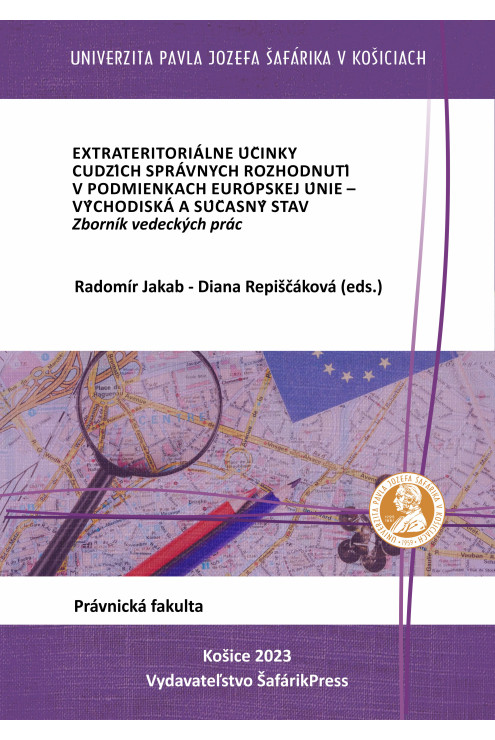
Extrateritoriálne účinky cudzích správnych rozhodnutí v podmienkach Európskej únie – východiská a súčasný stav

E-book

Radomír Jakab - Diana Repiščáková (eds.)

The collection of scientific papers was created as part of a scientific seminar entitled “Extraterritorial Effects of Foreign Administrative Decisions in the Conditions of the European Union – Starting Points and Current State,” held from November 23 to 25, 2022, at the training and educational facility in Danišovce, in connection with the implementation of a scientific project entitled “Extraterritorial Effects of Foreign Administrative Decisions in the Conditions of the European Union,” supported by a grant from the Scientific Grant Agency under No. 01/187/2022.

The aim of the mentioned project is the scientific examination of extraterritoriality, i.e., the extraterritorial effects of administrative decisions of the Member States of the European Union on the territory of other Member States, in order to assess the need for, possibilities of, and desirable scope of harmonization of the legal regulation of the Member States of the European Union, with the goal of increasing the level of free movement of administrative decisions within the European Union. As part of the research project, an initial scientific seminar was held under the title “Extraterritorial Effects of Foreign Administrative Decisions in the Conditions of the European Union – Starting Points and Current State.”

Members of the research team, who are also members of the Department of Constitutional Law and Administrative Law at the Faculty of Law of Pavol Jozef Šafárik University in Košice, participated in this scientific seminar. At the seminar, contributions were presented that primarily summarized the current state of knowledge in the area of extraterritorial effects of foreign administrative decisions in the context of the European Union. This summary will serve as a basis for the further scientific examination of this issue by the members of the research team. These contributions subsequently formed the scientific papers included in this collection.

Download the e-book for free (pdf)

Quantity

978-80-574-0235-0

Data sheet

Method of publication:
E-book (pdf)
Editors:
Radomír Jakab - Diana Repiščáková
Document type:
Proceedings of scientific works
Number of pages:
168
Available from:
10.08.2023
Year of publication:
2023
Edition:
1st edition
Publication language:
Slovak
Note:
Zborník vedeckých prác vznikol v rámci súvislosti s riešením vedeckého projektu s názvom „Extrateritoriálne účinky cudzích správnych rozhodnutí v podmienkach Európskej únie“ podporeného grantom Vedeckej grantovej agentúry pod č. 01/187/2022.
License:
CC BY NC (Uveďte autora - Nepoužívajte komerčne)
DOI:
https://doi.org/10.33542/ETU-0235-0
- Free for download

16 other products in the same category:

Ochrana súkromia zamestnanca

E-book

E-book

Jana Žuľová(ed.)

Proceedings from the 1st Annual Student Symposium on Labor Law held on April 8–9, 2016 in Danišovce

Discussions on the topic of privacy are currently very topical and interesting. The advancement and progress of technology have added a new dimension to individual privacy. With the use of modern electronic devices, terms such as precious commodity, chimera, or illusion are increasingly associated with privacy. Workplaces have not remained immune to modernization either. Machines are replacing human labor, programming and planning the production process, but also controlling, monitoring, and recording the fulfillment of assigned work tasks.

The availability of technology and its implementation in employers’ operations intrude upon the personal and private sphere of employees, which is an inherent part of every person’s life and does not remain left behind the doors of the workplace. Proper and correct use of monitoring mechanisms by employers means not only mastering their technical installation at the workplace and covering the associated financial costs, but also respecting the privacy of employees.

It cannot be overlooked that the right to privacy is among the fundamental human rights and freedoms, enjoying the corresponding characteristics (inalienability, non-transferability, irrevocability, etc.) and appropriate legal protection. And even though it is not absolute and may be suspended in favor of another right (especially the employer’s right to protect their property), every intervention—such as comprehensive camera surveillance, monitoring of phone calls, email correspondence, blocking certain websites, etc.—always has adverse consequences for the privacy of the employee.

Download the e-book for free (pdf)

Liber Amicorum Ján Klučka

E-book

E-book

Dominika Becková (ed.)

This Liber Amicorum presents a collection of contributions in Honour of Professor Ján Klučka. This Liber Amicorum was written by his colleagues from universities, collaborators from the judiciary, former colleagues from the Constitutional Court of the Slovak republic and the Court of Justice of the European Union, current colleagues from the Faculty of Law and his former PhD. students. Their contributions elaborate the knowledge their gained from the work they conducted together with Professor Ján Klučka and are interspersed with references to memories associated with Professor Ján Klučka.

Download e-book for free (pdf)

Medzinárodné a európske právo v kinematografii II.

E-book

E-book

Dominika Becková (ed.)

Proceedings of Contributions from the XIII. Year of the Student Symposium on International and European Law held on March 6, 2020, at the Faculty of Law of UPJŠ in Košice

The Student Symposium on International and European Law has its traditional place in the calendar of events at the Faculty of Law of Pavol Jozef Šafárik University in Košice. In the academic year 2019/2020, the Institute of International Law and European Law decided to continue this tradition and offer students an opportunity to present their professional opinions on selected topics and problematic issues of international and European law.

The XIII. edition of the student symposium continued from its previous year and once again focused students' attention on the institutions of international and European law depicted in films. The films processed by the participants of the symposium offer a wide range of institutions of international and European law.

In their contributions, participants addressed issues related to diplomatic law, terrorism, armed conflicts, the use of robots, environmental protection, and questions regarding the legal regime of outer space.

Download the e-book for free  (pdf)

Ochrana (duševného) zdravia zamestnanca

E-book

E-book

Milena Barinková (ed.)

The complex of legal norms protecting work, ensuring safety and health protection at work, is very broad in scope, extending beyond the Labour Code to include other specific legal regulations, collective agreements, executive legal regulations, and internal corporate normative acts.

Health protection of employees from hazardous workplace influences is a central requirement stemming from fundamental human rights guaranteed by the Constitution of the Slovak Republic. To ensure its universal enforcement across all employers in both private and public sectors, strict regulation through cogent norms is fully justified. The European Commission’s Communication to the European Parliament, Council, European Economic and Social Committee, and Committee of the Regions on the EU Strategic Framework on Health and Safety at Work 2014–2020 (COM(2014) 332 final) addresses the need to account for labor market changes arising from demographic shifts, aging populations, and technological advancements.

Work pace demands are intensifying, and all age categories of employees must adapt to new technologies, organizational changes, and evolving job structures. This increases requirements for maintaining health fitness throughout entire professional careers. Mental health fitness, which receives insufficient specific attention, is an inherent part of health fitness requirements. Prevention plays a critical role in mental health protection.

Download the e-book for free (pdf)

Current Challenges of Financial law and Tax law

E-book

E-publication

Karin Cakoci-Ladislav Hrabčák

The proceedings of student papers from the V. Annual Student Symposium represent a collection of analytical and comparative studies in the fields of tax policy, public finance, and financial law, reflecting the current challenges of the Slovak and European economies. The authors (students) focus on a wide range of topics – from considerations regarding the reintroduction of inheritance tax in Slovakia, through issues of tax evasion and abuse of law in taxation, to measures aimed at public finance consolidation. The authors (students) in their contributions also analyse practical aspects of tax administration, such as tax enforcement proceedings, case law concerning the burden of proof, and the financing of civic associations through tax assignation mechanisms. Particular attention is paid to modern challenges of tax policy, including the taxation of digital giants, financial transaction tax, and the regulation of crypto-asset service provision in the V4 countries. The proceedings also highlight the connection between tax instruments, the financing of cultural institutions, and the broader social context of public expenditures. The publication thus offers a comprehensive overview of current trends and perspectives in the field of taxation and public finance within the conditions of the Slovak Republic and the European Union.
Download the e-book for free

Vatican diplomacy around Trianon from a...

E-book

E-book

Nándor Birher-Péter Tamás Bertalan

The document, titled "Vatican Diplomacy Around Trianon from a Hungarian Perspective," is a scholarly work that examines the geopolitical and ecclesiastical changes in East-Central Europe after the Treaty of Trianon in 1920, with a focus on the role of the Vatican. The book explores the interactions between the Vatican and the reshaped geopolitical landscape, emphasizing the influence of religious and ecclesiastical issues on international relations. The monograph posits that Central Europe is not merely a geographic or economic concept but a "spiritual kingdom" with a shared destiny shaped by interdependence and cultural achievements, despite its history of conflicts. Central Europe's rich intellectual and cultural heritage, deeply influenced by religious convictions and Vatican diplomacy, continues to impact the region's identity and unity. The book suggests that the lessons from the early 20th century, including the Trianon Peace Treaty and subsequent geopolitical shifts, are still relevant in understanding the contemporary political and cultural dynamics of Central Europe. The authors encourage readers to reflect on the past and consider how historical events and decisions have shaped present-day Central Europe. The book aims to provide insights into the region's complex history and its ongoing struggle to find its place in the broader European and global context.

Download e-book for free (pdf)

Právne postavenie spoločníka v obchodnej...

E-book

E-book

Žofia Šuleková (ed.)

Proceedings of the Contributions from the IV. Student Symposium on Corporate Law held on November 24-25, 2016, at the Training Facility of Pavol Jozef Šafárik University in Danišovce.

The Department of Commercial Law and Economic Law at the Faculty of Law of Pavol Jozef Šafárik University in Košice organized the fourth edition of the student symposium, this time focusing on corporate law.

The event took place on November 24-25, 2016, at the training facility of Pavol Jozef Šafárik University in Danišovce. The aim of the annually organized symposiums is to create a discussion platform for students with the participation of mentors from the department, including teachers, researchers, and doctoral students. This year’s symposium focused on problematic issues related to the legal status of a partner in a commercial company. The topics were assigned to allow students to demonstrate and develop their analytical and argumentative skills while improving their ability to present and formulate their own views and perspectives.

The presented proceedings are the outcome of the students' work from this event.

Download the e-book for free (pdf)

Právo fondov EÚ v teórii a praxi

E-book

E-book

Alena KrunkováSimona Farkašová

Proceedings of the International Scientific Conference on EU Funds Law in Theory and Practice held on October 3, 2019, in Košice.

The conference was attended by representatives from the academic sphere, educators from the Faculty of Law at UPJŠ in Košice, who created the subject and continue to participate in its teaching. The participants included professionals from practice, such as those from the Office of the Deputy Prime Minister of the Slovak Republic for Investments and Informatization, the Office for Public Procurement of the Slovak Republic, the Supreme Audit Office of the Slovak Republic, and the Ministry of Labor, Social Affairs, and Family of the Slovak Republic. Valuable information was also shared at the conference by representatives from the Ministry of Regional Development of the Czech Republic, OECD representatives, and representatives from the European Commission's Representation in Slovakia. The presented contributions reflected current issues in a highly professional manner, identified problematic areas, and outlined suitable solutions for contentious issues.

From the individual presentations of the conference participants, it was possible to compile a work that, while not extensive in scope, is very remarkable in value. It connects theory and practice in an outstanding manner and thus expands knowledge in the still complex issue of the legal regulation of European Union funds.

Download the e-book for free (pdf)

Medzinárodné a európske právo v kinematografii

E-book

E-book

Lucia Bakošová (ed.)

Proceedings from the XII Student Symposium on International and European Law held on March 29, 2019, in Košice

The primary goal of films or TV series is typically not to educate their audience. However, contemporary cinematography includes a significant number of works that present issues related to international and European law to both professional and general audiences.

For this reason, the Institute of International and European Law at the Faculty of Law of Pavol Jozef Šafárik University in Košice organized the XII Student Symposium on International and European Law titled "International and European Law in Cinematography," under the auspices of Professor JUDr. Ján Klučka, CSc.

The main objective of the symposium was to popularize international and European law among students through films or series. The films analyzed during the symposium could be divided into two categories: those dramatizing real events and those creating fictional scenarios incorporating aspects of international or European law. Most contributions focused on films depicting real events, such as the genocide in Rwanda in the 1990s, the Nuremberg Trials, the occupation of the U.S. Embassy in Tehran, or the legal dispute between the heir of the painting Woman in Gold and Austria. On the other hand, works like the series MASH* were also discussed; while not based on real events, it uses its narrative to portray the lives of medical personnel in a military field hospital during the Korean War.

Download the e-book for free (pdf)

Členovia orgánov obchodnej spoločnosti....

E-book

E-book

Jaroslav DolnýMonika Seilerová (eds.)

The collection of contributions from the VII. Student Symposium on Commercial Law and Labor Law held on December 5, 2019, at the Faculty of Law of Pavol Jozef Šafárik University in Košice

The theme of this year's symposium provided students with the opportunity to choose between addressing issues related to commercial law or focusing on labor law aspects concerning the position of members of the governing bodies of commercial companies, based on an analysis of legal regulations and case law.

The creative exploration of commercial law questions particularly related to areas such as the manner of acting on behalf of a commercial company, the liability of the de facto statutory body of a commercial company, information obligations of the statutory body towards its shareholders, and the remuneration for serving as a member of the board of directors of a joint-stock company. It also addressed the liability of the statutory body for the insolvency of the company and the enforcement of non-competition clauses concerning managing directors of limited liability companies.

The connection between commercial law and labor law was directed towards a legal analysis of personal data protection related to health and its misuse by members of the governing bodies of commercial companies, as well as the legitimacy of concurrently holding a position (as a member) in a statutory body with an employment relationship, and the legal status of senior employees, particularly concerning their duties and responsibilities for ensuring employee health through creating healthy working conditions.

Download the e-book for free (pdf)

Evaluation of Evidence in the Tax Law

E-book

E-book

Jozef Sábo

The monograph deals with two fundamental aspects concerning evaluation of evidence in the law. In the first part, the monograph addresses the question: „How it is possible to apply law in individual case, if human knowledge about past is objectively limited and flawed?“ (e.g. what is the nature of truth in the law?). The second part of the monograph identifies certain models of reasoning concerning factual questions which occur across different individual legal cases (especially tax cases and criminal cases). In that regard, the monograph draws from Anglo-American legal scholarship and deals with three main concepts concerning evaluation of evidence: argumentation, probability and narratives and their role in evaluation of evidence.

The monograph is the output of the grant project APVV no. 16-0160 which deals with the issue of tax evasion and tax avoidance (especially their motivating factors, emergence, and elimination). The author believes that better understanding of evaluation of evidence may contribute to the improvement in effectiveness of tax administration.

Download the e-book for free  (pdf)

Návrh metodického postupu medzinárodných...

E-book

E-book

Lucia BakošováĽudmila ElbertĽubica Gregová Širicová 

Disasters, whether natural or industrial, have a serious impact on the functioning of society and are a negative phenomenon which, with the increasing impact of climate change, is increasingly affecting the sustainable development and prosperity of States. Their increasing regularity and intensity affect the current evolution not only of social life, but also of legal debates on the necessity of responding to international and national disaster response, eliminating their negative consequences and protecting affected persons. No State is immune to the occurrence of disasters, and this also applies to the Slovak Republic, which is mostly affected by sudden natural disasters, namely floods, landslides, droughts, fires, windstorms and snow calamities.

The subject of this publication is the proposal of the methodological guidelines regulating the activities of NGOs in case of disaster, as well as cooperation with the state affected by the disaster, and the glossary of legal terms which need to be clear and unified in case of disaster. Slovak and English version of the proposal is basic precondition of its usability not only for the state organs of the Slovak republic and Slovak NGOs, but also for foreign NGOs.The Proposal of the methodological guidelines is the result of the research project VVGS-PCOV 2018-459: Návrh metodického postupu mimovládnych organizácií v prípade katastrofy v podmienkach Slovenskej republiky (The Proposal of the methodological guidelines for the non-governmental organisations in case of disaster in conditions of the Slovak republic).

Download the e-book for free  (pdf)

Hranice zmluvnej slobody v pracovnom práve

E-book

E-book

Marcel Dolobáč

The author's ambition is to build on the current and at the same time to stimulate further discussion of the anchoring of labour law in the system of private law sectors and to contribute to the variation of views in relation to freedom of contract and its limits in labour law. The broad contractual freedom of civil law does not apply to the field of labour law, and thus the penetration of standard civil law institutes into labour law relations is not always self-evident.

The above constitutes the main theses of the present monograph. The issue of freedom of contract in labour law can be grasped in several ways. The author has chosen a content structure that is built on three basic pillars. In the first part, the author assesses the position of labour law in the system of law, which is determined primarily by the actual subject of legal regulation - dependent labour and the specific method of legal regulation through cogent and relatively cogent norms. In this context, the author would like to note at the outset that the much-discussed dispositive nature of labour law norms appears to be merely presumptive. Labour law is built on minima and maxima, with relative mandatory norms being the building blocks of fixed boundaries, a fact that distinguishes labour law from other branches of private law. These considerations are followed by the author's view of autonomy of will in labour law. The limits of contractual freedom (not only) in the theoretical sense form the second pillar of the author's ideas.

Finally, the third part of the thesis is to be the one that translates the theoretical-legal considerations of the interconnection of civil law and labour law into the interpretation of selected civil law institutes and the possibility of their application and implementation in labour law relations.

Download he e-book for free (pdf)

KOŠICE CRIMINAL LAW DAYS 2022, VI. „The value...

E-book

E-book

Sergej RomžaVeronika TóthováBronislava Vinnerová (eds.)


The Collection of scientific contributions nationwide interdisciplinary scientific conference with international participation

The text book of scientific contributions The value direction of criminal law is the output of a nationwide interdisciplinary scientific conference with international participation organized by the Department of Criminal Law of the Faculty of Law of the UPJŠ in Košice. The proceedings contain contributions focused on issues of the value direction of criminal law, both in the field of substantive and procedural law.

This is a highly topical issue, as the values of law as such are reflected in each of its areas. In view of social events, the constant amendment of the criminal codes and, in particular, the forthcoming amendment of both the Criminal Code and the Code of Criminal Procedure, we consider the topic of the conference and the title of the text book to be highly topical, without significant limits in scientific research.

In their contributions, the participants of the national interdisciplinary scientific conference with international participation also devoted themselves to reflections de lege ferenda and offer insights into the above-mentioned amendments to the criminal codes into practice as well as their upcoming amendments.

The aim of the published proceedings is to continue to improve and develop new knowledge in the field of criminal law in the light of the new rules, while adhering to all established values, on the basis of the previous professional knowledge.

Download the e-book for free  (pdf)

Míľniky právneho vývoja v Európe po prvej...

E-book

E-book

Ivan SvatuškaLucia Pištejová (eds.)

Collection of Scientific Contributions from the International Scientific Conference of PhD Students and Young Researchers held on April 22, 2022, organized by the Department of State and Law History of the Faculty of Law, Pavol Jozef Šafárik University in Košice.

We recommend this collection to the attention not only of PhD students and young researchers but also to all experts working in the fields of general history and legal science. At the same time, we bring it to the attention of all lay enthusiasts interested in the issues of legal development after the First World War. After all, as one of the world-renowned foreign legal historians likes to say: "Law is the most beautiful science in the world, because everyone can find an area that interests them in it."

Download the e-book for free (pdf)

Informačná spoločnosť a medzinárodné právo

E-book

E-book

Adam Giertl - Ľubica Gregová Širicová (eds.)

Proceedings from the 5th Student Symposium held on April 21-22, 2013

The French delegate to the Commission on Human Rights, while discussing the inclusion of the term "media" in the article on freedom of expression in the draft of the International Covenant on Civil and Political Rights, wisely urged other members of the commission to be forward-looking regarding the information media of the future.

The discussion took place in 1950, when delegates could not yet foresee the impact of the internet on social relations. Given that it is now clear that information technologies significantly influence law, including international law, the organizers of the student symposium decided to dedicate its sixth edition to the theme "Information Society and International Law."

Students of the Faculty of Law, after registering for the symposium, first focused on preparing their contributions, with each participant having access to a consultant if needed. This year, the list of consultants, in addition to members of the Institute of European Law and the Department of International Law, was expanded to include an expert in intellectual property law, Mgr. Martin Husovec, a graduate of our Faculty of Law and currently an IMPRS-CI doctoral student at the Max Planck Institute for Intellectual Property and Competition Law. We also take this opportunity to thank him for dedicating his time to the students and providing them with valuable advice in preparing their contributions. After the preparatory phase, the symposium itself took place, with the aim of presenting the prepared contributions and discussing them.

The presented contributions reflected a wide range of intersections between international law and the information society.

Download the e-book for free (pdf)

This website uses cookies to ensure you get the best experience on our website