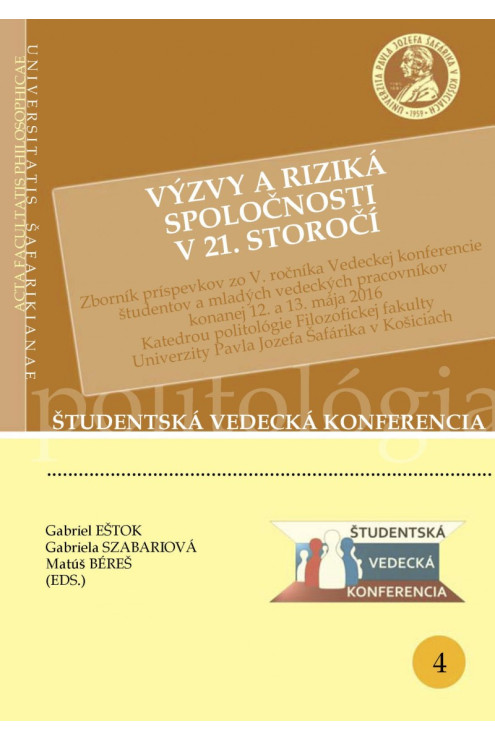
Výzva a riziká spoločnosti v 21. storočí

E-book

Gabriel EštokGabriela SzabariováMatúš Béreš (eds.)

Presented publication is an outcome from the scientific conference for students and young scientists that took place on 12th and 13th May 2016 at the Department of Political science, Faculty of Arts, Pavol Jozef Šafárik University in Košice. The main aim of the presented is to bring up outcomes of research of young scientists and students from Slovakia, as well as from abroad. Many of the presented papers have become integral part of qualification theses of their authors.

This conference proceedings contains 22 papers in Slovak, Czech and English language thematically creating four different parts.

Papers regarding international relations or issues exceeding a level of state power are dealing with issues of globalization, counterculture, international terrorism, extremism and a role of the EU in the Arctic. Papers dealing with the situation in the Slovak republic and abroad cover reform of security in Slovakia and in Romania, issue of dealing with totalitarian history of the states of the Visegrad group as well as development of funding of education system in Slovakia since 1919. In case of authors focusing on the socio-political situation in Slovakia we can find papers analyzing role of a reeve in city of Košice, first great political conflict during a rule of Vladimír Mečiar in Slovakia, role of Roma population in political environment in Slovakia, but also those concerning local activist or action groups and examining attitude of nursing care students towards euthanasia. The conference proceedings contents also four papers regarding theoretical or philosophical issues.

Their authors focused on topic of social state, social equality, democratic theories and transformation of human nature in “post-human” era.

Download the e-book for free (pdf)

Quantity

978-80-8152-616-9

Data sheet

Method of publication:
E-book (pdf)
Editors:
Gabriel Eštok - Gabriela Szabariová - Matúš Béreš
Document type:
Proceedings
Number of pages:
336
Year of publication:
2018
Edition:
1st edition
Publication language:
slovenčina, čeština, angličtina
Faculty:
Faculty of Arts
Note:
Zborník vychádza ako súčasť riešenia projektu VEGA 1/0658/16 - Výskum sekundárneho analfabetizmu v Slovenskej republike (stav - kontexty - perspektívy).
- Free for download

16 other products in the same category:

Sociálna práca: formy, postupy a metódy

Sociálna práca: formy, postupy a metódy

E-book

E-book

Soňa Lovašová

In front of you is a textbook whose main aim is to introduce readers to the issues of methods, methodology, techniques, and research methodology in social work. The book is divided into four main sections, each arranged with a specific purpose. This arrangement is primarily based on the logical progression of the textbook’s content. The first part consists of chapters dealing with professional terminology, the development of social work methodology, and the classification of methods.

The second part focuses on research methods in social work, where the author devotes space to the methodology of social work research. The goal of these chapters is not to provide the reader with a comprehensive methodological minimum, but rather to orient them in the basic types of research and to demonstrate, step by step, how to create a research project. The third part presents an overview of the various forms of social work: social work with individuals, families, groups, communities, and society. Each of these chapters begins with a brief historical introduction to the topic. The final section of the textbook consists of chapters on working with aggression in social work practice and its various forms.

We believe that this textbook will be helpful to students in their studies and that its structure will appeal to readers.

Soňa Lovašová

Download the e-book for free (pdf)

Súčasnosť a budúcnosť sociálnej práce v reflexiách spoločenských zmien. 10.ročník Košických dní sociálnej práce

Súčasnosť a budúcnosť sociálnej práce v...

E-book

E-book

Vladimír Lichner - Tomáš Šeďo

Peer-Reviewed Collection of Contributions from a Scientific Conference with International Participation Held on November 25, 2022 in Košice

"The presented peer-reviewed collection of contributions titled "Present and Future of Social Work in the Reflection of Social Changes" is the output of a scientific conference with international participation, marking the 10th anniversary of the Košické dni sociálnej práce, held on November 25, 2022.

The conference was dedicated to the vision of social work, its methods, and techniques in the context of societal changes. With the changing times come new challenges to which social work must be prepared to respond. The central focus of the collection is the search for answers to pre-defined questions: "Is the current social work system adequately configured for current societal problems? Can social work promptly respond to new and unknown challenges? Are the known methods of social work effective in dealing with contemporary negative phenomena? Do we need additional methods?

If so, what are they?" Individual contributions touch on theoretical concepts in the search for answers, but they also include empirically based contributions that reflect research results from various areas of society and problematic situations, with a view to providing recommendations for both the theory and practice of social work.

Download e-book for free (pdf)

Bedeker onkologickej liečby

Bedeker onkologickej liečby

E-book

E-book

Lucia TóthováKatarína ŠiňanskáEva Žiaková

Here is the translation of the provided text into English: A guide to oncological treatment was created at a time when the importance of health became even more emphasized, becoming a kind of mega-value for the new modern "pandemic" human. The use of the term "pandemic" person arose, of course, in connection with the emergence of the coronavirus pandemic worldwide, but primarily because other dangerous long-term diseases that threaten contemporary humans are somehow being pushed into the background.

The severity of such diseases (including cancer) does not diminish just because attention has shifted to something more acute. It is very important to realize this and not fall under the illusion that if we overcome an acute danger, then automatically improve conditions for chronic diseases as well. We believe it's quite the opposite; prolonged stress and social negative factors constantly affecting us—among which undoubtedly includes pandemic situations—worsen not only psychological but also somatic states.

The guide to oncological treatment aims precisely at highlighting those psychological and social factors that negatively "support" cancer development in any form and can positively influence treatment and coping with illness. The guide offers opportunities for social engagement with groups of people undergoing similar oncological treatments, allowing them to share psychologically as well as professionally similar situations with those facing similar problems in treatment. The authors hope that this guidebook will reach those who will become more self-sufficient in overcoming such a formidable enemy as cancer.

Authors

Download the e-book for free (pdf)

Psychológia rodičovskej kontroly v dospievaní

Psychológia rodičovskej kontroly v dospievaní

E-book

E-book

Mária Bačíková

The primary aim of the presented monograph is to introduce Slovak readers to the current state of knowledge in the field of parental control psychology and its consequences for various aspects of adolescent development. Additionally, it seeks to present research findings obtained from a representative sample of Slovak adolescents in early adolescence. The topic of parental control has been marginally addressed in the Slovak context, primarily as part of studies on parenting styles, but a detailed analysis of its forms and consequences within the Slovak environment is lacking.

The monograph is divided into nine chapters, with the first seven being theoretical in nature: Chapter 1 focuses on specific aspects of the parent-adolescent relationship and describes changes that occur during adolescence. Chapter 2 introduces the construct of parental control, situating it within several social-personality theories and general parenting styles. Chapter 3 examines two fundamental forms of control: behavioral and psychological, as well as their interplay. Chapter 4 defines the concept of structure as one form of parental control. Chapter 5 summarizes current knowledge about gender differences in the application of parental control. Chapter 6 presents factors related to the application of control, including child-related, parent-related, and contextual factors. Chapter 7, concluding the theoretical section, discusses discrepancies in perceptions of control between adolescents and their parents.

Download the e-book for free  (pdf)

Ako sa píšu dejiny? Metódy – prístupy – pramene Stretnutie mladých historikov IX.

Ako sa píšu dejiny? Metódy – prístupy – pramene...

E-book

E-book

Katarína Hromuľáková (ed.)


Proceedings of the Scientific Conference. Košice, October 16-17, 2019

The proceedings titled "Ako sa píšu dejiny? Metódy – prístupy – pramene" present the contributions from the conference "Meeting of Young Historians IX," annually organized by the Department of History, Faculty of Arts, UPJŠ.

In the individual contributions, which span from the Middle Ages to the most recent history, the authors propose various theoretical and methodological research approaches to history, which currently represent fundamental prerequisites for historical research.

The ambition of the authors, as the next generation of historians, is not only to open up current questions of theoretical reflection in historiography but also to offer concrete examples supported by their own research.

Mgr. Katarína Hromuľáková

Download the e-book for free (pdf)

Časopis ŽIVENA v rokoch 1919 – 1928

Časopis ŽIVENA v rokoch 1919 – 1928

E-book

E-book

Ivica Hajdučeková

The anthology was created based on the study of archival volumes of Živena preserved in the Slovak National Library in Martin and the selection of material representing samples of texts that reflect the spirit of the times and contribute to the image of the contemporary modern woman.

The selection of articles from 1919 to 1928 uncovers the cultural atmosphere at the beginning of the 20th century when, thanks to emancipation efforts, doors were opening for women into public and professional life. Students from the 3rd and 4th years of the School of Applied Arts in Košice, under the guidance of teachers in photographic design and Slovak language and literature, were involved in preparing the illustrative component of the anthology, whose artistic interpretations are part of the publication. Their contribution meets the criteria for combining science and practice with a focus on popularizing research results.

Download e-book for free (pdf)

Občianstvo Európskej únie

Občianstvo Európskej únie

E-book

E-book

Gabriel Eštok

The university textbook Citizenship of the European Union is structured into four parts. The first chapter focuses on the characteristics of citizenship in a historical context (concepts of citizenship in the ancient, medieval and modern periods).

The second chapter deals with a theoretical introduction to citizenship. It comes up with the characteristics of citizenship, introduces the ways of acquiring and losing citizenship and the transformations of citizenship in the context of globalization and multiculturalism.

The third chapter focuses on European Union citizenship itself, its historical development and the process of introducing and strengthening citizenship in the European Union.

The fourth chapter presents the specific rights of citizens deriving from European Union citizenship - the right to free movement, the right to vote and stand as a candidate in municipal and European Parliament elections, the right to diplomatic and consular protection in the territory of a third country, the right to petition the institutions of the European Union, the right of access to documents of the institutions and bodies of the Union, and the right of initiative of the citizens of the European Union.

Download e-book for free (pdf)

Heidegger a grécka filozofia

Heidegger a grécka filozofia

E-book

E-kniha

Vladimír Leško - Katarína Mayerová (eds.)


The main aim of the present work is to try to capture the decisive mode of Heidegger's philosophical understanding of the central problem of Greek philosophy, the problem of being, in the teachings of Anaximander, Heracleitus, Parmenides, Plato, and Aristotle. The authors of each section present their own understanding of Heidegger and his distinctive philosophical reception of Greek philosophy. In this context, it should be noted that the authors themselves sought their own point of view. With Heidegger's work in general, it is almost impossible to find the same interpretive consonance. This is also true for his reception of the Greek heritage. However, it is all the more professionally provoking for further philosophical investigations.

Download the e-book for free (pdf)

Sociálna práca s ľuďmi so zdravotným znevýhodnením I - Sociálne potreby ľudí so zmyslovým znevýhodnením

Sociálna práca s ľuďmi so zdravotným...

E-book

E-book

Lucia Tóthová

Počet ľudí so zdravotným znevýhodnením neustále rastie, čo predstavuje výzvu aj pre oblasť sociálnej práce. Tá zohráva kľúčovú úlohu v podpore týchto osôb a hľadaní efektívnych spôsobov napĺňania ich potrieb.

Vysokoškolská učebnica vznikla v rámci riešenia projektu KEGA č. 018UPJŠ-4/2024 s názvom „PhotoVoice ako inovatívna metóda advokácie sociálnych potrieb ľudí so sluchovým postihnutím“. Je prvou časťou viacdielneho cyklu, ktorý sa venuje rôznym aspektom tejto problematiky. Učebnica analyzuje historické a teoretické východiská, terminológiu a modely zdravotného znevýhodnenia. Venuje sa špecifikám vybraných druhov zmyslového znevýhodnenia. Osobitná pozornosť sa upriamuje na sociálne potreby týchto osôb a advokácii v sociálnej práci, pričom zdôraznený je význam aktívneho zapojenia ľudí so zdravotným znevýhodnením do riešenia vlastných životných situácií.

Okrem poskytovania odborných poznatkov môže učebnica slúžiť aj ako podnet na hlbšiu reflexiu vlastného prístupu k ľuďom so zdravotným znevýhodnením a na rozvoj citlivého prístupu k ľuďom so zdravotným znevýhodnením. Navyše, učebnica obsahuje vybrané prvky tzv. jasnej tlače, čím podporuje jej prístupnosť.

Download the e-book for free (pdf)

Pedagogická prax študentov učiteľstva akademických predmetov

Pedagogická prax študentov učiteľstva...

E-book

E-book

Silvia Kontírová a kol.

Pedagogical practice is an organizational form of higher education training for prospective teachers, implemented through mandatory pedagogical practice subjects.

These subjects have an integrative and practical-training character, building upon the theoretical and practical instruction provided to students at the faculty. They are conducted within the scope defined by curricula in the conditions of specialized workplaces (training schools) and under the supervision of qualified professionals (training teachers). Unlike other higher education subjects, pedagogical practice primarily provides students with opportunities for independent creative teaching in real school environments.

The practical activities of students in training schools are characterized as supervised, monitored, and evaluated by designated entities.

Download the e-book for free (pdf)

Pavol Jozef Šafárik v kontinuite

Pavol Jozef Šafárik v kontinuite

E-book

E-book

Marianna SedlákováMarián Gladiš (eds.)

The content of the book publication Pavol Jozef Šafárik in Continuity consists of contributions from two events organized by the Department of Slovak Studies, Slavic Philologies, and Communication at the Faculty of Arts of Pavol Jozef Šafárik University in Košice during its short existence.

The first event was a scientific seminar held on the occasion of the 150th anniversary of the death of P. J. Šafárik, titled Pavol Jozef Šafárik – Scientist and Artist, which took place on January 27–28, 2012, in Košice and Kobeliarovo. The second event was an internal scientific seminar on the occasion of the 220th anniversary of Šafárik’s birth, held on December 15, 2015, under the title In the Quiet Home Circle. Symbolically—beginning with death and ending with birth (thus indicating the living continuity of Šafárik’s research legacy)—we aim to continue the study of Pavol Jozef Šafárik’s scientific work and increasingly involve the youngest generation of researchers (represented by doctoral students of the department in the field of literary studies). This is despite the fact that the literature on the life and work of this scholar and poet, who stood at the birth of Slavic studies, is very rich, and most of his works have already been scientifically analyzed. However, it appears that even seemingly outdated views of Šafárik still deserve scientific attention in the new context of humanities and natural sciences, as can be read in the contributions published in this volume.

Through the continuous publication of the Collected Works of Pavol Jozef Šafárik, both mentioned seminars, and the publication of this volume, the Faculty of Arts of Pavol Jozef Šafárik University in Košice has continued the activities of the Prešov Faculty of Arts from the time before its separation from the union of faculties of Pavol Jozef Šafárik University in Košice in 1997. The selection and arrangement of contributions in the volume symbolize the "passing of the baton" in research and publishing activities related to Pavol Jozef Šafárik—a scientific personality of global stature, who in 1959 gave his name to our university.

Compiled by the editors.

Download the e-book for free  (pdf)

Možné svety z pohľadu logickej sémantiky a analytickej filozofie

Možné svety z pohľadu logickej sémantiky a...

E-book

E-book

Eugen Andreanský

The presented monograph aims to critically map the understanding of the concept of possible worlds.

The first chapter describes the formation of the semantics of possible worlds, along with indicating some problems it brings, which were incisively revealed primarily by W. V. O. Quine. In the next two chapters, the work focuses on more modern views on the nature of possible worlds, with the main attention given to the dichotomy between the possibilist and actualist approach to the question of modalities, alongside which it is necessary to assess other distinctions (essentialism - anti-essentialism, realism - reductionism (or ersatzism or fictionalism), naturalism - non-naturalism, etc.). Increased attention in the work is specifically devoted to the possibilism of D. Lewis and the actualist concepts of S. Kripke, A. Plantinga, R. M. Adams, N. Rescher, D. Armstrong, and J. Hintikka.

An unconventional approach to the issue of possible worlds is captured in the fourth chapter. It is primarily dedicated to the significant concept of Jaakko Hintikka, which works with the notion of epistemic possible worlds and documents the inclination towards the modification and relativization of modal discourse. The conclusion provides an evaluation of the discussion that touches on the main problems associated with considerations of possible worlds.

In the presented monograph, some representative concepts of possible worlds, or possible individuals, are clarified, and the overall process is indicated from assessing possible worlds as ideal logical constructs through their relativization by separate domains of individuals for individual worlds and further through the relationship of attainability to financial, impossible, and non-standard possible worlds.

Download the e-book for free (pdf)

Moc v dejinách ľudskej spoločnosti. Stretnutie mladých historikov XIII.

Moc v dejinách ľudskej spoločnosti. Stretnutie...

E-book

E-book

Simona Bilecová-Monika Tresová

Proceedings of the 13th Scientific Conference of Young Historians, organized by the Department of History of the Faculty of Arts of the University of Pavol Jozef Šafárik in Košice in cooperation with the State Archives in Košice and the Slovak Historical Society at the Slovak Academy of Sciences on 24 October 2023 The central theme of the conference proceedings of the scientific conference of doctoral students is the issue of power as an instance that is an inherent part of human existence and has been present in society de facto since its beginning. Since power and the desire for power are present even today, perhaps more than at any other time in the history of human society, the proceedings provide adequate answers to the questions: where is power born and from what does it originate? How do social science disciplines view those social groups that do not hold power? The publication consists of eight contributions by authors working at Slovak and Czech universities. The volume opens with a paper by Dávid Nykodým on power in the city of silver in the era of Jiří of Poděbrady. The administration of estates in the hands of widows in the 17th century (on the example of Judith Balassa) was discussed by Sabina Danková. The issue of the role of the university grand master in the monopolization of education during the First Empire 1808-1815 in France was examined by Michael Dudzik. The period between the two world wars on the territory of Czechoslovakia was mapped in their contributions by two authors: Simona Bilecová, who characterized the emergence and creation of the political elite on the example of the Rožňava region, and Dominik Šípoš, who evaluated the power of the party as an ideological problem of the Czechoslovak National Democracy. This line was continued by Patrik Beňuš, who analysed in detail the crisis in railway transport in the southern territory of Slovakia after 1938. Monika Tresová dealt with the activities of Catholic associations in Košice and their disappearance under the pressure of the communist power after 1948. Miriama Balvirčáková dealt with the power and its legitimacy, judicial rehabilitation of the victims of the communist regime in Eastern Slovakia in 1968-1971.

Download e-book for free (pdf)

Pandémia & demokracia. Budúcnosť demokracie v postcovidovej dobe

Pandémia & demokracia. Budúcnosť demokracie v...

E-book

E-book

Barbora Linhartová - Peter Dubóczi - Dávid Gajdoščík (eds.)

Proceedings of the Xth Annual International Scientific Conference of Students and Young Researchers organized on October 1, 2021, by the Department of Political Science of the Faculty of Arts at Pavol Jozef Šafárik University in Košice, in cooperation with the Institute of Political Science and Public Administration of the Faculty of Political Science and Journalism at Maria Curie-Skłodowska University in Lublin, the Institute of Social Studies of the Faculty of Regional Development and International Studies at Mendel University in Brno, the Department of Political Science of the Faculty of Arts at the University of Miskolc, and the Res Publica Civic Association.

DOWNLOAD THE E-BOOK FOR FREE (pdf)

Etika vedy a techniky (vybrané problémy)

Etika vedy a techniky (vybrané problémy)

E-book

E-book

Ľubov VladykováMarián Bednár a kol.

The university textbook Ethics of Science and Technique (Selected Problems) is a collection of contributions by various authors who deal with selected problems and areas of science and technique. For the last hundred years, we can observe the rapid development of science and technique (technology). The transition of society in the 20th century into the information age and in the current 21st century into the digital age brings radical challenges and changes in all areas of human life, but especially in the moral field.

Ethical discussions, responding to the development of science and technique (technology), have stimulated the emergence of ethics of science and technique, which as a subdiscipline of applied ethics is a way out of the conflict between professional autonomy, social control and self-regulation of action and behaviour; not only in science and technique, but also in economy and politics. In the digital age, technique, technology and science are fundamentally changing our lives; from the way we work to the way we communicate, how we fight local and global problems, and how we try to solve societal problems.

These radical changes are not without controversy, and many provoke intense debates that are often polarized or associated with scientific ambiguities or dishonest demagoguery and ideology.

Download the e-book for free (pdf)

Pull and push factors of radicalization in the scope of helping professionals

Pull and push factors of radicalization in the...

E-book

E-book

Dušan Šlosár

The monograph offers an insight into radicalization pull and push factors, influencing which is the competence of helping professionals.Radicalization is conditioned by the current social, economic, cultural and political context, i.e. the time-space in which radicalization occurs.It is this fact that directs the content of the monograph to factors that can be considered triggering and influencing factors of radicalization processes as well as radicalization itself.

The monograph systematizes knowledge about radicalization from the point of view of pull and push factors, which have been identified as factors of radicalization in professional literature, research reports and other verified sources, including Internet resources focused on radicalization and processes of radicalization, as well as available interventions to influence or prevent radicalization.The monograph mainly focuses on the analysis of pull and push factors that are related to radicalization and radicalization processes.

The monograph offers the results of research carried out through qualitative methodology.The research focused on issues related to radicalization in the research sample consisting of radicalized and non-radicalized respondents.The research focused on the investigation of pull and push factors related to radicalization, which can occur in the family, school or work environment, among peers, in the wider social environment related to the social and political climate in society and the influence of mass media.

Download the e-book for free (pdf)

This website uses cookies to ensure you get the best experience on our website