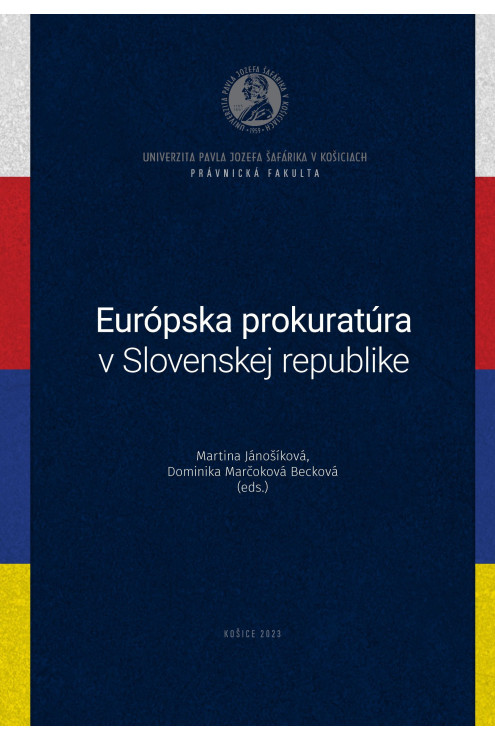
Európska prokuratúra v Slovenskej republike

E-book

Martina Jánošíková -  Dominika Marčoková Becková (eds.)

The peer-reviewed Proceeding of Scientific Papers is dedicated to the issue of the European Public Prosecutor's Office and is the result of a scientific project APVV-18-0421 European Public Prosecutor's Office in Connections of the Constitutional Order of the Slovak Republic as Strengthening of the European Integration through Law.

In their works, the authors of scientific papers, dealt with the issue of the European Public Prosecutor's Office in the context of European Union law and criminal law, as well as the relation of the European Public Prosecutor's Office with the national prosecutor's office and law enforcement authorities. The scientific works published in the proceeding dealt with the topics of the reasons for the establishment of the European Public Prosecutor's Office, the position of the European Public Prosecutor's Office in the institutional system of the EU and the Slovak Republic, relations of cooperation and coordination between the European Public Prosecutor's Office and the Public Prosecutor's Office of the Slovak Republic, the protection of the constitutionality and legality of the procedures and decisions of the European Public Prosecutor's Office, with special attention to the protection of fundamental rights, as well as the first result and evaluation of the operation of the European Public Prosecutor's Office in the Slovak Republic.

Thanks to the content of scientific papers, the reader can get a more comprehensive idea of this new body of the European Union, which operates in an area traditionally associated with state sovereignty and represents another step forward in the integration processes represented by the European Union.

Download the e-book for free (pdf)

Quantity

978-80-574-0218-3

Data sheet

Method of publication:
E-book (pdf)
Editors:
Martina Jánošíková - Dominika Marčoková Becková
Document type:
Proceedings of scientific works
Number of pages:
278
Available from:
14.06.2023
Year of publication:
2023
Edition:
1st edition
Publication language:
Slovak
Note:
Publikácia vznikla v rámci riešenia projektu podporeného Agentúrou na podporu výskumu a vývoja č. APVV-18-0421 Európska prokuratúra v súradniciach ústavného poriadku Slovenskej republiky ako posilnenie európskej integrácie prostredníctvom práva.
License:
Creative Commons BY NC (Uveďte autora - Nepoužívajte komerčne)
DOI:
https://doi.org/10.33542/EPSR-0218-3
- Free for download

16 other products in the same category:

Diverzné a inkluzívne pracoviská - legislatívne...

E-book

E-book

Jana ŽuľováDenisa Rudžiková

In the environment of Slovak employers, an active approach to diversity and inclusion in the workplace is coming to the fore. Targeted diversity and inclusion programs help make employers more attractive on the labor market and attract more job seekers. Proactively, better working conditions are created for employees with responsibilities to the family (in most cases still in relation to mothers), groups of people who have been on the fringes of interest until now are also employed (elderly, disabled, LGBT groups, minorities, graduates of secondary and higher education schools).

The presented collection of abstracts responds to the outlined facts, which is a grouping of the starting motives and conclusions of the contributions presented at the scientific conference Diverse and inclusive workplaces - legislative starting points organized by the department of labor law and social security law of the Faculty of Law of the P. J. Šafárik University in Košice, which took place on September 29, 2023 in a hybrid form.

With their abstracts, the authors point to a range of problematic areas that are not only a reflection of academic considerations, but also those legal questions that have to be dealt with in ordinary legal practice. The goal is to use analysis and explanation to define the existing labor law measures/tools applicable to the implementation of diversity and inclusion in the workplace according to the current Slovak legal framework and the EU legal framework and thus emphasize the starting point of any effort to build diversity and the implementation of inclusion in the workplace.

Download e-book for free (pdf)

The loan or usury? Compulsory enforcement of...

E-book

E-book

Terézia HišemováDarina Kmecová (eds.)

Reviewed proceedings of scientific papers of Conference of Slovak and Czech law romanists, which take place at May, 10.-11.5.2018, at Faculty of Law, UPJŠ in Košice.

The submitted reviewed proceeding of scientific papers on „The loan or usury? Compulsory enforcement of roman - law basics and problems of application practice.”  is prepared within the solution of the grant project VEGA on: „The loan or usury? Compulsory enforcement of historical - law basics and problems of application practice.”, no. p. 1/0198/17.

The authors of papers are important personalities of Roman law working in the Slovak and Czech Republic, as well as PhD students and young scientists from Slovak and foreign universities who are active in the academic environment as well as in legal practice. The main goal of the editors is to help improve the current legal situation, which is assessed as unsatisfactory, and through a historical excursion of the development of the loan institute and then the forced execution of the decision, to create de lege ferenda proposals considering all areas of research.

The Proceedings trace the interrelationships between the substantive law institute in terms of the Roman law of contractus unilaterales - mutuum in its various types, often realized by the attachment of high interest rates, which bordered on the insurrection and the procedural law of individual lawsuits enforced in the legislative, formular and cognitive process. If there was no possibility to impose certain behaviour on the obligated person (the debtor, the sentenced person), then the declared general obligation to enforce the legal norms was only a legal term. It has always been the case that every internally well-organized state, whether antique or present, has to use power tools - often with the use of gross violence - but within the limits of the law, to promote what it has declared valid law. It must protect creditors on the one hand, but it must also prevent self-help and the use of illegal, unjustified and disproportionate violence.

The loan contract as a real contract has often become an integral part and relatively the most frequent reason leading to the compulsory enforcement, especially when contracting parties often agree on the connection of interest - sometimes within the legal limit, sometimes exceeding the legal framework - and in this way the potential future creditor (the plaintiff) significantly increased the insolvency risk of the debtor (the defendant, the sentenced) and of the subsequent execution. The pronounced and deepening social stratification of the Roman population and the secondary depreciation effort, the cancellation of the debts of the poor part of the population logically culminated in social unrest and revolt against the enforcement of the enforcement law.

The proceedings capture not only the rich scientific discussion of Slovak and Czech legal Romanists, but also the opinions, experience and knowledge of experts on contemporary law dealing with this type of issues. As a result, it provides a unique interdisciplinary view of the subject and raises many stimulus points for future research. This work proves that the problems encountered by the various representatives of the Roman jurisprudence and their legal and theoretical bases and solutions are undoubtedly useful and serve as a guideline also for solving legal issues in the field of modern enforcement proceedings.

Download the e-book for free (pdf)

Current Challenges of Financial law and Tax law

E-book

E-publication

Karin Cakoci-Ladislav Hrabčák

The proceedings of student papers from the V. Annual Student Symposium represent a collection of analytical and comparative studies in the fields of tax policy, public finance, and financial law, reflecting the current challenges of the Slovak and European economies. The authors (students) focus on a wide range of topics – from considerations regarding the reintroduction of inheritance tax in Slovakia, through issues of tax evasion and abuse of law in taxation, to measures aimed at public finance consolidation. The authors (students) in their contributions also analyse practical aspects of tax administration, such as tax enforcement proceedings, case law concerning the burden of proof, and the financing of civic associations through tax assignation mechanisms. Particular attention is paid to modern challenges of tax policy, including the taxation of digital giants, financial transaction tax, and the regulation of crypto-asset service provision in the V4 countries. The proceedings also highlight the connection between tax instruments, the financing of cultural institutions, and the broader social context of public expenditures. The publication thus offers a comprehensive overview of current trends and perspectives in the field of taxation and public finance within the conditions of the Slovak Republic and the European Union.
Download the e-book for free

V.SLOVENSKO-ČESKÉ DNI DAŇOVÉHO PRÁVA

E-book

E-book

Miroslav Štrkolec - Filip Baláži - Natália Priateľová - Anna Vartašová

Tax Law and New Phenomena in the Economy. This collection of scientific papers presents contributions from the international scientific conference “V. SLOVAK-CZECH DAYS OF TAX LAW: Tax Law and New Phenomena in the Economy,” which took place on June 5 and 6, 2023, at the Faculty of Law of Pavol Jozef Šafárik University in Košice and was supported by the Scientific and Grant Agency within the project APVV-19-0124 “Tax Law and New Phenomena in the Economy (digital services, shared economy, virtual currencies).”

The individual contributions focus on addressing current issues of tax law in the context of new phenomena in the economy. The authors in their contributions mainly deal with digitalization and the resulting challenges for tax law, especially specific problems related to crypto-assets, digital tax, and technologies, as well as the shared economy and its tax impacts.

Attention is also given to selected extraordinary measures adopted in the financial sector in response to the COVID-19 pandemic and application problems that have arisen or may arise in their implementation in practice.

Download e-book for free (pdf)

Implementácia iniciatív EÚ v oblasti...

E-book

E-book

Karin Cakoci et al.

The authors in the monograph focused on describing the genesis and current state of the legal regulation of consumption taxes in the Slovak Republic in interaction with the harmonization process, as well as identifying the mutual dependence of the legal regulation and revenues from consumption taxation on the effect on the state budget of the Slovak Republic.

Given the importance and justification of the researched issue, particularly in relation to the future functioning of the European Union, as well as the impact on the performance of the economies of individual member states, with an emphasis on the development and quality functioning of the single internal market, the authors, through the publication of the monograph, attempt to provoke a broader professional discussion about their own summarized presented results, which were obtained during the entire period of solving the scientific project, concerning current trends as well as perspectives in the field of EU tax policy and its influence on domestic tax legislation in the Slovak Republic in the area of consumption taxes in interaction with budgetary impacts.

The overall goal of the monograph is to present existing and own acquired knowledge related to the issue of consumption taxes in Slovakia, with an emphasis on the development of EU initiatives in this area, as well as a critical evaluation of their impact on the state budget of the Slovak Republic, and presenting possible future developments.

Download the e-book for free  (pdf)

Hranice zmluvnej slobody v pracovnom práve

E-book

E-book

Marcel Dolobáč

The author's ambition is to build on the current and at the same time to stimulate further discussion of the anchoring of labour law in the system of private law sectors and to contribute to the variation of views in relation to freedom of contract and its limits in labour law. The broad contractual freedom of civil law does not apply to the field of labour law, and thus the penetration of standard civil law institutes into labour law relations is not always self-evident.

The above constitutes the main theses of the present monograph. The issue of freedom of contract in labour law can be grasped in several ways. The author has chosen a content structure that is built on three basic pillars. In the first part, the author assesses the position of labour law in the system of law, which is determined primarily by the actual subject of legal regulation - dependent labour and the specific method of legal regulation through cogent and relatively cogent norms. In this context, the author would like to note at the outset that the much-discussed dispositive nature of labour law norms appears to be merely presumptive. Labour law is built on minima and maxima, with relative mandatory norms being the building blocks of fixed boundaries, a fact that distinguishes labour law from other branches of private law. These considerations are followed by the author's view of autonomy of will in labour law. The limits of contractual freedom (not only) in the theoretical sense form the second pillar of the author's ideas.

Finally, the third part of the thesis is to be the one that translates the theoretical-legal considerations of the interconnection of civil law and labour law into the interpretation of selected civil law institutes and the possibility of their application and implementation in labour law relations.

Download he e-book for free (pdf)

1. svetová vojna a jej dôsledky v štátoprávnej...

E-book

E-book

Erik Štenpien  - Lucia PištejováIvan Svatuška

The presented publication is the proceedings of the international conference held on 29.-30. September 2022 in Košice as an output of the grant project APVV-19-0419.

The ambition of the project is to try to reconcile legal and general historians from Slovakia and Hungary in the difficult topic of looking at the Treaty of Trianon from 1920. The conference, held on 29.-30. September 2022 was the third in a series of conferences that for the purpose of assisting in the achievement of said goal. It was attended by legal historians and positive lawyers from several Central European countries. So let the collection serve as another step towards understanding between nations.

Download e-book for free (pdf)

Transteritoriálne správne akty v podmienkach...

E-book

E-book

Radomír JakabTibor SemanLukáš Jančát

The concept of a transterritorial administrative act is relatively new in administrative law, especially in the conditions of the Slovak Republic. It has practical applicability to the application of European Union law (including international law). Its essence lies in the fact that the effects of such an administrative act issued within one Member State exceed the territory of that Member State, have effects in other Member States, in all Member States of the European Union without being subject to the recognition process.

The purpose of the monograph is to present outputs of the scientific examination of this type of administrative acts, the definition of its characteristics and its effects, the examination of the possibilities of procedural defense against its effects by the State concerned, and possibly the possibility of unifying the action of the Member States of the European Union in case of procedural defense against the effects of transterritorial administrative acts. The monograph also contains analysis of certain types of transterrritorial administrative acts that are commonly used in the conditions of the European union and Slovak republic; they are also categorized under specific criteria.,

Download the e-book for free  (pdf)

Ako správne pracovať s prameňmi práva Európskej...

E-book

E-book

Dominika BeckováRadoslav BenkoValéria Ružičková

Studies of the European Union law may hardly be possible without making use of its sources. Lots of types of legal rules, several forms of judicial decisions as well as a wide spectrum of criteria used while searching among legal acts of the European Union and case-law of its courts in search engines on the official websites of the European Union may, however, appear confusing, thereby making the work with sources of the European Union law more complicated and prolonging it.

Methodology Guide „How to Work Correctly with the Sources of the European Union Law“ aims to help students to understand the system of sources of the European Union law as well as the sources themselves, offer them tips and advice useful during their search and thus contribute to the adoption of fundamental procedures for working with them.

Download the e-book for free (pdf)

Pracovnoprávne elementy výkonu (závislej)...

E-book

E-book

Jana Žuľová (ed.)

Collection of Scientific Works

Article 35 of the Constitution of the Slovak Republic guarantees everyone the right to freely choose their profession and receive training for it, as well as the right to engage in entrepreneurial or other gainful activity. Everyone has the right to freely decide whether to secure their livelihood through self-employment—with all the associated consequences and risks—or through employment within labor-law relationships by performing dependent work.

The framework and rules for exercising these rights are primarily regulated by labor, commercial, and tax legislation, each with its own set of rights and obligations applicable specifically to entrepreneurs and employees. Constant competitive pressure, along with the effects of economic crises, pushes employers to seek ways to extract the most from workers while optimizing for the lowest possible insurance, administrative, and tax costs. As a result, employment contracts are being terminated, and under the pressure of losing their income, individuals are "voluntarily" shifting to commercial-law relationships.

This situation, along with other distortions in the labor market, confronts those entitled to work with unfair practices by employers, thereby undermining their ability to freely exercise this fundamental right.

Download the e-book for free (pdf)

Extrateritoriálne účinky cudzích správnych...

E-book

E-book

Radomír Jakab - Diana Repiščáková (eds.)

The collection of scientific papers was created as part of a scientific seminar entitled “Extraterritorial Effects of Foreign Administrative Decisions in the Conditions of the European Union – Starting Points and Current State,” held from November 23 to 25, 2022, at the training and educational facility in Danišovce, in connection with the implementation of a scientific project entitled “Extraterritorial Effects of Foreign Administrative Decisions in the Conditions of the European Union,” supported by a grant from the Scientific Grant Agency under No. 01/187/2022.

The aim of the mentioned project is the scientific examination of extraterritoriality, i.e., the extraterritorial effects of administrative decisions of the Member States of the European Union on the territory of other Member States, in order to assess the need for, possibilities of, and desirable scope of harmonization of the legal regulation of the Member States of the European Union, with the goal of increasing the level of free movement of administrative decisions within the European Union. As part of the research project, an initial scientific seminar was held under the title “Extraterritorial Effects of Foreign Administrative Decisions in the Conditions of the European Union – Starting Points and Current State.”

Members of the research team, who are also members of the Department of Constitutional Law and Administrative Law at the Faculty of Law of Pavol Jozef Šafárik University in Košice, participated in this scientific seminar. At the seminar, contributions were presented that primarily summarized the current state of knowledge in the area of extraterritorial effects of foreign administrative decisions in the context of the European Union. This summary will serve as a basis for the further scientific examination of this issue by the members of the research team. These contributions subsequently formed the scientific papers included in this collection.

Download the e-book for free (pdf)

INNOVATIVE LAW & INNOVATIONS IN LAW

E-book

E-book

Dominika Cukerová - Andrej Oriňak - Kateřina Hrabánková (eds.)

The proceedings offers contributions from the international scientific conference of doctoral students and young researchers held on 25 April 2024 at the Faculty of Law, UPJŠ in Košice, which was thematically oriented on Innovative Law and Innovations in Law. The authors of the papers confirmed that innovation in law can take many forms. The first part of the papers, which pays attention to how law can respond to innovations, is a manifestation of this. These are the papers by Jana Cihanová, Andrej Oriňák, Denisa Rudžiková and Matej Biroš, who presented the use of deepfake technology, artificial intelligence and software tools in legal practice in the context of their legal regulation. Looking at familiar things differently can also be a source of innovation. In this vein, Dominik Mizerski, Juraj Valentovič, Lucián Török and Kateřina Hrabánková presented interpretive and application innovations in the field of private law. The third part of the papers by Michaela Szittyaiová, Natália Priateľová, Filip Baláži, Elena Lazoríková and Laura Gazdagová offers a preview of the innovations that the public law section is facing today. Finally, the fourth and last group of papers specifically explains innovations against the background of criminal law regulation. These are contributions by Michal Novák, Miroslav Srholec, Vladimír Petrila and Martina Makaturová. The variety of topics covered in this proceedings shows that each area of legal regulation can be characterised by specific innovations and, in this context, by the dynamics with which they permeate legal regulation.

Download the e-book for free (pdf)

Ochrana (duševného) zdravia zamestnanca

E-book

E-book

Milena Barinková (ed.)

The complex of legal norms protecting work, ensuring safety and health protection at work, is very broad in scope, extending beyond the Labour Code to include other specific legal regulations, collective agreements, executive legal regulations, and internal corporate normative acts.

Health protection of employees from hazardous workplace influences is a central requirement stemming from fundamental human rights guaranteed by the Constitution of the Slovak Republic. To ensure its universal enforcement across all employers in both private and public sectors, strict regulation through cogent norms is fully justified. The European Commission’s Communication to the European Parliament, Council, European Economic and Social Committee, and Committee of the Regions on the EU Strategic Framework on Health and Safety at Work 2014–2020 (COM(2014) 332 final) addresses the need to account for labor market changes arising from demographic shifts, aging populations, and technological advancements.

Work pace demands are intensifying, and all age categories of employees must adapt to new technologies, organizational changes, and evolving job structures. This increases requirements for maintaining health fitness throughout entire professional careers. Mental health fitness, which receives insufficient specific attention, is an inherent part of health fitness requirements. Prevention plays a critical role in mental health protection.

Download the e-book for free (pdf)

Oslava právneho štátu (Právny štát z pohľadu...

E-book

E-book

Ľudmila Pošiváková Zuzana Antošová - Milan Kočan (eds.)

Proceedings from the Student Debate held on April 24, 2013, at the Faculty of Law of Pavol Jozef Šafárik University in Košice.

In the current period, the rule of law is widely debated both at the academic and political levels. This debate is not only related to the effort to establish the Rule of Law in states that have transitioned from socialist to democratic systems but also in states experiencing various unrests, whether political or religious.

However, it is not just a debate about certain characteristics of the Rule of Law that are missing in domestic law or at the level of international law, but also a debate about the very definition and meaning of the Rule of Law. The rule of law can be likened to an ideal that almost every state strives to achieve. Even in the case of the establishment of the independent Slovak Republic, the framers decided to include among the introductory provisions, which should form the core of the constitution, that the Slovak Republic is a state governed by the rule of law.

However, to achieve the ideal of the rule of law, it is necessary not only to declare it but also to adopt measures essential for an independent judiciary, democracy, the effective enforcement of human rights, the separation of powers, and many other elements that characterize a state governed by the rule of law.

Download the e-book for free (pdf)

Ownership rights protection in Polish and...

E-book

E-book

Milan Sudzina, Renata Świrgoń-Skok, Wojciech J. Kosior

Given the importance of the ownership right, the aim of this monograph is to provide an analysis, a clear systematic interpretation and an evaluation of the above issue, not only from the theoretical point of view, but also from the point of view of legal practice. The protection of ownership relations is ensured in various ways. It is judicial protection, protection provided by local self-government authorities, self-help, public registration of real property and other instruments of administrative and criminal law. In connection with the transformation of legislation in Slovakia and Poland after the fall of the socialist regime, there have been many changes in the legislation of both countries concerning the protection of ownership rights. A number of private law institutions related to the ownership of real property, the use of which was impossible or limited during the socialist period, have been restored. Legislation has also been adopted to alleviate the consequences of certain property and other injustices caused by the deprivation of ownership of real property during the socialist period. The adoption of restitution legislation was the basis for restoring the ownership rights of the original owners, who were allowed to get back their real property that had been used by socialist organisations. After the end of the socialist regime, the various forms of ownership, which until then had favoured the state ownership, were abolished. Changes were made to ensure that the ownership rights of all owners had the same content and enjoyed the same legal protection. The monograph is structured in such a way as to enable a comparison of individual institutions of rights in rem under Polish and Slovak law. The monograph also analyses the relevant decision-making practice of the supreme judicial authorities. The scientific methods applied enabled the authors not only to analyse and evaluate the historical context and the current legal regulation of ownership rights in Poland and Slovakia, but also to point out possible gaps and shortcomings and to elaborate de lege ferenda proposals that can be used in future legislative activity.

Download e-book for free (pdf)

Sankcie v pracovnom práve

E-book

E-book

Marcel DolobáčĽuboš DobrovičIvan Kundrát

Hypothesis, disposition, sanction. The standard tripartite structure of a legal norm, which is taught to first-year law students. Three concepts that students undoubtedly master from their perspective, yet they simultaneously challenge legal science, which repeatedly revisits them. The publication does not aim to theoretically address all aspects of the legal norm; it focuses solely on one of them, and as the title suggests, that is the sanction.

The monograph has been developed by three authors, whose contributions are equal; they engaged in debates and often could not reach a consensus. We hope that the reader will also join this debate and that the presented monograph will inspire further reflection and scientific activity.

Download the e-book for free (pdf)

This website uses cookies to ensure you get the best experience on our website