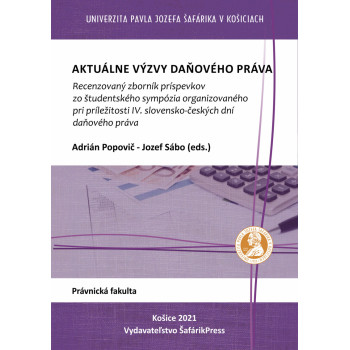
Aktuálne výzvy daňového práva

E-book

Adrián Popovič  - Jozef Sábo

Reviewed proceedings from the student symposium organized on the occasion of IV. Slovak-Czech days of tax law.

The International Scientific Conference IV. Slovak-Czech days of tax law was held 16th - 18th June 2021 in Košice (Faculty of Law of Pavol Jozef Šafárik University in Košice). On this occasion, a student symposium on the topic: "Current Challenges of Tax Law" was organized for students of the Pavol Jozef Šafárik University Faculty of Law in Košice on 15th June 2021. The focus of the symposium was chosen due to the content of the grant project APVV-19-0124 entitled "Tax law and new phenomena in the economy (digital services, shared economy, virtual currencies)", which is currently being addressed at the Department of Financial Law, Tax Law and Economy, Faculty of Law, Pavol Jozef Šafárik University in Košice. The output of this symposium is a reviewed proceeding of papers, in which students focus on examining the current challenges of tax law. In this context, students examine not only the current challenges in the field of real estate tax and the introduction of taxation based on their market value of real estate, the decision-making of the Court of Justice of the European Union in the field of direct taxation and indirect taxation, but also new and extremely current taxation issues of cryptoactive (virtual currency) taxation, not only in the Slovak Republic but also in the world. The authors also assess in detail the current situation in the research area, and they also present de lege ferenda proposals that could contribute to the development and improvement of several aspects of taxation, which is a benefit not only for legal science but also for application practice.

Download e-book for free (pdf)

Quantity

978-80-574-0070-7

Data sheet

Method of publication:
E-book (pdf)
Editors:
Adrián Popovič - Jozef Sábo
Document type:
Proceedings
Number of pages:
53
Available from:
13.12.2021
Year of publication:
2021
Edition:
1st edition
Publication language:
Slovak
Faculty:
Faculty of Law
Note:
Podporené v rámci projektu APVV-19-0124 „Daňové právo a nové javy v ekonomike (digitálne služby, zdieľaná ekonomika, virtuálne meny)“.
License:
CC BY NC ND (Uveďte autora - Nepoužívajte komerčne - Nespracovávajte)
- Free for download

16 other products in the same category:

The loan or usury? Compulsory enforcement of judgment - roman and law foundations and problems of application practice

The loan or usury? Compulsory enforcement of...

E-book

E-book

Terézia HišemováDarina Kmecová (eds.)

Reviewed proceedings of scientific papers of Conference of Slovak and Czech law romanists, which take place at May, 10.-11.5.2018, at Faculty of Law, UPJŠ in Košice.

The submitted reviewed proceeding of scientific papers on „The loan or usury? Compulsory enforcement of roman - law basics and problems of application practice.”  is prepared within the solution of the grant project VEGA on: „The loan or usury? Compulsory enforcement of historical - law basics and problems of application practice.”, no. p. 1/0198/17.

The authors of papers are important personalities of Roman law working in the Slovak and Czech Republic, as well as PhD students and young scientists from Slovak and foreign universities who are active in the academic environment as well as in legal practice. The main goal of the editors is to help improve the current legal situation, which is assessed as unsatisfactory, and through a historical excursion of the development of the loan institute and then the forced execution of the decision, to create de lege ferenda proposals considering all areas of research.

The Proceedings trace the interrelationships between the substantive law institute in terms of the Roman law of contractus unilaterales - mutuum in its various types, often realized by the attachment of high interest rates, which bordered on the insurrection and the procedural law of individual lawsuits enforced in the legislative, formular and cognitive process. If there was no possibility to impose certain behaviour on the obligated person (the debtor, the sentenced person), then the declared general obligation to enforce the legal norms was only a legal term. It has always been the case that every internally well-organized state, whether antique or present, has to use power tools - often with the use of gross violence - but within the limits of the law, to promote what it has declared valid law. It must protect creditors on the one hand, but it must also prevent self-help and the use of illegal, unjustified and disproportionate violence.

The loan contract as a real contract has often become an integral part and relatively the most frequent reason leading to the compulsory enforcement, especially when contracting parties often agree on the connection of interest - sometimes within the legal limit, sometimes exceeding the legal framework - and in this way the potential future creditor (the plaintiff) significantly increased the insolvency risk of the debtor (the defendant, the sentenced) and of the subsequent execution. The pronounced and deepening social stratification of the Roman population and the secondary depreciation effort, the cancellation of the debts of the poor part of the population logically culminated in social unrest and revolt against the enforcement of the enforcement law.

The proceedings capture not only the rich scientific discussion of Slovak and Czech legal Romanists, but also the opinions, experience and knowledge of experts on contemporary law dealing with this type of issues. As a result, it provides a unique interdisciplinary view of the subject and raises many stimulus points for future research. This work proves that the problems encountered by the various representatives of the Roman jurisprudence and their legal and theoretical bases and solutions are undoubtedly useful and serve as a guideline also for solving legal issues in the field of modern enforcement proceedings.

Download the e-book for free (pdf)

Európska únia a jej vplyv na organizáciu a fungovanie verejnej správy v Slovenskej republike

Európska únia a jej vplyv na organizáciu a...

E-book

E-book

Alena Krunková (ed.)

Proceedings of the Scientific Conference Held on June 28, 2016 at the Faculty of Law of Pavol Jozef Šafárik University in Košice in connection with the implementation of the project “The European Union and Its Impact on the Organization and Functioning of Public Administration in the Slovak Republic” – approved under number MVZP – SK PRES/2016/134

The Slovak Republic, as a member state of the European Union, is undertaking a historic role associated with the Presidency of the Council of the European Union within the presidency trio. At the beginning of 2016, the Ministry of Foreign and European Affairs of the Slovak Republic announced a call for applications for grants for 2016 in the field of international relations and foreign policy, specifically focused on the Slovak Republic’s Presidency of the Council of the European Union. The Faculty of Law of Pavol Jozef Šafárik University in Košice responded to this call and obtained a project aimed at carrying out research activities through a series of events focused on regional self-government in the Slovak Republic in the context of its role within the European Union. The Faculty has long been engaged with issues of European Union law both in its teaching and in the scientific research activities of its individual faculty members. The project aims to enrich this portfolio with special activities targeting not only professionals, but also students and the general public.

The first activity of the project was a conference entitled “The European Union and Its Impact on the Organization and Functioning of Public Administration in the Slovak Republic – Development So Far, Current State, and Perspectives.” The conference was attended by invited public officials, representatives of academia, and representatives of local government, as one of the main goals of the project is to connect the academic community with the practical sphere and thus involve practitioners in the planned activities within the project.

Download the e-book for free (pdf)

Ochrana súkromia zamestnanca

Ochrana súkromia zamestnanca

E-book

E-book

Jana Žuľová(ed.)

Proceedings from the 1st Annual Student Symposium on Labor Law held on April 8–9, 2016 in Danišovce

Discussions on the topic of privacy are currently very topical and interesting. The advancement and progress of technology have added a new dimension to individual privacy. With the use of modern electronic devices, terms such as precious commodity, chimera, or illusion are increasingly associated with privacy. Workplaces have not remained immune to modernization either. Machines are replacing human labor, programming and planning the production process, but also controlling, monitoring, and recording the fulfillment of assigned work tasks.

The availability of technology and its implementation in employers’ operations intrude upon the personal and private sphere of employees, which is an inherent part of every person’s life and does not remain left behind the doors of the workplace. Proper and correct use of monitoring mechanisms by employers means not only mastering their technical installation at the workplace and covering the associated financial costs, but also respecting the privacy of employees.

It cannot be overlooked that the right to privacy is among the fundamental human rights and freedoms, enjoying the corresponding characteristics (inalienability, non-transferability, irrevocability, etc.) and appropriate legal protection. And even though it is not absolute and may be suspended in favor of another right (especially the employer’s right to protect their property), every intervention—such as comprehensive camera surveillance, monitoring of phone calls, email correspondence, blocking certain websites, etc.—always has adverse consequences for the privacy of the employee.

Download the e-book for free (pdf)

Právo informačných a komunikačných technológií

Právo informačných a komunikačných technológií

€19.50
Availability: 5 In Stock

Regina Hučková - Diana Treščáková - Laura Rózenfeldová

Vysokoškolská učebnica Právo informačných a komunikačných technológií je určená študentom vysokých škôl vo všeobecnosti, najmä však študentom Právnickej fakulty, ktorí majú záujem o štúdium práva v spojení s informačnými a komunikačnými technológiami. Učebnica predstavuje zdroj informácií potrebných nielen pre štúdium tejto problematiky, ale aj pre rozšírenie celkového obzoru v danej problematike.

Ako správne pracovať s prameňmi práva Európskej únie. Metodická príručka.

Ako správne pracovať s prameňmi práva Európskej...

E-book

E-book

Dominika BeckováRadoslav BenkoValéria Ružičková

Studies of the European Union law may hardly be possible without making use of its sources. Lots of types of legal rules, several forms of judicial decisions as well as a wide spectrum of criteria used while searching among legal acts of the European Union and case-law of its courts in search engines on the official websites of the European Union may, however, appear confusing, thereby making the work with sources of the European Union law more complicated and prolonging it.

Methodology Guide „How to Work Correctly with the Sources of the European Union Law“ aims to help students to understand the system of sources of the European Union law as well as the sources themselves, offer them tips and advice useful during their search and thus contribute to the adoption of fundamental procedures for working with them.

Download the e-book for free (pdf)

Current Challenges of Financial law and Tax law

Current Challenges of Financial law and Tax law

E-book

E-publication

Karin Cakoci-Ladislav Hrabčák

The proceedings of student papers from the V. Annual Student Symposium represent a collection of analytical and comparative studies in the fields of tax policy, public finance, and financial law, reflecting the current challenges of the Slovak and European economies. The authors (students) focus on a wide range of topics – from considerations regarding the reintroduction of inheritance tax in Slovakia, through issues of tax evasion and abuse of law in taxation, to measures aimed at public finance consolidation. The authors (students) in their contributions also analyse practical aspects of tax administration, such as tax enforcement proceedings, case law concerning the burden of proof, and the financing of civic associations through tax assignation mechanisms. Particular attention is paid to modern challenges of tax policy, including the taxation of digital giants, financial transaction tax, and the regulation of crypto-asset service provision in the V4 countries. The proceedings also highlight the connection between tax instruments, the financing of cultural institutions, and the broader social context of public expenditures. The publication thus offers a comprehensive overview of current trends and perspectives in the field of taxation and public finance within the conditions of the Slovak Republic and the European Union.
Download the e-book for free

The Impact of industrial and technological Changes on state social Policy and social Structure ...

The Impact of industrial and technological...

E-book

E-book

bolya Katalin Koncz

The exploration of the interplay between innovation and society elucidates fundamental connections between human advancement and societal transformation. Technological development and its dissemination profoundly influence both the economy and social structures, often restructuring them while presenting new challenges and opportunities. This monograph delves into the theme of "Innovation and Society", focusing specifically on how technological advancements impact various facets of society ‒ from the realm of work to social policies and the evolution of gender roles. These areas are approached through a novel lens, examining them from the perspective of legislative reforms enacted and endorsed by the state. The monograph examines the characteristics and legal framework of 20th-century Hungarian society using diverse laws, regulations, and statistical data. Through analyses and documented evidence, it offers a comprehensive understanding of societal structure and operations, encompassing aspects such as the labor market, female employment, the status of industry and commerce, and shifts in legal frameworks. Detailed statistical insights into population dynamics, labor market trends, and economic sectors further deepen our comprehension of social processes. The documents scrutinize the employment distribution and conditions across different sectors, including food processing and milling, while also providing specific details on the roles, distribution, and wages of women in the workforce, with particular emphasis on occupations where women are prominently engaged. The analysis of legislative provisions delineates the historical backdrop and measures enacted for fostering social and economic transformations, covering issues such as patent legislation, guardianship laws, and family law. This compilation offers an exhaustive overview of 20th-century Hungarian society and its legal underpinnings, enriching scholarly inquiries into historical and sociological dimensions within this domain.

Download e-book for free (pdf)

Vybrané otázky sociálneho práva Európskej únie
  • -50%

Vybrané otázky sociálneho práva Európskej únie

€21.80 €10.90 -50%
Availability: 38 In Stock

 Marcel Dolobáč a kol. 

Učebnica s názvom Vybrané otázky sociálneho práva Európskej únie prierezovo spracúva najzásadnejšie otázky pracovného práva a práva sociálneho zabezpečenia v Európskej únii. V úvodných statiach učebnice sa autori zamerali na objasnenie základnej terminológie a stručne poukazujú na vývoj sociálneho práva v Únii. Ďalšie kapitoly práce postupne vysvetľujú vybranú problematiku ktorá celkovo dotvára sociálne právo Európskej únie, konkrétne – voľný pohyb zamestnancov, zákaz diskriminácie, flexibilitu pracovných vzťahov prostredníctvom atypických pracovných pomerov, dočasné pridelenie zamestnancov, ochranu osobitných kategórií zamestnancov, ochranu osobných údajov, oblasť bezpečnosti a ochrany zdravia pri práci, ochranu práv zamestnancov pri prevode, prechode zamestnávateľa a jeho platobnej neschopnosti, kolektívnu ochranu práv zamestnancov a napokon uplatňovanie systémov sociálneho zabezpečenia. Učebnica analyzuje predovšetkým úniovú úpravu s akcentom na rozhodnú judikatúru Súdneho dvora Európskej únie, vnútroštátny právny poriadok objasňuje iba vo vybraných problematických oblastiach. 

Autori

Konanie o súlade právnych predpisov – návrhové oprávnenie a účinky rozhodnutí ústavného súdu. XIII.ústavné dni

Konanie o súlade právnych predpisov – návrhové...

E-book

E-book

Ladislav OroszSimona KarafováMartina Makaturová (eds.)

Zborník z XIII. ústavných dní s názvom „Konanie o súlade právnych predpisov – návrhové oprávnenie a účinky rozhodnutí ústavného súdu“ reflektuje novú právnu úpravu účinnú od 1. januára 2025, konkrétne čl. 127 ods. 5 Ústavy SR, ktorá rozširuje právomoci sťažovateľov iniciovať konanie o súlade právnych predpisov prostredníctvom Ústavného súdu Slovenskej republiky. Príspevky renomovaných odborníkov mapujú teoretické aj praktické výzvy spojené s touto novou kompetenciou. Zborník tematicky pokrýva otázky týkajúce sa iniciačných mechanizmov senátov Ústavného súdu, derogačných a časových účinkov rozhodnutí či komparatívnych skúseností z Českej republiky, Maďarska a Poľska. Publikácia zároveň ponúka reflexiu širších javov, ako je judicializácia politického života, či rast implicitných právomocí ústavných súdov. Niektoré príspevky sa zameriavajú na otázky právnej istoty a retroaktivity derogačných nálezov, najmä v konaniach iniciovaných všeobecnými súdmi. Iné analyzujú aplikačné dopady spojenia individuálnej ústavnej sťažnosti a abstraktnej kontroly právnych predpisov. Publikácia obsahuje aj úvahy o ústavnoprávnych dôsledkoch porušenia konzultačnej povinnosti s Európskou centrálnou bankou. Nechýbajú reflexie o možnostiach ústavného preskúmania noriem v oblasti rozpočtovej zodpovednosti. Zborník ponúka pestrú škálu domácich aj komparatívnych prístupov k výzvam spojeným s novou rozhodovacou agendou. Je tak hodnotným príspevkom do diskusie o posilnení ochrany ústavnosti v Slovenskej republike.

Download the e-book for free (pdf)

Spotrebitelia a obchodníci online: právne a ekonomické výzvy digitálnych trhov

Spotrebitelia a obchodníci online: právne a...

E-book

E-book

Renáta Bačárová, Kristián Vassay (eds.)

The proceedings Consumers and Traders Online: Legal and Economic Challenges of Digital Markets present a collection of scientific studies addressing contemporary issues of digital market functioning within the European Union. The contributions analyse legal, economic and technological dimensions of digital services, particularly in the context of the VEGA project 1/0431/23 focused on the conflict of interests between consumers and traders in the delivery of digital content and services. The studies highlight the dynamic growth of the digital economy, bringing new regulatory challenges, issues of data protection and enforcement of consumer rights. The authors examine topics such as geographical indications in the digital environment, the use of artificial intelligence in public enforcement, fintech regulation, liability for damages, and the impacts of the Digital Services Act (DSA) and the Digital Markets Act (DMA). The proceedings also expose increasing fragmentation of responsibility across digital actors and emphasise the need for a harmonised EU regulatory framework. Further attention is given to evolving consumer behaviour, cybersecurity risks, deepfake technologies, the functioning of online marketplaces and digital payment systems. A significant part of the analysis addresses the role of major online platforms, their obligations and influence on transparency in digital markets. The publication offers an interdisciplinary perspective combining law, economics and technology, representing an important contribution to the discourse on modern consumer protection in the digital era.

Download the e-book for free (pdf)

Ochrana kultúrnych hodnôt prostriedkami medzinárodného a regionálneho práva

Ochrana kultúrnych hodnôt prostriedkami...

E-book

E-book

Adam GiertlĽudmila Elbert

Collection of Papers from the 8th Student Symposium held on April 20–21, 2015 in Danišovce

The capture of the historic Syrian city of Palmyra by fighters of the radical Islamic State caused shock among the global public. The main reason is the barbarism with which this organization proceeds, not only in relation to the treasures of the world’s cultural heritage. The situation in the Middle East, where cultural treasures of inestimable value are under direct threat, demonstrates how fragile the world’s cultural heritage is. The reaction of the international public and world leaders shows how sensitively the destruction of cultural heritage is perceived.

The quoted statement chosen by the editors relates to the threat posed by the Islamic State—however, the spirit of this statement can be applied to any cultural wealth that forms part of the world’s cultural heritage. The destruction or damage of these values primarily represents a loss for humanity as such. Each destroyed artifact of world cultural heritage signifies the disappearance of a unique legacy left by previous generations for the future. At the same time, cultural heritage must be understood as a broad spectrum of assets—both tangible and intangible. Their legal protection was the topic of this year’s symposium. As with any social interest, the protection of cultural heritage can be ensured through various mechanisms and under different forms of social organization.

These diverse approaches are unified by law as a normative system. The question for the 8th year of the symposium on international law was what role international law plays in the protection of cultural heritage. In the context of the European region, the role of the European Union as a regional organization was examined.

Download the e-book for free (pdf)

Právna regulácia volebnej kampane a jej uplatňovanie vo volebnej praxi v SR a vo vybraných štátoch Rady Európy (2025))

Právna regulácia volebnej kampane a jej...

E-book

E-book

Ladislav Orosz, Martina Makaturová

This scientific volume has been published as an output of the VEGA grant project No. 1/0474/24 Audit of Slovak Electoral and Referendum Legislation. Thematically, it focuses on the issue of the legal regulation of election campaigns and a critical analysis of the experience of its application in electoral practice. On this basis, the authors also formulate proposals for improving the current legal framework of election campaigns.

The proceedings include contributions presented at the scientific conference of the same name held in May 2025. The volume contains papers not only from domestic but also from foreign authors, who present the legal regulation of election campaigns in their respective home countries. Contributions from academics are complemented and enriched by those of representatives of non-governmental organizations engaged in election and campaign monitoring, as well as by contributions from authors working in public authorities responsible for the administration of elections and for overseeing the constitutionality and legality of elections.

Download the e-book for free (pdf)

Rule of Law a medzinárodné právo

Rule of Law a medzinárodné právo

E-book

E-book

Ľudmila Elbert

The presented scientific monograph addresses the issue of the Rule of Law and its place, roles, and particularities at the level of international law. The Rule of Law is understood as a value that should govern communities, both domestic and international. It is thus compared to Kelsen’s basic norm, which should stand at the top of the legal order as the norm justifying the validity and existence of the norms of the legal order, both domestic and international.

Although the Rule of Law is studied at the international law level, it cannot be considered without understanding the Rule of Law in domestic law. Just as its development differs depending on whether it evolved within Anglo-American or continental law, its application and development also differ between domestic law and international law.

These differences are mainly caused by the roles and objectives that international Rule of Law is meant to secure, as well as by the distinct characteristics of domestic and international law.

Download the e-book for free (pdf)

Právo fondov EÚ v teórii a praxi

Právo fondov EÚ v teórii a praxi

E-book

E-book

Alena KrunkováSimona Farkašová

Proceedings of the International Scientific Conference on EU Funds Law in Theory and Practice held on October 3, 2019, in Košice.

The conference was attended by representatives from the academic sphere, educators from the Faculty of Law at UPJŠ in Košice, who created the subject and continue to participate in its teaching. The participants included professionals from practice, such as those from the Office of the Deputy Prime Minister of the Slovak Republic for Investments and Informatization, the Office for Public Procurement of the Slovak Republic, the Supreme Audit Office of the Slovak Republic, and the Ministry of Labor, Social Affairs, and Family of the Slovak Republic. Valuable information was also shared at the conference by representatives from the Ministry of Regional Development of the Czech Republic, OECD representatives, and representatives from the European Commission's Representation in Slovakia. The presented contributions reflected current issues in a highly professional manner, identified problematic areas, and outlined suitable solutions for contentious issues.

From the individual presentations of the conference participants, it was possible to compile a work that, while not extensive in scope, is very remarkable in value. It connects theory and practice in an outstanding manner and thus expands knowledge in the still complex issue of the legal regulation of European Union funds.

Download the e-book for free (pdf)

Rozhodovacia prax súdnych autorít v súkromnom práve II
  • New

Rozhodovacia prax súdnych autorít v súkromnom...

E-book

E-book

Žofia Mrázová Natália Kalinák

On November 28, 2025, the Department of Commercial Law and Economic Law, in cooperation with the Department of Labor Law and Social Security Law of the Faculty of Law at UPJŠ in Košice, organized the 10th anniversary student symposium focused on commercial law, labor law, and IT law. The symposium, entitled "Decision-making practice of judicial authorities in private law II," built on the success of the previous year and once again provided students with an opportunity to showcase their analytical skills and legal creativity. The symposium was prepared as part of the APVV-23-0331 scientific project "Integration of the Capital Markets Union: Changes in Corporate Financing and the Rescue of Commercial Companies in Financial Difficulties."

Download the e-book for free (pdf)

Spravodlivosť, spoločenstvo, sloboda

Spravodlivosť, spoločenstvo, sloboda

E-book

E-book

Alexander BröstlMarta Breichová Lapčáková (eds.)

The presented Collection Volume is dedicated to three framework areas, namely justice, community and freedom. These are the thematic areas of the 30th IVR World Congress, on the occasion of which a meeting of its Slovak section was held. The published contributions focus on the main topic of the congress, which is also the central topic of legal and social sciences. Thus, in the Collection we will find reflections on the freedom of the individual in society, its various shades of meaning and forms. The question of the organization of social relations in the form of the degree of participation of citizens in state power in the context of the democratic form of government and its current challenges should not be neglected either. Thus, the institutions of direct and indirect democracy, the dangers of the lures of the so-called totalitarian democracy, or the question of identities in a postmodern pluralistic society. The question of justice in procedural law is not avoided either.

The collection thus provides the reader with a wide area of research from legal-philosophical questions, through questions of the theory of the constitutional state, to their application in legal practice. Geographically, it maps the events in the Central European and wider European area with an impact on their global dimension. The publication can thus become a useful source of knowledge and current developments in jurisprudence and its main topics with the aim of a better understanding of social reality.

Download the e-book for free  (pdf)

This website uses cookies to ensure you get the best experience on our website