Starostlivosť o zdravie zamestnancov

E-book

Marcel DolobáčMonika Seilerová (eds.)

The Proceedings presents papers from international scientific conference The Employees health care held on 6th and 8th June 2018 in High Tatras and is published as a partial outcome of the implementation of the project APVV-16- 0002 - Mental Health in the Workplace and Employee Health Assessment.

Pri hodnotení informačného veku sa ťažko uhýba streľbe fráz. Moderné technológie, internet, smartfóny, komunikačná technológia, či sociálne siete zmenili rytmus života na nepoznanie a svojim dosahom prekvapili aj samotných tvorcov. Možno takéto strohé hodnotenie znie až priveľmi povedome, snáď ako mnohokrát vyslovená fráza, ale je vskutku pravdivé. Rýchlo, obratom, hneď. ASAP. Heslá dnešnej doby. Pracovný život nevynímajúc. Namiesto uľahčenia práce a možnosti zosúladenia pracovného a rodinného života, čo je stále nenaplneným snom modelu flexikurity, moderné technológie prepletajú voľný čas s tým pracovným a nedokážu ich od seba oddeliť. Zamestnávateľ prostredníctvom emailu kladie požiadavky na neustálu online zapojenosť, z jeho pohľadu odpoveď možno zaberie iba pár minút, ale pripravený máme byť takmer vždy. Výsledkom je nezdravý, nadmerný, ba neustály stres. Stres sa stal takým fenoménom nového pracovného sveta, že mladí uchádzači o prácu sa vzájomne predbiehajú v tom, že práve oni vedia pracovať pod stresom, bez obáv zvládajú stresové situácie, dokonca majú stres radi, vyhľadávajú ho a túžia v stresovom prostredí pracovať. Nuž, nevedia, nezvládajú a netúžia ... ak, iba dočasne.

Nové stresové faktory sú predmetom skúmania nielen prírodných vied, najmä medicíny, ale aj humanitných vedných odborov, vrátane psychológie a práva. Autor tohto predhovoru s potešením konštatuje, že viacerí odborníci z týchto tieto zdanlivo vzdialených odborov sa stretli na spoločnej konferencii pod gesciou grantovej úlohy APVV-16-0002 Duševné zdravie na pracovisku a posudzovanie zdravotnej spôsobilosti zamestnanca a vzájomne si vymieňali poznatky a myšlienky. Vzájomná interdisciplinárna interakcia sa stáva základom pre nové poňatie problematiky a inšpiratívne metódy skúmania.

Zborník predstavuje výsledky prednesov prezentovaných na spoločnej konferencii s názvom Starostlivosť o zdravie zamestnancov, ktorá sa konala v dňoch 6. až 8. júna 2018 v Hornom Smokovci, vo Vysokých Tatrách. Veríme, že jeho obsah zaujme a podnieti i vás, čitateľov.

JUDr. Marcel Dolobáč, PhD.

Download the e-book for free (pdf)

Quantity

978-80-8152-665-7

Data sheet

Method of publication:
E-book (pdf)
Editors:
Marcel Dolobáč - Monika Seilerová
Document type:
Proceedings
Number of pages:
366
Available from:
17.12.2018
Year of publication:
2018
Edition:
1st edition
Publication language:
slovenčina, čeština, angličtina
Faculty:
Faculty of Law
Note:
Tento recenzovaný zborník príspevkov vznikol ako čiastkový výstup z riešenia grantovej úlohy projektu APVV-16-0002 - Duševné zdravie na pracovisku a posudzovanie zdravotnej spôsobilosti zamestnanca.
- Free for download

16 other products in the same category:

V.SLOVENSKO-ČESKÉ DNI DAŇOVÉHO PRÁVA

E-book

E-book

Miroslav Štrkolec - Filip Baláži - Natália Priateľová - Anna Vartašová

Tax Law and New Phenomena in the Economy. This collection of scientific papers presents contributions from the international scientific conference “V. SLOVAK-CZECH DAYS OF TAX LAW: Tax Law and New Phenomena in the Economy,” which took place on June 5 and 6, 2023, at the Faculty of Law of Pavol Jozef Šafárik University in Košice and was supported by the Scientific and Grant Agency within the project APVV-19-0124 “Tax Law and New Phenomena in the Economy (digital services, shared economy, virtual currencies).”

The individual contributions focus on addressing current issues of tax law in the context of new phenomena in the economy. The authors in their contributions mainly deal with digitalization and the resulting challenges for tax law, especially specific problems related to crypto-assets, digital tax, and technologies, as well as the shared economy and its tax impacts.

Attention is also given to selected extraordinary measures adopted in the financial sector in response to the COVID-19 pandemic and application problems that have arisen or may arise in their implementation in practice.

Download e-book for free (pdf)

Košické dni súkromného práva IV. Pocta...

E-book

E-book

Peter Molnár - Viktória Koľveková - Miroslava Kušníriková - Renáta Romanová - Lukáš Macko (eds.)

Recenzovaný zborník vedeckých prác z medzinárodnej vedeckej konferencie Košické dni súkromného práva IV., ktorá sa konala v dňoch 15. až 17. júna 2022, je čiastkovým výstupom riešenia grantovej úlohy projektu schváleného Vedeckou grantovou agentúrou Ministerstva školstva, vedy, výskumu a športu Slovenskej republiky a Slovenskej akadémie vied pod registračným číslom 1/0765/20 s názvom „Ochrana ľudských hodnôt v súkromnom práve v kontexte moderných trendov a prebiehajúcej rekodifikácie súkromného práva“.

Predkladaný zborník vedeckých prác je výstupom zo 4. ročníka medzinárodnej vedeckej konferencie Košické dni súkromného práva IV. organizovanej Katedrou občianskeho práva, Právnickej fakulty UPJŠ v Košiciach. Publikačné výstupy autorov sú tematicky orientované najmä na výskumný projekt VEGA č. 1/0765/20 "Ochrana ľudských hodnôt v súkromnom práve v kontexte moderných trendov a prebiehajúcej rekodifikácie súkromného práva" riešený organizátormi konferencie. Jednotlivé príspevky sú rozdelené do troch sekcií – občianske právo hmotné, civilné právo procesné, právo duševného vlastníctva. Rozdelenie sekcií reflektuje na jednotlivé výskumné oblasti vymedzené v rámci projektu.

Download the e-book for free (pdf)

Umelá inteligencia z pohľadu práva

E-book

E-book

Valéria Ružičková (ed.)

Proceedings of the XIVth Student Symposium on International Law and European Law.

For the XIV Year of Student Symposium on International Law and European Law under the topic „Artificial Intelligence from the Perspective of Law“, students of the Faculty of Law and the Faculty of Science prepared several papers regarding current questions related to the ongoing development of the artificial intelligence. From the legal point of view, the papers regard the importance of the artificial intelligence in human activities in space, its impact on fundamental rights, development of new human rights in relation to its application in healthcare and nursing care as well as personal data protection while making use of the artificial intelligence.

Apart from the papers concerning the artificial intelligence from the legal perspective, two of the papers regard the artificial intelligence from the scientific perspective, explaining the importance of the artificial intelligence in localization in indoor environment as well as its importance in prediction of healthcare costs.

Download the e-book for free (pdf)

Ochrana súkromia zamestnanca

E-book

E-book

Jana Žuľová(ed.)

Proceedings from the 1st Annual Student Symposium on Labor Law held on April 8–9, 2016 in Danišovce

Discussions on the topic of privacy are currently very topical and interesting. The advancement and progress of technology have added a new dimension to individual privacy. With the use of modern electronic devices, terms such as precious commodity, chimera, or illusion are increasingly associated with privacy. Workplaces have not remained immune to modernization either. Machines are replacing human labor, programming and planning the production process, but also controlling, monitoring, and recording the fulfillment of assigned work tasks.

The availability of technology and its implementation in employers’ operations intrude upon the personal and private sphere of employees, which is an inherent part of every person’s life and does not remain left behind the doors of the workplace. Proper and correct use of monitoring mechanisms by employers means not only mastering their technical installation at the workplace and covering the associated financial costs, but also respecting the privacy of employees.

It cannot be overlooked that the right to privacy is among the fundamental human rights and freedoms, enjoying the corresponding characteristics (inalienability, non-transferability, irrevocability, etc.) and appropriate legal protection. And even though it is not absolute and may be suspended in favor of another right (especially the employer’s right to protect their property), every intervention—such as comprehensive camera surveillance, monitoring of phone calls, email correspondence, blocking certain websites, etc.—always has adverse consequences for the privacy of the employee.

Download the e-book for free (pdf)

Condition and perspectives of financial law and...

E-book

E-book

Adrián PopovičJozef SáboAnna Vartašová (eds.)

The International Scientific Conference on the topic Condition and perspectives of public finances in the EU was held 2nd – 3rd June 2022in Košice focused on the topics of the EU Budget and Real Estate in taxation. On this occasion, a student symposium on the topic: "Condition and perspectives of financial law and tax law" was organized for students of the Pavol Jozef Šafárik University Faculty of Law in Košice on 1st June 2022. The focus of the symposium was chosen due to the content of the grant project VEGA no. 1/0485/21: „Simultaneity and possibilities of reforming the system of own resources of the EU budget (legal and economic aspects also in the context of the consequences of the COVID-19 pandemic)“, of the grant project VEGA no. 1/0214/21: „Taxation of real property – legal status and potential“ and of the grant project APVV-19-0124 entitled "Tax law and new phenomena in the economy (digital services, shared economy, virtual currencies)", which are currently being addressed at the Department of Financial Law, Tax Law and Economy, Faculty of Law, Pavol Jozef Šafárik University in Košice.

The output of this symposium is a reviewed proceeding of papers, in which students focus on examining the current challenges of financial law and tax law. In this context, students examine not only the issue of current challenges in the field of real estate tax and the introduction of taxation based on their market value of real estate and the institute of remedies in tax procedural law, but also the current issue of EU budget law with a focus on the revenue side of the EU budget.

The authors also assess in detail the current situation in the research area, and they also present de lege ferenda proposals that could contribute to the development and improvement of several aspects of taxation, which is a benefit not only for legal science but also for application practice.

Download the e-book for free  (pdf)

Mierové rokovania po roku 1918 a ich vplyv na...

E-book

E-book

Erik Štenpien - Lucia Pištejová  - Ivan Svatuška (eds.)

Proceedings of the international scientific conference held on April 13-14, 2023, organized by the Department of History of State and Law, Faculty of Law, University of Pavel Jozef Šafárik in Košice.

The presented collection provides a summary of scientific works from the last international conference dealing with the issue of the Trianon Peace Treaty and the negotiations during the peace conference after 1918. The collection contains scientific contributions from members of the research team of the APVV 19-0419 project, as well as other experts from the field of legal history. Through their contributions, they offer an insight into the complex processes of the formation of Europe after the First World War. They approximate the essential and relatively complicated processes of negotiations on important issues of the post-war arrangement and the further direction of individual countries. Contributions of foreign legal historians, which bring an alternative view of the examined issue, are a stimulating contribution to the collection.

The anthology includes scientific studies related to the investigated issue, often with an overlap with the present. The collection also includes scientific contributions with positive legal topics. The collection in the presented form is thus primarily intended for readers from the professional public.

Last but not least, it can interest the lay public interested in the issue of the post-war arrangement and Slovak-Hungarian relations.

Download the e-book for free (pdf)

Kúpna zmluva – história a súčasnosť I.

E-book

E-book

Erik Štenpien (ed.)

Proceedings of the International Scientific Conference held on September 27, 2013, at the Faculty of Law of UPJŠ in Košice

The Civil Code is one of the fundamental legal codifications of our time. Paradoxically, in the Slovak Republic, the 1964 Code still applies today, albeit with certain modifications brought by the modern era. Currently, recodification efforts are underway, with the goal of adopting a new Civil Code.

However, it is not possible to build something new without knowledge of the old. It is therefore a positive sign when legal historians and civil law experts come together at a conference to exchange views and insights. The Department of State and Legal History at the Faculty of Law in Košice is in its first year of working on the scientific grant project VEGA: The Historical-Legal Development of the Institute of the Sales Contract and Trends in Its Current Recodification in the Slovak Republic - No. 1/0131/13.

This project was acquired as a historical-legal initiative, but the Department of Civil Law is also participating, as Assoc. Prof. JUDr. K. Kirstová, CSc., is the deputy head of the project. Aware that this represents a completely unique connection between legal history and practice, our department organized the international scientific conference The Sales Contract - History and Present I. on September 27, 2013, which was a planned grant output but ultimately coincided with the 40th anniversary of the Faculty of Law in Košice.

This proceedings volume thus summarizes contributions from the grant project, as well as related presentations. It aims to significantly contribute to the understanding of the history and current recodification efforts of the sales contract institution both domestically and internationally.

Download the e-book for free (pdf)

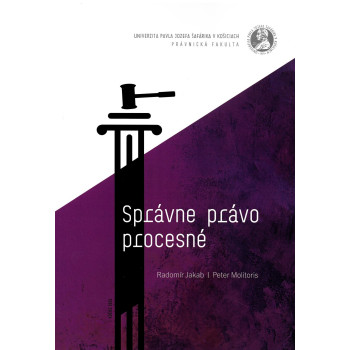
Správne právo procesné

€18.10
Availability: 67 In Stock

Radomír Jakab - Peter Molitoris

Predkladaná učebnica má slúžiť ako učebná pomôcka v pedagogickom procese v rámci študijných predmetov zameraných na správne právo procesné. Z hľadiska štruktúry a obsahových náležitostí reflektuje požiadavky, ktoré sú požadované pre účely postupových skúšok a štátnej skúšky na Právnickej fakulte a Fakulte verejnej správy Univerzity Pavla Jozefa Šafárika v Košiciach. Rovnako, je využiteľným zdrojom informácií aj pre potreby štúdia na iných právnických fakultách v rámci Slovenskej republiky. V neposlednom rade, môže byť vhodnou pomôckou i pre aplikačnú prax, a to tak na orgánoch verejnej správy, na súdoch, ako aj pre advokátov prichádzajúcich do styku so správnym konaním.

Diverzné a inkluzívne pracoviská - legislatívne...

E-book

E-book

Jana ŽuľováDenisa Rudžiková

In the environment of Slovak employers, an active approach to diversity and inclusion in the workplace is coming to the fore. Targeted diversity and inclusion programs help make employers more attractive on the labor market and attract more job seekers. Proactively, better working conditions are created for employees with responsibilities to the family (in most cases still in relation to mothers), groups of people who have been on the fringes of interest until now are also employed (elderly, disabled, LGBT groups, minorities, graduates of secondary and higher education schools).

The presented collection of abstracts responds to the outlined facts, which is a grouping of the starting motives and conclusions of the contributions presented at the scientific conference Diverse and inclusive workplaces - legislative starting points organized by the department of labor law and social security law of the Faculty of Law of the P. J. Šafárik University in Košice, which took place on September 29, 2023 in a hybrid form.

With their abstracts, the authors point to a range of problematic areas that are not only a reflection of academic considerations, but also those legal questions that have to be dealt with in ordinary legal practice. The goal is to use analysis and explanation to define the existing labor law measures/tools applicable to the implementation of diversity and inclusion in the workplace according to the current Slovak legal framework and the EU legal framework and thus emphasize the starting point of any effort to build diversity and the implementation of inclusion in the workplace.

Download e-book for free (pdf)

Medzinárodné a európske právo v kinematografii

E-book

E-book

Lucia Bakošová (ed.)

Proceedings from the XII Student Symposium on International and European Law held on March 29, 2019, in Košice

The primary goal of films or TV series is typically not to educate their audience. However, contemporary cinematography includes a significant number of works that present issues related to international and European law to both professional and general audiences.

For this reason, the Institute of International and European Law at the Faculty of Law of Pavol Jozef Šafárik University in Košice organized the XII Student Symposium on International and European Law titled "International and European Law in Cinematography," under the auspices of Professor JUDr. Ján Klučka, CSc.

The main objective of the symposium was to popularize international and European law among students through films or series. The films analyzed during the symposium could be divided into two categories: those dramatizing real events and those creating fictional scenarios incorporating aspects of international or European law. Most contributions focused on films depicting real events, such as the genocide in Rwanda in the 1990s, the Nuremberg Trials, the occupation of the U.S. Embassy in Tehran, or the legal dispute between the heir of the painting Woman in Gold and Austria. On the other hand, works like the series MASH* were also discussed; while not based on real events, it uses its narrative to portray the lives of medical personnel in a military field hospital during the Korean War.

Download the e-book for free (pdf)

Ownership rights protection in Polish and...

E-book

E-book

Milan Sudzina, Renata Świrgoń-Skok, Wojciech J. Kosior

Given the importance of the ownership right, the aim of this monograph is to provide an analysis, a clear systematic interpretation and an evaluation of the above issue, not only from the theoretical point of view, but also from the point of view of legal practice. The protection of ownership relations is ensured in various ways. It is judicial protection, protection provided by local self-government authorities, self-help, public registration of real property and other instruments of administrative and criminal law. In connection with the transformation of legislation in Slovakia and Poland after the fall of the socialist regime, there have been many changes in the legislation of both countries concerning the protection of ownership rights. A number of private law institutions related to the ownership of real property, the use of which was impossible or limited during the socialist period, have been restored. Legislation has also been adopted to alleviate the consequences of certain property and other injustices caused by the deprivation of ownership of real property during the socialist period. The adoption of restitution legislation was the basis for restoring the ownership rights of the original owners, who were allowed to get back their real property that had been used by socialist organisations. After the end of the socialist regime, the various forms of ownership, which until then had favoured the state ownership, were abolished. Changes were made to ensure that the ownership rights of all owners had the same content and enjoyed the same legal protection. The monograph is structured in such a way as to enable a comparison of individual institutions of rights in rem under Polish and Slovak law. The monograph also analyses the relevant decision-making practice of the supreme judicial authorities. The scientific methods applied enabled the authors not only to analyse and evaluate the historical context and the current legal regulation of ownership rights in Poland and Slovakia, but also to point out possible gaps and shortcomings and to elaborate de lege ferenda proposals that can be used in future legislative activity.

Download e-book for free (pdf)

III. SLOVAK-CZECH DAYS OF TAX LAW. Positive and...

E-book

E-book

Vladimír BabčákAdrián PopovičJozef Sábo (eds.)

Within the project APVV-16-0160 "Tax evasion and tax avoidance (motivation factors , formation and elimination)" was organized conference called III. SLOVAK-CZECH DAYS OF TAX LAW " Positive and Negative Stimulation of the State in the Area of Taxation ". From this conference was prepared the eponymous output in the form of reviewed proceedings of scientific works.

In this publication is published the contributions from several prominent personalities of tax law science in Slovakia and the Czech Republic. lndividual contributions map tax legislation and also changes due to the development of tax legislation , especially under the influence of European Union law. Th ese changes are approached in the context of their specific economic impacts and their impact on status and legal relations in the business and social field . The main topics elaborated in the individual contributions are in particular: EU activities in relation to tax fraud and tax evasion, the impact of tax construction on the act of the addressees of tax law and tax policy of the state and its economic impacts.

The publication presents one of the most actual topics in the current legal and economic environment.

Prof. h.c. prof. JUDr. Vladimír Babčák, CSc.

Download the e-book for free  (pdf)

Spracúvanie osobných údajov zamestnanca podľa GDPR

E-book

E-book

Jana Žuľová a kol.

The presented publication is intended for employers, managers, and HR professionals who process employees' personal data for various employment-related purposes and need to conduct an audit of their processing in compliance with the GDPR and the new Personal Data Protection Act. The publication will also be useful for new employers who are encountering data protection for the first time and need to establish internal data protection rules, essentially starting from scratch.

The reader has the opportunity to gain a comprehensive understanding of the data protection rules applicable in the employment sector, the obligations of the employer, and the rights of the data subject, i.e., job applicants, employees, and former employees.

Download the e-book for free (pdf)

Zákon o národnostiach a Rada vlády Slovenskej...

E-book

E-book

Jana Šutajová

From January 1, 1969, the Constitutional Act on the Status of Nationalities in the Czechoslovak Socialist Republic (ČSSR) and the Constitutional Act on the Federation came into effect. The Constitutional Act on the Status of Nationalities represented at least a formal significant step forward in the legal regulation of minority rights. However, this law was intended to serve as a foundation for further legal adjustments. It was declared that additional steps and negotiations for the adoption of implementing regulations would follow and that further laws would be enacted at both the federal and national levels. Nevertheless, no additional law or government regulation related to the constitutional act on the status of nationalities in the ČSSR was ever issued.

During the normalization period, issues concerning further legislation related to national minorities were not addressed. However, in the brief period following the adoption of the constitutional act in 1968 until the end of 1969, some institutions attempted to prepare and promote such legal norms. One of these institutions was the Government Council of the Slovak Socialist Republic (SSR) for Nationalities (hereafter referred to as the Council or the Government Council for Nationalities). The monograph provides an insight into the development of additional legal norms arising from the constitutional act on the status of nationalities in the Slovak Socialist Republic, prepared by the Government Council of SSR for Nationalities. This council was one of the institutions established in Slovakia after the formation of the Czechoslovak federation and dealt with nationality issues.

In addressing further legal norms stemming from the constitutional act on nationalities in ČSSR, it was necessary to consider prior developments. Therefore, the first part of the monograph examines the status of minorities in Czechoslovakia before adopting the constitutional act, activities of nationalities preceding its adoption, and its enactment itself. Subsequent sections focus on institutional changes in SSR following federalization, the establishment of the Government Council of SSR for Nationalities, and specific actions taken by this Council and its expert bodies in drafting proposals for laws concerning nationalities in the Slovak Socialist Republic.

The motivation for writing this monograph stemmed from the fact that this topic has so far received attention only in a few studies in Slovakia, which primarily focused on the Hungarian minority during either the Prague Spring or normalization periods.

Download the e-book for free (pdf)

Miesto a význam regionálnych súdnych orgánov v...

E-book

E-book

Ján Klučka et al.

The aim of the current monograph is to provide comprehensive view of the status of regional judicial organs in current conditions of regionalism. Based on selected issues examined in individual chapters research team presents the comprehensive study focused on clarification of the status and significance of regional judicial organs in terms of new regionalism.

Research of the role of regional courts in the system of peaceful settlement of disputes demonstrates the significant role of the regional courts within the promotion of the rule of law, regional integration and also significant role of regional courts to ensure legal certainty within the system of compliance with decisions of regional courts. The result of examination of possibilities of individuals to access to regional judicial organs is comparative evaluation of regional possibilities of individual to defend his/her rights within regional courts of various regions. Particular part of this area is the right to an effective remedy and to a fair trial as basic rights within the proceedings of regional judicial organs. Within the examination of preliminary rulings of international regional courts of different regions the role of regional judicial organs in the process of effective implementation of the principle of the rule of law was the subject of examination.

For the proper functioning of the regional judicial organs as well as independence of judges and legal certainty in International law, the ethical rules of international judicial organs and tribunals, which are the subject of the last chapter, are significant.

Download the e-book for free  (pdf)

This website uses cookies to ensure you get the best experience on our website