PRÁVO – OBCHOD – EKONOMIKA XI.

E-book

Jozef SuchožaJán HusárRegina Hučková

In 2020 and 2021, the tradition of holding the Law – Business – Economics conference was exceptionally interrupted due to the unprecedented situation associated with the spread of Covid-19. This year, the situation allows us to restore the tradition of our Tatra conference and, after two years, to once again meet in person with our traditional domestic and international participants. At the same time, we look forward to welcoming participants who are attending our conference for the first time (and we hope it will not be the last).

You are holding in your hands the proceedings of scientific papers, published in connection with the implementation of scientific projects at the scientific workplace – the Department of Commercial and Economic Law, as the main organizer of the scientific conference, as well as at other departments of the Faculty of Law at UPJŠ and at many academic institutions both at home and abroad. The proceedings are published with the support of the Slovak Research and Development Agency. The editors would like to thank everyone who contributed their scientific articles, as well as the reviewers for their valuable comments and recommendations.

Download e-book for free(pdf)

Quantity

978-80-574-0154-4

Data sheet

Method of publication:
E-book (pdf)
Editors:
Jozef Suchoža - Ján Husár - Regina Hučková
Document type:
Proceedings of scientific works
Number of pages:
298
Available from:
20.10.2022
Year of publication:
2022
Edition:
1st edition
Publication language:
slovenčina, angličtina
Faculty:
Faculty of Law
Note:
Zborník bol vydaný v rámci riešenia grantových úloh APVV-17-0561 “Ľudskoprávne a etické aspekty kybernetickej spoločnosti ” a APVV-19-0424 „Inovatívna obchodná spoločnosť: vnútrokorporátne premeny, digitálne výzvy a nástup umelej inteligencie“.
License:
CC BY NC ND (Uveďte autora - Nepoužívajte komerčne - Nespracovávajte)
DOI:
https://doi.org/10.33542/POE2022-0154-4
- Free for download

You might also like

LAW – COMMERCE – ECONOMY

E-book

E-book

Jozef SuchožaJán HusárRegina Hučková (eds.)

Collection of scientific works

The year 2020 has been marked globally by an unprecedented situation related to the spread of Covid-19 since its beginning. At the start of this calendar year, as our organizational team began preparing for another edition, we still hoped that our traditional autumn conference was far away, and in this maximum optimism, we launched the organization of the jubilee 10th edition of our now-traditional conference. This conference has become a stable part of scientific and professional conference events under domestic conditions and has become a stable part of many people's work programs. However, 2020 was almost entirely filled with restrictions from its start, with these restrictions affecting even the organization of conferences. Our 10th Law – Business – Economy Conference fell victim to this current situation and had to be canceled "with gritted teeth." The situation allows us nothing but hope that in 2021 we will be able to meet at our traditional location in High Tatras. We take these meetings for granted; if this situation is good for nothing else, it at least serves as a slowdown and an awareness of our own vulnerability.

See you at the next edition of Law-Business-Economics in October 2021.

You are receiving a collection of scientific papers published in connection with the resolution of scientific projects at the Department of Commercial Law and Economic Law as the main organizer of the scientific conference, as well as other departments of the Faculty of Law at UPJŠ in Košice, and many academic workplaces both domestically and abroad. The collection is published with support from the Agency for Support of Research and Development. The editors thank all who contributed to it with their scientific articles, as well as reviewers for their valuable comments and recommendations.

On behalf of the editors: Regina Hučková

Download the e-book for free  (pdf)

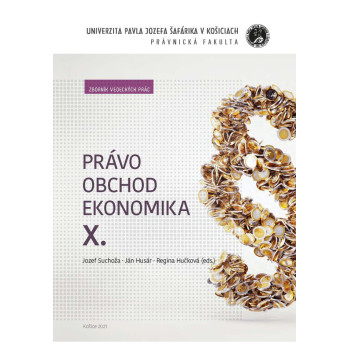
PRÁVO – OBCHOD – EKONOMIKA X.

E-book

E-book

Jozef SuchožaJán Husár - Regina Hučková

Proceedings of the International Scientific Symposium

Collection Law-Commerce-Economy X. is a publication containing professional contributions by the authors, especially with regard to commercial law, civil law, labor law, intellectual property law, but also digital technology law. The thematic focus of the international scientific symposium was concentrated in three areas representing open problems of commercial law with regard to the solution of the economic and social crisis caused by the so-called pandemic (corona crisis), current issues of corporate law in the EU and artificial intelligence and law: the influence of artificial intelligence on the normative activity of the state and court decisions. With regard to the content orientation of the outputs, the publication is suitable not only for readers from the academic environment, but also from applied practice.

Download e-book for free (pdf)

LAW – COMMERCE – ECONOMY XII.

E-book

E-book

Jozef Suchoža - Ján Husár - Regina Hučková

The Proceedings of the International Scientific Symposium "LA W-BUSINESS-ECONOMICS XII" is a collection of scientific works by authors participating in the symposium of the same name. The publication focuses primarily on the area of representation in private law, related pai1ies in corporate and bankruptcy law, and current issues of legal regulation of artificial intelligence.

The authors of indivídua! contributions are erudite experts from various branches of law. The collection of scientific papers is a complete work in the form of a collection, with an overlap into private and public law sectors.

Readers are presented with scientific outputs from authors from the Slovak legal environment, as well as from foreign authors. Several authors' paper provide a European legal perspective or an international comparative perspective.

Download e-book for free (pdf)

16 other products in the same category:

Orgány obchodných spoločností

E-book

E-book

Kristián Csach - Dušan Rostáš (eds.)

Proceedings of the 2nd Student Symposium on Company Law In November 2014

The second annual Student Symposium on Commercial Law—more specifically, on Company Law—was held at the university’s facility in Danišovce. As in the previous year, the aim of the symposium was to provide students with a greater opportunity to articulate their own perspectives on current legal issues and to present the results of their individual work.

The theme of the second symposium focused on the governing bodies of commercial companies, aligning it thematically with the APVV research project being carried out by members of the Department of Commercial and Economic Law at our Faculty of Law. This overarching topic made it possible to assign a range of current legal issues, allowing students to explore problems they are likely to encounter in their future professional practice. The selected topics are not among those unanimously settled by legal doctrine or established case law.

On the contrary, they were deliberately chosen for their complexity and the lack of sufficient domestic literature. As a result, students had to go beyond standard textbook or commentary-based knowledge to thoroughly address their assigned topics.

Download the e-book for free (pdf)

Pracovnoprávne elementy výkonu (závislej)...

E-book

E-book

Jana Žuľová (ed.)

Collection of Scientific Works

Article 35 of the Constitution of the Slovak Republic guarantees everyone the right to freely choose their profession and receive training for it, as well as the right to engage in entrepreneurial or other gainful activity. Everyone has the right to freely decide whether to secure their livelihood through self-employment—with all the associated consequences and risks—or through employment within labor-law relationships by performing dependent work.

The framework and rules for exercising these rights are primarily regulated by labor, commercial, and tax legislation, each with its own set of rights and obligations applicable specifically to entrepreneurs and employees. Constant competitive pressure, along with the effects of economic crises, pushes employers to seek ways to extract the most from workers while optimizing for the lowest possible insurance, administrative, and tax costs. As a result, employment contracts are being terminated, and under the pressure of losing their income, individuals are "voluntarily" shifting to commercial-law relationships.

This situation, along with other distortions in the labor market, confronts those entitled to work with unfair practices by employers, thereby undermining their ability to freely exercise this fundamental right.

Download the e-book for free (pdf)

Míľniky právneho vývoja v Európe po prvej...

E-book

E-book

Ivan SvatuškaLucia Pištejová (eds.)

Collection of Scientific Contributions from the International Scientific Conference of PhD Students and Young Researchers held on April 22, 2022, organized by the Department of State and Law History of the Faculty of Law, Pavol Jozef Šafárik University in Košice.

We recommend this collection to the attention not only of PhD students and young researchers but also to all experts working in the fields of general history and legal science. At the same time, we bring it to the attention of all lay enthusiasts interested in the issues of legal development after the First World War. After all, as one of the world-renowned foreign legal historians likes to say: "Law is the most beautiful science in the world, because everyone can find an area that interests them in it."

Download the e-book for free (pdf)

Aktuálne otázky trestného práva z pohľadu...

E-book

E-book

Dominika Marčoková Becková (ed.)

Proceedings of Papers of XVIth year of the student symposium of the Institute of International Law and European Law

Proceedings of Papers of XVIth year of the student symposium of the Institute of International Law and European Law is devoted to selected aspects of the place and role of criminal law from the point of view of contemporary EU law and international law. In their contributions, students deal with current topics of criminal law in the law of the European Union and international law. In the EU law, the most actual issue is the European Public Prosecutor's Office, a body of the EU responsible for investigateing and prosecuting criminal offenses affecting the Union's financial interests.

The first part of papers dealt with the reasons for the establishment of the European Public Prosecutor's Office, its structure and tasks, the issue of conducting the investigation of the European Public Prosecutor's Office in the conditions of the Slovak Republic, as well as with the relations of the European Public Prosecutor's Office with its closest partner, the European Anti-Fraud Office.

The second part of the contributions reflects current issues and challenges of criminal law in international law. Authors in their papers focused on the issue of the International Criminal Tribunal for Ukraine, the legal problems and challenges associated with its creation, on the issue of the crime of aggression before the International Criminal Court, as well as on issues of immunity of state representatives before national courts.

Download the e-book for free  (pdf)

Medzinárodné právo verejné (Materiály k štúdiu)

E-book

E-book

Ľudmila Pošiváková - Adam Giertl

The presented selection of public international law documents aims to map international law from both historical and sectoral perspectives. The reader will find several historical documents in this collection, but the focus is primarily on currently valid legal sources.

The selection is guided by the publication Public International Law – General and Special Part by Prof. Ján Klučko, which is reflected in the division into general and special parts. The general part addresses the historical development of international law but primarily focuses on the protection of individuals and responsibility relationships in international law. The special part then examines the international regulation of various institutions of international law.

We acknowledge that this selection offers room for expansion, but we believe it meets basic requirements and fills a certain gap in the study of international law.

We trust that this collection of public international law materials will be beneficial for students, and not only for them, in the study of public international law and will contribute to raising awareness in this field.

Download the e-book for free (pdf)

Základné zásady v rozhodovacej činnosti súdnej...

E-book

E-book

Alexander Bröstl - Marta Breichová Lapčáková - Martin Štrkolec (eds.)

Collection of scientific papers by doctoral students.

Thematically, the contributions are diverse: they feature fundamental principles in public law (basic principles of criminal proceedings, the principle of contradiction, basic principles of constitutional court proceedings, basic principles in private law and procedural law (superficies solo cedit), the principle of civil court proceedings in deciding labor disputes, equality of participants and the duty to instruct, objection of bias in light of the right to an impartial court, the principle of speed and the principle of economy in the decision-making activities of general courts, basic principles in legal theory and international law (general legal principles recognized by civilized nations), coexistence of the principle of equality and the principle of non-discrimination in the legal order of the European Union, argumentation through the principle of rule of law in the decision-making activities of courts, the impact of fundamental principles on the interpretation of legal norms.

It is important that the authors, i.e., doctoral students from law faculties in the Czech Republic and the Slovak Republic, almost unanimously examine these principles in the process of application (interpretation) of law, from the perspective of how legal (primarily judicial) practice deals with them. This should be fundamentally welcomed and appreciated.

Download the e-book for free (pdf)

Základy zdaňovania (v interakcii ekonómie a práva)

E-book

E-book

Karolína ČervenáAnna Vartašová

The scientific textbook in the form of an electronic interactive publication is intended for university students who are interested in an interdisciplinary view of taxation in the context of linking the basic theoretical knowledge in the field of law and economics related to taxation with an emphasis on application practice. The content of the textbook primarily covers general theoretical knowledge in the field of taxation in terms of their historical creation and characteristics in the scope of the legal and economic framework of tax system in general, as well as that currently applied in the Slovak Republic.

The textbook also includes pictures and graphs (listed in the appendix), which interactively complement the text part, as well as a set of questions in (in the context of the scope of particular chapters), whose task is to contribute to the fulfilment of didactic goals of the textbook.

Download the e-book for free  (pdf)

Zákon o národnostiach a Rada vlády Slovenskej...

E-book

E-book

Jana Šutajová

From January 1, 1969, the Constitutional Act on the Status of Nationalities in the Czechoslovak Socialist Republic (ČSSR) and the Constitutional Act on the Federation came into effect. The Constitutional Act on the Status of Nationalities represented at least a formal significant step forward in the legal regulation of minority rights. However, this law was intended to serve as a foundation for further legal adjustments. It was declared that additional steps and negotiations for the adoption of implementing regulations would follow and that further laws would be enacted at both the federal and national levels. Nevertheless, no additional law or government regulation related to the constitutional act on the status of nationalities in the ČSSR was ever issued.

During the normalization period, issues concerning further legislation related to national minorities were not addressed. However, in the brief period following the adoption of the constitutional act in 1968 until the end of 1969, some institutions attempted to prepare and promote such legal norms. One of these institutions was the Government Council of the Slovak Socialist Republic (SSR) for Nationalities (hereafter referred to as the Council or the Government Council for Nationalities). The monograph provides an insight into the development of additional legal norms arising from the constitutional act on the status of nationalities in the Slovak Socialist Republic, prepared by the Government Council of SSR for Nationalities. This council was one of the institutions established in Slovakia after the formation of the Czechoslovak federation and dealt with nationality issues.

In addressing further legal norms stemming from the constitutional act on nationalities in ČSSR, it was necessary to consider prior developments. Therefore, the first part of the monograph examines the status of minorities in Czechoslovakia before adopting the constitutional act, activities of nationalities preceding its adoption, and its enactment itself. Subsequent sections focus on institutional changes in SSR following federalization, the establishment of the Government Council of SSR for Nationalities, and specific actions taken by this Council and its expert bodies in drafting proposals for laws concerning nationalities in the Slovak Socialist Republic.

The motivation for writing this monograph stemmed from the fact that this topic has so far received attention only in a few studies in Slovakia, which primarily focused on the Hungarian minority during either the Prague Spring or normalization periods.

Download the e-book for free (pdf)

Trestné právo procesné

€9.85
Availability: 75 In Stock

 Jozef Olej a kol. 

Preložená vysokoškolská učebnica je venovaná problematike trestného práva procesného, ktorú autori v rovnakom zložení spracovali v roku 2006, bezprostredne po účinnosti nového rekodifikovaného Tr. por. – zák. č. 301/2005 Z.z. Obdobie, ktoré uplynulo od účinnosti tejto právnej normy nepochybne prispelo k potvrdeniu či ustáleniu názorov na niektoré nové inštitúty a súčasne si vyžiadalo potrebu reagovať na početné novelizácie tohto zákona.

Štruktúra predloženej publikácie, členenie do jednotlivých kapitol, v podstate korešponduje s úpravou jednotlivých inštitútov obsiahnutých v Tr. poriadku, a to od úpravy základných pojmov, prameňov, zásad trestného konania, cez postavenie jednotlivých subjektov trestného konania, procesné úkony, inštitúty zaisťovacej povahy a dôkaznej povahy, jednotlivé štádia trestného konania až po úpravu právneho styku s cudzinou, resp. trov trestného konania. Ako už bolo uvedené, autori reagujú na pomerne časté a v mnohých prípadoch aj výrazné zmeny úpravy rekodofikovaného Tr. poriadku, vrátane súvisiacich právnych predpisov, prezentujú svoje názory i názory mnohých iných odborníkov na spracovanú problematiku a tieto konfrontujú s poznatkami z praxe, vrátane uvádzania aktuálnej iudikatúry.

Ambíciou autorov tak bolo a naďalej zostáva, ponúknuť predovšetkým študentom právnických fakúlt základnú učebnú pomôcku pre štúdium trestného práva procesného.

Autori

Slovenské a české obchodné právo v roku 2015:...

E-book

E-book

Jozef Čorba(ed.)

Collection of Contributions from the Conference

On June 11–12, 2015, the Department of Commercial Law and Economic Law at the Faculty of Law, P. J. Šafárik University in Košice, organized the 13th meeting of the departments of commercial law from the law faculties of Czech and Slovak universities. This event further demonstrates that the idea of an annual gathering of representatives from these departments, initiated by Professor Bejček of the Faculty of Law at Masaryk University in Brno, has taken root and is likely to continue. Not only to preserve the tradition but primarily for the benefit of such meetings and the interest of participants to meet regularly.

A traditional part of these meetings, besides the exchange of knowledge and information about the teaching process and experience sharing, is a scientific conference focused on current issues in commercial law. This year’s conference was held under the title Slovak and Czech Commercial Law in 2015 – Selected Problems. A total of 17 contributions from various departments were included in the conference proceedings, divided into three thematic areas. The first group of contributions addresses selected issues related to the legal regulation of commercial companies and its practical implementation. The second group focuses on arbitration and insolvency law.

The third group includes contributions on the interpretation of the amended regulation of interest on late payments in commercial obligations, problems related to the application of this regulation, and issues concerning the interpretation of legal acts contained in the new Czech Civil Code. An additional part features an informational contribution on the development of Slovenian commercial law and its current form.

Ján Husár, Kristián Csach

Download the e-book for free(pdf)

Demokracia, dôstojnosť, diverzita: Zborník z...

E-book

E-book

Alexander BröstlMarta Breichová Lapčáková (eds.)

Under the auspices of the Institute of Legal Theory of Gustav Radbruch and the Slovak Section of the International Association for Philosophy of Law and Social Philosophy (IVR), a 3D flash conference was held on May 16, 2019, at the Faculty of Law of UPJŠ in Košice. This event was primarily dedicated to the upcoming 29th World Congress of IVR in Lucerne, Switzerland. In line with the main theme of the congress, the conference focused on "Dignity, Democracy, Diversity." At the time of the conference, it was clear that the number of participants at the world congress would significantly exceed 1,000, with discussions taking place in 151 special workshops and 28 working groups.

During the congress, a round table was also announced featuring Professor Brian Tamanaha, recipient of the IVR award for best book for "Realistic Theory of Law" (Cambridge 2017), a meeting regarding the IVR Encyclopedia, a panel on academic freedom issues, and a gathering of chairs from national sections of IVR.

Download the e-book for free (pdf)

Ochrana zamestnanca perspektívou priemyselnej...

E-book

E-book

Milena Barinková (ed.)

Proceedings from the IV Annual Student Symposium on Labor Law held on April 5–6, 2019, in Danišovce

The term "Industrial Revolution 4.0" is currently widely used, yet remains mysterious and its content unfamiliar to many. While we do not claim omniscience, through the educational process at the Faculty of Law of Pavol Jozef Šafárik University in Košice and the scientific research of the Department of Labor Law and Social Security Law, we have delved into examining the accompanying features and anticipated phenomena of this modern industrial revolution.

It can be stated with great certainty that this revolution already affects—and will continue to affect—production processes, including radical changes in their structure, the emergence of groundbreaking technological and communication tools, and, undoubtedly, labor relations. The rise of new forms and methods of work based on automation and digitalization, applied within new models of labor relations, is beginning to threaten jobs in certain sectors of the economy. There is an increasing demand for specialized qualifications and skills, particularly in information technology, with an emphasis on process digitalization, data processing, and the creation of communication networks connecting objects and people. This intelligent industry inevitably disqualifies many existing jobs from their current structures, leading to job losses for numerous employees. Analysts openly predict that by 2030, robots will replace up to 20 million industrial jobs worldwide.

The vision of which occupations or working conditions will be impacted is becoming increasingly concrete. Radical changes will require radical solutions as well as previously unknown movements and new elements or measures in the labor market.

Download the e-book for free  (pdf)

Prípady z medzinárodného práva verejného

E-book

E-book

Ľudmila ElbertĽubica Gregová Širicová (eds.)

In addition to acquiring theoretical knowledge, it is necessary to study and analyze the decisions of international judicial and arbitration bodies in order to fully understand the subject of the Public International Law or disciplines closely related to it.

Since the Slovak literature in the field of Public International Law does not contain any electronic textbook of selected decisions of international judicial and arbitration bodies, the authors of the submitted publication aim to eliminate this gap by elaborating the “Public International Law Casebook”, which will primarily be intended for undergraduate students of the law faculties in the Slovak republic and the Czech republic.

The proposed publication seeks to make the study of international law more attractive through a publication that will make students familiar with the decisions translated into the Slovak language in a popular electronic form.

Download the e-book for free (pdf)

PRÁVO – OBCHOD – EKONOMIKA X.

E-book

E-book

Jozef SuchožaJán Husár - Regina Hučková

Proceedings of the International Scientific Symposium

Collection Law-Commerce-Economy X. is a publication containing professional contributions by the authors, especially with regard to commercial law, civil law, labor law, intellectual property law, but also digital technology law. The thematic focus of the international scientific symposium was concentrated in three areas representing open problems of commercial law with regard to the solution of the economic and social crisis caused by the so-called pandemic (corona crisis), current issues of corporate law in the EU and artificial intelligence and law: the influence of artificial intelligence on the normative activity of the state and court decisions. With regard to the content orientation of the outputs, the publication is suitable not only for readers from the academic environment, but also from applied practice.

Download e-book for free (pdf)

Ochrana (duševného) zdravia zamestnanca v...

E-book

E-book

Marcel DolobáčMonika Seilerová

The Industrial Revolution cannot be avoided or hidden from, but it is equally wrong to see it only in gray tones. Let us be optimistic. The Information Age can also mean a reduction in working hours, perhaps more time for family and interpersonal relationships, or an overall increase in individual economic luxury. The Information Age will take away many job opportunities but will put many others on the table, though mostly for the educated. Science and research will become even more important for overall economic development than they are today. Let us be prepared.

The ambition of this monograph is not, and cannot be, to provide an exhaustive answer to the above-outlined debates. Its goal is to stimulate broader scientific discussion, particularly on the issue of mental health protection in correlation with the advent of the Information Age. The subject of study is the protection of the individual—the employee—who must adapt to a new technological environment and its associated demands.

The monograph represents a comprehensive output by authors who, over the past two years, have published on similar topics within the APVV-16-0002 grant "Mental Health in the Workplace and Assessment of Employee Health Capability." The authors believe that thanks to this APVV grant, they will continue to build on this topic in the coming years. Most importantly, they hope that its content will engage you, the readers.


Marcel Dolobáč

Download the e-book for free (pdf)

This website uses cookies to ensure you get the best experience on our website