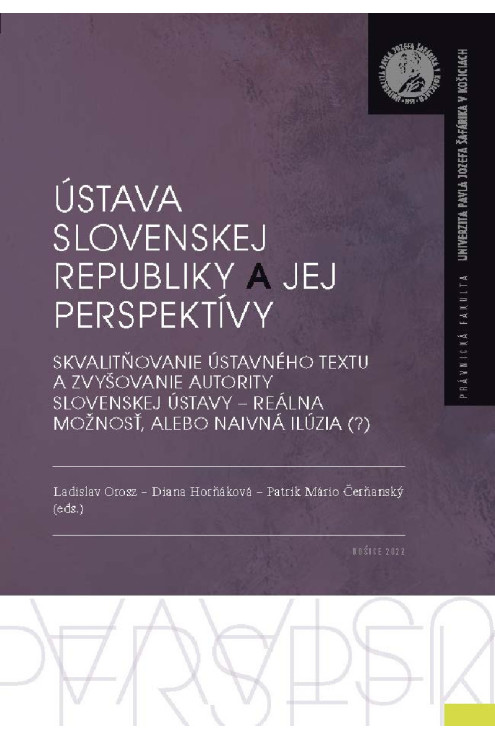
Ústava Slovenskej republiky a jej perspektívy

E-book

Ladislav OroszDiana HorňákováPatrik Mário Čerňanský

This scientific proceedings volume serves as the final joint publication output of essentially the entire research team of the aforementioned scientific project. It consists of contributions presented at the scientific seminar The Constitution of the Slovak Republic and Its Perspectives. Improving the Constitutional Text and Increasing the Authority of the Slovak Constitution – A Real Possibility or a Naive Illusion? held from November 23 to 25, 2022, at the training and educational facility of UPJŠ in Košice, Danišovce. The final form of the contributions emerged from the constructive scientific discourse that accompanied the entire course of this seminar.

The content of this scientific proceedings volume, which we offer not only to the broad (especially legal-political) professional public but also primarily to Slovak constitution makers, includes, alongside contributions from members of the research team and invited guests, the literary debut works of doctoral students from the organizing Department of Constitutional and Administrative Law of the Faculty of Law of UPJŠ and the Department of Public Law Disciplines of the Faculty of Public Administration of UPJŠ in Košice. These works thematically correspond to the tasks addressed within the aforementioned scientific project “Constitutional Activity of the National Council of the Slovak Republic (Legal-Political Analysis – Evaluation – Perspectives).”

Download e-book for free (pdf)

Quantity

978-80-574-0160-5

Data sheet

Method of publication:
E-book (pdf)
Editors:
Ladislav Orosz - Diana Horňáková - Patrik Mário Čerňanský
Document type:
Proceedings
Number of pages:
300
Available from:
13.12.2022
Year of publication:
2022
Edition:
1st edition
Publication language:
Slovak
Faculty:
Faculty of Law
Note:
Zborník vznikol v rámci riešenia grantového projektu VEGA č. 1/0399/20 „Ústavodarná činnosť Národnej rady Slovenskej republiky (právno-politologická analýza – hodnotenie – perspektívy)
License:
CC BY NC ND (Uveďte autora - Nepoužívajte komerčne - Nespracovávajte)
DOI:
https://doi.org/10.33542/USR-0160-5
- Free for download

16 other products in the same category:

Ochrana (duševného) zdravia zamestnanca v...

E-book

E-book

Marcel DolobáčMonika Seilerová

The Industrial Revolution cannot be avoided or hidden from, but it is equally wrong to see it only in gray tones. Let us be optimistic. The Information Age can also mean a reduction in working hours, perhaps more time for family and interpersonal relationships, or an overall increase in individual economic luxury. The Information Age will take away many job opportunities but will put many others on the table, though mostly for the educated. Science and research will become even more important for overall economic development than they are today. Let us be prepared.

The ambition of this monograph is not, and cannot be, to provide an exhaustive answer to the above-outlined debates. Its goal is to stimulate broader scientific discussion, particularly on the issue of mental health protection in correlation with the advent of the Information Age. The subject of study is the protection of the individual—the employee—who must adapt to a new technological environment and its associated demands.

The monograph represents a comprehensive output by authors who, over the past two years, have published on similar topics within the APVV-16-0002 grant "Mental Health in the Workplace and Assessment of Employee Health Capability." The authors believe that thanks to this APVV grant, they will continue to build on this topic in the coming years. Most importantly, they hope that its content will engage you, the readers.


Marcel Dolobáč

Download the e-book for free (pdf)

Algoritmy a inklúzia: Pracovné právo v ére...

E-book

E-book

Marek Švec, Jana Žuľová

The collection of scientific contributions offers an interdisciplinary analysis of the challenges labour law faces due to digitalization and social change. Its main goal is to highlight potential synergies between the technological management of work processes and the promotion of diversity and inclusion in the workplace, with a focus on legal mechanisms that ensure equal opportunities and protect employees. The collection includes studies on various aspects of labour law protection, such as the prohibition of discrimination, transparency in algorithmic management, protection of individuals with diverse needs, and legislative challenges related to GDPR. It also features contributions to innovative remuneration systems and the protection of socially and health-disadvantaged groups, with special attention to employees of different sexual orientations and pregnant women. A significant portion of the work is dedicated to issues surrounding the use of artificial intelligence and algorithmic management in decision-making within labour relations. This publication serves as an insightful resource for academics, lawyers, students, and practitioners addressing modern employment law challenges, and it encourages further discussion on innovative approaches to contemporary labour law topics.

Download the e-book for free (pdf.)

Rule of Law a medzinárodné právo

E-book

E-book

Ľudmila Elbert

The presented scientific monograph addresses the issue of the Rule of Law and its place, roles, and particularities at the level of international law. The Rule of Law is understood as a value that should govern communities, both domestic and international. It is thus compared to Kelsen’s basic norm, which should stand at the top of the legal order as the norm justifying the validity and existence of the norms of the legal order, both domestic and international.

Although the Rule of Law is studied at the international law level, it cannot be considered without understanding the Rule of Law in domestic law. Just as its development differs depending on whether it evolved within Anglo-American or continental law, its application and development also differ between domestic law and international law.

These differences are mainly caused by the roles and objectives that international Rule of Law is meant to secure, as well as by the distinct characteristics of domestic and international law.

Download the e-book for free (pdf)

Miesto a význam regionálnych súdnych orgánov v...

E-book

E-book

Ján Klučka et al.

The aim of the current monograph is to provide comprehensive view of the status of regional judicial organs in current conditions of regionalism. Based on selected issues examined in individual chapters research team presents the comprehensive study focused on clarification of the status and significance of regional judicial organs in terms of new regionalism.

Research of the role of regional courts in the system of peaceful settlement of disputes demonstrates the significant role of the regional courts within the promotion of the rule of law, regional integration and also significant role of regional courts to ensure legal certainty within the system of compliance with decisions of regional courts. The result of examination of possibilities of individuals to access to regional judicial organs is comparative evaluation of regional possibilities of individual to defend his/her rights within regional courts of various regions. Particular part of this area is the right to an effective remedy and to a fair trial as basic rights within the proceedings of regional judicial organs. Within the examination of preliminary rulings of international regional courts of different regions the role of regional judicial organs in the process of effective implementation of the principle of the rule of law was the subject of examination.

For the proper functioning of the regional judicial organs as well as independence of judges and legal certainty in International law, the ethical rules of international judicial organs and tribunals, which are the subject of the last chapter, are significant.

Download the e-book for free  (pdf)

Transteritoriálne správne akty v podmienkach...

E-book

E-book

Radomír JakabTibor SemanLukáš Jančát

The concept of a transterritorial administrative act is relatively new in administrative law, especially in the conditions of the Slovak Republic. It has practical applicability to the application of European Union law (including international law). Its essence lies in the fact that the effects of such an administrative act issued within one Member State exceed the territory of that Member State, have effects in other Member States, in all Member States of the European Union without being subject to the recognition process.

The purpose of the monograph is to present outputs of the scientific examination of this type of administrative acts, the definition of its characteristics and its effects, the examination of the possibilities of procedural defense against its effects by the State concerned, and possibly the possibility of unifying the action of the Member States of the European Union in case of procedural defense against the effects of transterritorial administrative acts. The monograph also contains analysis of certain types of transterrritorial administrative acts that are commonly used in the conditions of the European union and Slovak republic; they are also categorized under specific criteria.,

Download the e-book for free  (pdf)

Ochrana proti obmedzovaniu hospodárskej súťaže

E-book

E-book

Žofia Mrázová(ed.)

Proceedings from the VI. Student Symposium on Commercial Law Held on November 28, 2018, at the Faculty of Law, Pavol Jozef Šafárik University in Košice

The Department of Commercial and Economic Law at the Faculty of Law, Pavol Jozef Šafárik University in Košice, organized the sixth annual Student Symposium on Commercial Law on November 28, 2018. The event was part of the research project VEGA 1/0917/16 titled "Atypical and De Facto Relationships in Commercial Law." The symposium aims to provide a platform for discussion among students with the guidance of mentors from the department, including professors, researchers, and doctoral candidates.

This year’s symposium focused on protection against anti-competitive practices. Unchecked anti-competitive behavior could grant economic advantages to violators at the expense of other competitors and threaten the free-market system. Students explored various challenges related to competition law, analyzing Slovak and European legal frameworks as well as court rulings and decisions by other authorities. Through their research, students honed their analytical thinking, argumentation skills, and critical reasoning. The discussions generated new perspectives and encouraged active engagement among participants.

This proceedings volume presents the outcomes of students' work from this event.

Download the e-book for free(pdf)

Členovia orgánov obchodnej spoločnosti....

E-book

E-book

Jaroslav DolnýMonika Seilerová (eds.)

The collection of contributions from the VII. Student Symposium on Commercial Law and Labor Law held on December 5, 2019, at the Faculty of Law of Pavol Jozef Šafárik University in Košice

The theme of this year's symposium provided students with the opportunity to choose between addressing issues related to commercial law or focusing on labor law aspects concerning the position of members of the governing bodies of commercial companies, based on an analysis of legal regulations and case law.

The creative exploration of commercial law questions particularly related to areas such as the manner of acting on behalf of a commercial company, the liability of the de facto statutory body of a commercial company, information obligations of the statutory body towards its shareholders, and the remuneration for serving as a member of the board of directors of a joint-stock company. It also addressed the liability of the statutory body for the insolvency of the company and the enforcement of non-competition clauses concerning managing directors of limited liability companies.

The connection between commercial law and labor law was directed towards a legal analysis of personal data protection related to health and its misuse by members of the governing bodies of commercial companies, as well as the legitimacy of concurrently holding a position (as a member) in a statutory body with an employment relationship, and the legal status of senior employees, particularly concerning their duties and responsibilities for ensuring employee health through creating healthy working conditions.

Download the e-book for free (pdf)

10 rokov v EÚ: Vzťahy, otázky, problémy

E-book

E-book

Ján Klučka(ed.)

Collection of Papers from the International Scientific Conference Held on May 29–30, 2014 at the Faculty of Law, Pavol Jozef Šafárik University in Košice.

In the first half of this year, a scientific conference entitled “10 Years in the EU: Relations, Questions, Issues” was held in Košice, and the contributions from this event constitute the content of the present collection bearing the same name.

The aim of the organizers—namely, the Slovak Association of European Law, the Representation of the European Commission in the Slovak Republic, and the Institute of European Law together with the Department of International Law of the Faculty of Law at Pavol Jozef Šafárik University—was not only (even if loosely) to follow up on the previous 2009 conference “Community Law in Slovakia – Five Years ‘After’”, but, after another five years, to continue its main objective: to provide participants from both the academic and non-academic community with a space for further analysis and exchange of views on legal issues related to the membership of the Slovak Republic in the European Union and various current issues of the Union’s legal order.

From this perspective, a shift in the overall focus of the conference contributions in 2009 and 2014 can be observed. While the contributions from the first conference focused primarily on various aspects of the application of Union law in the Slovak legal system and related application problems, especially before courts and other authorities, the basic orientation of the contributions from the second conference is already different. The present collection also confirms that the contributions focus primarily on current issues of the European legal order and on certain aspects of the Union’s external policy, while the relationship of Union law to the Slovak legal system is no longer given primary attention.

Several contributions focus on areas characterized by a certain overlap or “cohabitation” of Union law with public international law, private international law, or, more broadly, international relations.

Download the e-book for free (pdf)

Regionalizmus a jeho prínos pre všeobecné...

E-book

E-book

Ján Klučka a kol.

The presented monograph, “Regionalism and Its Contribution to General International Law,” was prepared at the Institute of European Law and the Department of International Law of the Faculty of Law at Pavol Jozef Šafárik University in Košice as part of a project of the same name (APVV-0823-11) carried out in the years 2011–2015, and represents one of its final publication outputs.

The main reason for choosing this topic was the effort to evaluate regionalism in its various forms in relation to international law, and, conversely, to assess the place, significance, and role of international law in the creation and functioning of different forms of regional groupings. In fact, although regionalism is receiving increasing attention in doctrine, a more comprehensive assessment of its impact on international law and vice versa has so far been lacking.

This monograph attempts to partially fill this gap. Against the background of a brief historical development of regionalism, as well as its substantive and terminological components, the monograph examines in greater detail the individual types of regionalism—such as old and new regionalism, as well as contractual and institutional regionalism—their specific features, and their contribution to general international law.

Attention is also devoted to a specific phenomenon of contemporary regionalism, namely the influence of the European Union on its stabilization and development, both through practical measures and through a set of measures regulated by international treaties.

Download the e-book for free (pdf)

Vybrané otázky sociálneho práva Európskej únie

€21.80 €10.90 -50%
Availability: 38 In Stock

 Marcel Dolobáč a kol. 

Učebnica s názvom Vybrané otázky sociálneho práva Európskej únie prierezovo spracúva najzásadnejšie otázky pracovného práva a práva sociálneho zabezpečenia v Európskej únii. V úvodných statiach učebnice sa autori zamerali na objasnenie základnej terminológie a stručne poukazujú na vývoj sociálneho práva v Únii. Ďalšie kapitoly práce postupne vysvetľujú vybranú problematiku ktorá celkovo dotvára sociálne právo Európskej únie, konkrétne – voľný pohyb zamestnancov, zákaz diskriminácie, flexibilitu pracovných vzťahov prostredníctvom atypických pracovných pomerov, dočasné pridelenie zamestnancov, ochranu osobitných kategórií zamestnancov, ochranu osobných údajov, oblasť bezpečnosti a ochrany zdravia pri práci, ochranu práv zamestnancov pri prevode, prechode zamestnávateľa a jeho platobnej neschopnosti, kolektívnu ochranu práv zamestnancov a napokon uplatňovanie systémov sociálneho zabezpečenia. Učebnica analyzuje predovšetkým úniovú úpravu s akcentom na rozhodnú judikatúru Súdneho dvora Európskej únie, vnútroštátny právny poriadok objasňuje iba vo vybraných problematických oblastiach. 

Autori

Právne postavenie spoločníka v obchodnej...

E-book

E-book

Žofia Šuleková (ed.)

Proceedings of the Contributions from the IV. Student Symposium on Corporate Law held on November 24-25, 2016, at the Training Facility of Pavol Jozef Šafárik University in Danišovce.

The Department of Commercial Law and Economic Law at the Faculty of Law of Pavol Jozef Šafárik University in Košice organized the fourth edition of the student symposium, this time focusing on corporate law.

The event took place on November 24-25, 2016, at the training facility of Pavol Jozef Šafárik University in Danišovce. The aim of the annually organized symposiums is to create a discussion platform for students with the participation of mentors from the department, including teachers, researchers, and doctoral students. This year’s symposium focused on problematic issues related to the legal status of a partner in a commercial company. The topics were assigned to allow students to demonstrate and develop their analytical and argumentative skills while improving their ability to present and formulate their own views and perspectives.

The presented proceedings are the outcome of the students' work from this event.

Download the e-book for free (pdf)

Kúpna zmluva – história a súčasnosť I.

E-book

E-book

Erik Štenpien (ed.)

Proceedings of the International Scientific Conference held on September 27, 2013, at the Faculty of Law of UPJŠ in Košice

The Civil Code is one of the fundamental legal codifications of our time. Paradoxically, in the Slovak Republic, the 1964 Code still applies today, albeit with certain modifications brought by the modern era. Currently, recodification efforts are underway, with the goal of adopting a new Civil Code.

However, it is not possible to build something new without knowledge of the old. It is therefore a positive sign when legal historians and civil law experts come together at a conference to exchange views and insights. The Department of State and Legal History at the Faculty of Law in Košice is in its first year of working on the scientific grant project VEGA: The Historical-Legal Development of the Institute of the Sales Contract and Trends in Its Current Recodification in the Slovak Republic - No. 1/0131/13.

This project was acquired as a historical-legal initiative, but the Department of Civil Law is also participating, as Assoc. Prof. JUDr. K. Kirstová, CSc., is the deputy head of the project. Aware that this represents a completely unique connection between legal history and practice, our department organized the international scientific conference The Sales Contract - History and Present I. on September 27, 2013, which was a planned grant output but ultimately coincided with the 40th anniversary of the Faculty of Law in Košice.

This proceedings volume thus summarizes contributions from the grant project, as well as related presentations. It aims to significantly contribute to the understanding of the history and current recodification efforts of the sales contract institution both domestically and internationally.

Download the e-book for free (pdf)

Trestné právo procesné

€9.85
Availability: 75 In Stock

 Jozef Olej a kol. 

Preložená vysokoškolská učebnica je venovaná problematike trestného práva procesného, ktorú autori v rovnakom zložení spracovali v roku 2006, bezprostredne po účinnosti nového rekodifikovaného Tr. por. – zák. č. 301/2005 Z.z. Obdobie, ktoré uplynulo od účinnosti tejto právnej normy nepochybne prispelo k potvrdeniu či ustáleniu názorov na niektoré nové inštitúty a súčasne si vyžiadalo potrebu reagovať na početné novelizácie tohto zákona.

Štruktúra predloženej publikácie, členenie do jednotlivých kapitol, v podstate korešponduje s úpravou jednotlivých inštitútov obsiahnutých v Tr. poriadku, a to od úpravy základných pojmov, prameňov, zásad trestného konania, cez postavenie jednotlivých subjektov trestného konania, procesné úkony, inštitúty zaisťovacej povahy a dôkaznej povahy, jednotlivé štádia trestného konania až po úpravu právneho styku s cudzinou, resp. trov trestného konania. Ako už bolo uvedené, autori reagujú na pomerne časté a v mnohých prípadoch aj výrazné zmeny úpravy rekodofikovaného Tr. poriadku, vrátane súvisiacich právnych predpisov, prezentujú svoje názory i názory mnohých iných odborníkov na spracovanú problematiku a tieto konfrontujú s poznatkami z praxe, vrátane uvádzania aktuálnej iudikatúry.

Ambíciou autorov tak bolo a naďalej zostáva, ponúknuť predovšetkým študentom právnických fakúlt základnú učebnú pomôcku pre štúdium trestného práva procesného.

Autori

III. SLOVAK-CZECH DAYS OF TAX LAW. Positive and...

E-book

E-book

Vladimír BabčákAdrián PopovičJozef Sábo (eds.)

Within the project APVV-16-0160 "Tax evasion and tax avoidance (motivation factors , formation and elimination)" was organized conference called III. SLOVAK-CZECH DAYS OF TAX LAW " Positive and Negative Stimulation of the State in the Area of Taxation ". From this conference was prepared the eponymous output in the form of reviewed proceedings of scientific works.

In this publication is published the contributions from several prominent personalities of tax law science in Slovakia and the Czech Republic. lndividual contributions map tax legislation and also changes due to the development of tax legislation , especially under the influence of European Union law. Th ese changes are approached in the context of their specific economic impacts and their impact on status and legal relations in the business and social field . The main topics elaborated in the individual contributions are in particular: EU activities in relation to tax fraud and tax evasion, the impact of tax construction on the act of the addressees of tax law and tax policy of the state and its economic impacts.

The publication presents one of the most actual topics in the current legal and economic environment.

Prof. h.c. prof. JUDr. Vladimír Babčák, CSc.

Download the e-book for free  (pdf)

Medzinárodné daňové úniky a metódy ich...

E-book

E-book

Peter Huba - Jozef Sábo - Martin Štrkolec

The presented monograph aims to provide an in-depth overview of the issue of international tax evasion, both in terms of its conceptual foundations and with regard to specific methods and schemes used to carry out tax evasion.

The members of the authorial team have also addressed questions of tax evasion in their previous works: "International Tax Evasion and Tax Havens" (JUDr. Jozef Sábo) and "Legal Aspects of the Elimination of Double Taxation and Prevention of Tax Evasion" (JUDr. Peter Huba).

This monograph represents a synthesis of the relevant research activities of the authorial team, enriched by the interdisciplinary dimension of the tax evasion problem. At the same time, it highlights those shortcomings that appear to be the most serious from the perspective of the risk of international tax evasion and base erosion in Slovakia. In this respect, a comparative perspective on the issue is presented, drawing extensively from American sources, mainly due to the high quality and long-standing research on international tax evasion in the United States.

The authorial team believes that this monograph will help to bring the issue of corporate income tax evasion closer to the professional public, and that it will receive attention equal to that given to VAT fraud and other pressing issues of current tax legislation.

Download the e-book for free (pdf)

Ochrana zamestnanca perspektívou priemyselnej...

E-book

E-book

Milena Barinková (ed.)

Proceedings from the IV Annual Student Symposium on Labor Law held on April 5–6, 2019, in Danišovce

The term "Industrial Revolution 4.0" is currently widely used, yet remains mysterious and its content unfamiliar to many. While we do not claim omniscience, through the educational process at the Faculty of Law of Pavol Jozef Šafárik University in Košice and the scientific research of the Department of Labor Law and Social Security Law, we have delved into examining the accompanying features and anticipated phenomena of this modern industrial revolution.

It can be stated with great certainty that this revolution already affects—and will continue to affect—production processes, including radical changes in their structure, the emergence of groundbreaking technological and communication tools, and, undoubtedly, labor relations. The rise of new forms and methods of work based on automation and digitalization, applied within new models of labor relations, is beginning to threaten jobs in certain sectors of the economy. There is an increasing demand for specialized qualifications and skills, particularly in information technology, with an emphasis on process digitalization, data processing, and the creation of communication networks connecting objects and people. This intelligent industry inevitably disqualifies many existing jobs from their current structures, leading to job losses for numerous employees. Analysts openly predict that by 2030, robots will replace up to 20 million industrial jobs worldwide.

The vision of which occupations or working conditions will be impacted is becoming increasingly concrete. Radical changes will require radical solutions as well as previously unknown movements and new elements or measures in the labor market.

Download the e-book for free  (pdf)

This website uses cookies to ensure you get the best experience on our website