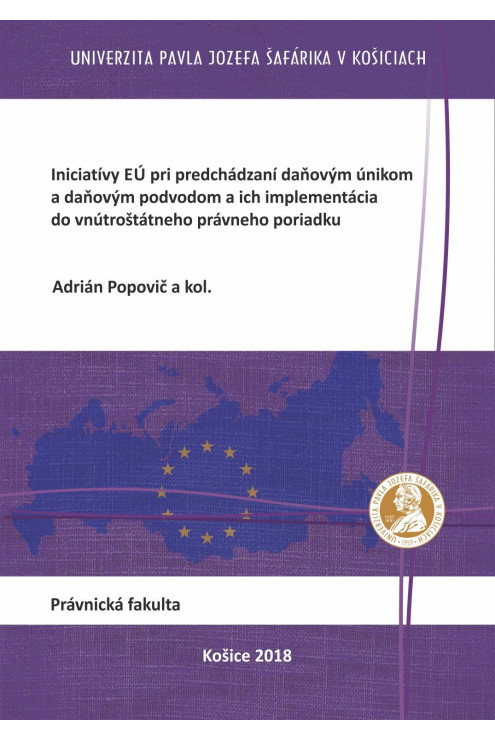
Iniciatívy EÚ pri predchádzaní daňovým únikom a daňovým podvodom a ich implementácia do vnútroštátneho právneho poriadku

E-book

Adrián Popovič a kol.

The possibility of solving the grant project VVGS-2016-284 has provided a unique opportunity for members of the author´s team in the interdisciplinary composition to examine the issue not only from a tax-law point of view, but also from a political point of viewIn the presented monograph, the authors focused on the characterization of different aspects of the EU in order to allow the reader correctly understand its position in relation to the outside world and to its inward relations within its Member States in the context of the creation and implementation of the EU tax policy.

Particular attention is paid to the definition of the relationship between national tax legislation and EU law, the impact of the EU's tax policy on the national laws of its Member States, with reference to the identification of the harmonized areas with the approximation of their current stage of development and the final objective. This definition can be seen as a prerequisite for a correct and comprehensive understanding of the application and implementation of EU institutions' initiatives to prevent tax evasion and tax fraud and their implementation into the national legal order of the Slovak Republic. In the last part of the monograph, the authors focused on defining individual EU initiatives to combat tax evasion and tax fraud as a means of implementing its tax policy, in the area of ​​indirect taxation, in particular in the field of value added tax and in the field of direct taxation, especially with regard to corporate taxation, and to evaluate their projection into the national tax legislation of the Slovak Republic. At the same time, in these chapters, they assessed the real impact and effect of the measures admitted on the basis of the initiatives in practice.

The presented work is intended for a university student studying in the field of Tax Law and European Law, as well as the broader legal and economic community. However, in view of the scope and recency of the subject under consideration, the authors believe that the publication will find its application not only in the theoretical field but also in the practical field.

 JUDr. Adrián Popovič

Download the e-book for free (pdf)

Quantity

978-80-8152-633-6

Data sheet

Method of publication:
E-book (pdf)
Authors:
Adrián Popovič - František Bonk - Ivana Štieberová - Gabika Szabariová - Matúš Béreš
Executive Editor:
Vladimír Babčák
Document type:
Monograph
Year of publication:
2018
Edition:
1st edition
Publication language:
Slovak
Faculty:
Faculty of Law
Note:
Táto monografia vznikla ako výstup z riešenia grantovej úlohy projektu VVGS-2016-284 s názvom: „Iniciatívy EÚ pri predchádzaní daňovým únikom a ich implementácia do vnútroštátneho právneho poriadku“.
- Free for download

16 other products in the same category:

Oslava právneho štátu (Právny štát z pohľadu...

E-book

E-book

Ľudmila Pošiváková Zuzana Antošová - Milan Kočan (eds.)

Proceedings from the Student Debate held on April 24, 2013, at the Faculty of Law of Pavol Jozef Šafárik University in Košice.

In the current period, the rule of law is widely debated both at the academic and political levels. This debate is not only related to the effort to establish the Rule of Law in states that have transitioned from socialist to democratic systems but also in states experiencing various unrests, whether political or religious.

However, it is not just a debate about certain characteristics of the Rule of Law that are missing in domestic law or at the level of international law, but also a debate about the very definition and meaning of the Rule of Law. The rule of law can be likened to an ideal that almost every state strives to achieve. Even in the case of the establishment of the independent Slovak Republic, the framers decided to include among the introductory provisions, which should form the core of the constitution, that the Slovak Republic is a state governed by the rule of law.

However, to achieve the ideal of the rule of law, it is necessary not only to declare it but also to adopt measures essential for an independent judiciary, democracy, the effective enforcement of human rights, the separation of powers, and many other elements that characterize a state governed by the rule of law.

Download the e-book for free (pdf)

The place, role and significance of domestic law

E-book

E-book

Dominika BeckováAdam Giertl (eds.)

Collection of Papers of PhD. students and young researchers

Institute of International Law and European Law offered a place to PhD. students and young researchers to publish scientific outputs of their research. Submited collection of scientific contributions is the result of that initiative. Papers deal with the implementation of international law and law of the EU into the domestic legal system.

Thematically is the collection of contributions divided into several parts, that are dedicated to contributions dealing with the issues of legal theory and international and european law.

Contributions are addressing issues of human rights protection, they aim to the roles of international and supranational judiciary, environment, criminal and public law. Collection of contributions includes also chosen problems of private law and it also dedicates space for contributions focused on foreign investments.

Download the e-book for free  (pdf)

Hranice zmluvnej slobody v pracovnom práve

E-book

E-book

Marcel Dolobáč

The author's ambition is to build on the current and at the same time to stimulate further discussion of the anchoring of labour law in the system of private law sectors and to contribute to the variation of views in relation to freedom of contract and its limits in labour law. The broad contractual freedom of civil law does not apply to the field of labour law, and thus the penetration of standard civil law institutes into labour law relations is not always self-evident.

The above constitutes the main theses of the present monograph. The issue of freedom of contract in labour law can be grasped in several ways. The author has chosen a content structure that is built on three basic pillars. In the first part, the author assesses the position of labour law in the system of law, which is determined primarily by the actual subject of legal regulation - dependent labour and the specific method of legal regulation through cogent and relatively cogent norms. In this context, the author would like to note at the outset that the much-discussed dispositive nature of labour law norms appears to be merely presumptive. Labour law is built on minima and maxima, with relative mandatory norms being the building blocks of fixed boundaries, a fact that distinguishes labour law from other branches of private law. These considerations are followed by the author's view of autonomy of will in labour law. The limits of contractual freedom (not only) in the theoretical sense form the second pillar of the author's ideas.

Finally, the third part of the thesis is to be the one that translates the theoretical-legal considerations of the interconnection of civil law and labour law into the interpretation of selected civil law institutes and the possibility of their application and implementation in labour law relations.

Download he e-book for free (pdf)

STAV A PERSPEKTÍVY VEREJNÝCH FINANCIÍ V EÚ

E-book

E-book

Elena LazoríkováAdrián PopovičAnna Románová

Reviewed proceedings of scientific papers

The Proceedings presents papers from international scientific conference “The Condition of Public Finances in the EU and their Future Perspectives” held on June 2 – 3, 2022 in Košice, Slovakia and is published as a partial outcome of the implementation of the VEGA project No. 1/0485/21: "Simultaneity and possibilities of reforming the system of own resources of the EU budget (legal and economic aspects also in the context of the consequences of the COVID-19 pandemic)" and VEGA project No. 1/0214/21: "Real Property Tax - Legal Status and Potential".

The proceedings consist of contributions from conference participants divided into two thematic sections: “The EU Budget” and “Real Estate in Taxation.” While the first section addresses both the revenue side of the EU budget (particularly in the context of the own resources system), as well as its expenditure side and its relationship to other budgets, the second section focuses on real estate as the subject of specific regulations under various taxes, including those that directly tax real estate through a tax of the same name.

Download e-book for free (pdf)

PRÁVO – OBCHOD – EKONOMIKA XI.

E-book

E-book

Jozef SuchožaJán HusárRegina Hučková

In 2020 and 2021, the tradition of holding the Law – Business – Economics conference was exceptionally interrupted due to the unprecedented situation associated with the spread of Covid-19. This year, the situation allows us to restore the tradition of our Tatra conference and, after two years, to once again meet in person with our traditional domestic and international participants. At the same time, we look forward to welcoming participants who are attending our conference for the first time (and we hope it will not be the last).

You are holding in your hands the proceedings of scientific papers, published in connection with the implementation of scientific projects at the scientific workplace – the Department of Commercial and Economic Law, as the main organizer of the scientific conference, as well as at other departments of the Faculty of Law at UPJŠ and at many academic institutions both at home and abroad. The proceedings are published with the support of the Slovak Research and Development Agency. The editors would like to thank everyone who contributed their scientific articles, as well as the reviewers for their valuable comments and recommendations.

Download e-book for free(pdf)

Slovenské a české obchodné právo v roku 2015:...

E-book

E-book

Jozef Čorba(ed.)

Collection of Contributions from the Conference

On June 11–12, 2015, the Department of Commercial Law and Economic Law at the Faculty of Law, P. J. Šafárik University in Košice, organized the 13th meeting of the departments of commercial law from the law faculties of Czech and Slovak universities. This event further demonstrates that the idea of an annual gathering of representatives from these departments, initiated by Professor Bejček of the Faculty of Law at Masaryk University in Brno, has taken root and is likely to continue. Not only to preserve the tradition but primarily for the benefit of such meetings and the interest of participants to meet regularly.

A traditional part of these meetings, besides the exchange of knowledge and information about the teaching process and experience sharing, is a scientific conference focused on current issues in commercial law. This year’s conference was held under the title Slovak and Czech Commercial Law in 2015 – Selected Problems. A total of 17 contributions from various departments were included in the conference proceedings, divided into three thematic areas. The first group of contributions addresses selected issues related to the legal regulation of commercial companies and its practical implementation. The second group focuses on arbitration and insolvency law.

The third group includes contributions on the interpretation of the amended regulation of interest on late payments in commercial obligations, problems related to the application of this regulation, and issues concerning the interpretation of legal acts contained in the new Czech Civil Code. An additional part features an informational contribution on the development of Slovenian commercial law and its current form.

Ján Husár, Kristián Csach

Download the e-book for free(pdf)

Právo informačných a komunikačných technológií

€19.50
Availability: 5 In Stock

Regina Hučková - Diana Treščáková - Laura Rózenfeldová

Vysokoškolská učebnica Právo informačných a komunikačných technológií je určená študentom vysokých škôl vo všeobecnosti, najmä však študentom Právnickej fakulty, ktorí majú záujem o štúdium práva v spojení s informačnými a komunikačnými technológiami. Učebnica predstavuje zdroj informácií potrebných nielen pre štúdium tejto problematiky, ale aj pre rozšírenie celkového obzoru v danej problematike.

Členovia orgánov obchodnej spoločnosti....

E-book

E-book

Jaroslav DolnýMonika Seilerová (eds.)

The collection of contributions from the VII. Student Symposium on Commercial Law and Labor Law held on December 5, 2019, at the Faculty of Law of Pavol Jozef Šafárik University in Košice

The theme of this year's symposium provided students with the opportunity to choose between addressing issues related to commercial law or focusing on labor law aspects concerning the position of members of the governing bodies of commercial companies, based on an analysis of legal regulations and case law.

The creative exploration of commercial law questions particularly related to areas such as the manner of acting on behalf of a commercial company, the liability of the de facto statutory body of a commercial company, information obligations of the statutory body towards its shareholders, and the remuneration for serving as a member of the board of directors of a joint-stock company. It also addressed the liability of the statutory body for the insolvency of the company and the enforcement of non-competition clauses concerning managing directors of limited liability companies.

The connection between commercial law and labor law was directed towards a legal analysis of personal data protection related to health and its misuse by members of the governing bodies of commercial companies, as well as the legitimacy of concurrently holding a position (as a member) in a statutory body with an employment relationship, and the legal status of senior employees, particularly concerning their duties and responsibilities for ensuring employee health through creating healthy working conditions.

Download the e-book for free (pdf)

Regionalism and Its Contribution to General...

E-book

E-book

Ján KlučkaĽudmila Elbert

The present monograph "Regionalism and its Contribution to General International Law" was written at the Institute of European Law and Department of International Law, Faculty of Law, Pavol Jozef Safarik University in Kosice, as a part of the project (APVV-O823-11) carried out in 2011-2015, representing one of its final publication utputs. 

The main reason for choosing the topic was to evaluate regionalism in its various relationships and forms with respect to international law, and also to evaluate the place,importance and duties of international law in respect to the establishment and functioning of various forms of regionalgroups.

It is a fact that even though a lot of attention has been paid to regionalism, a more complex evaluation of the impact it has had on international law, and vice versa, is still lacking. The efforts of the present monograph are to partially eliminate this gap.

After giving a brief insight into how regionalism has developed, its content and terminology, the monograph studies in more details individual types of regionalism in the form of old and new regionalism, as well as treaty and institutional regionalism; its specifications and contributions to the international law.

Download the e-book for free (pdf)

Všeobecná štátoveda

€24.00
Availability: 18 In Stock

Alexander Bröstl

Učebnica Všeobecnej štátovedy predstavuje tradičný obsah predmetu, ako sa rozvinul v európskej kontinentálnej podobe (altematívou štátovedy je dnes na viacerých univerzitách, aj mimo právnických fakúlt, politická veda). Medzi dvanástimi kapitolami  sa okrem viac-menej stabilne prítomných  (1. Jednotlivca spoločnosť; 2. Teórie o príčinách vzniku štátu a o účele štátu; 3. Znaky (prvky)štátu; 8. Politické strany a štát) nachádzajú aj kapitoly, ktoré spravidla nie sú, alebo doteraz neboli predmetom štandardného záujmu (5. Politický spor, zmena ústavy,  revolúcia,  právo  na  odpor;  6. Rozpadnuté  a stroskotané  štáty;  7. Štát a cirkev).Niektoré kapitoly predstavujú návrat k pôvodným štátovedným klasifikáciám (9. Funkcie štátu). V rámci prezentácie historických a aktuálnych otázok týkajúcich sa Formy štátu (najrozsiahlejšia 1O. kapitola)ide o pokus objasnit' nové aspekty problematiky(napríklad, podkapitoly ako Parlamentná opozícia, Ústavné súdnictvo). Záverečná časť učebnice sa venuje Modernému ústavnému štátu: právnemu štátu(12.kapitola)a možno ju považovat' za príspevok k analýze princípov právneho štátu a jeho viacerých teórií. Úmyslom autora bolo tiež prispieť k autentickému výkladu názorov niektorých myslitel'ov  predošlých období, návratom k pôvodným textom ich diel. Všeobecná štátoveda, adresovaná predovšetkým študentom, má za ciel' tvoriť úvod do právnického štúdia ako jeho osvedčená základňa, zdroj i východisko.

Zákon o národnostiach a Rada vlády Slovenskej...

E-book

E-book

Jana Šutajová

From January 1, 1969, the Constitutional Act on the Status of Nationalities in the Czechoslovak Socialist Republic (ČSSR) and the Constitutional Act on the Federation came into effect. The Constitutional Act on the Status of Nationalities represented at least a formal significant step forward in the legal regulation of minority rights. However, this law was intended to serve as a foundation for further legal adjustments. It was declared that additional steps and negotiations for the adoption of implementing regulations would follow and that further laws would be enacted at both the federal and national levels. Nevertheless, no additional law or government regulation related to the constitutional act on the status of nationalities in the ČSSR was ever issued.

During the normalization period, issues concerning further legislation related to national minorities were not addressed. However, in the brief period following the adoption of the constitutional act in 1968 until the end of 1969, some institutions attempted to prepare and promote such legal norms. One of these institutions was the Government Council of the Slovak Socialist Republic (SSR) for Nationalities (hereafter referred to as the Council or the Government Council for Nationalities). The monograph provides an insight into the development of additional legal norms arising from the constitutional act on the status of nationalities in the Slovak Socialist Republic, prepared by the Government Council of SSR for Nationalities. This council was one of the institutions established in Slovakia after the formation of the Czechoslovak federation and dealt with nationality issues.

In addressing further legal norms stemming from the constitutional act on nationalities in ČSSR, it was necessary to consider prior developments. Therefore, the first part of the monograph examines the status of minorities in Czechoslovakia before adopting the constitutional act, activities of nationalities preceding its adoption, and its enactment itself. Subsequent sections focus on institutional changes in SSR following federalization, the establishment of the Government Council of SSR for Nationalities, and specific actions taken by this Council and its expert bodies in drafting proposals for laws concerning nationalities in the Slovak Socialist Republic.

The motivation for writing this monograph stemmed from the fact that this topic has so far received attention only in a few studies in Slovakia, which primarily focused on the Hungarian minority during either the Prague Spring or normalization periods.

Download the e-book for free (pdf)

Sankcie v pracovnom práve

E-book

E-book

Marcel DolobáčĽuboš DobrovičIvan Kundrát

Hypothesis, disposition, sanction. The standard tripartite structure of a legal norm, which is taught to first-year law students. Three concepts that students undoubtedly master from their perspective, yet they simultaneously challenge legal science, which repeatedly revisits them. The publication does not aim to theoretically address all aspects of the legal norm; it focuses solely on one of them, and as the title suggests, that is the sanction.

The monograph has been developed by three authors, whose contributions are equal; they engaged in debates and often could not reach a consensus. We hope that the reader will also join this debate and that the presented monograph will inspire further reflection and scientific activity.

Download the e-book for free (pdf)

Extrateritoriálne účinky cudzích správnych...

E-book

E-book

Radomír Jakab - Diana Repiščáková (eds.)

The collection of scientific papers was created as part of a scientific seminar entitled “Extraterritorial Effects of Foreign Administrative Decisions in the Conditions of the European Union – Starting Points and Current State,” held from November 23 to 25, 2022, at the training and educational facility in Danišovce, in connection with the implementation of a scientific project entitled “Extraterritorial Effects of Foreign Administrative Decisions in the Conditions of the European Union,” supported by a grant from the Scientific Grant Agency under No. 01/187/2022.

The aim of the mentioned project is the scientific examination of extraterritoriality, i.e., the extraterritorial effects of administrative decisions of the Member States of the European Union on the territory of other Member States, in order to assess the need for, possibilities of, and desirable scope of harmonization of the legal regulation of the Member States of the European Union, with the goal of increasing the level of free movement of administrative decisions within the European Union. As part of the research project, an initial scientific seminar was held under the title “Extraterritorial Effects of Foreign Administrative Decisions in the Conditions of the European Union – Starting Points and Current State.”

Members of the research team, who are also members of the Department of Constitutional Law and Administrative Law at the Faculty of Law of Pavol Jozef Šafárik University in Košice, participated in this scientific seminar. At the seminar, contributions were presented that primarily summarized the current state of knowledge in the area of extraterritorial effects of foreign administrative decisions in the context of the European Union. This summary will serve as a basis for the further scientific examination of this issue by the members of the research team. These contributions subsequently formed the scientific papers included in this collection.

Download the e-book for free (pdf)

Blockchain technológia ako činiteľ (faktor)...

E-book

E-book

Ladislav Hrabčák et al.

The comprehensive work represents the final output from solving Project VVGS-2019-1068 titled 'Blockchain technology as a factor influencing the current form of law' and was created simultaneously as one of the partial outputs from Project APVV-19-0124 titled 'Tax Law and New Phenomena in Economy (Digital Services, Shared Economy, Virtual Currencies)'. The partial overlap in research topics between these projects allowed for such research, especially regarding digital (virtual) currencies.

Download e-book for free (pdf)

Diverzné a inkluzívne pracoviská - legislatívne...

E-book

E-book

Jana ŽuľováDenisa Rudžiková

In the environment of Slovak employers, an active approach to diversity and inclusion in the workplace is coming to the fore. Targeted diversity and inclusion programs help make employers more attractive on the labor market and attract more job seekers. Proactively, better working conditions are created for employees with responsibilities to the family (in most cases still in relation to mothers), groups of people who have been on the fringes of interest until now are also employed (elderly, disabled, LGBT groups, minorities, graduates of secondary and higher education schools).

The presented collection of abstracts responds to the outlined facts, which is a grouping of the starting motives and conclusions of the contributions presented at the scientific conference Diverse and inclusive workplaces - legislative starting points organized by the department of labor law and social security law of the Faculty of Law of the P. J. Šafárik University in Košice, which took place on September 29, 2023 in a hybrid form.

With their abstracts, the authors point to a range of problematic areas that are not only a reflection of academic considerations, but also those legal questions that have to be dealt with in ordinary legal practice. The goal is to use analysis and explanation to define the existing labor law measures/tools applicable to the implementation of diversity and inclusion in the workplace according to the current Slovak legal framework and the EU legal framework and thus emphasize the starting point of any effort to build diversity and the implementation of inclusion in the workplace.

Download e-book for free (pdf)

This website uses cookies to ensure you get the best experience on our website