Slovenčina


E-book
Erik Štenpien - Lucia Pištejová - Ivan Svatuška
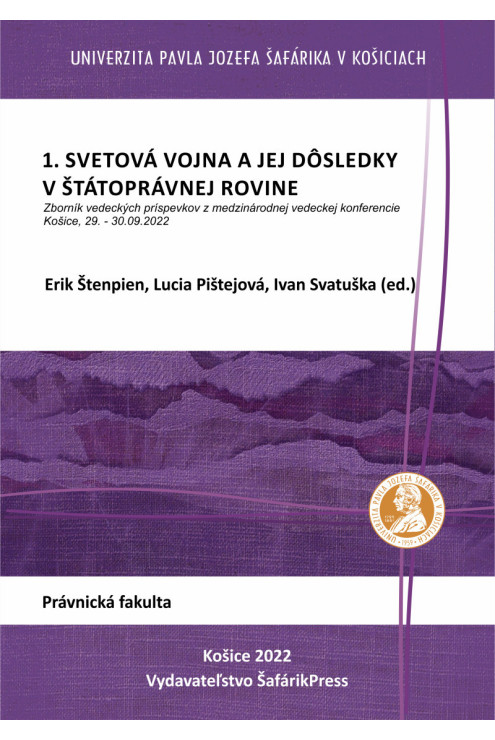
The presented publication is the proceedings of the international conference held on 29.-30. September 2022 in Košice as an output of the grant project APVV-19-0419.
The ambition of the project is to try to reconcile legal and general historians from Slovakia and Hungary in the difficult topic of looking at the Treaty of Trianon from 1920. The conference, held on 29.-30. September 2022 was the third in a series of conferences that for the purpose of assisting in the achievement of said goal. It was attended by legal historians and positive lawyers from several Central European countries. So let the collection serve as another step towards understanding between nations.
Download e-book for free (pdf)

Data sheet
E-book
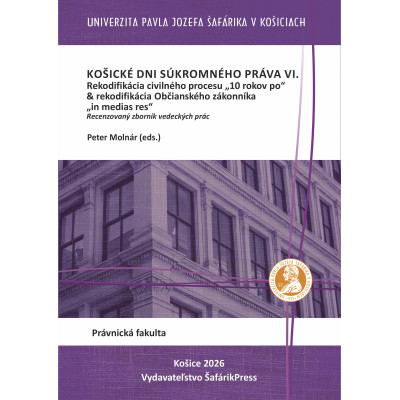
Peter Molnár Miroslava Kušníriková Michal Bartko Júlia Krajčírová Marek Kohút
The peer‑reviewed proceedings of the international scientific conference Košice Days of Private Law VI, held on 22–24 April 2026, represent a partial output of research projects approved by the Scientific Grant Agency of the Ministry of Education, Science, Research and Sport of the Slovak Republic and the Slovak Academy of Sciences (VEGA). The publication results from the projects VEGA No. 1/0492/26, entitled “The Concept of Civil Litigation and Individual Types of Actions under the Civil Dispute Procedure Code – Findings, Challenges, Perspectives”, and VEGA No. 1/0501/26, entitled “Trustworthy Online Space: Protection of the Minor Consumer in the European Digital Market”.
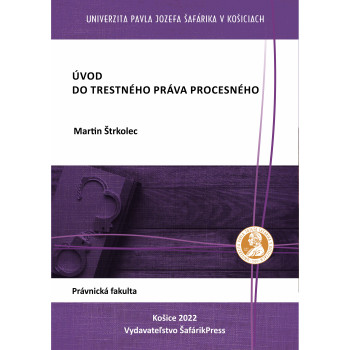
E-book
Anotation Within the university textbook, the author focuses on the introduction to the criminal law of procedural and criminal proceedings, especially in terms of its purpose, individual parts and stages, subjects, procedural acts, decisions, as well as the costs of criminal proceedings. This publication is intended for easier orientation in the basics of criminal procedural law, on which it is possible to build qualified knowledge within the following legal branches or legal institutes. The methodology presented in the publication represents a concentrated form of individual provisions of the relevant generally binding legal regulations, while arguments of criminal law doctrine.
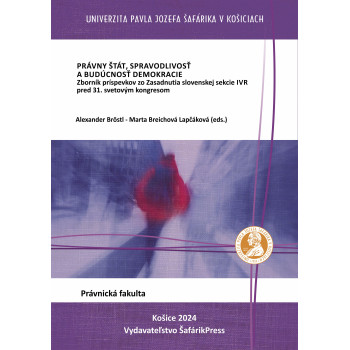
E-book
Alexander Bröstl - Marta Breichová Lapčáková (eds.)
Collection of papers from session of the slovak section of the IVR
In accordance with its name, the collection is devoted to three framework areas consisting of the rule of law, justice and the future of democracy, reflecting the focus of the 31st World Congress of the International Association for the Philosophy of Law and Social Philosophy (IVR). Published contributions of the slovak section of the IVR are devoted to the present questions of the rule of law in relation to the democratic legal state. Principles of the rule of law and present questions connected to the democratic character of the Slovak republic, including the democratic procedures on the local level, are juxtaposed with shifts on the international and global scene. Individual contributions are thus devoted to the technical and biotechnological challenges of contemporary democracy, the manifestation of game theory in the search for consensus in collegial judicial bodies, or to the concept of loyal opposition in the ongoing judicial dialogue surrounding the application of law in the european legal space. Space is also devoted to the universal questions of the nature of legal science, and to the present and future of the rule of law. The collection thus goes beyond the borders of the slovak legal space and aims to understand current trends in a broader context.