Filter By

Categories

Categories

Selections

Selections

Year of publication:

Year of publication:

Publication language:

Publication language:

Faculty:

Faculty:

Method of publication:

Method of publication:

Active filters

  • Year of publication:: 2015
  • Year of publication:: 2019
  • Year of publication:: 2019
  • Year of publication:: 2019
  • Year of publication:: 2019
  • Year of publication:: 2019
  • Year of publication:: 2019
  • Year of publication:: 2019
  • Year of publication:: 2019
  • Year of publication:: 2019
  • Year of publication:: 2019
  • Year of publication:: 2019
  • Year of publication:: 2019
  • Year of publication:: 2019
  • Year of publication:: 2022
  • Year of publication:: 2022
  • Year of publication:: 2022
  • Year of publication:: 2022
  • Year of publication:: 2026
  • Year of publication:: 2026
  • Year of publication:: 2026
  • Faculty:: Faculty of Arts
Študentská vedecká konferencia XIV.
  • New

Študentská vedecká konferencia XIV.

E-book

E-book
Mikuláš Jančura Maroš Melichárek (eds.)
This conference textbook is published as the output of the 13th annual Student Scientific Conference held in December 2025. The Student Scientific Conference is a selective course included in the curricula of the Department of History at the Faculty of Arts, Pavol Jozef Šafárik University in Košice (FF UPJŠ), which has been organized since 2011. Its primary objective is to provide a platform for Bachelor’s and Master’s students to present fragments of their primary research conducted during the preparation of their final theses. The aim of these proceedings is not only to publish these thematically diverse texts but also to demonstrate a commitment to above-standard pedagogical activities and to provide benefit to university studies. This is reflected, on the one hand, in the form of a published output and, on the other, in the motivation it provides for students to actively participate in the event. This year's volume contains twelve texts with a chronological scope ranging from Antiquity to 20th-century history. Thematically, it covers a broad spectrum, from political and economic to cultural history. A specific feature of this volume is the inclusion of four international papers by students from the Cardinal Stefan Wyszyński University in Warsaw and Charles University in Prague. Their participation in the conference is the result of established cooperation based on the Erasmus+ Blended Intensive Programme (BIP), which took place in Košice from October 13 to October 17, 2025.
Download the e-book for free (pdf)
Úvodné kapitoly do základných modelov systemickej terapie
  • New

Úvodné kapitoly do základných modelov...

E-book

E-book

Ondrej Kalina

The publication provides a systematic overview of the core models of systemic therapy and its theoretical as well as practical foundations. The opening chapters of the textbook outline the historical development of psychotherapeutic approaches and the shift toward the systemic paradigm, which emphasizes the importance of relationships, context, and circularity in understanding psychological phenomena.

The core of the text focuses on the philosophical foundations of systemic therapy, particularly general systems theory, cybernetics, constructivism, and social constructionism, all of which have significantly shaped the understanding of reality, knowledge, and the therapeutic process. Subsequent chapters address biological and social foundations, including the concepts of autopoiesis, cognition, and communication, and their relevance to the functioning of social systems. The publication further elaborates on the practical implications of these theoretical frameworks, especially in relation to causality, language, and the construction of social reality. Systemic understanding of problems is presented as a dynamic and relational process maintained through interactional patterns within the system.

Download the e-book for free (pdf)
Slovenčina pre zubárov

Slovenčina pre zubárov

€22.00
Availability: 49 In Stock

Beáta Jurečková 

Slovak for Dentists is a textbook intended for international dental students preparing to communicate professionally in Slovak in a real dental environment. The second, expanded and revised edition is the result of several years of practical use and feedback from students. In terms of content and structure, the textbook focuses on developing all language skills, with particular emphasis on understanding spoken language and oral communication in dentist–patient interactions. The textbook contains 14 lessons, including two review test lessons, as well as a Slovak–English dictionary, an answer key, and six appendices. Compared to the first edition, this version includes updated dialogues in audio format, new texts, revised exercises, and a redesigned layout. The vocabulary is specifically focused on the field of dentistry and the most frequent communication situations in a dental office. The textbook reflects different levels of students’ Slovak language proficiency and also offers additional texts for more advanced learners. The lessons include grammar boxes with practical explanations for learners of Slovak as a foreign language. The publication is primarily intended for classroom use but also allows for effective self-study. The aim of the textbook is to support students in mastering practical communication in a dental clinic

Občianstvo v kontexte etiky starostlivosti

Občianstvo v kontexte etiky starostlivosti

E-book

E-book

Adriana Jesenková

The textbook Citizenship in the Context of the Ethics of Care seeks to introduce students of the humanities and social sciences to current issues of citizenship from the perspective of a specific moral-philosophical theory—namely, feminist moral philosophy, specifically the feminist ethics of care. Traditionally, the topic of citizenship and its related questions have been perceived and studied primarily as subjects of political thought and political theory.

We predominantly consider citizenship as a political category, which is mainly the domain of political science or, at most, other social science disciplines. However, both the past and the present urge us to reflect on citizenship in connection with humanity and solidarity, and thus from a moral perspective. Understanding citizenship solely as a political category and political institution is insufficient. The conceptual separation of politics from morality and ethics results in difficulties in grasping citizenship as a morally relevant category and as an ethical value. This, in turn, prevents us from critically analyzing the assumptions underlying our understanding of citizenship and, ultimately, from identifying the causes and factors that contribute to the failures of civil society, as well as the shortcomings and deficits in the realization of citizenship as a vision based on freedom, equality, and solidarity.

Thus, the textbook clarifies the values associated with democratic citizenship, while also highlighting the potential of the feminist ethics of care as an analytical, evaluative-critical, and applicative tool for understanding and examining the concept of citizenship and the practice of citizenship as a caring practice, and as the practice of caring for a good life in civil society.

Download the e-book for free (pdf)
Význam a úloha aktívneho občianstva v kontexte eliminácie nárastu politického extrémizmu

Význam a úloha aktívneho občianstva v kontexte...

E-book

E-book

Alexander OnufrákJán Ruman - Jana Šutajová - Peter Getlík

The presented textbook aims to introduce students to the issue of political extremism from various perspectives—namely, normative, historical, and discursive-empirical.

It addresses the significance and role of active citizenship, which, as one of several potential solutions, has the capacity to a certain extent to eliminate the rise of manifestations of political extremism in society by deepening democratic principles in practice.

The presented textbook is a direct output of the KEGA grant project "Innovative Model of Education Leading to Active Citizenship as a Prevention of the Rise of Political Extremism among Students" (014UPJŠ-4/2020). The principal investigator of the project is Assoc. Prof. Mgr. Gabriel Eštok, PhD. The project was carried out in the years 2020–2022.

Download e-book for free (pdf)

Výmena obyvateľstva medzi Československom a Maďarskom (v rokovaniach Československo-maďarskej zmiešanej komisie)

Výmena obyvateľstva medzi Československom a...

E-book

E-book

Štefan ŠutajJana Šutajová

The population exchange between Czechoslovakia and Hungary was carried out on the basis of the Agreement on the Exchange of Populations between Czechoslovakia and Hungary, which was signed on February 27, 1946. Its adoption was not only part of Czechoslovak solutions to the status of national minorities, but also part of the strategic concept of building a state of Czechs and Slovaks without Germans and Hungarians.

The agreement was part of the postwar resolution of mutual disputes and misunderstandings and was intended to be one of the solutions that, in the postwar period, would eliminate a factor which, according to Czechoslovak political leaders, had caused the war conflict.

The population exchange between Czechoslovakia and Hungary was therefore not an isolated historical event, but part of migratory movements that had begun in Europe already after the First World War, and can be seen as a continuation of previous developments as part of migration patterns in Europe.

Download e-book for free (pdf)

Občianstvo Európskej únie

Občianstvo Európskej únie

E-book

E-book

Gabriel Eštok

The university textbook Citizenship of the European Union is structured into four parts. The first chapter focuses on the characteristics of citizenship in a historical context (concepts of citizenship in the ancient, medieval and modern periods).

The second chapter deals with a theoretical introduction to citizenship. It comes up with the characteristics of citizenship, introduces the ways of acquiring and losing citizenship and the transformations of citizenship in the context of globalization and multiculturalism.

The third chapter focuses on European Union citizenship itself, its historical development and the process of introducing and strengthening citizenship in the European Union.

The fourth chapter presents the specific rights of citizens deriving from European Union citizenship - the right to free movement, the right to vote and stand as a candidate in municipal and European Parliament elections, the right to diplomatic and consular protection in the territory of a third country, the right to petition the institutions of the European Union, the right of access to documents of the institutions and bodies of the Union, and the right of initiative of the citizens of the European Union.

Download e-book for free (pdf)

Študentská vedecká konferencia X. Zborník príspevkov.

Študentská vedecká konferencia X. Zborník...

E-book

E-book

Mikuláš Jančura - Maroš Melichárek (eds.)

The Student Scientific Conference is defined as a compulsory elective subject within the accredited study programs of the Department of History at the Faculty of Arts, UPJŠ. It was organized for the first time at the department in 2011.

The primary goal of this already traditional event is the presentation of partial results of student-authored research, primarily linked to selected factual parts or theoretical foundations of bachelor’s and master’s theses. This also explains the broad thematic spectrum of the internal content of each conference. Besides awarding credits for participation, the conference offers students a range of added values, which can be understood as its secondary objectives.

On this basis, as organizers, we considered it beneficial to qualitatively elevate the “round” anniversary edition of the Student Scientific Conference and give students the opportunity to publish their contributions. Within the submitted proceedings, 7 texts are published, of which 4 are from the bachelor’s level and 3 from the master’s level of study. The contributions cover a wider spectrum, mainly cultural-historical topics spanning from the Early Middle Ages to the second half of the 20th century, which also demonstrates the wide range of thesis topics processed at the department.

As organizers of the event, we have the ambition for publishing the proceedings to become as much a tradition as the Student Scientific Conference itself, as we consider this meaningful in relation to our work with students. Last but not least, we would like to express our gratitude to our colleague and friend Mgr. Henrich Hrehor, PhD., who has been the long-term main organizer and the “spiritual father” of the entire event since 2011. Thanks are also due to the head of the department for annual support and to the colleagues who undertook the reviewing of contributions within the submitted proceedings.

Download the e-book for free (pdf)
Pandémia & demokracia. Budúcnosť demokracie v postcovidovej dobe

Pandémia & demokracia. Budúcnosť demokracie v...

E-book

E-book

Barbora Linhartová - Peter Dubóczi - Dávid Gajdoščík (eds.)

Proceedings of the Xth Annual International Scientific Conference of Students and Young Researchers organized on October 1, 2021, by the Department of Political Science of the Faculty of Arts at Pavol Jozef Šafárik University in Košice, in cooperation with the Institute of Political Science and Public Administration of the Faculty of Political Science and Journalism at Maria Curie-Skłodowska University in Lublin, the Institute of Social Studies of the Faculty of Regional Development and International Studies at Mendel University in Brno, the Department of Political Science of the Faculty of Arts at the University of Miskolc, and the Res Publica Civic Association.

DOWNLOAD THE E-BOOK FOR FREE (pdf)

Politické systémy štátov BRICS

Politické systémy štátov BRICS

E-book

E-book

Patrik Furik Michaela RužičkováDávid GajdoščíkPeter DubócziBarbora LinhartováLucia Grieger

The textbook entitled Political Systems of the BRICS States is published as an output of the KEGA 014UPJŠ-4/2020 Innovative Model of Education Leading to Active Citizenship as a Prevention of the Rise of Political Extremism among Students. The aim of the given publication is to present the basic principles of the political systems of the BRICS bloc states and to provide the reader with the nature and character of the bloc's functioning.

The textbook consists of an introduction and five further chapters. All sections are written in Slovak. The individual chapters focus primarily on characterizing the historical development of the BRICS states, the evolution of their constitutionalism, public administration, and on defining the legislative, executive, and judicial branches of power

The individual chapters describe the political systems of the states: Brazil, the Russian Federation, India, China, and South Africa. The introductory chapter of the textbook contains the characteristics of the development and formation of the bloc, as well as information on the cooperation among the BRICS members.

Download the e-book for free (pdf)
Čínska mäkká moc a slovenská skúsenosť

Čínska mäkká moc a slovenská skúsenosť

E-book

E-book

Tomáš Dvorský

The attention devoted to the issue of Chinese activity is highly relevant. Creating a positive reputation abroad is a legitimate tool of every state in its effort to generate influence. The People's Republic of China has been very successful in this regard since the beginning of the millennium, which has allowed it to start occupying positions in the international system that it legitimately claims based on its own history, size, and potential.

Examples from abroad also highlight the fact that Chinese foreign policy should not be accepted uncritically and deserves a cautious approach and thoughtful discussion. All of this must be done while respecting not only China's particularity but also taking into account the realities of the great power rivalry visible at the beginning of the 21st century.

In this context, one cannot abstract from a detailed look at Chinese soft power as one of the key tools for generating influence in the world. Understanding it is an essential prerequisite for a relevant evaluation of the practices and motivations of China's foreign policy, while it can also serve as a guideline in the effort to create an adequate approach toward this resurgent global great power.

Download the e-book for free (pdf)
Pohyb ku kognitívnym adaptačným štúdiám. Adaptácia ako hra

Pohyb ku kognitívnym adaptačným štúdiám....

E-book

E-book

Peter Getlík

The main goal of the monograph "Moving Towards Cognitive Adaptation Studies: Adaptation as Play" was to orient current research in adaptation studies towards the empirically responsible cognitive branch of non-radical constructivism.

This intention results from the rapid progressive differentiation of adaptation studies research, which has mainly manifested itself in this area in the last two decades. With the model of adaptation as play in a cognitive-scientific perspective, author provides the possibility of predicting the nature (also in a broader sense) of the experience of adaptation. Since the form of this experience significantly shapes the products of the adaptation process into their final form, the model of adaptation as play can be applied even in the interpretation of individual adaptations. In the monograph, the author synthesized the model of adaptation as play based on the knowledge of various disciplines. In the field of cognitive sciences, he saw help from the starting points of philosophy, linguistics, informatics, psychology, anthropology, biology and neuroscience – especially affective neuroscience, which also deals with the emotional dimension of the play.

In the intersection with the essential interdisciplinary components of adaptation research, he also used the knowledge of classical and cognitive variations of literary science, film science (also theatrology) and media studies to a large extent. Consistent with other similar results of cognitive sciences, it turns out that even seemingly serious adaptations, like in many aspects of our culture, have a ludic base.

Download the e-book for free  (pdf)
American Ethnic Literatures and Cultures

American Ethnic Literatures and Cultures

E-book

E-book

Zuzana BurákováPetra Filipová

The canon of American literature has undergone constant revision with many authors who were long excluded from wider recognition now being accepted as significant figures. With the emergence of postcolonial and ethnic studies after the 1960s, the diversity of the literary canon has become greater than ever, and we can now see American literature as remarkably distinctive in this respect.

The question of how to define ethnicity and how far an immigrant should go to preserve their ethnic heritage have always been addressed by writers, together with larger issues such as the definition of national identity and national literature, and where we should draw the lines between local and global identities. We understand that a single course in American ethnic literature cannot hope to answer all these complex questions, but we firmly believe that discussing these questions in classes can help us to be more understanding and tolerant of ethnic diversity.

For this reason, the main aim of this textbook is to provide an interdisciplinary introduction to American ethnic literatures with an emphasis on their historical and cultural background, to expand students’ knowledge of American literatures and cultures at the master’s level and familiarize them with specific features of ethnic literatures in the contemporary USA. The textbook contains information on Native American, African American, Asian American, Jewish American, and Hispanic American literature, history and culture.

Download e-book for free (pdf)

VARIA XXXI

VARIA XXXI

E-book

E-book

Katarína GajdošováLucia Jasinská

Book of Abstracts from the XXXI Colloquium of Young Linguists (Danišovce, November 30 – December 1, 2022)

In the present book of abstracts from the 31st Colloquium of Young Linguists, VARIA XXXI, we offer readers an overview of the current research efforts of its participants. The volume contains 23 thematically and methodologically diverse contributions by 24 authors from Slovak as well as Czech linguistic institutions. From the perspective of language components, the book includes abstracts from the fields of corpus linguistics, onomastics, morphology, dialectology, syntax, stylistics, lexicology, phraseology, didactics, and also with overlaps into literary texts.

Download e-book for free (pdf)

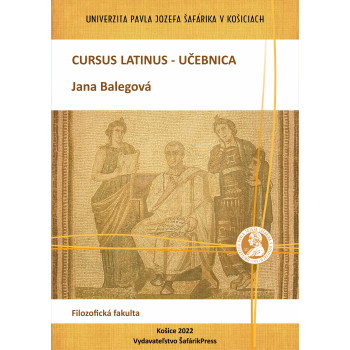
Cursus Latinus - učebnica

Cursus Latinus - učebnica

E-book

E-book

Jana Balegová

University textbook „Cursus Latinus - textbook“ is intended for students of the study program Latin language and literature. It is divided into „Introduction“ and 37 lessons. The content of lessons is morphology, sentence syntax and selected phenomena of case syntax of the Latin language. Each of the lessons contains a grammatical explanation, followed by sentences designed to demonstrate the forms of grammatical phenomena and the required vocabulary (Dictionary). Using these examples, students learn the basic principles of translation from Latin into Slovak and from Slovak into Latin. The textbook also includes a Latin-Slovak dictionary containing the entire vocabulary used in the textbook. The „Cursus Latinus - textbook“ is intended for the interpretation of grammar and the acquisition of grammatical phenomena of the Latin language under the guidance of the teacher. A parallel exercise book (Cursus Latinus – exercise book) is used to practice Latin grammar at home. The exercise book includes a key to the exercises and a Latin-Slovak dictionary containing vocabulary from the textbook and the exercise book. University textbook „Cursus Latinus - textbook“ is available electronically in PDF format.

Download the e-book for free  (pdf)
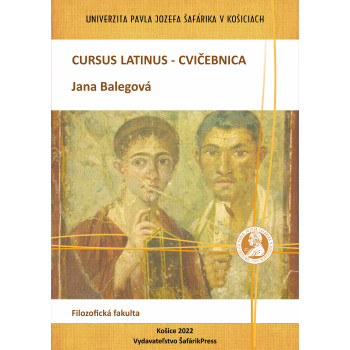
Cursus Latinus - cvičebnica

Cursus Latinus - cvičebnica

E-book

E-book

Jana Balegová

The university textbook „Cursus Latinus – exercise book“ is a parallel study material to the textbook „Cursus Latinus – textbook“. It is designed for practicing grammar at home. The content of the exercises corresponds in its focus to the lessons of the mentioned textbook, both in terms of the grammatical phenomena, as well as the vocabulary. For this reason, only vocabulary that was not included in the lessons of the textbook is included in the exercises. The Latin-Slovak dictionary at the end of the exercise book contains the entire vocabulary from the exercise book and the textbook. Part of the exercise book is a key that allows students to immediately check the correctness of their work. „Cursus Latinus - exercise book“ is available electronically in PDF format.

Download the e-book for free  (pdf)
Úvod do klinickej psychológie

Úvod do klinickej psychológie

E-book

E-book

Monika Hricová

Introduction to clinical psychology is designed as a teaching text. It is intended primarily for students of psychology at the bachelor degree. The publication offers the basic knowledge needed in the study of clinical psychology. It represents the theoretical basis for the following courses Clinical Psychology, Psychodiagnostics and Psychotherapy in the master's degree.

The text is divided into two parts. The first part deals with general issues of clinical psychology: its parts, history, professional practice of clinical psychologist, classification of mental disorders, or the specifics of research in clinical psychology. It covers also the topics of ethical work and the conditions of education of future clinical psychologists. The second part is focused on the issue of clinical-psychological practice in psychodiagnostics, the specifics of clinical-psychological work with patients with somatic diseases and disabilities. The publication does not describe psychopathology, psychodiagnostics and psychotherapy of mental disorders.

The aim of the publication is to acquaint students with the basic general knowledge necessary for building knowledge in the field of clinical psychology and its practice. To offer the necessary theoretical and practical basis for follow-up clinical psychological subjects and follow-up study in this area.

Download the e-book for free (pdf)
Metanoia v teórii a praxi sociálnej práce

Metanoia v teórii a praxi sociálnej práce

E-book

E-book

Eva ŽiakováTomáš Šeďo (eds.)

Peer-reviewed collection of contributions from an online scientific conference (9th year of Košické dni sociálnej práce) with international attendance held on the 26th of November 2021.

The present peer-reviewed collection of contributions titled “Metanoia in social work theory and practice” is an output of the 9th year of Košické dni sociálnej práce, an online conference with international attendance held on the 26th of November 2021. As the name of the conference implies, the pivotal topic of submitted contributions is metanoia, which represents a change in life attitude. Various interesting and actual issues concerning diverse aspects of social work are discussed in the individual contributions.

The present collection comprises contributions oriented towards the issues of social pathology and its prevention, supervision, the importance of digital technologies in social work, research methods, self-care and so forth. The collection further contains several contributions devoted to the exceptionally actual issues of radicalism and extremism, which are widespread and serious occurrences in the present time. The contributions are highly original and beneficial from the point of view of theoretical conceptions and methodological procedures apart from offering quality empirical processing and interesting results.

Download the e-book for free (pdf)
Comparative Phonetics and Phonology of the English and the Slovak Language

Comparative Phonetics and Phonology of the...

E-book

E-book

Renáta Gregová

The book is primary designed for the first-year students of the study programme “English Language for European Institutions and Economy” and its subject “Comparative Phonetics and Phonology”. Following the structure of this subject, the textbook is divided into eleven chapters whose content provides the reader with the essential theoretical information about the given issue from the sound subsystems of the English and the Slovak languages. The structure of each chapter is as follows: (1) theoretical explanation of the topic, (2) Suggestions for further reading recommending additional sources that develop the topic, (3) exercises whose aim is to evaluate students’ theoretical knowledge of the theme presented in the particular chapter, as well as its practical application in the process of communication. Considering the content of the book, it can be also used a study material for the students of all philological study programmes whose content encompasses the sound system of the English and/or the Slovak language.

Download the e-book for free  (pdf)
Poznanie, spoločnosť, dejiny. Stretnutie mladých historikov XI.

Poznanie, spoločnosť, dejiny. Stretnutie...

E-book

E-book

Miriama Filčáková (ed.)

Proceedings of the 11th Scientific Conference of Young Historians, organized by the Department of History at the Faculty of Arts, Pavol Jozef Šafárik University in Košice, in cooperation with the Slovak Historical Society at the Slovak Academy of Sciences, on October 19-20, 2021.

Currently, these histories are often presented as an extension of the history of science. The history of knowledge not only expands the boundaries of the history of science but also explores the boundaries between different forms of knowledge and ignorance. Just as studies of historical memory have expanded and complemented their interest in researching forgetting, the history of knowledge includes studies of ignorance. They focus on the change that has occurred over the past decades: from the sacralization of science and respect for professional knowledge to the rejection of science and constant questioning of professional knowledge, to which the history of knowledge must also respond. Findings as a product form the basis of human interactions and have their own past. What was the significance of knowledge and cognition in different historical periods? How did state power influence the development of knowledge and cognition? What can be considered knowledge in a particular historical era or culture? Finally, is there any human activity that cannot be considered knowledge?

Currently, in the field of the history of knowledge, a significant surge in research, publishing, and the emergence of new institutions can be observed. The eleventh doctoral conference—Meeting of Young Historians XI, organized by the Department of History at Pavol Jozef Šafárik University in cooperation with the Slovak Historical Society at the Slovak Academy of Sciences—will contribute to expanding the perspective on the past of knowledge and cognition. The conference, intended for Slovak and foreign doctoral students, aims to provide a space for presenting the latest results of scientific research, professional discussion, establishing contacts, developing cooperation, and exchanging experiences among the broader historical community. The starting point for the conference is a peer-reviewed proceedings volume consisting of publication outputs from active participants.

Download the e-book for free  (pdf)
e-Slovenčina pre zubárov v praxi – kazuistiky

e-Slovenčina pre zubárov v praxi – kazuistiky

E-book

E-book

Beáta JurečkováLívia Barnišinová

The e-Slovak textbook for dentists in practice - case studies is intended for foreign students of dentistry. It is primarily intended for students of the Slovak language as a foreign language, but the knowledge of the grammatical and lexical basics of the Slovak language at the A1, A2 level is needed.

The textbook consists of eight lessons, which are focused on listening comprehension (audio recordings), vocabulary expansion, systematisation of grammar and development of speech skills (case studies). The two lessons consist of repetitive, concluding exercises. The primary goal of the textbook is to connect language training with professional dental practice.

Download the e-book for free  (pdf)
Hovorové lexémy v publicistických textoch

Hovorové lexémy v publicistických textoch

E-book

E-book

Lucia Jasinská

The submitted monograph, "Colloquial Lexemes in Journalistic Texts," presents an original perspective on the analysis and description of lexical and grammatical expressive means in the examined communication field.

The main research problem is the colloquialization of expressive means as a marked feature in publicly published journalistic texts. The starting point of the research itself was the search for lexical units with the stylistic qualifier of colloquiality in the "Short Dictionary of the Slovak Language." Their presence and frequency, as well as any potential shifts in meaning, were verified in publicly accessible media communications.

Since this is research into "living language," the source material consists of journalistic texts in the Slovak National Corpus database.

Download the e-book for free (pdf)
Časopis ŽIVENA v rokoch 1919 – 1928

Časopis ŽIVENA v rokoch 1919 – 1928

E-book

E-book

Ivica Hajdučeková

The anthology was created based on the study of archival volumes of Živena preserved in the Slovak National Library in Martin and the selection of material representing samples of texts that reflect the spirit of the times and contribute to the image of the contemporary modern woman.

The selection of articles from 1919 to 1928 uncovers the cultural atmosphere at the beginning of the 20th century when, thanks to emancipation efforts, doors were opening for women into public and professional life. Students from the 3rd and 4th years of the School of Applied Arts in Košice, under the guidance of teachers in photographic design and Slovak language and literature, were involved in preparing the illustrative component of the anthology, whose artistic interpretations are part of the publication. Their contribution meets the criteria for combining science and practice with a focus on popularizing research results.

Download e-book for free (pdf)
Literárny príbeh ako nástroj mravnej výchovy

Literárny príbeh ako nástroj mravnej výchovy

E-book

E-book

Adriana Jesenková

The textbook "Literary Story as a Tool for Moral Education" aims to contribute to the preparation of future teachers of ethical education, as well as students from other fields, particularly in the humanities. It focuses on an area that remains trivialized and marginalized—gender-sensitive education and training. The author operates under the assumption that applying a gender-sensitive approach in education requires an understanding of what a gender perspective entails.

Experience from interdisciplinary and transdisciplinary research, along with teaching experiences where ethical questions and themes—such as those related to gender, gender equality, gender justice, and gender relations—are presented, taught, and explored through various media or texts (not only traditional scientific and professional ones but also artistic, especially literary), inspired the author to present such an approach in a relatively coherent form.

This includes summarizing existing knowledge and experiences on the topic so that they can serve as a suitable starting point for enhancing the competencies of future teachers (not only) in ethical education when applying a gender-sensitive approach in education and teaching issues related to gender and gender relations in the context of applied ethics and ethical education.

Autor

Download the e-book for free (pdf)

GENDER PERSPECTIVES IN SLOVAK LITERATURE OF THE LATE 19th AND EARLY 20th CENTURIES (Interpretation Studies)

GENDER PERSPECTIVES IN SLOVAK LITERATURE OF THE...

E-book

E-book

Ivica Hajdučeková

The second (supplemented and expanded) edition of the bilingual textbook Rodový aspekt v slovenskej literatúre na prelome 19. a 20. storočia (Interpretačné etudy) / Gender Perspectives in the Slovak Literature of the Late 19th and Early 20th Centuries (Interpretation Studies) offers to a wider range of recipients – students of Teaching of Academic Subjects and teachers in practice – a didactic transformation of current research issues (supported by e-literacy using online approaches and QR codes), which was developed in cooperation with the School of Applied Arts in Košice (since 2019/20 the so-called School of Art Industry) ) in the academic year 2018/2019.

Professional cooperation within the KEGA project No. 008UPJŠ-4/2017 – Science Without Barriers (Interdisciplinary Inspirations of Contemporary Literary Scholarship and Linguistics in Educational Practice at University) with teacher of Slovak Language and Literature, PaedDr. Jana Valicová, and Mgr. Renáta Novotná Markovičová of ŠUP took place in project teaching. It yielded results in two interdisciplinary outcomes:

1. Creation of the Literary Lounge in the Student Café Minerva in the premises of the UPJŠ Faculty of Arts;

2. Illustrations of the 2nd edition of the textbook Gender Aspect in the Slovak Literature at the Turn of the 19th and the 20th Centuries (2019).

Download the e-book for free (pdf)
Jazyková kultúra nielen pre lingvistov (vybrané javy)

Jazyková kultúra nielen pre lingvistov (vybrané...

E-book

E-book

Iveta BónováLucia Jasinská

Language culture is not only for linguists; it is a professional publication suitable as a textbook, in which we attempt to describe and explain the most frequent phenomena of speech practice in an innovative way.

These phenomena are observed not only in the media environment but also in the academic sphere, which, with regard to the communication sphere (mass media communication, scientific research), are often used incorrectly and thus subconsciously penetrate the language awareness of all language users.

This includes those for whom language is a working tool with a primarily representative function (teachers at all levels of schools or radio and television workers).

Download the e-book for free (pdf)
Lingua Latina – cvičebnica pre historikov

Lingua Latina – cvičebnica pre historikov

E-book

E-book

Jana Balegová

University textbook Lingua Latina – Exercise Book for Historians is a parallel study material to the textbook Lingua Latina – Cursus Communis. It is designed for practicing grammar at home. The content of the exercises corresponds to the focus of the individual lessons in the mentioned textbook, both in terms of the covered grammatical phenomena and vocabulary. For this reason, only vocabulary not covered in the textbook's lessons is included in the exercises.

The Latin-Slovak dictionary at the end of the exercise book contains all the vocabulary from both the exercise book and the textbook. The Slovak-Latin dictionary includes the vocabulary from exercises that require translation into Latin. The vocabulary in this exercise book is oriented towards the needs of history students and, given the selection of source materials, also includes non-classical lexicon or non-classical meanings of classical words (this lexicon is marked with the symbol *).

The exercise book includes a key that allows students to directly verify the correctness of their work. The textbook Lingua Latina – Exercise Book for Historians is available electronically in PDF format. As part of the teaching program, online tests available on the KKF FF UPJŠ website (https://www.upjs.sk/filozoficka-fakulta/katedra-klasickejfilologie/katedra/) also serve to practice the covered material.

Download the e-book for free (pdf)
Lingua Latina – cvičebnica pre filológov

Lingua Latina – cvičebnica pre filológov

E-book

E-book

Jana BalegováAnabela Katreničová

The university textbook Lingua Latina – a workbook for philologists is a parallel study material to the textbook Lingua Latina – cursus communis. It is designed for practicing grammatical material at home. The content of the exercises corresponds to the focus of individual lessons in the mentioned textbook, both in terms of the covered grammatical phenomena and vocabulary. For this reason, only vocabulary that was not part of the lessons covered in the textbook is included in the exercises.

A Latin-Slovak dictionary at the end of the workbook contains the entire vocabulary from both the workbook and the textbook. A Slovak-Latin dictionary includes the vocabulary from exercises that require translation into Latin. The vocabulary of this workbook is oriented towards the needs of students specializing in philology and, with regard to the selection of source materials, also includes non-classical lexicon or non-classical meanings of classical words (this lexicon is marked with an asterisk). The workbook includes a key that allows students to directly verify the correctness of their work.

The textbook Lingua Latina – a workbook for philologists is available electronically in PDF format. As part of the educational program, online tests available on the KKF FF UPJŠ website (https://www.upjs.sk/filozoficka-fakulta/katedra-klasickejfilologie/katedra/) also serve to practice the covered material.

Download the e-book for free (pdf)
Lingua Latina – cvičebnica pre filozofov

Lingua Latina – cvičebnica pre filozofov

E-book

E-book

Jana BalegováFrantišek Šimon

The university textbook "Lingua Latina – Exercise Book for Philosophers" is a parallel study material to the textbook "Lingua Latina – Cursus Communis." It is designed for practicing grammatical lessons at home. The content of the exercises corresponds to the focus of each lesson in the mentioned textbook, both in terms of the covered grammatical phenomena and vocabulary. For this reason, only vocabulary not included in the lessons of the textbook is presented in the exercises.

The Latin-Slovak dictionary at the end of the exercise book contains the entire vocabulary from both the exercise book and the textbook, while the Slovak-Latin dictionary includes the vocabulary from exercises that require translation into Latin. The vocabulary in this exercise book is oriented towards the needs of philosophy students and, with regard to the selection of source materials, also includes non-classical lexicon or non-classical meanings of classical words (this lexicon is marked with an asterisk *).

The exercise book includes a key that allows students to directly verify the correctness of their work. The textbook "Lingua Latina – Exercise Book for Philosophers" is available electronically in PDF format. As part of the educational program, online tests available on the website of the Department of Classical Philology at the Faculty of Arts, UPJŠ (https://www.upjs.sk/filozoficka-fakulta/katedra-klasickejfilologie/katedra/) also serve to practice the covered material.

Download the e-book for free (pdf)
Lingua Latina – cursus communis

Lingua Latina – cursus communis

E-book

E-book

Jana Balegová

The university textbook Lingua Latina – cursus communis is designed for students of all study programs at the Faculty of Arts, where Latin is included as a subject related to the main field of study or specialization (history, philosophy, philological specializations, etc.).

The textbook contains Latin grammar, exercise sentences intended for practicing the grammatical phenomena covered in seminars under the guidance of an instructor, and a Latin-Slovak dictionary. To practice Latin grammar at home, parallel workbooks are available, which are tailored to meet the needs of students from specific study fields and specializations (e.g., Lingua Latina – workbook for historians, Lingua Latina – workbook for philosophers, Lingua Latina – workbook for philologists).

The textbook Lingua Latina – cursus communis is accessible electronically in PDF format. As part of the educational program, online tests available on the KKF FF UPJŠ website serve to reinforce the learned material. This textbook is a product of the grant project KEGA 010UPJŠ-4/2017.

Download the e-book for free (pdf)
Veda bez bariér

Veda bez bariér

E-book

E-book

Iveta BónováIvica HajdučekováLucia Jasinská (eds.)

The proceedings maps three significant events organised in 2018 – 2019 within the project KEGA No. 008UPJŠ-4/2017 Science without barriers (Interdisciplinary inspirations of contemporary literary scholarship and linguistics in university educational practice; principal investigator prof. PhDr. J. Gbúr, CSc.) at the Department of Slovak Studies, Slavonic Philologies and Communication, Faculty of Arts, Pavol Jozef Šafárik University in Košice.

The first activity was a scholarly and artistic symposium Science without barriers held in March 6 – 8, 2019 on the occassion of the 80th birthday of Dr. h. c. prof. PhDr. Ján Sabol, DrSc. It brought extended abstracts of participants in two sections (Slovak studies and literary scholarship in interdisciplinary contexts) as its outcome. The next two parts describe artistically oriented events: Interpretational afternoon (a competition for the best interpretation of Ján Sabol´s book of verse Love in Blue) with the winning works added, and the vernissage Literature through an objective lens with the share of students of the School of Industrial Visual Arts in Košice.

Download the e-book for free (pdf)
This website uses cookies to ensure you get the best experience on our website