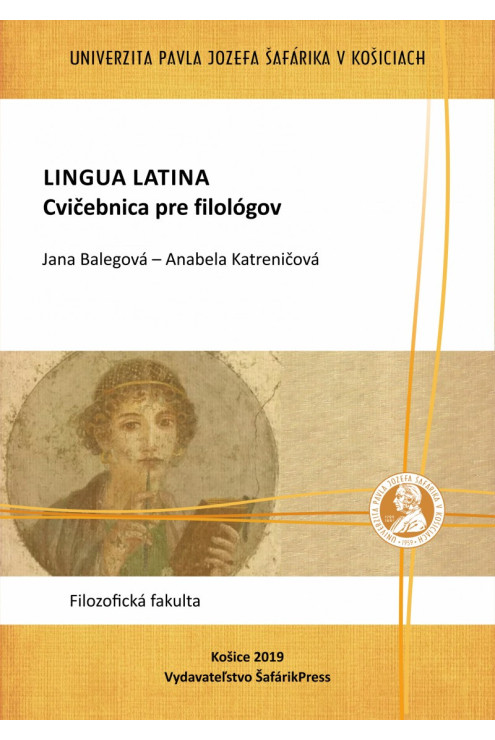
Lingua Latina – cvičebnica pre filológov

E-book

Jana BalegováAnabela Katreničová

The university textbook Lingua Latina – a workbook for philologists is a parallel study material to the textbook Lingua Latina – cursus communis. It is designed for practicing grammatical material at home. The content of the exercises corresponds to the focus of individual lessons in the mentioned textbook, both in terms of the covered grammatical phenomena and vocabulary. For this reason, only vocabulary that was not part of the lessons covered in the textbook is included in the exercises.

A Latin-Slovak dictionary at the end of the workbook contains the entire vocabulary from both the workbook and the textbook. A Slovak-Latin dictionary includes the vocabulary from exercises that require translation into Latin. The vocabulary of this workbook is oriented towards the needs of students specializing in philology and, with regard to the selection of source materials, also includes non-classical lexicon or non-classical meanings of classical words (this lexicon is marked with an asterisk). The workbook includes a key that allows students to directly verify the correctness of their work.

The textbook Lingua Latina – a workbook for philologists is available electronically in PDF format. As part of the educational program, online tests available on the KKF FF UPJŠ website (https://www.upjs.sk/filozoficka-fakulta/katedra-klasickejfilologie/katedra/) also serve to practice the covered material.

Download the e-book for free (pdf)

Quantity

978-80-8152-812-5

Data sheet

Method of publication:
E-book (pdf)
Authors:
Jana Balegová - Anabela Katreničová
Document type:
Course Notes
Number of pages:
253
Available from:
20.12.2019
Year of publication:
2019
Edition:
1st edition
Publication language:
slovenčina, latinčina
Faculty:
Faculty of Arts
Note:
Učebný text Lingua Latina – cvičebnica filológov je výstupom grantového projektu KEGA 010UPJŠ-4/2017.
- Free for download

16 other products in the same category:

G. W. Leibniz - filozofia raného a stredného obdobia

G. W. Leibniz - filozofia raného a stredného...

E-book

E-book

Martin Škára

The presented university textbook is a reaction to two fundamental shortcomings. The first one is the absence of a similar, if not equivalent, textbook in the Slovak university environment. The second shortcoming is the mistake that Leibniz's philosophy is a system called monadology.

The presented textbook corrects this mistake and at the same time fills the gap of the absence of this kind of textbook with a Leibniz subject. For the above reasons, the presented textbook brings a new perspective on the philosophy of G. W. Leibniz, especially in the period of early philosophical beginnings with an overlap into the so-called Paris period and the De summa rerum period up to the first philosophical doctrinal formulation expressed in the Discours de métaphysique (Winter 1685-1686). The textbook is conceived as a selection of sections of source texts translated by the author of the textbook from French and partly from Latin and equipped with comments accessible to the target audience.

It is therefore the author's wish that this textbook not only serve as a form of correction for the misinterpretation of Leibniz's philosophy, but as an inspiring text that will introduce the reader to the world of Leibniz's philosophy in its undistorted light.

Download e-book for free (pdf)

Mediácia v systéme sociálnej práce

Mediácia v systéme sociálnej práce

E-book

E-book

Dušan ŠlosárVladimír Lichner

This university textbook aims to provide readers with knowledge of the philosophical foundations, meaning, and purpose of mediation, based on research and analysis of mediators' activities. In countries where mediation services operate, their staff often include graduates of social work departments.

An individual approach to both the perpetrator and victim of a criminal offense requires knowledge and skills from social work, psychology, sociology, communication, and related fields tied to social work. The principles of social work apply not only in social policy and social care but also in justice. A mediator’s mission is to facilitate alternative resolutions to unlawful acts while preserving the purpose of legal proceedings as defined by valid legal norms. They fulfill this mission through specific methods of individual social work applied in the justice sector. The mediator’s focus extends beyond the current conflict to uncover related issues, activate parties to resolve disputes, and prevent new conflicts.

Special attention is devoted to the philosophical foundations of mediation in Slovakia. We provide an overview of mediators’ core activities and mediation types used to uphold justice in Slovakia. We analyze mediation goals, the roles of parties involved, and procedural steps. In applying mediation, we explore its potential and implementation in both legal and social work contexts.

As indicated, mediation cannot be understood solely as a specialized activity in criminal justice, as it has broader applications in non-judicial dispute resolution, such as family or community work, which are often overlooked by the public. The mediator’s approach to diverse target groups is grounded in theoretical frameworks. From this foundation, we derive activities expected of mediators in the future. Expanded activities arise from concrete situations encountered during mediation.

Download the e-book for free (pdf)

Basic Concepts of Morphology I.

Basic Concepts of Morphology I.

E-book

E-book

Renáta Panocová

The textbook Basic Concepts of Morphology is an introduction to morphology intended for undergraduate students of British and American Studies and students of English (and French/German) for European Institutions and Economy and other philology studies in Slovakia. The textbook gradually guides students from key terms to concepts and from there to theoretically more challenging phenomena. The textbook is primarily for Slovak students of English, which explains that the majority of the examples presented are English. As the textbook progresses, data from Slovak, German, French, Hungarian and sometimes from slightly more exotic languages are given. It is expected that such an approach will prepare students for carrying out morphological analysis independently.

Download the e-book for free (pdf)

Analýza radikálnych a extrémistických skupín, hnutí, siekt a kultov a ich pôsobenie v Slovenskej republike

Analýza radikálnych a extrémistických skupín,...

E-book

E-book

Vladimír Lichner

The scientific monograph focuses on the analysis of radical and extremist groups, movements, sects and cults and their activities in the Slovak Republic.

It provides a theoretical insight into the issues of specific organizations and movements that have been characterized in the past, or are currently characterized by belonging to ideologies that we might call anti-social.

It does not focus unilaterally on one type of violent extremism, but focuses on the issue of both right-wing and left-wing religious groups. In the final part it offers a brief suggestion of prevention procedures, which could significantly influence the increase of extremist manifestations especially in young people.

Download the e-book for free (pdf)

Slovenčina pre cudzincov (Pracovné listy)

Slovenčina pre cudzincov (Pracovné listy)

E-book

E-book

Marianna Sedláková a kol. 

The worksheets, based on the direct specific needs of teaching medical students in Košice, respect the real situation of teaching Slovak as a foreign language at UPJŠ.

They also reflect the relatively high number of Slavic students, especially from neighboring countries, who, although just beginning with the Slovak language, are at a higher communicative level compared to students from non-Slavic countries. Therefore, a special part of the worksheets with exercises is dedicated to them, which includes special exercises and dictionaries aimed at eliminating Slovak-Polish or Slovak-Ukrainian interference phenomena. Since some non-Slavic students come from the Czech language environment, we also add a glossary of the most common different expressions in Slovak, Czech, and, for the aforementioned reasons, Polish and Ukrainian. In the part intended for all students, both Slavic and non-Slavic, communicatively focused exercises for practicing grammatical phenomena predominantly at the A1 and A2 communication skill levels (according to the Common European Framework of Reference) prevail, and last but not least, exercises thematically focused on medicine and healthcare.

The texts from the thematic area are, of course, supplemented with realia of the city of Košice. As a functional supplement in the working material, we also publish test samples.

Download the e-book for free (pdf)

Betriebswirtschaft für Übersetzer. Lehr- und Übungsbuch

Betriebswirtschaft für Übersetzer. Lehr- und...

E-book

E-book

Blanka JenčíkováUlrika Strömplová

Text book Betriebswirtschaft für Übersetzer. Lehr- und Übungsbuch is primarily intended for students of translation and interpreting who speak German at least at level B1 of the European Framework of Reference for Languages. The aim is to convey basic knowledge about business and entrepreneurship, to build a basic terminology database, to consolidate selected grammatical phenomena, and to develop translation procedures and strategies. The thematic areas were selected with regard to common translation and interpretation practice.

Download e-book for free (pdf)

Úvod do dejín stredovekej židovskej filozofie

Úvod do dejín stredovekej židovskej filozofie

E-book

E-book

Mária Mičaninová

Scholars whose works constitute medieval philosophy were active as theologians, jurists, physicians, and sometimes even poets. Among them, there is hardly anyone who could be described exclusively as a philosopher.

For theologians and (religious) jurists, the primary source of their philosophical reflection was the Bible or the Qur’an. The second source was the philosophical heritage of the preceding antiquity, in which the figure of Aristotle and his commentators dominated. The Peripatetic legacy was complemented by followers of Plato in the long line of so-called Neoplatonic philosophy (e.g., Plotinus, Iamblichus, and Proclus), which in its beginnings developed within the environment of Hellenistic schools.

It is therefore not surprising that the main philosophical problem for medieval scholars was the relationship between theology and philosophy, or faith and reason, and, consequently, the relationship between theology and metaphysics. In the context of Christian thought, this was already discussed in the 2nd century, when some Church Fathers questioned the value of secular learning for those to whom the truth had been revealed by God.

Download the e-book for free (pdf)

O lyrickom triptychu Maše Haľamovej (život a tvorba)

O lyrickom triptychu Maše Haľamovej (život a...

E-book

E-book

Ivica Hajdučeková - Iveta Bónová

https://unibook.upjs.sk/en/filozoficka-fakulta/995-masa-halamova-in-the-dar-cerveny-mak-smrt-tvoju-zijem-triad.html

The first personal monograph, On the Lyrical Triptych of Maša Haľamová (Life and Work), by co-authors Ivica Hajdučeková and Iveta Bónová, presents the results of archival research and analytical-interpretative insights into the structure of poetic texts. Life events at key points (V znamení osmičiek, Domov na brehu jazera, V ruchu redakčnej práce, Fáza po Mladých letách) are reconstructed based on autobiographical memories, archival documents, personal correspondence, as well as unpublished or published articles and interviews. An intriguing perspective on the author´s work is offered by self-referential notes and a reconstruction of opinions on her poetics and the artistic value of her poetry from the years 1928 – 2017, as expressed by contemporary and modern literary critics. The reconstruction of the genesis of the poem Dar (Gift), which relates to her connections with A. Kostolný and E.B. Lukáč, revealed the underpinnings of poetic inspiration and confirmed the productivity of archival research and exegetical methods. The analytical-interpretative insight into lyrical triptych Dar – Červený mak – Smrť tvoju žijem, realized through a spectrum of differentiated spirituality and the method of hermeneutic reading with an emphasis on the function of polyvocality, demonstrated that meta-empirical reality is shaped through natural imagery and the function of allusion. Across the three poetry collections, the lyrical parable and the process of spiritualization or spiritual growth of the lyrical subject are depicted, emblemized by the red poppy, blooming limber pine, and flowering moss. In conjunction with the analysis of the rhythmic-melodic structure of free yet phonetically organized verse – utilizing not only the folkloric inspirations of folk songs and ballads but also the religious tradition of spiritual hymns, prayers, and psalms – which confirmed that the poet´s sense and sensitivity for the „colourfulness“ of sounds and the „melodiousness“ of tones contributed to the architectural formation of the final form. This form is inseparably infused with the meta-empirical dimension of spirituality (eisos – eidos – Logos).

Download the e-book for free (pdf)

Kant v kontextoch Husserlovej a Heideggerovej filozofie

Kant v kontextoch Husserlovej a Heideggerovej...

E-book

E-book

Vladimír Leško - Zlatica Plašienková (eds.)

Philosophical Proceedings Kant in the Contexts of Husserl's and Heidegger's Philosophy is a presentation of the results of the Second International Philosophical Conference, which took place on November 5-7, 2008 at the UPJŠ in Košice.

The conference was prepared by the Department of Philosophy and History of Philosophy, Faculty of Philosophy, UPJŠ in very close cooperation with the Slovak Philosophical Association at the Slovak Academy of Sciences in Bratislava. The structure of the presented proceedings was divided into three basic parts. The first part contains the papers that were presented at the conference and constitute a crucial part of the content of our proceedings. The individual papers are arranged in the order in which they were presented at the conference. The second part of the proceedings contains the speeches from the inauguration ceremony of the award of the honorary title of Doctor honoris causa to Milan Sobotka and Teodor Münz. In the third part, a photo-documentation is published in which the ceremonial academic act of conferring the honorary degree of Doctor honoris causa is captured. Translated with DeepL.com (free version)

Download the e-book for free (pdf)

Malý anglicko-slovenský slovník verzologických pojmov

Malý anglicko-slovenský slovník verzologických...

E-book

E-book

Marián Andričík

The basis for the creation of this publication was both our many years of translation activities in the field of Anglophone poetry and a consistent interest in theoretical questions in the area of versology. Years of collecting and compiling material ultimately culminated in this dictionary, which we present to the professional public with the awareness of its incompleteness and occasional terminological uncertainty in finding equivalents, since a more comprehensive comparative study in this field has not yet been published.

For this reason, alongside established terminological equivalents, we decided to offer our own proposals for those terms that so far have had no Slovak equivalents – these are graphically marked in italics. Given the narrowly defined target group of users, we have dispensed with the grammatical classification of individual headwords and, except for a few exceptions, also with their phonetic transcription, phenomena common in general dictionaries. In addition to individual headwords, the dictionary also contains established collocations used in versological literature. Since we expect the dictionary to serve as study material for students of English and Slovak philology, we have added a closer characterization or explanation of many equivalents in parentheses.

We believe that this dictionary, the first of its kind in our literary-scientific context, will become a solid foundation for further, more extensive, and more comprehensive handbooks.

Download e-book for free (pdf)

Výchova a vzdelávanie 2018: Pedagóg 21. storočia a jeho perspektívy v edukačnej praxi

Výchova a vzdelávanie 2018: Pedagóg 21....

E-book

E-book

Renáta OrosováLucia DiheneščíkováKatarína PetríkováLívia Nemcová

Proceedings of Abstracts from the International Scientific Conference: Education and Training 2018: The 21st Century Educator and Their Perspectives in Educational Practice

The international scientific conference focuses on issues related to education and training in primary, secondary, and higher education institutions from the perspective of educators.

It emphasizes the current state and future perspectives of 21st-century educators in educational practice, addressing pedagogical and sociological aspects of education within foundational educational institutions. Additionally, it explores contemporary aspects of pre-service teacher preparation.

The conference is aimed at researchers, young university lecturers, doctoral students, as well as professional and educational practitioners. Its goal is to present the educator—whether a teacher, social pedagogue, or special educator—in a modern perspective, highlighting their essential collaboration in the context of education. Furthermore, it seeks to stimulate discussions on pressing issues within the fields of education and training in light of the current situation in the education sector.

Download the e-book for free (pdf)

Literárny príbeh ako nástroj mravnej výchovy

Literárny príbeh ako nástroj mravnej výchovy

E-book

E-book

Adriana Jesenková

The textbook "Literary Story as a Tool for Moral Education" aims to contribute to the preparation of future teachers of ethical education, as well as students from other fields, particularly in the humanities. It focuses on an area that remains trivialized and marginalized—gender-sensitive education and training. The author operates under the assumption that applying a gender-sensitive approach in education requires an understanding of what a gender perspective entails.

Experience from interdisciplinary and transdisciplinary research, along with teaching experiences where ethical questions and themes—such as those related to gender, gender equality, gender justice, and gender relations—are presented, taught, and explored through various media or texts (not only traditional scientific and professional ones but also artistic, especially literary), inspired the author to present such an approach in a relatively coherent form.

This includes summarizing existing knowledge and experiences on the topic so that they can serve as a suitable starting point for enhancing the competencies of future teachers (not only) in ethical education when applying a gender-sensitive approach in education and teaching issues related to gender and gender relations in the context of applied ethics and ethical education.

Autor

Download the e-book for free (pdf)

Jarná škola doktorandov 2022

Jarná škola doktorandov 2022

E-book

E-book

Peter Fedoročko (eds.)

From June 14 to June 17, 2022, the 8th annual Spring School for Doctoral Students at Pavol Jozef Šafárik University in Košice will take place in Liptovský Ján. The scientific program of the spring school will comprise 3 plenary lectures by leading scientific experts and 1 workshop. Doctoral students will present their research papers in two sections: 22 doctoral students of Faculty of Public Administration, Faculty of Law and Faculty of Arts, and 26 doctoral students of Faculty of Medicine and Faculty of Science. The scientific programme of the spring school will also include a panel discussion with the management of Pavol Jozef Šafárik University in Košice.

Download the e-book for free (pdf)

Pán doktor, hovoríte po slovensky?

Pán doktor, hovoríte po slovensky?

€14.00
Availability: 19 In Stock

Ingrid Madárová - Lívia Barnišinová - Veronika Pálová

Táto učebnica je určená pre zahraničných študentov medicíny – začiatočníkov – ako slovenčina na špecifický účel výučby. Jej cieľom je pomôcť zahraničným študentom, ktorí (1) študujú medicínu (2) v cudzom jazyku (anglický jazyk) a (3) v zahraničí (Slovensko) zvládnuť výzvu pri príprave na praktickú časť ich štúdia – konverzácia s pacientom v Slovenskom jazyku.Zámerom je poskytnúť študentom krok za krokom najfrekventovanejšie slovné spojenia a výrazy potrebné pri komunikácii s pacientom. Lekcie sa zameriavajú hlavne na slovnú zásobu týkajúcu sa častí ľudského tela a na základné symptómy a príznaky chorôb.Dôraz je kladený na krátke dialógy medzi lekárom a pacientom. Pri precvičovaní dialógov sú študenti vedení k nácviku komunikácie so zreteľom na porozumenie, bez prípadných obáv o gramatickú správnosť. Gramatické javy sú predstavované postupne, cez jednoduché  pomôcky – „tipy“.V prípade potreby si môžu študenti nájsť a doplniť si „chýbajúce časti gramatiky“ prostredníctvom odkazov na odporúčanú literatúru. Cieľom tejto knihy je uľahčiť a zefektívniť celý proces štúdia/osvojenia si (lekárskej) slovenčiny.

Sociálne a politické analýzy 2-2013

Sociálne a politické analýzy 2-2013

E-book

E-journal

Juraj Schenk et al.

The scientific journal Sociálne a politické analýzy (Social and Political Analyses) serves as an interactive electronic platform for communication and the presentation (publication) of experts and their work in the fields of basic and applied research and analyses within sociological, psychological, political, and methodological contexts. It is a medium focused on intensively supporting research activities and analyses within an interdisciplinary framework, facilitating the exchange of experiences, fostering collaboration, and revitalizing the production of scientific work in this area.

The publication section of the journal offers space for works such as:

- Original sociological, psychological, and political studies and analyses in any areas of social life

- Methodological studies

- Research reports

- Studies from qualification theses Research and analysis projects

- Reviews

Download the e-journal for free (pdf)

Etika starostlivosti

Etika starostlivosti

E-book

E-book

Adriana Jesenková

The ethics of care offers inspiring ways to think about the relationships and connections we are part of. It provides a new and unconventional reading and understanding of human relationships, thereby enabling us to respond in new and appropriate ways to certain empirical challenges (Pettersen 2011, p. 51).

Just twenty-five years ago, thinking about care was associated with women’s decisions in the private sphere concerning their personal dilemmas and problems. Over the last two decades, advocates of the ethics of care have demonstrated that the ideal of care has the potential to regulate not only private behavior but also human interactions in general.

Today, ideas about care have the power to change how we evaluate personal relationships, professional conduct, public policy, international relations, and global issues. The relevance of the ethics of care in such a wide range of areas of life, many of which are characterized by mutual incompatibilities and conflicting interests, is conditioned by several factors. However, one of the most significant is the creativity and fruitfulness of the thinking of the representatives of the ethics of care, who develop ethical concepts, models, and methods capable of grasping and analyzing human relationships in all their diversity (Pettersen 2011, p. 52).

Compared to traditional ethical concepts and theories in moral philosophy, the ethics of care introduces radically different sets of models and normative concepts. Today, it is precisely feminist ethics of care that offers a critical reflection on care within the realm of moral philosophy, ethics, and social philosophy. The aim of this publication is to identify the concept, subject, approach, philosophical foundations and starting points, as well as the possibilities for applying the ethics of care as a specific moral approach and, at the same time, as a specific moral theory in the field of social science and humanities research.

Download the e-book for free (pdf)

This website uses cookies to ensure you get the best experience on our website