Slovenčina



E-book
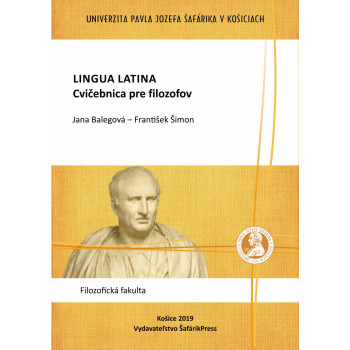
Jana Balegová - František Šimon
The university textbook "Lingua Latina – Exercise Book for Philosophers" is a parallel study material to the textbook "Lingua Latina – Cursus Communis." It is designed for practicing grammatical lessons at home. The content of the exercises corresponds to the focus of each lesson in the mentioned textbook, both in terms of the covered grammatical phenomena and vocabulary. For this reason, only vocabulary not included in the lessons of the textbook is presented in the exercises.
The Latin-Slovak dictionary at the end of the exercise book contains the entire vocabulary from both the exercise book and the textbook, while the Slovak-Latin dictionary includes the vocabulary from exercises that require translation into Latin. The vocabulary in this exercise book is oriented towards the needs of philosophy students and, with regard to the selection of source materials, also includes non-classical lexicon or non-classical meanings of classical words (this lexicon is marked with an asterisk *).
The exercise book includes a key that allows students to directly verify the correctness of their work. The textbook "Lingua Latina – Exercise Book for Philosophers" is available electronically in PDF format. As part of the educational program, online tests available on the website of the Department of Classical Philology at the Faculty of Arts, UPJŠ (https://www.upjs.sk/filozoficka-fakulta/katedra-klasickejfilologie/katedra/) also serve to practice the covered material.
Data sheet
E-book
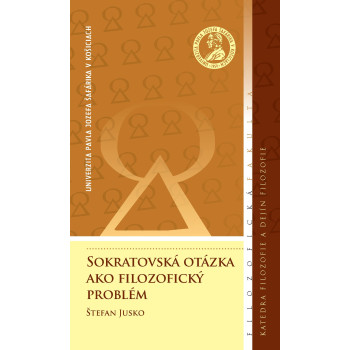
The goal of the monograph is to highlight the significant problem of interpreting the Socratic question, as its approach represents a method of interpreting the history of philosophy, specifically in our case, the interpretation of Socrates and Plato. The Socratic question can be grasped in diametrically different ways, as shown by Patočka and Nietzsche, among others. The former aligns with Socrates and innovatively updates his question for the present. The latter is ambivalent towards Socrates but ultimately labels him a decadent.
In the first part of the monograph, Patočka's characterization of human existence is presented, which he formulates as unified and morally firm. Patočka interprets the Socratic question as care for the soul, for its well-being, without deriving the concept of good from something positively defined but from the whole world, which can only be defined negatively due to its constant openness. This sphere of negativity is for Patočka something immensely positive because transcendence lifts humans from relative goods to the overall meaning, making them morally capable in the true sense. The good, i.e., the requirement for a surge, for a turn of humans from the world of things to the whole world, is for him a program that Socrates first formulated through his knowing ignorance.
The second part of the work is dedicated to Nietzsche's concept based on the non-unified nature of human existence, which is not derived from the whole world or overall meaning but from situational meaning. Nietzsche strives to prove that in every situation, human existence is exposed to two opposing perspectives, between which it is impossible to decide which is correct. He concludes that both perspectives are equally valid and mutually conditioned, meaning that the opposite of good, what threatens meaning, is a beneficial condition for situational meaning. He labels this level as immoral, as a sphere where human existence creates meaning outside the thinking of good and evil in opposition.
The conclusion of the work is open because, as it turns out, we do not have a common denominator that could decide on the correctness of one or the other concept. Precisely in this lies the fact that the Socratic question remains a serious philosophical problem even today.
E-book
Jana Nezkusilová - Margita Mesárošová (eds.)
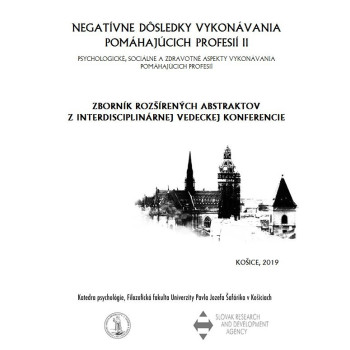
Proceedings of Extended Abstracts from Interdisciplinary Scientific Conference
Conference proceedings comprise extended abstracts from contributions that were presented during the conference Negative consequences of performing helping professions II – Psychological, social and health aspects of performing helping professions, which was held on 12th of June 2019 in Košice.
The conference was organized as one of the outputs of the research project APVV 14-0921 Self-care as a factor of coping with the negative consequences of the practicizing the helping professions. Abstracts present either original research by the authors or summaries of the authors' findings in their long-term research activities focused on helping professions. One of the ambitions of the conference was to create a space for dialogue between academics and professionals working in helping professions. The interdisciplinary character of the conference has brought new ideas and perception of this issue, which has also been reflected in the rich response during the discussions. Professionals from field of psychology, social work, occupational medicine and behavioral medicine participated actively or passively in the conference.
Thus, the enriching aspect of the resulting proceedings is the interconnection of applied and theoretical studies related to wide range of helping professions.
E-book
Lucia Tóthová - Katarína Šiňanská - Eva Žiaková
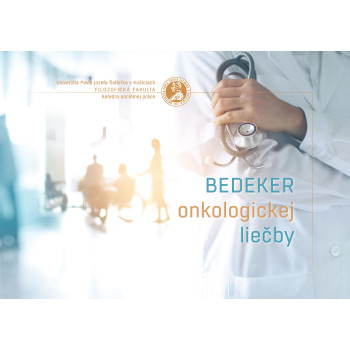
Here is the translation of the provided text into English: A guide to oncological treatment was created at a time when the importance of health became even more emphasized, becoming a kind of mega-value for the new modern "pandemic" human. The use of the term "pandemic" person arose, of course, in connection with the emergence of the coronavirus pandemic worldwide, but primarily because other dangerous long-term diseases that threaten contemporary humans are somehow being pushed into the background.
The severity of such diseases (including cancer) does not diminish just because attention has shifted to something more acute. It is very important to realize this and not fall under the illusion that if we overcome an acute danger, then automatically improve conditions for chronic diseases as well. We believe it's quite the opposite; prolonged stress and social negative factors constantly affecting us—among which undoubtedly includes pandemic situations—worsen not only psychological but also somatic states.
The guide to oncological treatment aims precisely at highlighting those psychological and social factors that negatively "support" cancer development in any form and can positively influence treatment and coping with illness. The guide offers opportunities for social engagement with groups of people undergoing similar oncological treatments, allowing them to share psychologically as well as professionally similar situations with those facing similar problems in treatment. The authors hope that this guidebook will reach those who will become more self-sufficient in overcoming such a formidable enemy as cancer.
Authors
E-book
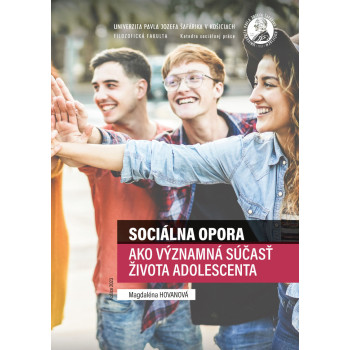
The monograph is devoted to social support, set in the adolescent's environment. Social support can also be described as relational support from the environment in which the individual lives, and thus increases his resistance to stress and the desire to overcome life's failures and crises. It is for this reason that social support was also defined in the context of social-ecological theory. An innovation in the relationship with social support was the "Push-pull" theory, oriented to the individual's motivation.
The defining anchoring of social support was built on its most famous theories. However, the greatest attention was focused on the possibilities of measuring social support, because its multidimensional measurement is necessary to determine the mechanism by which it works. The monograph therefore offered the author's validation processing and verification of psychometric properties of two separate methodologies Multidimensional Scale of Perceived Social Support (MSPSS) - (Zimet, Dahlem, Zimet, Farley 1988) and Social Support Survey (MOS) - (Sherbourne, Stewart 1991).
The monograph results in two validation-verified separate methodologies for measuring types and sources of social support, which are reliable for use in a group of Slovak adolescents (MOS-SK and MSPSS-SK).
Download e-book for free (pdf)