Slovenčina



E-book
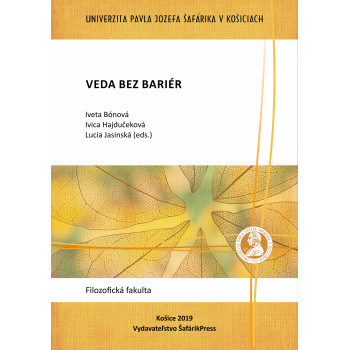
Iveta Bónová - Ivica Hajdučeková - Lucia Jasinská (eds.)
The proceedings maps three significant events organised in 2018 – 2019 within the project KEGA No. 008UPJŠ-4/2017 Science without barriers (Interdisciplinary inspirations of contemporary literary scholarship and linguistics in university educational practice; principal investigator prof. PhDr. J. Gbúr, CSc.) at the Department of Slovak Studies, Slavonic Philologies and Communication, Faculty of Arts, Pavol Jozef Šafárik University in Košice.
The first activity was a scholarly and artistic symposium Science without barriers held in March 6 – 8, 2019 on the occassion of the 80th birthday of Dr. h. c. prof. PhDr. Ján Sabol, DrSc. It brought extended abstracts of participants in two sections (Slovak studies and literary scholarship in interdisciplinary contexts) as its outcome. The next two parts describe artistically oriented events: Interpretational afternoon (a competition for the best interpretation of Ján Sabol´s book of verse Love in Blue) with the winning works added, and the vernissage Literature through an objective lens with the share of students of the School of Industrial Visual Arts in Košice.

Data sheet
E-journal
Juraj Schenk et al.
The scientific journal Sociálne a politické analýzy (Social and Political Analyses) serves as an interactive electronic platform for communication and the presentation (publication) of experts and their work in the fields of basic and applied research and analyses within sociological, psychological, political, and methodological contexts. It is a medium focused on intensively supporting research activities and analyses within an interdisciplinary framework, facilitating the exchange of experiences, fostering collaboration, and revitalizing the production of scientific work in this area.
The publication section of the journal offers space for works such as:
- Original sociological, psychological, and political studies and analyses in any areas of social life
- Methodological studies
- Research reports
- Studies from qualification theses Research and analysis projects
- Reviews
E-book
Jaroslav Marcin - Viktória Marcinová a kol.
This little book started out in a way that probably many other scholarly publications do: When the five of us met as doctoral students and instructors in the Department of British and American Studies, we soon realized that our research overlapped on a number of points. Most prominent among those was our interest in political or politicallymotivated discourse and the study of myths and manipulation that it employed.
In the end, we decided to pool the results of our research together in order to create a more complex picture, providing a variety of perspectives and voices. In our endeavor, we were greatly aided by the financial support we received from a grant offered by the Šafárik University. The outcome of these efforts is the five chapters of this brief, but hopefully informative and insightful monograph.
In Chapter 1, Viktória Marcinová deals with the impact of totalitarian ideology on the translation of so-called “capitalist” drama during the first stage of normalization in Slovakia (1948-1968). In Chapter 2, the focus shifts to political discourse and manipulation in a democracy, as Jaroslav Marcin takes a closer look at the wartime rhetoric of American presidents. USA remains the focus also in Chapter 3, but this time the question, addressed by Martina Martausová, will be one of the myth of the American Dream and its presentation in post-9/11 United States. A similar idea, though in a different geographical-cultural context, is dealt with in Chapter 4, where Božena Velebná identifies myths of Scottish identity as portrayed in historic films. Finally, in Chapter 5, Eduard Soták will take a look at the role of the mass media within the topic of politically-motivated discourse and spread of political ideology.
E-book
Magdaléna Halachová - Vladimír Lichner - Katarína Šiňanská (eds.)
Proceedings of Contributions from the Scientific Conference Held on April 25, 2013, in Košice
The proceedings of contributions from the scientific conference were created as part of the national round of the Student Scientific and Professional Activities event in the field of study 3.1.14 Social Work, which took place on April 25, 2013, in Košice.
The central theme of the proceedings focuses on addressing various problem areas within social work as both an academic discipline and a practical activity. These contributions were prepared by students and young researchers under the guidance of experienced professionals. The topics covered in the proceedings include issues such as social services, field social work, school social work, and similar areas. Additionally, they highlight the dangers of socio-pathological phenomena such as truancy, drug addiction, poverty, bullying, and more.
The presented results clearly demonstrate the importance of social work and other helping professions in working with specific client groups.
E-book
Marián Gladiš - Lucia Jasinská (eds.)
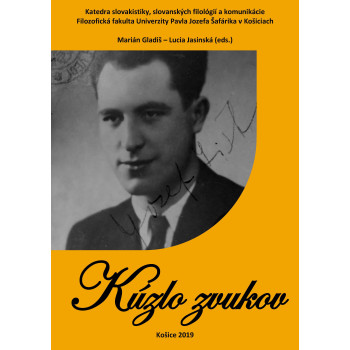
This peer-reviewed collection of papers is a publication output of the scientific colloquium named The Magic of Sounds, which was organized by the Department of Slovak Studies, Slavonic Philologies and Communication at the Faculty of Arts of the Pavol Jozef Šafárik University in Košice, and by the Košice Branch of the Slovak Linguistic Society at the Ľudovít Štúr Linguistic Institute of the Slovak Academy of Sciences in Bratislava, on the occasion of the 100th anniversary of birth of Associate Professor PhDr. Jozef Liška, PhD., the founder of the Slovak logopaedics.
Participants focused their papers on the analysis of the linguistic and speech therapy work of J. Liška, his contribution to Slovak dialectology and orthoepy, presented him as an Anglicist, and they also dealt with the audio aspect of children's speech, exact methods of disturbances and low voice quality measuring, or machine speech processing.
An interpretative paper of the documentary They Will Speak Well, a socially important piece of film work, which was made in 1958 under the supervision of J. Liška, is also included in the proceedings.