Slovenčina


E-book
Alexander Onufrák - Ján Ruman - Jana Šutajová - Peter Getlík
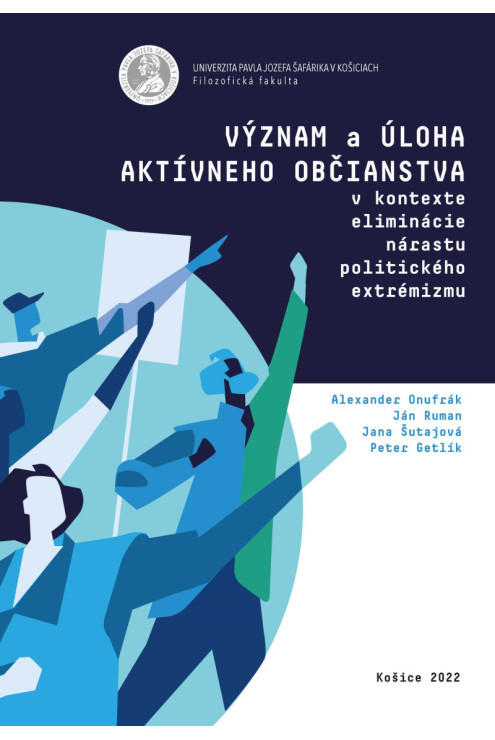
The presented textbook aims to introduce students to the issue of political extremism from various perspectives—namely, normative, historical, and discursive-empirical.
It addresses the significance and role of active citizenship, which, as one of several potential solutions, has the capacity to a certain extent to eliminate the rise of manifestations of political extremism in society by deepening democratic principles in practice.
The presented textbook is a direct output of the KEGA grant project "Innovative Model of Education Leading to Active Citizenship as a Prevention of the Rise of Political Extremism among Students" (014UPJŠ-4/2020). The principal investigator of the project is Assoc. Prof. Mgr. Gabriel Eštok, PhD. The project was carried out in the years 2020–2022.
Download e-book for free (pdf)

Data sheet
E-journal
Renáta Orosová (výkonný redaktor)
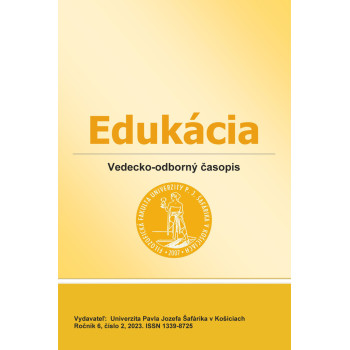
Vedecko-odborný časopis Edukácia je zameraný na problematiku vzdelávania a výchovy v oblasti základného, stredného a vysokého školstva. Zreteľ kladie na súčasný stav a perspektívy edukačnej praxe, aktuálne aspekty pregraduálnej prípravy učiteľov, sociálnej pedagogiky, špeciálnej pedagogiky, ako aj pedagogické a psychologické aspekty výchovy v základných výchovných inštitúciách z pohľadu širokej pedagogickej verejnosti. Je určený vedeckým pracovníkom, mladým vysokoškolským učiteľom, doktorandom, ako aj odborným a pedagogickým pracovníkom, s cieľom prezentovať trendy v edukácii a vyvolať diskusiu k aktuálnym otázkam prezentovaných oblastí výchovy a vzdelávania.
E-book
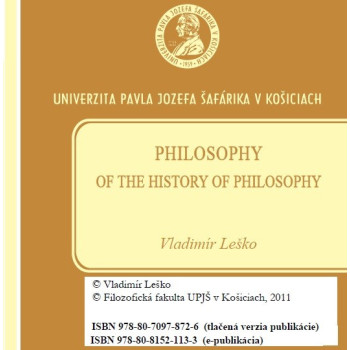
The book is the result of long-term contemplation on the relationships between the history of philosophy and its reflection in more or less systematic, or non-systematic forms of philosophizing of the most significant philosophical teachings of the 19th and 20th centuries (Hegel, Schelling, Marx, Nietzsche, Husserl, Heidegger, Fink, Patočka, and Gadamer).
The primary goal of the work is to present the most significant historical-philosophical teachings of the 19th and 20th centuries in the formation and fulfillment of strong and weak models of the philosophy of the history of philosophy in the concepts of Hegel, Schelling, Marx, Nietzsche, Husserl, Heidegger, Fink, Patočka, and Gadamer.
The results of the philosophy of the history of philosophy are presented here as a metatheoretical movement within historical-philosophical thinking, whose aim is not to empirically describe the historical-philosophical process, but to understand and explain it as an inseparable part of the most significant philosophical problems – what is philosophy, what is metaphysics, and the question of being.
Download the e-book for free (pdf)
E-book
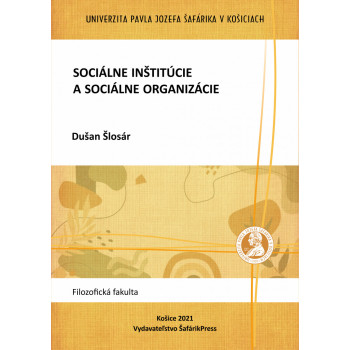
The monograph Social Institutions and Social Organizations analyzes the issues of society, spheres of society, models of social coexistence, social system, social institutions and social organizations that arise within individual social institutions. From social institutions, the monograph focuses on culture, religion, education, politics, health and economics.Individual social institutions are analyzed from several sociological perspectives, which allows the creation of a broader view of the analyzed issues.
Download e-book for free (pdf)
E-book
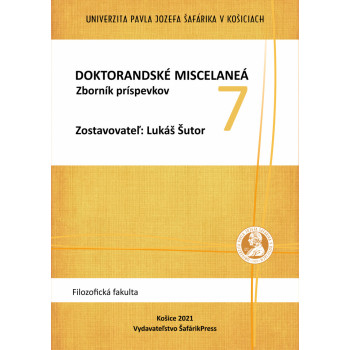
The seventh volume of Doctoral Miscellanea was created in this year's specific research and educational situation, which predetermined its character as a non-conference collection.
The previous two editions continued the tradition of domestic scientific events (initially seminars, later conferences) at the Autumn School of Doctoral Students of the Faculty of Arts at UPJŠ in Košice, thereby creating an opportunity to verify more comprehensive scientific conclusions before a diverse audience, not only of experienced educators but also of researchers from their own generation. This phase was narrowed down to communication between the supervisor/reviewer and the doctoral student during the publication's creation. However, this did not automatically mean a less intense dialogue. Many contributions underwent interesting changes and variations.
The resulting studies reflect not only the degree of development of dissertation projects but often also the interest of young scientists in specific issues that have the potential for independent research. After all, they chose our domestic collection for testing their ideas.
Download e-book for free (pdf)