Slovenčina




E-book
The publication provides a systematic overview of the core models of systemic therapy and its theoretical as well as practical foundations. The opening chapters of the textbook outline the historical development of psychotherapeutic approaches and the shift toward the systemic paradigm, which emphasizes the importance of relationships, context, and circularity in understanding psychological phenomena.
The core of the text focuses on the philosophical foundations of systemic therapy, particularly general systems theory, cybernetics, constructivism, and social constructionism, all of which have significantly shaped the understanding of reality, knowledge, and the therapeutic process. Subsequent chapters address biological and social foundations, including the concepts of autopoiesis, cognition, and communication, and their relevance to the functioning of social systems. The publication further elaborates on the practical implications of these theoretical frameworks, especially in relation to causality, language, and the construction of social reality. Systemic understanding of problems is presented as a dynamic and relational process maintained through interactional patterns within the system.
The publication provides a systematic overview of the core models of systemic therapy and its theoretical as well as practical foundations. The opening chapters of the textbook outline the historical development of psychotherapeutic approaches and the shift toward the systemic paradigm, which emphasizes the importance of relationships, context, and circularity in understanding psychological phenomena.
The core of the text focuses on the philosophical foundations of systemic therapy, particularly general systems theory, cybernetics, constructivism, and social constructionism, all of which have significantly shaped the understanding of reality, knowledge, and the therapeutic process. Subsequent chapters address biological and social foundations, including the concepts of autopoiesis, cognition, and communication, and their relevance to the functioning of social systems. The publication further elaborates on the practical implications of these theoretical frameworks, especially in relation to causality, language, and the construction of social reality. Systemic understanding of problems is presented as a dynamic and relational process maintained through interactional patterns within the system.
Special attention is given to the development of systemic thinking and selected therapeutic approaches, such as the Milan school, solution-focused therapy, and the narrative approach, which illustrate different ways of working with change and meaning in the therapeutic process. The textbook is intended for master’s-level students of psychology and related disciplines, offering both a solid theoretical grounding and inspiration for the application of systemic thinking in practice.

Data sheet
E-book
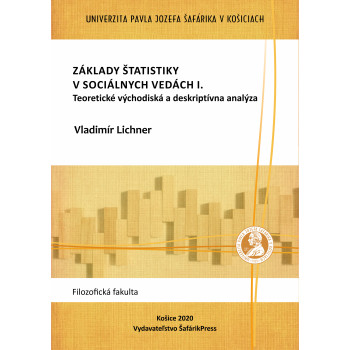
The presented university textbook presents a basic overview of statistical theory and practice intended for students of social work, including examples of their use in specific studies. This text deals with the first part of statistical practice, namely descriptive analysis, which we perceive as a basic condition for the processing of any empirical research and is also important in grasping typical statistical principles and concepts.
E-book
The attention devoted to the issue of Chinese activity is highly relevant. Creating a positive reputation abroad is a legitimate tool of every state in its effort to generate influence. The People's Republic of China has been very successful in this regard since the beginning of the millennium, which has allowed it to start occupying positions in the international system that it legitimately claims based on its own history, size, and potential.
Examples from abroad also highlight the fact that Chinese foreign policy should not be accepted uncritically and deserves a cautious approach and thoughtful discussion. All of this must be done while respecting not only China's particularity but also taking into account the realities of the great power rivalry visible at the beginning of the 21st century.
In this context, one cannot abstract from a detailed look at Chinese soft power as one of the key tools for generating influence in the world. Understanding it is an essential prerequisite for a relevant evaluation of the practices and motivations of China's foreign policy, while it can also serve as a guideline in the effort to create an adequate approach toward this resurgent global great power.
E-book
Jana Balegová - František Šimon
The university textbook "Lingua Latina – Exercise Book for Philosophers" is a parallel study material to the textbook "Lingua Latina – Cursus Communis." It is designed for practicing grammatical lessons at home. The content of the exercises corresponds to the focus of each lesson in the mentioned textbook, both in terms of the covered grammatical phenomena and vocabulary. For this reason, only vocabulary not included in the lessons of the textbook is presented in the exercises.
The Latin-Slovak dictionary at the end of the exercise book contains the entire vocabulary from both the exercise book and the textbook, while the Slovak-Latin dictionary includes the vocabulary from exercises that require translation into Latin. The vocabulary in this exercise book is oriented towards the needs of philosophy students and, with regard to the selection of source materials, also includes non-classical lexicon or non-classical meanings of classical words (this lexicon is marked with an asterisk *).
The exercise book includes a key that allows students to directly verify the correctness of their work. The textbook "Lingua Latina – Exercise Book for Philosophers" is available electronically in PDF format. As part of the educational program, online tests available on the website of the Department of Classical Philology at the Faculty of Arts, UPJŠ (https://www.upjs.sk/filozoficka-fakulta/katedra-klasickejfilologie/katedra/) also serve to practice the covered material.
E-book
Zuzana Buráková - Petra Filipová
The canon of American literature has undergone constant revision with many authors who were long excluded from wider recognition now being accepted as significant figures. With the emergence of postcolonial and ethnic studies after the 1960s, the diversity of the literary canon has become greater than ever, and we can now see American literature as remarkably distinctive in this respect.
The question of how to define ethnicity and how far an immigrant should go to preserve their ethnic heritage have always been addressed by writers, together with larger issues such as the definition of national identity and national literature, and where we should draw the lines between local and global identities. We understand that a single course in American ethnic literature cannot hope to answer all these complex questions, but we firmly believe that discussing these questions in classes can help us to be more understanding and tolerant of ethnic diversity.
For this reason, the main aim of this textbook is to provide an interdisciplinary introduction to American ethnic literatures with an emphasis on their historical and cultural background, to expand students’ knowledge of American literatures and cultures at the master’s level and familiarize them with specific features of ethnic literatures in the contemporary USA. The textbook contains information on Native American, African American, Asian American, Jewish American, and Hispanic American literature, history and culture.
Download e-book for free (pdf)