Slovenčina


E-book
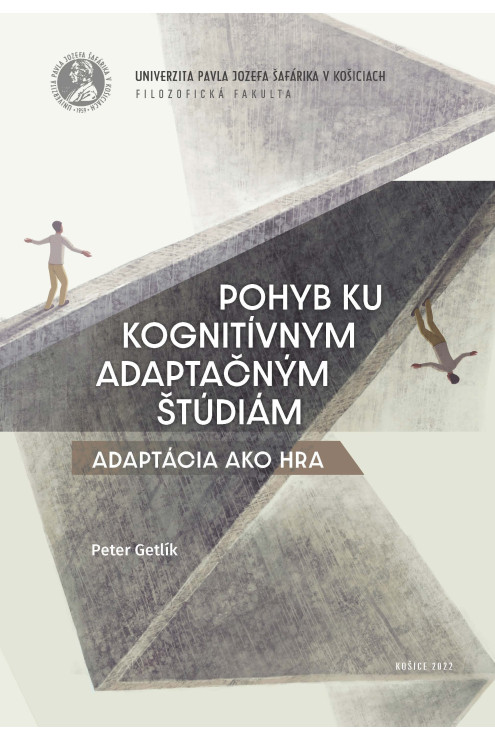
The main goal of the monograph "Moving Towards Cognitive Adaptation Studies: Adaptation as Play" was to orient current research in adaptation studies towards the empirically responsible cognitive branch of non-radical constructivism.
This intention results from the rapid progressive differentiation of adaptation studies research, which has mainly manifested itself in this area in the last two decades. With the model of adaptation as play in a cognitive-scientific perspective, author provides the possibility of predicting the nature (also in a broader sense) of the experience of adaptation. Since the form of this experience significantly shapes the products of the adaptation process into their final form, the model of adaptation as play can be applied even in the interpretation of individual adaptations. In the monograph, the author synthesized the model of adaptation as play based on the knowledge of various disciplines. In the field of cognitive sciences, he saw help from the starting points of philosophy, linguistics, informatics, psychology, anthropology, biology and neuroscience – especially affective neuroscience, which also deals with the emotional dimension of the play.
In the intersection with the essential interdisciplinary components of adaptation research, he also used the knowledge of classical and cognitive variations of literary science, film science (also theatrology) and media studies to a large extent. Consistent with other similar results of cognitive sciences, it turns out that even seemingly serious adaptations, like in many aspects of our culture, have a ludic base.

Data sheet
E-book
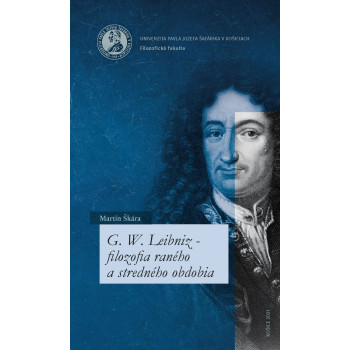
The presented university textbook is a reaction to two fundamental shortcomings. The first one is the absence of a similar, if not equivalent, textbook in the Slovak university environment. The second shortcoming is the mistake that Leibniz's philosophy is a system called monadology.
The presented textbook corrects this mistake and at the same time fills the gap of the absence of this kind of textbook with a Leibniz subject. For the above reasons, the presented textbook brings a new perspective on the philosophy of G. W. Leibniz, especially in the period of early philosophical beginnings with an overlap into the so-called Paris period and the De summa rerum period up to the first philosophical doctrinal formulation expressed in the Discours de métaphysique (Winter 1685-1686). The textbook is conceived as a selection of sections of source texts translated by the author of the textbook from French and partly from Latin and equipped with comments accessible to the target audience.
It is therefore the author's wish that this textbook not only serve as a form of correction for the misinterpretation of Leibniz's philosophy, but as an inspiring text that will introduce the reader to the world of Leibniz's philosophy in its undistorted light.
Download e-book for free (pdf)
E-book
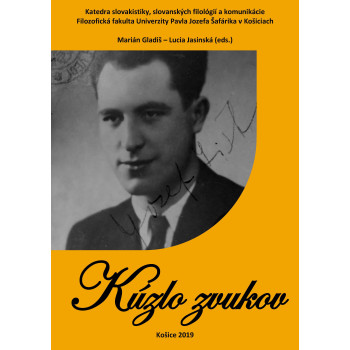
Marián Gladiš - Lucia Jasinská (eds.)
This peer-reviewed collection of papers is a publication output of the scientific colloquium named The Magic of Sounds, which was organized by the Department of Slovak Studies, Slavonic Philologies and Communication at the Faculty of Arts of the Pavol Jozef Šafárik University in Košice, and by the Košice Branch of the Slovak Linguistic Society at the Ľudovít Štúr Linguistic Institute of the Slovak Academy of Sciences in Bratislava, on the occasion of the 100th anniversary of birth of Associate Professor PhDr. Jozef Liška, PhD., the founder of the Slovak logopaedics.
Participants focused their papers on the analysis of the linguistic and speech therapy work of J. Liška, his contribution to Slovak dialectology and orthoepy, presented him as an Anglicist, and they also dealt with the audio aspect of children's speech, exact methods of disturbances and low voice quality measuring, or machine speech processing.
An interpretative paper of the documentary They Will Speak Well, a socially important piece of film work, which was made in 1958 under the supervision of J. Liška, is also included in the proceedings.
E-book
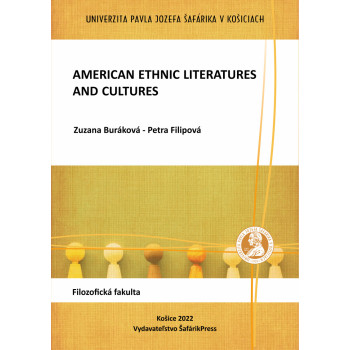
Zuzana Buráková - Petra Filipová
The canon of American literature has undergone constant revision with many authors who were long excluded from wider recognition now being accepted as significant figures. With the emergence of postcolonial and ethnic studies after the 1960s, the diversity of the literary canon has become greater than ever, and we can now see American literature as remarkably distinctive in this respect.
The question of how to define ethnicity and how far an immigrant should go to preserve their ethnic heritage have always been addressed by writers, together with larger issues such as the definition of national identity and national literature, and where we should draw the lines between local and global identities. We understand that a single course in American ethnic literature cannot hope to answer all these complex questions, but we firmly believe that discussing these questions in classes can help us to be more understanding and tolerant of ethnic diversity.
For this reason, the main aim of this textbook is to provide an interdisciplinary introduction to American ethnic literatures with an emphasis on their historical and cultural background, to expand students’ knowledge of American literatures and cultures at the master’s level and familiarize them with specific features of ethnic literatures in the contemporary USA. The textbook contains information on Native American, African American, Asian American, Jewish American, and Hispanic American literature, history and culture.
Download e-book for free (pdf)