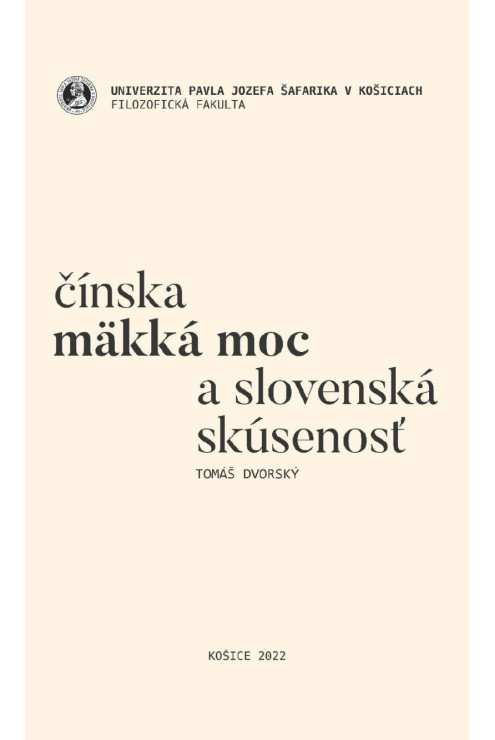
Čínska mäkká moc a slovenská skúsenosť

E-book

Tomáš Dvorský

The attention devoted to the issue of Chinese activity is highly relevant. Creating a positive reputation abroad is a legitimate tool of every state in its effort to generate influence. The People's Republic of China has been very successful in this regard since the beginning of the millennium, which has allowed it to start occupying positions in the international system that it legitimately claims based on its own history, size, and potential.

Examples from abroad also highlight the fact that Chinese foreign policy should not be accepted uncritically and deserves a cautious approach and thoughtful discussion. All of this must be done while respecting not only China's particularity but also taking into account the realities of the great power rivalry visible at the beginning of the 21st century.

In this context, one cannot abstract from a detailed look at Chinese soft power as one of the key tools for generating influence in the world. Understanding it is an essential prerequisite for a relevant evaluation of the practices and motivations of China's foreign policy, while it can also serve as a guideline in the effort to create an adequate approach toward this resurgent global great power.

Download the e-book for free (pdf)

Quantity

978-80-574-0128-5

Data sheet

Method of publication:
E-book (pdf)
Author:
Tomáš Dvorský
Document type:
Monograph
Number of pages:
236
Available from:
10.10.2022
Year of publication:
2022
Edition:
1st edition
Publication language:
Slovak
Faculty:
Faculty of Arts
Note:
Publikácia vychádza ako výstup grantového projektu APVV-20-0334 „Nie je to pravda, ale mohla by byť“: Konšpiračné teórie a hoaxy v modernom vývoji Slovenska v európskom kontexte.
- Free for download

16 other products in the same category:

Sociálne riziká v spoločnosti XXI. storočia

E-book

E-book

Lucia TóthováKatarína Šiňanská (eds.)

Proceedings of the scientific conference with international participation held on November 30, 2018, in Košice

Current social work addresses the serious development problems of society such as poverty, unemployment, chronic diseases, socially vulnerable groups and others. We must not forget that enough attention must be paid to the discovery of causes and a detailed analysis of these problems. The thing is that social problems have been around for a long time, they just changed their shape, old forms of social risks were replaced by the new ones that need to be explored and analyzed in order to be able to perform measures and remove the causes of social risks of the 21st century. Proceedings of the scientific conference with international participation entitled Social Risks in the Society of the XXI. Century is therefore devoted to various perspectives related to social risks of modern society in the variety of contributions, indicating the broad-spectrum not only of the proceedings, but also the social work itself.

Download the e-book for free (pdf)

Mám či nemám: Etika v psychologickej praxi

E-book

E-book

Monika Hricová

Despite the fact that a psychologist may have a good moral background, it is necessary for everyone to know and act in accordance with ethical professional principles in order not to harm the clients with whom they work in the course of psychological practice. There are many case studies in the professional literature that describe serious situations of violations of psychological ethics. On the one hand, they depict conscious professional misconduct or ignorance. On the other hand, they have contributed to the introduction of even legal standards for the ethical behavior of psychologists as professionals. Completion of a course or training in the topic of psychological ethics is required by several professional associations abroad, especially in the last years of undergraduate studies. Their goal is to supervise the quality and preparation of future psychologists. The university textbook Do I Have It or Not: Ethics in Psychological Practice provides a summary of essential information on the ethics of conducting psychological practice, the boundaries of the relationship with the client, and the rules of confidentiality. The goal is not for the student, as a future psychologist, to know ethical rules word for word, but for them to be sufficiently ethically sensitive.

Download the e-book for free (pdf)

Betriebswirtschaft für Übersetzer. Lehr- und...

E-book

E-book

Blanka JenčíkováUlrika Strömplová

Text book Betriebswirtschaft für Übersetzer. Lehr- und Übungsbuch is primarily intended for students of translation and interpreting who speak German at least at level B1 of the European Framework of Reference for Languages. The aim is to convey basic knowledge about business and entrepreneurship, to build a basic terminology database, to consolidate selected grammatical phenomena, and to develop translation procedures and strategies. The thematic areas were selected with regard to common translation and interpretation practice.

Download e-book for free (pdf)

Poznanie, spoločnosť, dejiny. Stretnutie...

E-book

E-book

Miriama Filčáková (ed.)

Proceedings of the 11th Scientific Conference of Young Historians, organized by the Department of History at the Faculty of Arts, Pavol Jozef Šafárik University in Košice, in cooperation with the Slovak Historical Society at the Slovak Academy of Sciences, on October 19-20, 2021.

Currently, these histories are often presented as an extension of the history of science. The history of knowledge not only expands the boundaries of the history of science but also explores the boundaries between different forms of knowledge and ignorance. Just as studies of historical memory have expanded and complemented their interest in researching forgetting, the history of knowledge includes studies of ignorance. They focus on the change that has occurred over the past decades: from the sacralization of science and respect for professional knowledge to the rejection of science and constant questioning of professional knowledge, to which the history of knowledge must also respond. Findings as a product form the basis of human interactions and have their own past. What was the significance of knowledge and cognition in different historical periods? How did state power influence the development of knowledge and cognition? What can be considered knowledge in a particular historical era or culture? Finally, is there any human activity that cannot be considered knowledge?

Currently, in the field of the history of knowledge, a significant surge in research, publishing, and the emergence of new institutions can be observed. The eleventh doctoral conference—Meeting of Young Historians XI, organized by the Department of History at Pavol Jozef Šafárik University in cooperation with the Slovak Historical Society at the Slovak Academy of Sciences—will contribute to expanding the perspective on the past of knowledge and cognition. The conference, intended for Slovak and foreign doctoral students, aims to provide a space for presenting the latest results of scientific research, professional discussion, establishing contacts, developing cooperation, and exchanging experiences among the broader historical community. The starting point for the conference is a peer-reviewed proceedings volume consisting of publication outputs from active participants.

Download the e-book for free  (pdf)

Ako nájsť zmysel života v sociálnej práci s...

E-book

E-book

Eva Žiaková (ed.)

Proceedings of the Scientific Conference with International Participation within the VEGA Project No. 1/0282/12 Interdisciplinary Analysis of the Meaning of Life and Its Components in Socially Significant Groups of Adolescents in Terms of Its Formation and Possible Intervention.

The introductory word is a very good opportunity for us to jointly evaluate what we have managed to achieve in addressing our common scientific research task focused on the study of the meaning of life in socially at-risk groups of adolescents. First and foremost, we asked ourselves what we have discovered about the meaning of life so far, that is, what we know about it.

The second question we asked was: what surprised us about the results we have obtained so far. The third question was about what we want to do to resolve the discrepancy between what we have discovered and what we want to achieve.

The final question in evaluating the solution of the scientific research task was: what do we (not) know about the meaning of life of adolescents and want to know in the future, or what should we focus on to develop the most effective logotherapeutic and sociotherapeutic methods for social workers working with socially at-risk groups of adolescents.

Download the e-book for free (pdf)

Slovenčina pre cudzincov (Pracovné listy)

E-book

E-book

Marianna Sedláková a kol. 

The worksheets, based on the direct specific needs of teaching medical students in Košice, respect the real situation of teaching Slovak as a foreign language at UPJŠ.

They also reflect the relatively high number of Slavic students, especially from neighboring countries, who, although just beginning with the Slovak language, are at a higher communicative level compared to students from non-Slavic countries. Therefore, a special part of the worksheets with exercises is dedicated to them, which includes special exercises and dictionaries aimed at eliminating Slovak-Polish or Slovak-Ukrainian interference phenomena. Since some non-Slavic students come from the Czech language environment, we also add a glossary of the most common different expressions in Slovak, Czech, and, for the aforementioned reasons, Polish and Ukrainian. In the part intended for all students, both Slavic and non-Slavic, communicatively focused exercises for practicing grammatical phenomena predominantly at the A1 and A2 communication skill levels (according to the Common European Framework of Reference) prevail, and last but not least, exercises thematically focused on medicine and healthcare.

The texts from the thematic area are, of course, supplemented with realia of the city of Košice. As a functional supplement in the working material, we also publish test samples.

Download the e-book for free (pdf)

Edukácia, roč. 7, č. 1/2024

E-book

Renáta Orosová (výkonný redaktor)

Stránka časopisu >>>

Vedecký recenzovaný časopis Edukácia je zameraný na problematiku vzdelávania a výchovy v oblasti základného, stredného a vysokého školstva. Zreteľ kladie na súčasný stav a perspektívy edukačnej praxe, aktuálne aspekty pregraduálnej prípravy učiteľov, sociálnej pedagogiky, špeciálnej pedagogiky, ako aj pedagogické a psychologické aspekty výchovy v základných výchovných inštitúciách z pohľadu širokej pedagogickej verejnosti. Je určený vedeckým pracovníkom, mladým vysokoškolským učiteľom, doktorandom, ako aj odborným a pedagogickým pracovníkom s cieľom prezentovať trendy v edukácii a vyvolať diskusiu k aktuálnym otázkam prezentovaných oblastí výchovy a vzdelávania.

Ciele vedeckého časopisu Edukácia:

  • • prezentovať súčasné postavenie a funkciu pedagóga v edukačnej praxi a jeho perspektívy,
  • • prezentovať aktuálne otázky vzdelávania a výchovy z pohľadu učiteľov, sociálnych pedagógov, špeciálnych pedagógov a psychológov,
  • • prezentovať inovácie v edukačnej praxi; analyzovať stav a problémy prepájania teórie a praxe výchovy a vzdelávania vo vzťahu k moderným
       vyučovacím koncepciám,
  • • prezentovať aktuálne trendy v pregraduálnej príprave pedagógov,
  • • prezentovať výsledky empirických výskumov z oblasti pedagogiky, sociálnej pedagogiky, špeciálnej pedagogiky a psychológie v prostredí
       rodiny, školy a mimoškolských výchovných inštitúcií.

Download the e-book for free (pdf)

Hranice v priestore a čase. Stretnutie mladých...

E-book

E-book

Dana KušnírováPeter Pavonič

Collection of Contributions from the Scientific Conference. Košice, November 18-19, 2020

The collection titled Borders in Space and Time consists of twelve contributions presented at the tenth edition of the doctoral conference Meeting of Young Historians, which is organized annually by the Department of History at the Faculty of Arts, UPJŠ in Košice. In 2020, we commemorated the centenary of the signing of the Trianon Peace Treaty, which definitively established the borders of Hungary, including those with Czechoslovakia, after World War I; therefore, the theme of the conference was chosen to be the history of borders. The individual contributions focus on the development of borders in the 20th century, borders in thought and education, and borders in earlier historical periods.

Download e-book for free (pdf)

Edukácia, roč. 2, č. 1/2017

E-book

E-journal

Renáta Orosová (výkonný redaktor)

Website >>>

The scientific-professional journal Edukácia focuses on issues of education and upbringing in the fields of primary, secondary, and higher education.

It emphasizes the current state and perspectives of educational practice, contemporary aspects of pre-service teacher training, social pedagogy, special pedagogy, as well as pedagogical and psychological aspects of upbringing in basic educational institutions from the perspective of the broader educational community.

It is intended for researchers, young university lecturers, doctoral students, and professional and pedagogical staff, with the aim of presenting trends in education and stimulating discussion on current issues in the presented areas of upbringing and education.

Download the e-journal for free (pdf)

Lingua Latina – cursus communis

E-book

E-book

Jana Balegová

The university textbook Lingua Latina – cursus communis is designed for students of all study programs at the Faculty of Arts, where Latin is included as a subject related to the main field of study or specialization (history, philosophy, philological specializations, etc.).

The textbook contains Latin grammar, exercise sentences intended for practicing the grammatical phenomena covered in seminars under the guidance of an instructor, and a Latin-Slovak dictionary. To practice Latin grammar at home, parallel workbooks are available, which are tailored to meet the needs of students from specific study fields and specializations (e.g., Lingua Latina – workbook for historians, Lingua Latina – workbook for philosophers, Lingua Latina – workbook for philologists).

The textbook Lingua Latina – cursus communis is accessible electronically in PDF format. As part of the educational program, online tests available on the KKF FF UPJŠ website serve to reinforce the learned material. This textbook is a product of the grant project KEGA 010UPJŠ-4/2017.

Download the e-book for free (pdf)

Voľby 2023/2024: výsledky - hodnotenia -...

E-book

E-book

Alexander Onufrák, Peter Dubóczi, Lukáš Jakabovič

The submitted publication entitled Voľby 2023/2024: výsledky – hodnotenia – dôsledky reflects a wide range of topics related to the electoral processes that took place in 2023 and 2024 in Slovakia and abroad. The publication deals with both the evaluation of the currently valid electoral legislation, including proposals for its further improvement, and the broader socio-political consequences of the elections in connection with democratization and integration processes. The submitted publication is published as an output of the VEGA project No. 1/0474/24 Audit of Slovak electoral and referendum legislation, the project leader of which is prof. JUDr. Ladislav Orosz, CSc. from the Faculty of Law of the Pavol Jozef Šafárik University in Košice and in which the Department of Political Science of the Faculty of Arts of the Pavol Jozef Šafárik University in Košice also participates. The authors of the individual contributions analyze all types of elections, from municipal and regional, through parliamentary and presidential, to elections to the European Parliament. While some authors focused primarily on the local or regional level, others chose an approach focused on the national or supranational level, and the geographical scope of the cases examined was extremely diverse. 

Download the e-book for free (pdf.)

Možné svety z pohľadu logickej sémantiky a...

E-book

E-book

Eugen Andreanský

The presented monograph aims to critically map the understanding of the concept of possible worlds.

The first chapter describes the formation of the semantics of possible worlds, along with indicating some problems it brings, which were incisively revealed primarily by W. V. O. Quine. In the next two chapters, the work focuses on more modern views on the nature of possible worlds, with the main attention given to the dichotomy between the possibilist and actualist approach to the question of modalities, alongside which it is necessary to assess other distinctions (essentialism - anti-essentialism, realism - reductionism (or ersatzism or fictionalism), naturalism - non-naturalism, etc.). Increased attention in the work is specifically devoted to the possibilism of D. Lewis and the actualist concepts of S. Kripke, A. Plantinga, R. M. Adams, N. Rescher, D. Armstrong, and J. Hintikka.

An unconventional approach to the issue of possible worlds is captured in the fourth chapter. It is primarily dedicated to the significant concept of Jaakko Hintikka, which works with the notion of epistemic possible worlds and documents the inclination towards the modification and relativization of modal discourse. The conclusion provides an evaluation of the discussion that touches on the main problems associated with considerations of possible worlds.

In the presented monograph, some representative concepts of possible worlds, or possible individuals, are clarified, and the overall process is indicated from assessing possible worlds as ideal logical constructs through their relativization by separate domains of individuals for individual worlds and further through the relationship of attainability to financial, impossible, and non-standard possible worlds.

Download the e-book for free (pdf)

Lingua Latina – cvičebnica pre historikov

E-book

E-book

Jana Balegová

University textbook Lingua Latina – Exercise Book for Historians is a parallel study material to the textbook Lingua Latina – Cursus Communis. It is designed for practicing grammar at home. The content of the exercises corresponds to the focus of the individual lessons in the mentioned textbook, both in terms of the covered grammatical phenomena and vocabulary. For this reason, only vocabulary not covered in the textbook's lessons is included in the exercises.

The Latin-Slovak dictionary at the end of the exercise book contains all the vocabulary from both the exercise book and the textbook. The Slovak-Latin dictionary includes the vocabulary from exercises that require translation into Latin. The vocabulary in this exercise book is oriented towards the needs of history students and, given the selection of source materials, also includes non-classical lexicon or non-classical meanings of classical words (this lexicon is marked with the symbol *).

The exercise book includes a key that allows students to directly verify the correctness of their work. The textbook Lingua Latina – Exercise Book for Historians is available electronically in PDF format. As part of the teaching program, online tests available on the KKF FF UPJŠ website (https://www.upjs.sk/filozoficka-fakulta/katedra-klasickejfilologie/katedra/) also serve to practice the covered material.

Download the e-book for free (pdf)

Malý anglicko-slovenský slovník verzologických...

E-book

E-book

Marián Andričík

The basis for the creation of this publication was both our many years of translation activities in the field of Anglophone poetry and a consistent interest in theoretical questions in the area of versology. Years of collecting and compiling material ultimately culminated in this dictionary, which we present to the professional public with the awareness of its incompleteness and occasional terminological uncertainty in finding equivalents, since a more comprehensive comparative study in this field has not yet been published.

For this reason, alongside established terminological equivalents, we decided to offer our own proposals for those terms that so far have had no Slovak equivalents – these are graphically marked in italics. Given the narrowly defined target group of users, we have dispensed with the grammatical classification of individual headwords and, except for a few exceptions, also with their phonetic transcription, phenomena common in general dictionaries. In addition to individual headwords, the dictionary also contains established collocations used in versological literature. Since we expect the dictionary to serve as study material for students of English and Slovak philology, we have added a closer characterization or explanation of many equivalents in parentheses.

We believe that this dictionary, the first of its kind in our literary-scientific context, will become a solid foundation for further, more extensive, and more comprehensive handbooks.

Download e-book for free (pdf)

This website uses cookies to ensure you get the best experience on our website