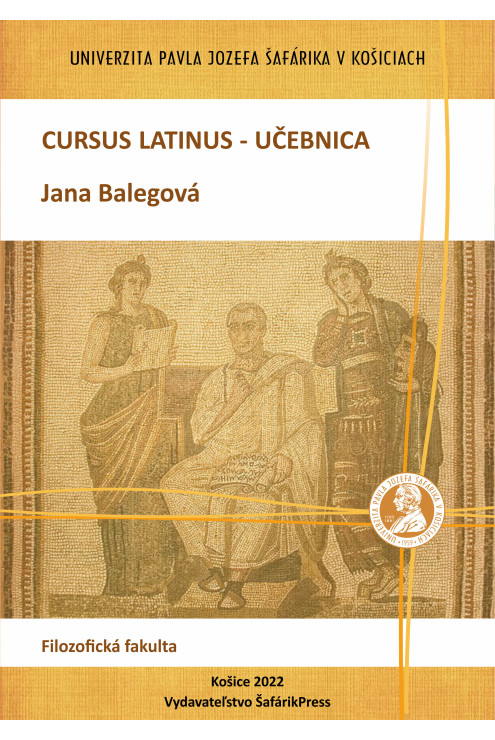
Cursus Latinus - učebnica

E-book

Jana Balegová

University textbook „Cursus Latinus - textbook“ is intended for students of the study program Latin language and literature. It is divided into „Introduction“ and 37 lessons. The content of lessons is morphology, sentence syntax and selected phenomena of case syntax of the Latin language. Each of the lessons contains a grammatical explanation, followed by sentences designed to demonstrate the forms of grammatical phenomena and the required vocabulary (Dictionary). Using these examples, students learn the basic principles of translation from Latin into Slovak and from Slovak into Latin. The textbook also includes a Latin-Slovak dictionary containing the entire vocabulary used in the textbook. The „Cursus Latinus - textbook“ is intended for the interpretation of grammar and the acquisition of grammatical phenomena of the Latin language under the guidance of the teacher. A parallel exercise book (Cursus Latinus – exercise book) is used to practice Latin grammar at home. The exercise book includes a key to the exercises and a Latin-Slovak dictionary containing vocabulary from the textbook and the exercise book. University textbook „Cursus Latinus - textbook“ is available electronically in PDF format.

Download the e-book for free  (pdf)

Quantity

978-80-574-0149-0

Data sheet

Method of publication:
E-book (pdf)
Author:
Jana Balegová
Document type:
Course Notes
Number of pages:
284
Available from:
21.12.2022
Year of publication:
2022
Edition:
1st edition
Publication language:
Latin
Faculty:
Faculty of Arts
Note:
Učebný text Cursus Latinus – cvičebnica je výstupom grantového projektu KEGA Cursus Latinus - vysokoškolské učebné texty latinského jazyka pre študijný program latinský jazyk 009UPJŠ-4/2020.
License:
Creative Commons BY NC ND (Uveďte autora - Nepoužívajte komerčne - Nespracovávajte)
- Free for download

16 other products in the same category:

Riziko ako sociálna kategória v období adolescencie

Riziko ako sociálna kategória v období...

E-book

E-book

Dušan Šlosár

The monograph "Risk as a Social Category in Adolescence" by Dušan Šlosár was created as part of the VEGA project No. 1-0285/18, which focuses on risky behavior among adolescents as clients of social work due to their loneliness. The monograph explores the issue of risk in a theoretical context and integrates risk as a component of social relationships, contacts, and information exchange. From this theoretical foundation, it defines risk within helping professions. Assessing the level of risk is left to leading managers; however, it currently affects those helping professionals who work with specific client groups, and thus their involvement in assessing the level of risk cannot be overlooked.

The monograph pays special attention to risky behavior among adolescents and discusses the most serious forms of such behavior, ranging from suicidality to crime, substance abuse (both material and non-material), and issues related to sexuality. The conclusion of the monograph consists of three empirical studies that address the topic of risky behavior among adolescents.

Download the e-book for free  (pdf)

Úvod do psychológie rozhodovania

Úvod do psychológie rozhodovania

E-book

E-book

Jozef Bavoľár

Decision-making is an everyday activity for us, whether it involves decisions about routine matters such as what to have for breakfast or more significant choices like selecting a career after finishing school. Due to the far-reaching consequences that a single decision can have on our entire lives, this area has received considerable attention in psychology. After all, the classic goals of psychology—describing, explaining, and predicting human behavior—are essentially attempts to understand decision-making and identify and describe the factors influencing it. Fundamental psychological disciplines such as the psychology of emotions and motivation, cognitive psychology, social psychology, and personality psychology all strive to achieve this understanding.

The presented text primarily adopts a cognitive approach, focusing on the processes of information processing and utilization. Since there are very few events in the future we can be completely certain about, key concepts include terms expressing uncertainty about the future, such as uncertainty, risk, objective probability, and subjective probability.

The central question thus lies in processing information from the environment and utilizing it in the decision-making process.

Download the e-book for free (pdf)

Malý anglicko-slovenský slovník verzologických pojmov

Malý anglicko-slovenský slovník verzologických...

E-book

E-book

Marián Andričík

The basis for the creation of this publication was both our many years of translation activities in the field of Anglophone poetry and a consistent interest in theoretical questions in the area of versology. Years of collecting and compiling material ultimately culminated in this dictionary, which we present to the professional public with the awareness of its incompleteness and occasional terminological uncertainty in finding equivalents, since a more comprehensive comparative study in this field has not yet been published.

For this reason, alongside established terminological equivalents, we decided to offer our own proposals for those terms that so far have had no Slovak equivalents – these are graphically marked in italics. Given the narrowly defined target group of users, we have dispensed with the grammatical classification of individual headwords and, except for a few exceptions, also with their phonetic transcription, phenomena common in general dictionaries. In addition to individual headwords, the dictionary also contains established collocations used in versological literature. Since we expect the dictionary to serve as study material for students of English and Slovak philology, we have added a closer characterization or explanation of many equivalents in parentheses.

We believe that this dictionary, the first of its kind in our literary-scientific context, will become a solid foundation for further, more extensive, and more comprehensive handbooks.

Download e-book for free (pdf)

Pohyb ku kognitívnym adaptačným štúdiám. Adaptácia ako hra

Pohyb ku kognitívnym adaptačným štúdiám....

E-book

E-book

Peter Getlík

The main goal of the monograph "Moving Towards Cognitive Adaptation Studies: Adaptation as Play" was to orient current research in adaptation studies towards the empirically responsible cognitive branch of non-radical constructivism.

This intention results from the rapid progressive differentiation of adaptation studies research, which has mainly manifested itself in this area in the last two decades. With the model of adaptation as play in a cognitive-scientific perspective, author provides the possibility of predicting the nature (also in a broader sense) of the experience of adaptation. Since the form of this experience significantly shapes the products of the adaptation process into their final form, the model of adaptation as play can be applied even in the interpretation of individual adaptations. In the monograph, the author synthesized the model of adaptation as play based on the knowledge of various disciplines. In the field of cognitive sciences, he saw help from the starting points of philosophy, linguistics, informatics, psychology, anthropology, biology and neuroscience – especially affective neuroscience, which also deals with the emotional dimension of the play.

In the intersection with the essential interdisciplinary components of adaptation research, he also used the knowledge of classical and cognitive variations of literary science, film science (also theatrology) and media studies to a large extent. Consistent with other similar results of cognitive sciences, it turns out that even seemingly serious adaptations, like in many aspects of our culture, have a ludic base.

Download the e-book for free  (pdf)

METÓDY EXPERIMENTÁLNEJ PSYCHOLÓGIE. Návody na cvičenia z kognitívnej psychológie.

METÓDY EXPERIMENTÁLNEJ PSYCHOLÓGIE. Návody na...

E-book

E-book

René Šebeňa

The main goal of this textbook is to introduce selected experimental methods that have been developed to study various psychological processes.

Traditional textbooks on cognitive psychology usually offer a comprehensive system of theoretical knowledge and descriptions of experiments. However, we believe that for a deeper understanding, students need to have their own experience.

This textbook provides instructions on how to demonstrate, visually verify, and thereby better understand selected theories and phenomena through practical exercises. Such direct experience can help in the realization of their own projects.

Download the e-book for free  (pdf)

Moc v dejinách ľudskej spoločnosti. Stretnutie mladých historikov XIII.

Moc v dejinách ľudskej spoločnosti. Stretnutie...

E-book

E-book

Simona Bilecová-Monika Tresová

Proceedings of the 13th Scientific Conference of Young Historians, organized by the Department of History of the Faculty of Arts of the University of Pavol Jozef Šafárik in Košice in cooperation with the State Archives in Košice and the Slovak Historical Society at the Slovak Academy of Sciences on 24 October 2023 The central theme of the conference proceedings of the scientific conference of doctoral students is the issue of power as an instance that is an inherent part of human existence and has been present in society de facto since its beginning. Since power and the desire for power are present even today, perhaps more than at any other time in the history of human society, the proceedings provide adequate answers to the questions: where is power born and from what does it originate? How do social science disciplines view those social groups that do not hold power? The publication consists of eight contributions by authors working at Slovak and Czech universities. The volume opens with a paper by Dávid Nykodým on power in the city of silver in the era of Jiří of Poděbrady. The administration of estates in the hands of widows in the 17th century (on the example of Judith Balassa) was discussed by Sabina Danková. The issue of the role of the university grand master in the monopolization of education during the First Empire 1808-1815 in France was examined by Michael Dudzik. The period between the two world wars on the territory of Czechoslovakia was mapped in their contributions by two authors: Simona Bilecová, who characterized the emergence and creation of the political elite on the example of the Rožňava region, and Dominik Šípoš, who evaluated the power of the party as an ideological problem of the Czechoslovak National Democracy. This line was continued by Patrik Beňuš, who analysed in detail the crisis in railway transport in the southern territory of Slovakia after 1938. Monika Tresová dealt with the activities of Catholic associations in Košice and their disappearance under the pressure of the communist power after 1948. Miriama Balvirčáková dealt with the power and its legitimacy, judicial rehabilitation of the victims of the communist regime in Eastern Slovakia in 1968-1971.

Download e-book for free (pdf)

Cursus Latinus - cvičebnica

Cursus Latinus - cvičebnica

E-book

E-book

Jana Balegová

The university textbook „Cursus Latinus – exercise book“ is a parallel study material to the textbook „Cursus Latinus – textbook“. It is designed for practicing grammar at home. The content of the exercises corresponds in its focus to the lessons of the mentioned textbook, both in terms of the grammatical phenomena, as well as the vocabulary. For this reason, only vocabulary that was not included in the lessons of the textbook is included in the exercises. The Latin-Slovak dictionary at the end of the exercise book contains the entire vocabulary from the exercise book and the textbook. Part of the exercise book is a key that allows students to immediately check the correctness of their work. „Cursus Latinus - exercise book“ is available electronically in PDF format.

Download the e-book for free  (pdf)

Ako sa píšu dejiny? Metódy – prístupy – pramene Stretnutie mladých historikov IX.

Ako sa píšu dejiny? Metódy – prístupy – pramene...

E-book

E-book

Katarína Hromuľáková (ed.)


Proceedings of the Scientific Conference. Košice, October 16-17, 2019

The proceedings titled "Ako sa píšu dejiny? Metódy – prístupy – pramene" present the contributions from the conference "Meeting of Young Historians IX," annually organized by the Department of History, Faculty of Arts, UPJŠ.

In the individual contributions, which span from the Middle Ages to the most recent history, the authors propose various theoretical and methodological research approaches to history, which currently represent fundamental prerequisites for historical research.

The ambition of the authors, as the next generation of historians, is not only to open up current questions of theoretical reflection in historiography but also to offer concrete examples supported by their own research.

Mgr. Katarína Hromuľáková

Download the e-book for free (pdf)

Simulačné stratégie v profesijnej príprave učiteľov

Simulačné stratégie v profesijnej príprave...

E-book

E-kniha

Renáta Orosová Michal Novocký Zuzana Vagaská

This publication provides a summary of knowledge about microteaching as a simulation strategy in the context of university teacher education. Readers will find theoretical foundations of simulation techniques, definitions and objectives of microteaching, the role of analysis as a tool for reflection, possibilities for implementation in both face-to-face and distance learning formats, and numerous examples of best practices. We believe that this text contributes to a deeper understanding of the importance of microteaching, a simulation strategy that systematically develops pedagogical skills and helps shape the professional competencies of future teachers.

Download the e-book for free (pdf)

Adolescents - target group?

Adolescents - target group?

E-book

E-book

Soňa Lovašová - Veronika Bérešová (eds.)

Reviewed proceedings from the scientific conference with international participation held on December 1, 2023, in Košice.

This proceedings volume collects contributions from the 11th annual conference focused on adolescents, reflecting current interdisciplinary issues faced by this age group. It consists of 12 scholarly contributions addressing various aspects of adolescent life, including loneliness, risky behavior, and the phenomenon of radicalization. The contributions are organized into thematic sections, facilitating easier navigation for readers. Topics include prevention of radicalization, family factors, and mechanisms of cyberbullying. The proceedings offer both theoretical and practical insights valuable for professionals in social work, psychology, and other helping professions, aiming to enhance understanding of the current challenges faced by adolescents and propose effective solutions.

Download the e-book for free (pdf)

Patočkova filozofia dejín

Patočkova filozofia dejín

E-book

E-book

Róbert Stojka

The aim of the presented monograph is primarily to introduce Patočka's concept of the philosophy of history as comprehensively as possible, although I am aware that this is by no means an easy task. This difficulty arises not only because, as already mentioned, there is currently no extensive and exhaustive work on this topic.

While there is a relatively large number of studies devoted to Patočka's concept of the philosophy of history, none of them, however, examine this concept from a comprehensive perspective as a unified whole – most focus on specific partial issues (and there are many) stemming from this concept. This fact, incidentally, serves as clear evidence to me that this is undoubtedly a highly demanding topic.

Download the e-book for free (pdf)

Literárny príbeh ako nástroj mravnej výchovy

Literárny príbeh ako nástroj mravnej výchovy

E-book

E-book

Adriana Jesenková

The textbook "Literary Story as a Tool for Moral Education" aims to contribute to the preparation of future teachers of ethical education, as well as students from other fields, particularly in the humanities. It focuses on an area that remains trivialized and marginalized—gender-sensitive education and training. The author operates under the assumption that applying a gender-sensitive approach in education requires an understanding of what a gender perspective entails.

Experience from interdisciplinary and transdisciplinary research, along with teaching experiences where ethical questions and themes—such as those related to gender, gender equality, gender justice, and gender relations—are presented, taught, and explored through various media or texts (not only traditional scientific and professional ones but also artistic, especially literary), inspired the author to present such an approach in a relatively coherent form.

This includes summarizing existing knowledge and experiences on the topic so that they can serve as a suitable starting point for enhancing the competencies of future teachers (not only) in ethical education when applying a gender-sensitive approach in education and teaching issues related to gender and gender relations in the context of applied ethics and ethical education.

Autor

Download the e-book for free (pdf)

Sokratovská otázka ako filozofický problém

Sokratovská otázka ako filozofický problém

E-book

E-book

Štefan Jusko

The goal of the monograph is to highlight the significant problem of interpreting the Socratic question, as its approach represents a method of interpreting the history of philosophy, specifically in our case, the interpretation of Socrates and Plato. The Socratic question can be grasped in diametrically different ways, as shown by Patočka and Nietzsche, among others. The former aligns with Socrates and innovatively updates his question for the present. The latter is ambivalent towards Socrates but ultimately labels him a decadent.

In the first part of the monograph, Patočka's characterization of human existence is presented, which he formulates as unified and morally firm. Patočka interprets the Socratic question as care for the soul, for its well-being, without deriving the concept of good from something positively defined but from the whole world, which can only be defined negatively due to its constant openness. This sphere of negativity is for Patočka something immensely positive because transcendence lifts humans from relative goods to the overall meaning, making them morally capable in the true sense. The good, i.e., the requirement for a surge, for a turn of humans from the world of things to the whole world, is for him a program that Socrates first formulated through his knowing ignorance.

The second part of the work is dedicated to Nietzsche's concept based on the non-unified nature of human existence, which is not derived from the whole world or overall meaning but from situational meaning. Nietzsche strives to prove that in every situation, human existence is exposed to two opposing perspectives, between which it is impossible to decide which is correct. He concludes that both perspectives are equally valid and mutually conditioned, meaning that the opposite of good, what threatens meaning, is a beneficial condition for situational meaning. He labels this level as immoral, as a sphere where human existence creates meaning outside the thinking of good and evil in opposition.

The conclusion of the work is open because, as it turns out, we do not have a common denominator that could decide on the correctness of one or the other concept. Precisely in this lies the fact that the Socratic question remains a serious philosophical problem even today.

Download the e-book for free  (pdf)

Prvý dotyk so slobodou. Sprítomňovanie minulosti na príklade Nežnej revolúcie z novembra ‘89

Prvý dotyk so slobodou. Sprítomňovanie...

E-book

E-book

Mikuláš JančuraAlžbeta Śnieżko   

In connection with the 30th anniversary of the Velvet Revolution, which was commemorated in the Czech Republic and Slovakia in 2019, an interactive exhibition titled "First Touch of Freedom" was organized under the auspices of Košice Self-Governing Region in collaboration with Ján Bocatius Public Library in Košice, Pavol Jozef Šafárik University in Košice, Nation's Memory Institute, and Slovak Radio and Television. The exhibition took place at Ján Bocatius Public Library and aimed to recall November's events from 1989 while emphasizing its cultural-social dimension and impact.

Conceptually, it focused on developing five dimensions of historical consciousness—a concept mainly developed in contemporary subject-specific didactics for history—namely identity, historicity, memory, spatial awareness, and temporal awareness.

Download the e-book for free (pdf)

Premeny sociálnej práce v čase

Premeny sociálnej práce v čase

E-book

E-book

Eva ŽiakováLucia Tóthová (eds.)

Proceedings of the scientific conference with international participation held on December 8, 2017, in Košice

6th Annual Košice Days of Social Work

Social work addresses a wide range of social issues, some of which have been tackled since time immemorial, while others can be considered modern.

The proceedings of the scientific conference with international participation, titled Transformations in Social Work Over Time, are therefore dedicated to diverse perspectives on social work questions that remain relevant across time.

The contributions in this volume highlight not only the broad scope of the proceedings but also the multifaceted nature of social work itself.

Download the e-book for free (pdf)

Intervenčný program starostlivosti o seba pre pomáhajúce profesie

Intervenčný program starostlivosti o seba pre...

E-book

E-book

Margita MesárošováMiroslava KöverováSoňa Lovašová

Intervention Program for Supporting Self-Care in Helping Professions: "How Do I Take Care of Myself?" The intervention program "How Do I Take Care of Myself?" was developed as part of the research project APVV14-0921, "Self-Care as a Factor in Coping with the Negative Consequences of Engaging in Helping Professions." Its uniqueness lies in being created based on specific research outputs from the program's authors and project.

In the first chapter, the authors offer insights into the preparation of the intervention program, justifying its theoretical foundations, methods, and specifics of the program participants. They also provide an overview of research on the effectiveness of various intervention programs aimed at reducing the negative consequences of helping and enhancing self-care and other positive effects of engaging in helping professions. Subsequent chapters focus on a detailed analysis and evaluation of the effectiveness of the intervention program "How Do I Take Care of Myself?" and its comparison with the effectiveness of other programs, which were differently focused, targeted at different populations of helping professionals, and had different theoretical and practical orientations and foundations. Most of these studies demonstrated positive changes only in isolated cases, due to various methodological shortcomings often related to practical application.

What differentiates the intervention program presented in this monograph is the participation of helping professionals actively practicing in the social field, unlike most intervention programs compiled and validated for students of these professions. The student population, being more accessible to researchers, allows for better methodology, including a larger number of participants, as well as experimental manipulation and group balancing. In the case of participants in the validation of the program "How Do I Take Care of Myself?", it involved practitioners who are engaged in the daily work process and completed training during their work breaks, which placed high demands on balancing their work and personal tasks. We believe that the effects we discovered during the validation of the effectiveness of the presented intervention program were not always clearly mathematically graspable but were evident from individual feedback.

We present the text of this monograph to the professional public with the aim of highlighting the benefits, limitations of the intervention program, as well as inspiring researchers and practitioners to further work in this area.

Authors

Download the e-book for free (pdf)

This website uses cookies to ensure you get the best experience on our website