Filter By

Categories

Categories

Year of publication:

Year of publication:

Publication language:

Publication language:

Faculty:

Faculty:

Method of publication:

Method of publication:

Active filters

  • Year of publication:: 2015
  • Year of publication:: 2019
  • Year of publication:: 2019
  • Year of publication:: 2019
  • Year of publication:: 2019
  • Year of publication:: 2020
  • Year of publication:: 2020
  • Year of publication:: 2024
  • Year of publication:: 2024
  • Publication language:: Slovak
  • Faculty:: Faculty of Law
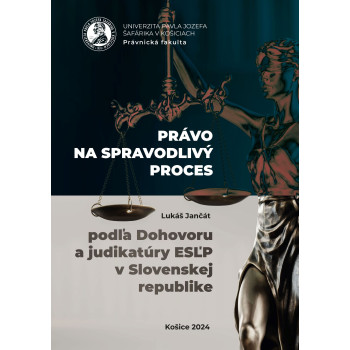
Právo na spravodlivý proces podľa Dohovoru a judikatúry ESĽP v Slovenskej republike

Právo na spravodlivý proces podľa Dohovoru a...

E-book

E-book

Lukáš Jančát

The Convention on the Protection of Human Rights and Fundamental Freedoms and the case-law of the ECtHR represent a decisive legal instrument for the evolution of the right to a fair trial in the member states of the Council of Europe and the European Union, including the Slovak Republic, which affects the minimum level of procedural guarantees for individuals in judicial and administrative proceedings.

The primary purpose of the textbook is to fill the gap consisting in the absence of a comprehensive study text for undergraduate students at Pavol Jozef Šafarik University in Košice, Faculty of Law for the planned subject Right to a fair trial in administrative issues, and doctoral students at this faculty for the subject Protection of fundamental rights and freedoms in criminal matters according to the case-law of the ECtHR.

However, this textbook is also intended as a supplementary study aid for bachelor students in order to deepen their knowledge of the subject Administrative Law II, the result of which is to acquire knowledge about procedural administrative law in the Slovak Republic, as well as the subject of European Administrative Law, the result of which is the acquisition of knowledge about the influence of Council of Europe law on the national administrative law of the Slovak Republic.
Download the e-book for free(pdf)

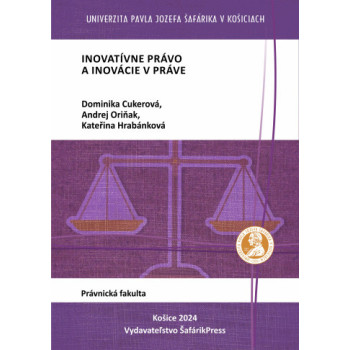
INNOVATIVE LAW & INNOVATIONS IN LAW

INNOVATIVE LAW & INNOVATIONS IN LAW

E-book

E-book

Dominika Cukerová - Andrej Oriňak - Kateřina Hrabánková (eds.)

The proceedings offers contributions from the international scientific conference of doctoral students and young researchers held on 25 April 2024 at the Faculty of Law, UPJŠ in Košice, which was thematically oriented on Innovative Law and Innovations in Law. The authors of the papers confirmed that innovation in law can take many forms. The first part of the papers, which pays attention to how law can respond to innovations, is a manifestation of this. These are the papers by Jana Cihanová, Andrej Oriňák, Denisa Rudžiková and Matej Biroš, who presented the use of deepfake technology, artificial intelligence and software tools in legal practice in the context of their legal regulation. Looking at familiar things differently can also be a source of innovation. In this vein, Dominik Mizerski, Juraj Valentovič, Lucián Török and Kateřina Hrabánková presented interpretive and application innovations in the field of private law. The third part of the papers by Michaela Szittyaiová, Natália Priateľová, Filip Baláži, Elena Lazoríková and Laura Gazdagová offers a preview of the innovations that the public law section is facing today. Finally, the fourth and last group of papers specifically explains innovations against the background of criminal law regulation. These are contributions by Michal Novák, Miroslav Srholec, Vladimír Petrila and Martina Makaturová. The variety of topics covered in this proceedings shows that each area of legal regulation can be characterised by specific innovations and, in this context, by the dynamics with which they permeate legal regulation.

Download the e-book for free (pdf)

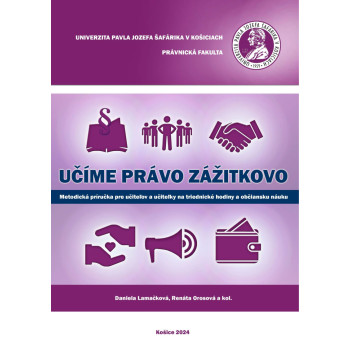
Učíme právo zážitkovo

Učíme právo zážitkovo

E-book

E-book

Daniela Lamačková-Renáta Orosová- Beáta Sakalová- Diana Repiščáková

Methodological guide for teachers for classroom lessons and civics Teaching law experientially? Is it even possible? The answers to these questions are provided by a methodological guide that uniquely links experiential learning methods with legal content. This methodological guide is a set of techniques based on the use of interactive and participatory learning methods, focusing on selected human rights and value-oriented topics, which also have the potential to develop other key competences of students, such as their communication skills, their ability to learn and educate independently, their ability to think critically, their ability to work with and analyse texts, their ability to discuss and express their opinions, and their ability to listen to each other. The methodological guide consists of a set of training activities - techniques, while each technique contains a precise description of the procedure for conducting a specific activity, the expected duration of the activity, aids, discussion topics and also a short pedagogical and legal commentary, precisely "tailored" to the specific legal topic. The legal topics are chosen to be generally applicable to both classroom and civics lessons, to raise questions about the functioning of rules and the need to respect them, mutual respect and tolerance, and to encourage reflection on the limits of individual rights and on responsibility in exercising one's rights. The techniques use training methods such as group work, brainstorming, role-playing, dealing with model situations, as well as a simulated court process. The methodological guide is intended for classroom teachers in the implementation of classroom lessons, and also for the purposes of the subject of civics, as well as for students of pedagogy at the Pavol Jozef Šafárik University in Košice.

Download e-book for free (pdf)

Hranice Československej republiky optikou Versaillského mierového systému

Hranice Československej republiky optikou...

E-book

E-book

Dominika Kováčová- Lucia Pištejová- Ivan Vaňa

The present monograph deals with the post-war settlement of relations and peace negotiations related to the settlement of the borders of the newly established Czechoslovak Republic. The work discusses in detail the negotiation processes related to the preparation and signing of the Versailles and Saint-Germain Peace Treaties. Similarly, it then discusses in detail the peripeties related to the drafting of the Treaty of Trianon dealing with the border with Hungary and its subsequent delineation in the field. Last but not least, the thesis captures the settling of Czechoslovakia's international relations with Poland and their common border, with a particular focus on the arbitration settlement on the territory of Orava and Spiš.

Download e-book for free (pdf)

Antické paradigmy a Trianonská zmluva

Antické paradigmy a Trianonská zmluva

E-book

E-book

Ľuboš Dobrovič - Vladimír Vrana

The world of diplomacy, whether ancient or modern, is naturally prone to problems associated with cultural clashes and often serves as an “unarmed battlefield” of cultural concepts. International diplomacy, however, stands on the assumption of war, as misunderstandings and cultural discrepancies lead to confusion. Cultural encounters also provide many opportunities for the choice of misunderstanding: the choice to perceive an act as an insult, even if unintended, or the choice to ignore the most blatant intentional insult, all according to momentary expediency.

The Roman historian Livy recounts an anecdote about the gates of the Temple of Janus, which, when open, signified that Rome was at war. However, the doors of the ancient Temple of Janus were closed only twice from the beginning of the 7th century BC to the end of the 1st century BC. One might ask, how many times and for how long after the signing of the Treaty of Trianon were the metaphorical gates of the European (or global) Temple of Janus closed?

The publication that the reader holds in their hands does not attempt to exhaustively answer all questions of ancient and modern international diplomacy. That is neither possible nor the goal of this scientific monograph. Authors seeking intersections between diplomacy of antiquity, the Middle Ages, and the early 20th century encountered some thought-provoking ideas and controversial debates. Indeed, what other conclusions can the topic of the Treaty of Trianon and the perpetual clash of cultures in the Mediterranean antiquity and medieval Europe bring?

We believe that the topic of ancient and modern diplomacy will inspire the reader and stimulate the professional public to new ideas, reflections, and scholarly activity.

The scientific monograph was prepared as an output of the project of the Agency for the Support of Research and Development No. APVV-19-0419: "100 years of the Treaty of Trianon."

Download the e-book for free (pdf)

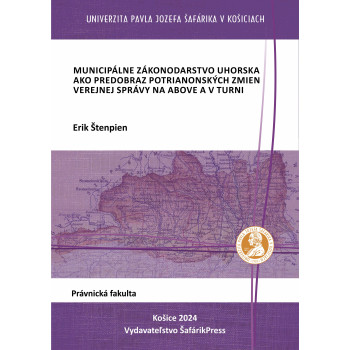
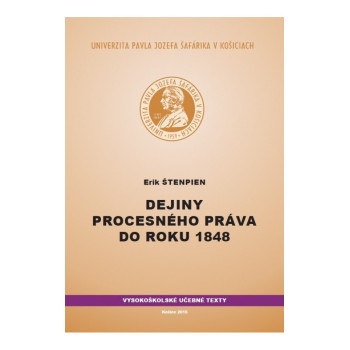
Municipálne zákonodarstvo Uhorska ako predobraz potrianonských zmien verejnej správy na Above a v Turni

Municipálne zákonodarstvo Uhorska ako predobraz...

E-book

E-book

Erik Štenpien

The presented monograph is dedicated to the reforms of local administration in the middle of the 19th century, which led to the introduction of municipalism - the nationalization of local administration. The work is primarily devoted to the analysis of the differences between legal articles 42/1870 and 21/1884, the second of which has so far been considered by Slovak legal historians as an amendment. I will explain the differences in the text of both standards, as well as by pointing out the practice of applying both standards in local practice in Abov and Turňa, the legal article 21/1884 is applicable, it is recoded and after the thresholds of the Czechoslovakia it was received as an obligation of the local sparva in Slovakia and is valid even in the time of Conclusion The Trianon peace treaty.

Download the e-book for free (pdf)

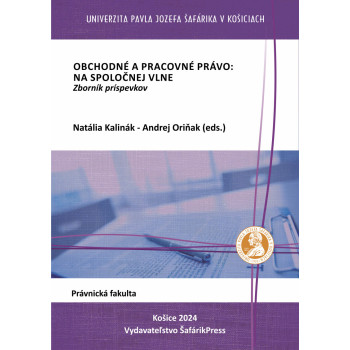
Obchodné a pracovné právo: Na spoločnej vlne

Obchodné a pracovné právo: Na spoločnej vlne

E-book

E-book

Natália Kalinák-Andrej Oriňak

The Department of Commercial Law and Economic Law together with the Department of Labour Law and Social Security Law of the Faculty of Law of UPJŠ in Košice organized the 8th annual student symposium, this time on commercial, labour and private international law, which took place at the Faculty of Law of UPJŠ in Košice on 1 December 2023. The student symposium under the title Commercial and Labour Law on a Common Wave was carried out as part of the research projects VEGA 1/0259/22 and VEGA č. 1/0291/23. The aim of the annual symposia is to create a discussion platform for students under the supervision of mentors from among the members of the department, namely teachers, researchers and PhD students. The theme of this year's symposium brought about discussion of interesting theoretical and practical legal issues thematically focused on the synergy of business law and labour law. The students addressed topical issues related to the status of entrepreneurs, the conduct of companies in labour law relations as well as the duties and responsibilities of employees. The topics of the sharing economy, gender quotas in corporate bodies and unfair bribery were not forgotten. While working on individual topics, students had the opportunity to improve their analytical thinking and argumentation skills, while they could practice writing a legal professional text, which in practice often increases the success of every lawyer. Students had the opportunity to develop their critical thinking and learn how to clearly formulate their own opinions on current legal issues. After the presentation of the papers, not only the team of lecturers and researchers, but also the students themselves engaged in a fruitful discussion, asking a number of original questions. Each student participant was awarded a certificate for their active participation in the symposium. The present proceedings are the outcome of the students' work from this event.

Download e-book for free (pdf)

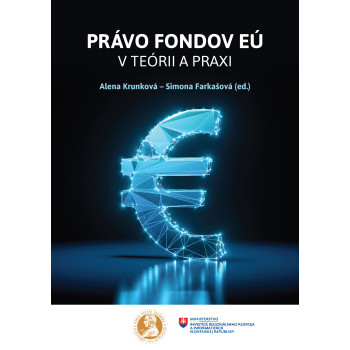
Právo fondov EÚ v teórii a praxi

Právo fondov EÚ v teórii a praxi

E-book

E-book

Alena KrunkováSimona Farkašová

Proceedings of the International Scientific Conference on EU Funds Law in Theory and Practice held on October 3, 2019, in Košice.

The conference was attended by representatives from the academic sphere, educators from the Faculty of Law at UPJŠ in Košice, who created the subject and continue to participate in its teaching. The participants included professionals from practice, such as those from the Office of the Deputy Prime Minister of the Slovak Republic for Investments and Informatization, the Office for Public Procurement of the Slovak Republic, the Supreme Audit Office of the Slovak Republic, and the Ministry of Labor, Social Affairs, and Family of the Slovak Republic. Valuable information was also shared at the conference by representatives from the Ministry of Regional Development of the Czech Republic, OECD representatives, and representatives from the European Commission's Representation in Slovakia. The presented contributions reflected current issues in a highly professional manner, identified problematic areas, and outlined suitable solutions for contentious issues.
From the individual presentations of the conference participants, it was possible to compile a work that, while not extensive in scope, is very remarkable in value. It connects theory and practice in an outstanding manner and thus expands knowledge in the still complex issue of the legal regulation of European Union funds.

Download the e-book for free (pdf)

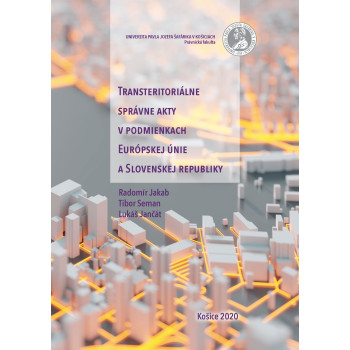
Transteritoriálne správne akty v podmienkach Európskej únie a Slovenskej republiky

Transteritoriálne správne akty v podmienkach...

E-book

E-book

Radomír JakabTibor SemanLukáš Jančát

The concept of a transterritorial administrative act is relatively new in administrative law, especially in the conditions of the Slovak Republic. It has practical applicability to the application of European Union law (including international law). Its essence lies in the fact that the effects of such an administrative act issued within one Member State exceed the territory of that Member State, have effects in other Member States, in all Member States of the European Union without being subject to the recognition process.
The purpose of the monograph is to present outputs of the scientific examination of this type of administrative acts, the definition of its characteristics and its effects, the examination of the possibilities of procedural defense against its effects by the State concerned, and possibly the possibility of unifying the action of the Member States of the European Union in case of procedural defense against the effects of transterritorial administrative acts. The monograph also contains analysis of certain types of transterrritorial administrative acts that are commonly used in the conditions of the European union and Slovak republic; they are also categorized under specific criteria.,

Download the e-book for free  (pdf)

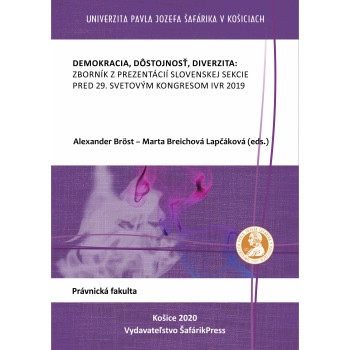
Demokracia, dôstojnosť, diverzita: Zborník z prezentácií slovenskej sekcie pred 29. svetovým kongresom IVR 2019

Demokracia, dôstojnosť, diverzita: Zborník z...

E-book

E-book

Alexander BröstlMarta Breichová Lapčáková (eds.)

Under the auspices of the Institute of Legal Theory of Gustav Radbruch and the Slovak Section of the International Association for Philosophy of Law and Social Philosophy (IVR), a 3D flash conference was held on May 16, 2019, at the Faculty of Law of UPJŠ in Košice. This event was primarily dedicated to the upcoming 29th World Congress of IVR in Lucerne, Switzerland. In line with the main theme of the congress, the conference focused on "Dignity, Democracy, Diversity." At the time of the conference, it was clear that the number of participants at the world congress would significantly exceed 1,000, with discussions taking place in 151 special workshops and 28 working groups.

During the congress, a round table was also announced featuring Professor Brian Tamanaha, recipient of the IVR award for best book for "Realistic Theory of Law" (Cambridge 2017), a meeting regarding the IVR Encyclopedia, a panel on academic freedom issues, and a gathering of chairs from national sections of IVR.

Download the e-book for free (pdf)

Evaluation of Evidence in the Tax Law

Evaluation of Evidence in the Tax Law

E-book

E-book

Jozef Sábo

The monograph deals with two fundamental aspects concerning evaluation of evidence in the law. In the first part, the monograph addresses the question: „How it is possible to apply law in individual case, if human knowledge about past is objectively limited and flawed?“ (e.g. what is the nature of truth in the law?). The second part of the monograph identifies certain models of reasoning concerning factual questions which occur across different individual legal cases (especially tax cases and criminal cases). In that regard, the monograph draws from Anglo-American legal scholarship and deals with three main concepts concerning evaluation of evidence: argumentation, probability and narratives and their role in evaluation of evidence.

The monograph is the output of the grant project APVV no. 16-0160 which deals with the issue of tax evasion and tax avoidance (especially their motivating factors, emergence, and elimination). The author believes that better understanding of evaluation of evidence may contribute to the improvement in effectiveness of tax administration.

Download the e-book for free  (pdf)

Nové výzvy ochrany zdravia zamestnancov

Nové výzvy ochrany zdravia zamestnancov

E-book

E-book

Katarína SkolodováMonika Minčičová (eds.)

Proceedings of the 5th Year of the Student Symposium of Labour Law

New trends in the digital age around the world do not avoid the labour market and the labour law relations. Do labour law standards and employers' practices correspond to the actual factors that influence an individual's physical or mental condition? Does digitization, including artificial intelligence, bring improvements or threats? Is the protection of employees' mental health paid equal attention that to the protection of physical health? The Department of Labour Law and Social Security Law of the Pavol Jozef Šafárik University in Košice examines and analyzes legal aspects of new risks that threaten and affect individual health in the work environment within the researching of the project APVV-16-0002 - Mental Health in the Workplace and Employee Health Assessment.

The members of the department, with the theme of the 5th year of the student symposium "New Challenges of Employees´ Health Protection" created an opportunity for students to search deeper current legal issues and reflect the results of their creative work in the submitted papers. The proceedings of papers of the student symposium is rich in content and offers the reader the space to get acquainted with interesting questions and application problems accompanying them.

Download the e-book for free  (pdf)

Členovia orgánov obchodnej spoločnosti. Obchodné, pracovné a socio-psychologické aspekty

Členovia orgánov obchodnej spoločnosti....

E-book

E-book

Jaroslav DolnýMonika Seilerová (eds.)

The collection of contributions from the VII. Student Symposium on Commercial Law and Labor Law held on December 5, 2019, at the Faculty of Law of Pavol Jozef Šafárik University in Košice

The theme of this year's symposium provided students with the opportunity to choose between addressing issues related to commercial law or focusing on labor law aspects concerning the position of members of the governing bodies of commercial companies, based on an analysis of legal regulations and case law.

The creative exploration of commercial law questions particularly related to areas such as the manner of acting on behalf of a commercial company, the liability of the de facto statutory body of a commercial company, information obligations of the statutory body towards its shareholders, and the remuneration for serving as a member of the board of directors of a joint-stock company. It also addressed the liability of the statutory body for the insolvency of the company and the enforcement of non-competition clauses concerning managing directors of limited liability companies.

The connection between commercial law and labor law was directed towards a legal analysis of personal data protection related to health and its misuse by members of the governing bodies of commercial companies, as well as the legitimacy of concurrently holding a position (as a member) in a statutory body with an employment relationship, and the legal status of senior employees, particularly concerning their duties and responsibilities for ensuring employee health through creating healthy working conditions.

Download the e-book for free (pdf)

Medzinárodné a európske právo v kinematografii II.

Medzinárodné a európske právo v kinematografii II.

E-book

E-book

Dominika Becková (ed.)

Proceedings of Contributions from the XIII. Year of the Student Symposium on International and European Law held on March 6, 2020, at the Faculty of Law of UPJŠ in Košice

The Student Symposium on International and European Law has its traditional place in the calendar of events at the Faculty of Law of Pavol Jozef Šafárik University in Košice. In the academic year 2019/2020, the Institute of International Law and European Law decided to continue this tradition and offer students an opportunity to present their professional opinions on selected topics and problematic issues of international and European law.

The XIII. edition of the student symposium continued from its previous year and once again focused students' attention on the institutions of international and European law depicted in films. The films processed by the participants of the symposium offer a wide range of institutions of international and European law.

In their contributions, participants addressed issues related to diplomatic law, terrorism, armed conflicts, the use of robots, environmental protection, and questions regarding the legal regime of outer space.

Download the e-book for free  (pdf)

Sankcie v pracovnom práve

Sankcie v pracovnom práve

E-book

E-book

Marcel DolobáčĽuboš DobrovičIvan Kundrát

Hypothesis, disposition, sanction. The standard tripartite structure of a legal norm, which is taught to first-year law students. Three concepts that students undoubtedly master from their perspective, yet they simultaneously challenge legal science, which repeatedly revisits them. The publication does not aim to theoretically address all aspects of the legal norm; it focuses solely on one of them, and as the title suggests, that is the sanction.

The monograph has been developed by three authors, whose contributions are equal; they engaged in debates and often could not reach a consensus. We hope that the reader will also join this debate and that the presented monograph will inspire further reflection and scientific activity.

Download the e-book for free (pdf)

Implementácia iniciatív EÚ v oblasti spotrebných daní a ich rozpočtovo-právne dopady

Implementácia iniciatív EÚ v oblasti...

E-book

E-book

Karin Cakoci et al.

The authors in the monograph focused on describing the genesis and current state of the legal regulation of consumption taxes in the Slovak Republic in interaction with the harmonization process, as well as identifying the mutual dependence of the legal regulation and revenues from consumption taxation on the effect on the state budget of the Slovak Republic.
Given the importance and justification of the researched issue, particularly in relation to the future functioning of the European Union, as well as the impact on the performance of the economies of individual member states, with an emphasis on the development and quality functioning of the single internal market, the authors, through the publication of the monograph, attempt to provoke a broader professional discussion about their own summarized presented results, which were obtained during the entire period of solving the scientific project, concerning current trends as well as perspectives in the field of EU tax policy and its influence on domestic tax legislation in the Slovak Republic in the area of consumption taxes in interaction with budgetary impacts.

The overall goal of the monograph is to present existing and own acquired knowledge related to the issue of consumption taxes in Slovakia, with an emphasis on the development of EU initiatives in this area, as well as a critical evaluation of their impact on the state budget of the Slovak Republic, and presenting possible future developments.

Download the e-book for free  (pdf)

Niekoľko poznámok k porozumeniu Zákonníka práce

Niekoľko poznámok k porozumeniu Zákonníka práce

E-book

E-book

Jana ŽuľováMilena Barinková 

Legal norms regulate everyday life. We learn about the rights and obligations that arise for us from these norms through language. It is therefore very important that they are created in such a way that all levels of society understand them, not only recipients with legal education.

The Labour Code is a norm of everyday use, and so far there is no publication that approximates or clarifies the understanding of the provisions of this law through the prism of its language. The main goal of the publication is to apply the acquired linguistic knowledge about the pitfalls of the comprehensibility of legal language for the general public to the Labour Code and thus enable its more adequate understanding. Our ambition is not a comprehensive interpretation of the provisions of the Labour Code, which give the impression of incomprehensibility for the average addressee.

We focused on selected problematic phenomena observed and identified during the solution of the VEGA grant project no. 1/0526/17 Linguistic and Sanctioning Mechanisms in the Creation and Operation of Labor Law Norms and strived for a conceptual approach to their examination enriched by empirical research.

Download the e-book for free  (pdf)

Medzinárodné a európske právo v kinematografii

Medzinárodné a európske právo v kinematografii

E-book

E-book

Lucia Bakošová (ed.)

Proceedings from the XII Student Symposium on International and European Law held on March 29, 2019, in Košice

The primary goal of films or TV series is typically not to educate their audience. However, contemporary cinematography includes a significant number of works that present issues related to international and European law to both professional and general audiences.

For this reason, the Institute of International and European Law at the Faculty of Law of Pavol Jozef Šafárik University in Košice organized the XII Student Symposium on International and European Law titled "International and European Law in Cinematography," under the auspices of Professor JUDr. Ján Klučka, CSc.

The main objective of the symposium was to popularize international and European law among students through films or series. The films analyzed during the symposium could be divided into two categories: those dramatizing real events and those creating fictional scenarios incorporating aspects of international or European law. Most contributions focused on films depicting real events, such as the genocide in Rwanda in the 1990s, the Nuremberg Trials, the occupation of the U.S. Embassy in Tehran, or the legal dispute between the heir of the painting Woman in Gold and Austria. On the other hand, works like the series MASH* were also discussed; while not based on real events, it uses its narrative to portray the lives of medical personnel in a military field hospital during the Korean War.

Download the e-book for free (pdf)

Ochrana zamestnanca perspektívou priemyselnej revolúcie 4.0

Ochrana zamestnanca perspektívou priemyselnej...

E-book

E-book

Milena Barinková (ed.)

Proceedings from the IV Annual Student Symposium on Labor Law held on April 5–6, 2019, in Danišovce

The term "Industrial Revolution 4.0" is currently widely used, yet remains mysterious and its content unfamiliar to many. While we do not claim omniscience, through the educational process at the Faculty of Law of Pavol Jozef Šafárik University in Košice and the scientific research of the Department of Labor Law and Social Security Law, we have delved into examining the accompanying features and anticipated phenomena of this modern industrial revolution.

It can be stated with great certainty that this revolution already affects—and will continue to affect—production processes, including radical changes in their structure, the emergence of groundbreaking technological and communication tools, and, undoubtedly, labor relations. The rise of new forms and methods of work based on automation and digitalization, applied within new models of labor relations, is beginning to threaten jobs in certain sectors of the economy. There is an increasing demand for specialized qualifications and skills, particularly in information technology, with an emphasis on process digitalization, data processing, and the creation of communication networks connecting objects and people. This intelligent industry inevitably disqualifies many existing jobs from their current structures, leading to job losses for numerous employees. Analysts openly predict that by 2030, robots will replace up to 20 million industrial jobs worldwide.

The vision of which occupations or working conditions will be impacted is becoming increasingly concrete. Radical changes will require radical solutions as well as previously unknown movements and new elements or measures in the labor market.

Download the e-book for free  (pdf)

Prípady z medzinárodného práva verejného

Prípady z medzinárodného práva verejného

E-book

E-book

Ľudmila ElbertĽubica Gregová Širicová (eds.)

In addition to acquiring theoretical knowledge, it is necessary to study and analyze the decisions of international judicial and arbitration bodies in order to fully understand the subject of the Public International Law or disciplines closely related to it.

Since the Slovak literature in the field of Public International Law does not contain any electronic textbook of selected decisions of international judicial and arbitration bodies, the authors of the submitted publication aim to eliminate this gap by elaborating the “Public International Law Casebook”, which will primarily be intended for undergraduate students of the law faculties in the Slovak republic and the Czech republic.

The proposed publication seeks to make the study of international law more attractive through a publication that will make students familiar with the decisions translated into the Slovak language in a popular electronic form.

Download the e-book for free (pdf)

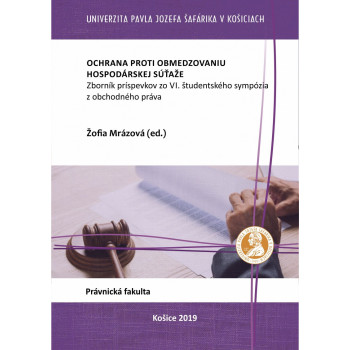
Ochrana proti obmedzovaniu hospodárskej súťaže

Ochrana proti obmedzovaniu hospodárskej súťaže

E-book

E-book

Žofia Mrázová(ed.)

Proceedings from the VI. Student Symposium on Commercial Law Held on November 28, 2018, at the Faculty of Law, Pavol Jozef Šafárik University in Košice

The Department of Commercial and Economic Law at the Faculty of Law, Pavol Jozef Šafárik University in Košice, organized the sixth annual Student Symposium on Commercial Law on November 28, 2018. The event was part of the research project VEGA 1/0917/16 titled "Atypical and De Facto Relationships in Commercial Law." The symposium aims to provide a platform for discussion among students with the guidance of mentors from the department, including professors, researchers, and doctoral candidates.

This year’s symposium focused on protection against anti-competitive practices. Unchecked anti-competitive behavior could grant economic advantages to violators at the expense of other competitors and threaten the free-market system. Students explored various challenges related to competition law, analyzing Slovak and European legal frameworks as well as court rulings and decisions by other authorities. Through their research, students honed their analytical thinking, argumentation skills, and critical reasoning. The discussions generated new perspectives and encouraged active engagement among participants.

This proceedings volume presents the outcomes of students' work from this event.

Download the e-book for free(pdf)

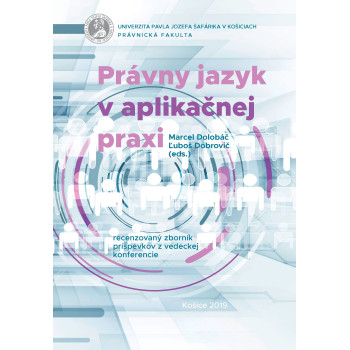
Právny jazyk v aplikačnej praxi

Právny jazyk v aplikačnej praxi

E-book

E-book

Marcel Dolobáč - Ľuboš Dobrovič (eds.)

Reviewed Proceedings of Contributions from a Scientific Conference

This reviewed collection of contributions from the scientific e-conference Legal Language in Application Practice, held from December 3 to 21, 2018, presents various academic contributions.

Legal language, as expressed in legal norms, is specific and should ideally be unambiguous, concise, and resistant to multiple interpretations. Is this an ideal world that does not exist but is worth striving for? Interpretative challenges and ambiguities in legal language and terminology (especially in the Labour Code) led the Department of Labour Law and Social Security Law at UPJŠ in Košice to undertake the VEGA grant project No. 1/0526/17 titled Linguistic and Sanction Mechanisms in the Creation and Operation of Labour Law Norms.

As part of this grant project, the department organized an e-conference open not only to labor law specialists but also to experts from other legal fields. Unsurprisingly, interpretative issues extend beyond labor law. The contributions in this collection are thus somewhat interdisciplinary, though with a focus on labor law. We hope this collection serves as an introduction to broader research and deeper study of legal language by experts beyond legal theory. Additionally, we trust these contributions will inspire you, the readers.

Authors

Download the e-book for free  (pdf)

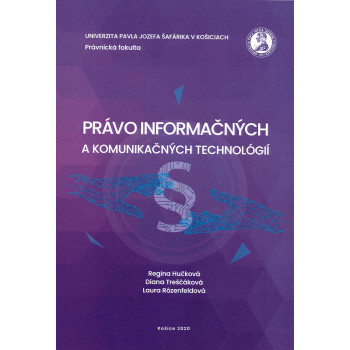
Právo informačných a komunikačných technológií

Právo informačných a komunikačných technológií

€19.50
Availability: 5 In Stock

Regina Hučková - Diana Treščáková - Laura Rózenfeldová

Vysokoškolská učebnica Právo informačných a komunikačných technológií je určená študentom vysokých škôl vo všeobecnosti, najmä však študentom Právnickej fakulty, ktorí majú záujem o štúdium práva v spojení s informačnými a komunikačnými technológiami. Učebnica predstavuje zdroj informácií potrebných nielen pre štúdium tejto problematiky, ale aj pre rozšírenie celkového obzoru v danej problematike.

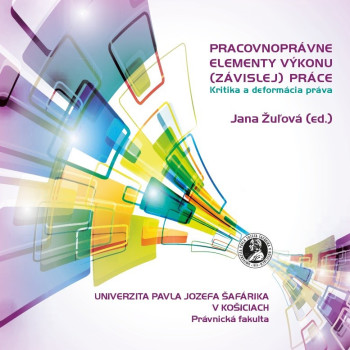
Pracovnoprávne elementy výkonu (závislej) práce. Kritika a deformácia práva.

Pracovnoprávne elementy výkonu (závislej)...

E-book

E-book

Jana Žuľová (ed.)

Collection of Scientific Works

Article 35 of the Constitution of the Slovak Republic guarantees everyone the right to freely choose their profession and receive training for it, as well as the right to engage in entrepreneurial or other gainful activity. Everyone has the right to freely decide whether to secure their livelihood through self-employment—with all the associated consequences and risks—or through employment within labor-law relationships by performing dependent work.

The framework and rules for exercising these rights are primarily regulated by labor, commercial, and tax legislation, each with its own set of rights and obligations applicable specifically to entrepreneurs and employees. Constant competitive pressure, along with the effects of economic crises, pushes employers to seek ways to extract the most from workers while optimizing for the lowest possible insurance, administrative, and tax costs. As a result, employment contracts are being terminated, and under the pressure of losing their income, individuals are "voluntarily" shifting to commercial-law relationships.

This situation, along with other distortions in the labor market, confronts those entitled to work with unfair practices by employers, thereby undermining their ability to freely exercise this fundamental right.

Download the e-book for free (pdf)

Orgány obchodných spoločností

Orgány obchodných spoločností

E-book

E-book

Kristián Csach - Dušan Rostáš (eds.)

Proceedings of the 2nd Student Symposium on Company Law In November 2014

The second annual Student Symposium on Commercial Law—more specifically, on Company Law—was held at the university’s facility in Danišovce. As in the previous year, the aim of the symposium was to provide students with a greater opportunity to articulate their own perspectives on current legal issues and to present the results of their individual work.

The theme of the second symposium focused on the governing bodies of commercial companies, aligning it thematically with the APVV research project being carried out by members of the Department of Commercial and Economic Law at our Faculty of Law. This overarching topic made it possible to assign a range of current legal issues, allowing students to explore problems they are likely to encounter in their future professional practice. The selected topics are not among those unanimously settled by legal doctrine or established case law.

On the contrary, they were deliberately chosen for their complexity and the lack of sufficient domestic literature. As a result, students had to go beyond standard textbook or commentary-based knowledge to thoroughly address their assigned topics.

Download the e-book for free (pdf)

Regionalizmus a jeho prínos pre všeobecné medzinárodné právo

Regionalizmus a jeho prínos pre všeobecné...

E-book

E-book

Ján Klučka a kol.

The presented monograph, “Regionalism and Its Contribution to General International Law,” was prepared at the Institute of European Law and the Department of International Law of the Faculty of Law at Pavol Jozef Šafárik University in Košice as part of a project of the same name (APVV-0823-11) carried out in the years 2011–2015, and represents one of its final publication outputs.

The main reason for choosing this topic was the effort to evaluate regionalism in its various forms in relation to international law, and, conversely, to assess the place, significance, and role of international law in the creation and functioning of different forms of regional groupings. In fact, although regionalism is receiving increasing attention in doctrine, a more comprehensive assessment of its impact on international law and vice versa has so far been lacking.

This monograph attempts to partially fill this gap. Against the background of a brief historical development of regionalism, as well as its substantive and terminological components, the monograph examines in greater detail the individual types of regionalism—such as old and new regionalism, as well as contractual and institutional regionalism—their specific features, and their contribution to general international law.

Attention is also devoted to a specific phenomenon of contemporary regionalism, namely the influence of the European Union on its stabilization and development, both through practical measures and through a set of measures regulated by international treaties.

Download the e-book for free (pdf)

Ochrana kultúrnych hodnôt prostriedkami medzinárodného a regionálneho práva

Ochrana kultúrnych hodnôt prostriedkami...

E-book

E-book

Adam GiertlĽudmila Elbert

Collection of Papers from the 8th Student Symposium held on April 20–21, 2015 in Danišovce

The capture of the historic Syrian city of Palmyra by fighters of the radical Islamic State caused shock among the global public. The main reason is the barbarism with which this organization proceeds, not only in relation to the treasures of the world’s cultural heritage. The situation in the Middle East, where cultural treasures of inestimable value are under direct threat, demonstrates how fragile the world’s cultural heritage is. The reaction of the international public and world leaders shows how sensitively the destruction of cultural heritage is perceived.

The quoted statement chosen by the editors relates to the threat posed by the Islamic State—however, the spirit of this statement can be applied to any cultural wealth that forms part of the world’s cultural heritage. The destruction or damage of these values primarily represents a loss for humanity as such. Each destroyed artifact of world cultural heritage signifies the disappearance of a unique legacy left by previous generations for the future. At the same time, cultural heritage must be understood as a broad spectrum of assets—both tangible and intangible. Their legal protection was the topic of this year’s symposium. As with any social interest, the protection of cultural heritage can be ensured through various mechanisms and under different forms of social organization.

These diverse approaches are unified by law as a normative system. The question for the 8th year of the symposium on international law was what role international law plays in the protection of cultural heritage. In the context of the European region, the role of the European Union as a regional organization was examined.

Download the e-book for free (pdf)

Rule of Law a medzinárodné právo

Rule of Law a medzinárodné právo

E-book

E-book

Ľudmila Elbert

The presented scientific monograph addresses the issue of the Rule of Law and its place, roles, and particularities at the level of international law. The Rule of Law is understood as a value that should govern communities, both domestic and international. It is thus compared to Kelsen’s basic norm, which should stand at the top of the legal order as the norm justifying the validity and existence of the norms of the legal order, both domestic and international.

Although the Rule of Law is studied at the international law level, it cannot be considered without understanding the Rule of Law in domestic law. Just as its development differs depending on whether it evolved within Anglo-American or continental law, its application and development also differ between domestic law and international law.

These differences are mainly caused by the roles and objectives that international Rule of Law is meant to secure, as well as by the distinct characteristics of domestic and international law.

Download the e-book for free (pdf)

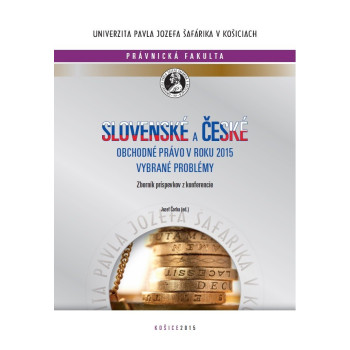
Slovenské a české obchodné právo v roku 2015: Vybrané problémy

Slovenské a české obchodné právo v roku 2015:...

E-book

E-book

Jozef Čorba(ed.)

Collection of Contributions from the Conference

On June 11–12, 2015, the Department of Commercial Law and Economic Law at the Faculty of Law, P. J. Šafárik University in Košice, organized the 13th meeting of the departments of commercial law from the law faculties of Czech and Slovak universities. This event further demonstrates that the idea of an annual gathering of representatives from these departments, initiated by Professor Bejček of the Faculty of Law at Masaryk University in Brno, has taken root and is likely to continue. Not only to preserve the tradition but primarily for the benefit of such meetings and the interest of participants to meet regularly.

A traditional part of these meetings, besides the exchange of knowledge and information about the teaching process and experience sharing, is a scientific conference focused on current issues in commercial law. This year’s conference was held under the title Slovak and Czech Commercial Law in 2015 – Selected Problems. A total of 17 contributions from various departments were included in the conference proceedings, divided into three thematic areas. The first group of contributions addresses selected issues related to the legal regulation of commercial companies and its practical implementation. The second group focuses on arbitration and insolvency law.

The third group includes contributions on the interpretation of the amended regulation of interest on late payments in commercial obligations, problems related to the application of this regulation, and issues concerning the interpretation of legal acts contained in the new Czech Civil Code. An additional part features an informational contribution on the development of Slovenian commercial law and its current form.

Ján Husár, Kristián Csach

Download the e-book for free(pdf)

This website uses cookies to ensure you get the best experience on our website