Slovenčina


E-book
Kristián Csach - Dušan Rostáš (eds.)
Proceedings of the 2nd Student Symposium on Company Law In November 2014
The second annual Student Symposium on Commercial Law—more specifically, on Company Law—was held at the university’s facility in Danišovce. As in the previous year, the aim of the symposium was to provide students with a greater opportunity to articulate their own perspectives on current legal issues and to present the results of their individual work.
The theme of the second symposium focused on the governing bodies of commercial companies, aligning it thematically with the APVV research project being carried out by members of the Department of Commercial and Economic Law at our Faculty of Law. This overarching topic made it possible to assign a range of current legal issues, allowing students to explore problems they are likely to encounter in their future professional practice. The selected topics are not among those unanimously settled by legal doctrine or established case law.
On the contrary, they were deliberately chosen for their complexity and the lack of sufficient domestic literature. As a result, students had to go beyond standard textbook or commentary-based knowledge to thoroughly address their assigned topics.

Data sheet
E-book
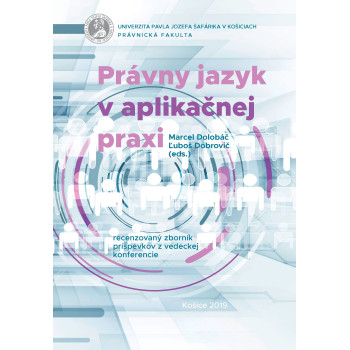
Marcel Dolobáč - Ľuboš Dobrovič (eds.)
Reviewed Proceedings of Contributions from a Scientific Conference
This reviewed collection of contributions from the scientific e-conference Legal Language in Application Practice, held from December 3 to 21, 2018, presents various academic contributions.
Legal language, as expressed in legal norms, is specific and should ideally be unambiguous, concise, and resistant to multiple interpretations. Is this an ideal world that does not exist but is worth striving for? Interpretative challenges and ambiguities in legal language and terminology (especially in the Labour Code) led the Department of Labour Law and Social Security Law at UPJŠ in Košice to undertake the VEGA grant project No. 1/0526/17 titled Linguistic and Sanction Mechanisms in the Creation and Operation of Labour Law Norms.
As part of this grant project, the department organized an e-conference open not only to labor law specialists but also to experts from other legal fields. Unsurprisingly, interpretative issues extend beyond labor law. The contributions in this collection are thus somewhat interdisciplinary, though with a focus on labor law. We hope this collection serves as an introduction to broader research and deeper study of legal language by experts beyond legal theory. Additionally, we trust these contributions will inspire you, the readers.
Authors
E-book
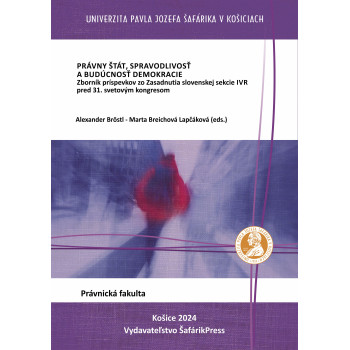
Alexander Bröstl - Marta Breichová Lapčáková (eds.)
Collection of papers from session of the slovak section of the IVR
In accordance with its name, the collection is devoted to three framework areas consisting of the rule of law, justice and the future of democracy, reflecting the focus of the 31st World Congress of the International Association for the Philosophy of Law and Social Philosophy (IVR). Published contributions of the slovak section of the IVR are devoted to the present questions of the rule of law in relation to the democratic legal state. Principles of the rule of law and present questions connected to the democratic character of the Slovak republic, including the democratic procedures on the local level, are juxtaposed with shifts on the international and global scene. Individual contributions are thus devoted to the technical and biotechnological challenges of contemporary democracy, the manifestation of game theory in the search for consensus in collegial judicial bodies, or to the concept of loyal opposition in the ongoing judicial dialogue surrounding the application of law in the european legal space. Space is also devoted to the universal questions of the nature of legal science, and to the present and future of the rule of law. The collection thus goes beyond the borders of the slovak legal space and aims to understand current trends in a broader context.
E-book
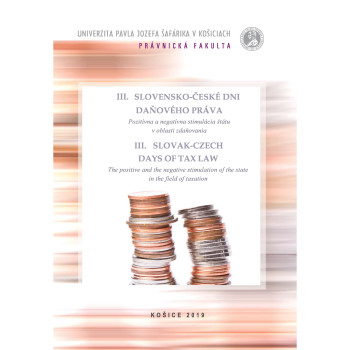
Vladimír Babčák - Adrián Popovič - Jozef Sábo (eds.)
Within the project APVV-16-0160 "Tax evasion and tax avoidance (motivation factors , formation and elimination)" was organized conference called III. SLOVAK-CZECH DAYS OF TAX LAW " Positive and Negative Stimulation of the State in the Area of Taxation ". From this conference was prepared the eponymous output in the form of reviewed proceedings of scientific works.
In this publication is published the contributions from several prominent personalities of tax law science in Slovakia and the Czech Republic. lndividual contributions map tax legislation and also changes due to the development of tax legislation , especially under the influence of European Union law. Th ese changes are approached in the context of their specific economic impacts and their impact on status and legal relations in the business and social field . The main topics elaborated in the individual contributions are in particular: EU activities in relation to tax fraud and tax evasion, the impact of tax construction on the act of the addressees of tax law and tax policy of the state and its economic impacts.
The publication presents one of the most actual topics in the current legal and economic environment.
Prof. h.c. prof. JUDr. Vladimír Babčák, CSc.
E-book
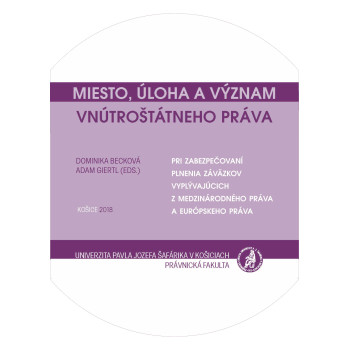
Dominika Becková - Adam Giertl (eds.)
Collection of Papers of PhD. students and young researchers
Institute of International Law and European Law offered a place to PhD. students and young researchers to publish scientific outputs of their research. Submited collection of scientific contributions is the result of that initiative. Papers deal with the implementation of international law and law of the EU into the domestic legal system.
Thematically is the collection of contributions divided into several parts, that are dedicated to contributions dealing with the issues of legal theory and international and european law.
Contributions are addressing issues of human rights protection, they aim to the roles of international and supranational judiciary, environment, criminal and public law. Collection of contributions includes also chosen problems of private law and it also dedicates space for contributions focused on foreign investments.