Slovenčina


E-book
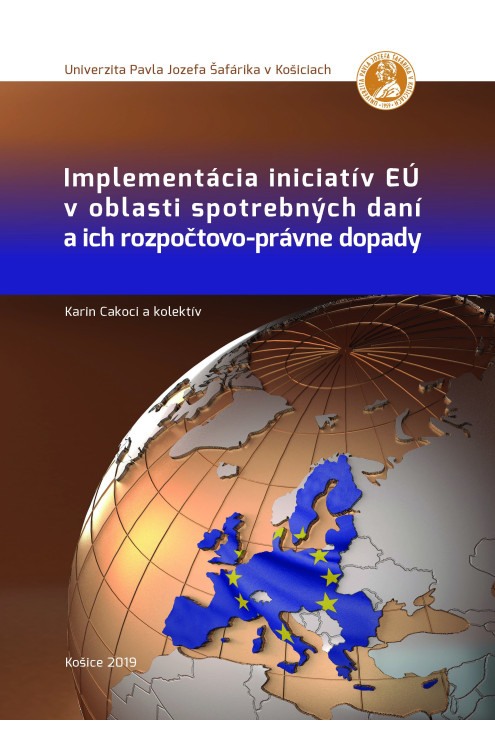
Karin Cakoci et al.
The authors in the monograph focused on describing the genesis and current state of the legal regulation of consumption taxes in the Slovak Republic in interaction with the harmonization process, as well as identifying the mutual dependence of the legal regulation and revenues from consumption taxation on the effect on the state budget of the Slovak Republic.
Given the importance and justification of the researched issue, particularly in relation to the future functioning of the European Union, as well as the impact on the performance of the economies of individual member states, with an emphasis on the development and quality functioning of the single internal market, the authors, through the publication of the monograph, attempt to provoke a broader professional discussion about their own summarized presented results, which were obtained during the entire period of solving the scientific project, concerning current trends as well as perspectives in the field of EU tax policy and its influence on domestic tax legislation in the Slovak Republic in the area of consumption taxes in interaction with budgetary impacts.
The overall goal of the monograph is to present existing and own acquired knowledge related to the issue of consumption taxes in Slovakia, with an emphasis on the development of EU initiatives in this area, as well as a critical evaluation of their impact on the state budget of the Slovak Republic, and presenting possible future developments.

Data sheet
E-publication
Laura Gazdagová-Bartolomej Mižák-Vladyslava Kryvoshei
Technological development is increasingly reshaping the environment in which international law operates. Rapid digitalization, global interconnectedness, and the emergence of new technologies raise questions that traditional legal norms are not always prepared to address. New forms of cross-border interactions, security challenges, and ethical dilemmas influence the functioning of states, international organizations, and other actors. Against this backdrop, discussions are evolving on how international law can maintain its relevance in an era of rapid innovation and how it may adapt to a dynamic technological landscape.
Download the e-book for free
E-book
Reviewed proceedings from the student symposium organized on the occasion of IV. Slovak-Czech days of tax law.
The International Scientific Conference IV. Slovak-Czech days of tax law was held 16th - 18th June 2021 in Košice (Faculty of Law of Pavol Jozef Šafárik University in Košice). On this occasion, a student symposium on the topic: "Current Challenges of Tax Law" was organized for students of the Pavol Jozef Šafárik University Faculty of Law in Košice on 15th June 2021. The focus of the symposium was chosen due to the content of the grant project APVV-19-0124 entitled "Tax law and new phenomena in the economy (digital services, shared economy, virtual currencies)", which is currently being addressed at the Department of Financial Law, Tax Law and Economy, Faculty of Law, Pavol Jozef Šafárik University in Košice. The output of this symposium is a reviewed proceeding of papers, in which students focus on examining the current challenges of tax law. In this context, students examine not only the current challenges in the field of real estate tax and the introduction of taxation based on their market value of real estate, the decision-making of the Court of Justice of the European Union in the field of direct taxation and indirect taxation, but also new and extremely current taxation issues of cryptoactive (virtual currency) taxation, not only in the Slovak Republic but also in the world. The authors also assess in detail the current situation in the research area, and they also present de lege ferenda proposals that could contribute to the development and improvement of several aspects of taxation, which is a benefit not only for legal science but also for application practice.
Download e-book for free (pdf)
Radomír Jakab - Peter Molitoris
Predkladaná učebnica má slúžiť ako učebná pomôcka v pedagogickom procese v rámci študijných predmetov zameraných na správne právo procesné. Z hľadiska štruktúry a obsahových náležitostí reflektuje požiadavky, ktoré sú požadované pre účely postupových skúšok a štátnej skúšky na Právnickej fakulte a Fakulte verejnej správy Univerzity Pavla Jozefa Šafárika v Košiciach. Rovnako, je využiteľným zdrojom informácií aj pre potreby štúdia na iných právnických fakultách v rámci Slovenskej republiky. V neposlednom rade, môže byť vhodnou pomôckou i pre aplikačnú prax, a to tak na orgánoch verejnej správy, na súdoch, ako aj pre advokátov prichádzajúcich do styku so správnym konaním.
E-book
Alexander Bröstl - Marta Breichová Lapčáková (eds.)
The presented Collection Volume is dedicated to three framework areas, namely justice, community and freedom. These are the thematic areas of the 30th IVR World Congress, on the occasion of which a meeting of its Slovak section was held. The published contributions focus on the main topic of the congress, which is also the central topic of legal and social sciences. Thus, in the Collection we will find reflections on the freedom of the individual in society, its various shades of meaning and forms. The question of the organization of social relations in the form of the degree of participation of citizens in state power in the context of the democratic form of government and its current challenges should not be neglected either. Thus, the institutions of direct and indirect democracy, the dangers of the lures of the so-called totalitarian democracy, or the question of identities in a postmodern pluralistic society. The question of justice in procedural law is not avoided either.
The collection thus provides the reader with a wide area of research from legal-philosophical questions, through questions of the theory of the constitutional state, to their application in legal practice. Geographically, it maps the events in the Central European and wider European area with an impact on their global dimension. The publication can thus become a useful source of knowledge and current developments in jurisprudence and its main topics with the aim of a better understanding of social reality.