Alternatívne spôsoby výkonu trestov
Sergej Romža a kolektív
OBSAH:
1 HISTORICKO-PRÁVNE ASPEKTY
2 KOMPARATÍVNE ASPEKTY
3 JURISTICKÉ ASPEKTY
4 KRIMINOLOGICKÉ ASPEKTY
5 PENOLOGICKÉ ASPEKTY
6 VIKTIMOLOGICKÉ ASPEKTY
7 ORGANIZAČNO TECHNICKÉ ASPEKTY

Zavolajte nám:
+421 55 234 1635E-book
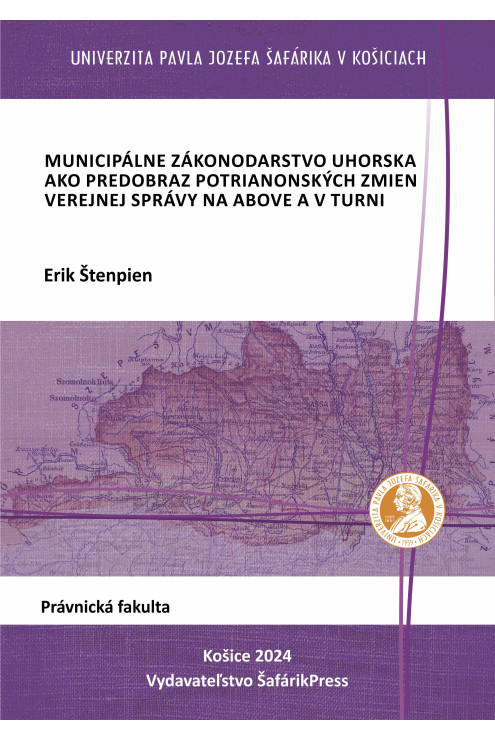
The presented monograph is dedicated to the reforms of local administration in the middle of the 19th century, which led to the introduction of municipalism - the nationalization of local administration. The work is primarily devoted to the analysis of the differences between legal articles 42/1870 and 21/1884, the second of which has so far been considered by Slovak legal historians as an amendment. I will explain the differences in the text of both standards, as well as by pointing out the practice of applying both standards in local practice in Abov and Turňa, the legal article 21/1884 is applicable, it is recoded and after the thresholds of the Czechoslovakia it was received as an obligation of the local sparva in Slovakia and is valid even in the time of Conclusion The Trianon peace treaty.
Data sheet
Sergej Romža a kolektív
OBSAH:
1 HISTORICKO-PRÁVNE ASPEKTY
2 KOMPARATÍVNE ASPEKTY
3 JURISTICKÉ ASPEKTY
4 KRIMINOLOGICKÉ ASPEKTY
5 PENOLOGICKÉ ASPEKTY
6 VIKTIMOLOGICKÉ ASPEKTY
7 ORGANIZAČNO TECHNICKÉ ASPEKTY
E-book
Adrián Popovič - Jozef Sábo - Anna Vartašová (eds.)
Reviewed proceedings from the IV. annual student symposium
E-book
Žofia Šuleková (ed.)
Proceedings of the Contributions from the IV. Student Symposium on Corporate Law held on November 24-25, 2016, at the Training Facility of Pavol Jozef Šafárik University in Danišovce.
The Department of Commercial Law and Economic Law at the Faculty of Law of Pavol Jozef Šafárik University in Košice organized the fourth edition of the student symposium, this time focusing on corporate law.
The event took place on November 24-25, 2016, at the training facility of Pavol Jozef Šafárik University in Danišovce. The aim of the annually organized symposiums is to create a discussion platform for students with the participation of mentors from the department, including teachers, researchers, and doctoral students. This year’s symposium focused on problematic issues related to the legal status of a partner in a commercial company. The topics were assigned to allow students to demonstrate and develop their analytical and argumentative skills while improving their ability to present and formulate their own views and perspectives.
The presented proceedings are the outcome of the students' work from this event.
E-publication
The proceedings of student papers from the V. Annual Student Symposium represent a collection of analytical and comparative studies in the fields of tax policy, public finance, and financial law, reflecting the current challenges of the Slovak and European economies. The authors (students) focus on a wide range of topics – from considerations regarding the reintroduction of inheritance tax in Slovakia, through issues of tax evasion and abuse of law in taxation, to measures aimed at public finance consolidation. The authors (students) in their contributions also analyse practical aspects of tax administration, such as tax enforcement proceedings, case law concerning the burden of proof, and the financing of civic associations through tax assignation mechanisms. Particular attention is paid to modern challenges of tax policy, including the taxation of digital giants, financial transaction tax, and the regulation of crypto-asset service provision in the V4 countries. The proceedings also highlight the connection between tax instruments, the financing of cultural institutions, and the broader social context of public expenditures. The publication thus offers a comprehensive overview of current trends and perspectives in the field of taxation and public finance within the conditions of the Slovak Republic and the European Union.
Download the e-book for free
E-book
Jana Žuľová - Denisa Rudžiková
In the environment of Slovak employers, an active approach to diversity and inclusion in the workplace is coming to the fore. Targeted diversity and inclusion programs help make employers more attractive on the labor market and attract more job seekers. Proactively, better working conditions are created for employees with responsibilities to the family (in most cases still in relation to mothers), groups of people who have been on the fringes of interest until now are also employed (elderly, disabled, LGBT groups, minorities, graduates of secondary and higher education schools).
The presented collection of abstracts responds to the outlined facts, which is a grouping of the starting motives and conclusions of the contributions presented at the scientific conference Diverse and inclusive workplaces - legislative starting points organized by the department of labor law and social security law of the Faculty of Law of the P. J. Šafárik University in Košice, which took place on September 29, 2023 in a hybrid form.
With their abstracts, the authors point to a range of problematic areas that are not only a reflection of academic considerations, but also those legal questions that have to be dealt with in ordinary legal practice. The goal is to use analysis and explanation to define the existing labor law measures/tools applicable to the implementation of diversity and inclusion in the workplace according to the current Slovak legal framework and the EU legal framework and thus emphasize the starting point of any effort to build diversity and the implementation of inclusion in the workplace.
Download e-book for free (pdf)
E-book
Erik Štenpien (ed.)
Proceedings of the International Scientific Conference held on September 27, 2013, at the Faculty of Law of UPJŠ in Košice
The Civil Code is one of the fundamental legal codifications of our time. Paradoxically, in the Slovak Republic, the 1964 Code still applies today, albeit with certain modifications brought by the modern era. Currently, recodification efforts are underway, with the goal of adopting a new Civil Code.
However, it is not possible to build something new without knowledge of the old. It is therefore a positive sign when legal historians and civil law experts come together at a conference to exchange views and insights. The Department of State and Legal History at the Faculty of Law in Košice is in its first year of working on the scientific grant project VEGA: The Historical-Legal Development of the Institute of the Sales Contract and Trends in Its Current Recodification in the Slovak Republic - No. 1/0131/13.
This project was acquired as a historical-legal initiative, but the Department of Civil Law is also participating, as Assoc. Prof. JUDr. K. Kirstová, CSc., is the deputy head of the project. Aware that this represents a completely unique connection between legal history and practice, our department organized the international scientific conference The Sales Contract - History and Present I. on September 27, 2013, which was a planned grant output but ultimately coincided with the 40th anniversary of the Faculty of Law in Košice.
This proceedings volume thus summarizes contributions from the grant project, as well as related presentations. It aims to significantly contribute to the understanding of the history and current recodification efforts of the sales contract institution both domestically and internationally.
E-book
Adam Giertl (ed.)
Collection of Papers from the 9th Annual Student Symposium on International and European Law held on April 22, 2016 at the Faculty of Law, Pavol Jozef Šafárik University in Košice
As indicated by the very title of the 9th Annual Student Symposium on International and European Law, “Current Issues of Migration from the Perspective of International Law with Special Regard to the Charter of Fundamental Rights of the European Union,” the participants focused on the highly topical subject of European migration, which they examined from various aspects of both international and Union law (a total of 9 contributions).
In assessing the role of individual actors primarily involved in addressing the problems arising from migration to Europe, particular emphasis was placed on the role of international specialized organizations, which often provide direct assistance to migrants “in the field” through humanitarian or medical aid. However, this is not the only response of the international community, as it is complemented by the activities of the concerned states as well as various non-governmental organizations and volunteers. Regarding the evaluation of the European Union’s activities, the symposium participants agreed that the mass migration wave caught the EU relatively unprepared—institutionally, legislatively, and technically—accompanied by a lack of clarity in adopting a fundamental approach to this reality.
It was also emphasized that these shortcomings occurred despite the fact that developments in the preceding period clearly signaled the possibility of gradual migration to the European Union escalating into a mass phenomenon. According to the participants, additional ex post and sometimes delayed measures adopted in response to the ongoing migration process contributed to an overall increase in political tension within the EU and divided its member states into opposing camps.
E-book
Dominika Becková (ed.)
Proceedings of Contributions from the XIII. Year of the Student Symposium on International and European Law held on March 6, 2020, at the Faculty of Law of UPJŠ in Košice
The Student Symposium on International and European Law has its traditional place in the calendar of events at the Faculty of Law of Pavol Jozef Šafárik University in Košice. In the academic year 2019/2020, the Institute of International Law and European Law decided to continue this tradition and offer students an opportunity to present their professional opinions on selected topics and problematic issues of international and European law.
The XIII. edition of the student symposium continued from its previous year and once again focused students' attention on the institutions of international and European law depicted in films. The films processed by the participants of the symposium offer a wide range of institutions of international and European law.
In their contributions, participants addressed issues related to diplomatic law, terrorism, armed conflicts, the use of robots, environmental protection, and questions regarding the legal regime of outer space.
E-book
Ján Klučka - Ľuboslav Sisák - Laura Gazdagová (eds.)
This publication captures the conference proceedings of the international scientific conference "20 years in the European Union in terms of law and the era of sustainability". The conference took place on 3rd September 2024 at the Faculty of Law, Pavol Jozef Šafárik University in Košice, in hybrid form.
The first part of the conference proceedings includes contributions concerning EU law in proceedings before the Constitutional Court of the Slovak Republic with focus to current issues and challenges after 20 years of membership of the Slovak Republic in the EU, European law from the perspective of international constitutionalism in a green coat, the impact of the entry of the Baltic states into the European Union on the question of the nationality of natural persons, the single digital market in the context of the Slovak Republic, the impact of European Union law in the field of personal data protection on the territory of the Slovak Republic, the principle of environmental protection in economic competition and international jurisdiction for private law claims for compensation for damage caused to the environment.
The second part of the conference proceedings includes contributions concerning the process of enshrining human right to environment in international law and European law, the development of biodiversity protection in the EU, NATO´s role in climate change response to meet the sustainability and suing tort damages from the Dieselgate emissions scandal.
E-book
Adrián Popovič - Jozef Sábo - Anna Vartašová (eds.)
The International Scientific Conference on the topic Condition and perspectives of public finances in the EU was held 2nd – 3rd June 2022in Košice focused on the topics of the EU Budget and Real Estate in taxation. On this occasion, a student symposium on the topic: "Condition and perspectives of financial law and tax law" was organized for students of the Pavol Jozef Šafárik University Faculty of Law in Košice on 1st June 2022. The focus of the symposium was chosen due to the content of the grant project VEGA no. 1/0485/21: „Simultaneity and possibilities of reforming the system of own resources of the EU budget (legal and economic aspects also in the context of the consequences of the COVID-19 pandemic)“, of the grant project VEGA no. 1/0214/21: „Taxation of real property – legal status and potential“ and of the grant project APVV-19-0124 entitled "Tax law and new phenomena in the economy (digital services, shared economy, virtual currencies)", which are currently being addressed at the Department of Financial Law, Tax Law and Economy, Faculty of Law, Pavol Jozef Šafárik University in Košice.
The output of this symposium is a reviewed proceeding of papers, in which students focus on examining the current challenges of financial law and tax law. In this context, students examine not only the issue of current challenges in the field of real estate tax and the introduction of taxation based on their market value of real estate and the institute of remedies in tax procedural law, but also the current issue of EU budget law with a focus on the revenue side of the EU budget.
The authors also assess in detail the current situation in the research area, and they also present de lege ferenda proposals that could contribute to the development and improvement of several aspects of taxation, which is a benefit not only for legal science but also for application practice.
E-book
Daniela Lamačková-Renáta Orosová- Beáta Sakalová- Diana Repiščáková
Methodological guide for teachers for classroom lessons and civics Teaching law experientially? Is it even possible? The answers to these questions are provided by a methodological guide that uniquely links experiential learning methods with legal content. This methodological guide is a set of techniques based on the use of interactive and participatory learning methods, focusing on selected human rights and value-oriented topics, which also have the potential to develop other key competences of students, such as their communication skills, their ability to learn and educate independently, their ability to think critically, their ability to work with and analyse texts, their ability to discuss and express their opinions, and their ability to listen to each other. The methodological guide consists of a set of training activities - techniques, while each technique contains a precise description of the procedure for conducting a specific activity, the expected duration of the activity, aids, discussion topics and also a short pedagogical and legal commentary, precisely "tailored" to the specific legal topic. The legal topics are chosen to be generally applicable to both classroom and civics lessons, to raise questions about the functioning of rules and the need to respect them, mutual respect and tolerance, and to encourage reflection on the limits of individual rights and on responsibility in exercising one's rights. The techniques use training methods such as group work, brainstorming, role-playing, dealing with model situations, as well as a simulated court process. The methodological guide is intended for classroom teachers in the implementation of classroom lessons, and also for the purposes of the subject of civics, as well as for students of pedagogy at the Pavol Jozef Šafárik University in Košice.
Download e-book for free (pdf)
E-book
Dominika Kováčová- Lucia Pištejová- Ivan Vaňa
The present monograph deals with the post-war settlement of relations and peace negotiations related to the settlement of the borders of the newly established Czechoslovak Republic. The work discusses in detail the negotiation processes related to the preparation and signing of the Versailles and Saint-Germain Peace Treaties. Similarly, it then discusses in detail the peripeties related to the drafting of the Treaty of Trianon dealing with the border with Hungary and its subsequent delineation in the field. Last but not least, the thesis captures the settling of Czechoslovakia's international relations with Poland and their common border, with a particular focus on the arbitration settlement on the territory of Orava and Spiš.
Download e-book for free (pdf)
E-book
Erik Štenpien - Ivan Svatuška (eds.)
The Collection of scientific Contributions of the International scientific conference: 100 Years of Treaty of Trianon – Diplomacy, State and Law on the Turn of the Century.
The presented publication is the first of a series of proceedings published within the solution of the grant APVV-19-0419. The conference took place from 14 to 15 October 2021 with the participation of experts from Slovakia, Hungary and Poland. The ambition of the research team, composed of legal historians and positive lawyers from three countries, is to provide a comprehensive, unbiased view of the peace negotiations that resulted in the Treaty of Trianon with Hungary. The conference, the result of which is the presented collection, was devoted to the causes of possible disputes in Europe - focusing on diplomacy and constitutional development of Central European countries at the turn of the 19th and 20th centuries, ie in the period immediately preceding the outbreak of World War I.
E-book
Adrián Popovič - Jozef Sábo - Anna Vartašová
Reviewed Proceedings of the 3rd Annual Student Symposium
The Intemational Scientific Conference - V. Slovak-Czech days of tax law on the topic Tax Law and New Phenomena in the Economy was held 5th - 6th June 2023 in Košice. Onthis occasion, a student symposium on the topic: "Financial Law and Tax Law in the 21st Century" was organized for students of the Pavol Jozef Šafárik University Faculty of Law in Košice on 7th June 2023. The focus of the symposium was chosen due to the content of thegrant project VEGA no. 1/0485/21: "Simultaneity and possibilities of reforming the system ofown resources of the EU budget (legal and economic aspects also in the context of the consequences of the COVID-19 pandemic) ",of the grant project VEGA no.1/0214/21: "Taxa/ionof real property - legal status and polential" and of the grant project APVV-19-0124 entitled" Tax law and new phenomena in the economy (digital services, sharedeconomy,virtualcurrencies) ", which are currently being addressed at the Department of Financial Law, Tax Law and Economy, Faculty of Law, Pavol Jozef Šafárik University in Košice.
The output of this symposium is a reviewed proceeding of papers, in which students focus on examining the issues of new phenomena in the digital economy (virtual currencies and the shared economy), but also the iss ues of the budget process, thedecision - making activity of the Court of Justice of the EU and theoretical - legal issues of tax justice with regard to the development of tax law.
The authors also assess in detail the current situation in the research area, and they also present de lege ferenda proposals that could contribute to the development and improvementof several aspects of taxation, which is a benefit not only for legal science but also for application practice.
Download e-book for free (pdf)
E-book
Marcel Dolobáč - Ľuboš Dobrovič (eds.)
Reviewed Proceedings of Contributions from a Scientific Conference
This reviewed collection of contributions from the scientific e-conference Legal Language in Application Practice, held from December 3 to 21, 2018, presents various academic contributions.
Legal language, as expressed in legal norms, is specific and should ideally be unambiguous, concise, and resistant to multiple interpretations. Is this an ideal world that does not exist but is worth striving for? Interpretative challenges and ambiguities in legal language and terminology (especially in the Labour Code) led the Department of Labour Law and Social Security Law at UPJŠ in Košice to undertake the VEGA grant project No. 1/0526/17 titled Linguistic and Sanction Mechanisms in the Creation and Operation of Labour Law Norms.
As part of this grant project, the department organized an e-conference open not only to labor law specialists but also to experts from other legal fields. Unsurprisingly, interpretative issues extend beyond labor law. The contributions in this collection are thus somewhat interdisciplinary, though with a focus on labor law. We hope this collection serves as an introduction to broader research and deeper study of legal language by experts beyond legal theory. Additionally, we trust these contributions will inspire you, the readers.
Authors
E-book
Peter Molnár - Viktória Koľveková - Miroslava Kušníriková - Renáta Romanová - Lukáš Macko (eds.)
Recenzovaný zborník vedeckých prác z medzinárodnej vedeckej konferencie Košické dni súkromného práva IV., ktorá sa konala v dňoch 15. až 17. júna 2022, je čiastkovým výstupom riešenia grantovej úlohy projektu schváleného Vedeckou grantovou agentúrou Ministerstva školstva, vedy, výskumu a športu Slovenskej republiky a Slovenskej akadémie vied pod registračným číslom 1/0765/20 s názvom „Ochrana ľudských hodnôt v súkromnom práve v kontexte moderných trendov a prebiehajúcej rekodifikácie súkromného práva“.
Predkladaný zborník vedeckých prác je výstupom zo 4. ročníka medzinárodnej vedeckej konferencie Košické dni súkromného práva IV. organizovanej Katedrou občianskeho práva, Právnickej fakulty UPJŠ v Košiciach. Publikačné výstupy autorov sú tematicky orientované najmä na výskumný projekt VEGA č. 1/0765/20 "Ochrana ľudských hodnôt v súkromnom práve v kontexte moderných trendov a prebiehajúcej rekodifikácie súkromného práva" riešený organizátormi konferencie. Jednotlivé príspevky sú rozdelené do troch sekcií – občianske právo hmotné, civilné právo procesné, právo duševného vlastníctva. Rozdelenie sekcií reflektuje na jednotlivé výskumné oblasti vymedzené v rámci projektu.
This website uses cookies to ensure you get the best experience on our website