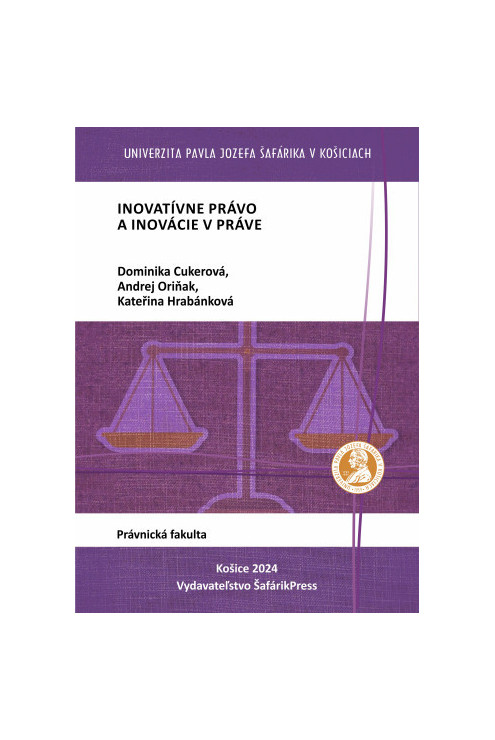
INNOVATIVE LAW & INNOVATIONS IN LAW

E-book

Dominika Cukerová - Andrej Oriňak - Kateřina Hrabánková (eds.)

The proceedings offers contributions from the international scientific conference of doctoral students and young researchers held on 25 April 2024 at the Faculty of Law, UPJŠ in Košice, which was thematically oriented on Innovative Law and Innovations in Law. The authors of the papers confirmed that innovation in law can take many forms. The first part of the papers, which pays attention to how law can respond to innovations, is a manifestation of this. These are the papers by Jana Cihanová, Andrej Oriňák, Denisa Rudžiková and Matej Biroš, who presented the use of deepfake technology, artificial intelligence and software tools in legal practice in the context of their legal regulation. Looking at familiar things differently can also be a source of innovation. In this vein, Dominik Mizerski, Juraj Valentovič, Lucián Török and Kateřina Hrabánková presented interpretive and application innovations in the field of private law. The third part of the papers by Michaela Szittyaiová, Natália Priateľová, Filip Baláži, Elena Lazoríková and Laura Gazdagová offers a preview of the innovations that the public law section is facing today. Finally, the fourth and last group of papers specifically explains innovations against the background of criminal law regulation. These are contributions by Michal Novák, Miroslav Srholec, Vladimír Petrila and Martina Makaturová. The variety of topics covered in this proceedings shows that each area of legal regulation can be characterised by specific innovations and, in this context, by the dynamics with which they permeate legal regulation.

Download the e-book for free (pdf)

Quantity

978-80-574-0346-3

Data sheet

Method of publication:
E-book (pdf)
Editors:
Dominika Cukerová - Andrej Oriňak - Kateřina Hrabánková
Document type:
Proceedings
Available from:
01.08.2024
Year of publication:
2024
Edition:
1st edition
Publication language:
Slovak
Faculty:
Faculty of Law
Note:
Zborník bol vydaný v rámci riešenia grantových úloh APVV-19-0424 „Inovatívna obchodná spoločnosť: vnútrokorporátne premeny, digitálne výzvy a nástup umelej inteligencie“ a APVV-21-0336 „Analýza súdnych rozhodnutí metódami umelej inteligencie“.
- Free for download

16 other products in the same category:

Aktuálne problémy medzinárodného leteckého a...

E-book

E-book

Adam Giertl (ed.)

Proceedings from the VII. annual student symposium on international law held on April 11-12, 2014 at the UPJŠ training facility in Danišovce

Despite this, flying and space travel are now a common part of human civilization. What is the role of law in this process? This is the question posed by the organizers of the VII. annual student symposium on international law, aiming to evaluate the contribution of international law in the field of aviation and space flights, especially in light of current developments.

The individual topics were tackled by second, third, and higher-year students of the Faculty of Law at UPJŠ in Košice. The result of their work on the assigned topics, which the authors could consult with members of the Institute of European Law and the Department of International Law, is the presented work.

The proceedings are thematically divided into two parts. The first part acquaints the reader with selected topics related to aviation law, and the second part is dedicated to international space law.

With its focus, the proceedings also have a broader impact, as in some aspects it fits into the broader context of research conducted at the Institute of European Law and the Department of International Law, which focuses on examining the influence of regionalism on general international law and vice versa. This issue is also reflected in the topics of the individual contributions.

Download the e-book for free (pdf)

The place, role and significance of domestic law

E-book

E-book

Dominika BeckováAdam Giertl (eds.)

Collection of Papers of PhD. students and young researchers

Institute of International Law and European Law offered a place to PhD. students and young researchers to publish scientific outputs of their research. Submited collection of scientific contributions is the result of that initiative. Papers deal with the implementation of international law and law of the EU into the domestic legal system.

Thematically is the collection of contributions divided into several parts, that are dedicated to contributions dealing with the issues of legal theory and international and european law.

Contributions are addressing issues of human rights protection, they aim to the roles of international and supranational judiciary, environment, criminal and public law. Collection of contributions includes also chosen problems of private law and it also dedicates space for contributions focused on foreign investments.

Download the e-book for free  (pdf)

Spravodlivosť, spoločenstvo, sloboda

E-book

E-book

Alexander BröstlMarta Breichová Lapčáková (eds.)

The presented Collection Volume is dedicated to three framework areas, namely justice, community and freedom. These are the thematic areas of the 30th IVR World Congress, on the occasion of which a meeting of its Slovak section was held. The published contributions focus on the main topic of the congress, which is also the central topic of legal and social sciences. Thus, in the Collection we will find reflections on the freedom of the individual in society, its various shades of meaning and forms. The question of the organization of social relations in the form of the degree of participation of citizens in state power in the context of the democratic form of government and its current challenges should not be neglected either. Thus, the institutions of direct and indirect democracy, the dangers of the lures of the so-called totalitarian democracy, or the question of identities in a postmodern pluralistic society. The question of justice in procedural law is not avoided either.

The collection thus provides the reader with a wide area of research from legal-philosophical questions, through questions of the theory of the constitutional state, to their application in legal practice. Geographically, it maps the events in the Central European and wider European area with an impact on their global dimension. The publication can thus become a useful source of knowledge and current developments in jurisprudence and its main topics with the aim of a better understanding of social reality.

Download the e-book for free  (pdf)

Zákon o národnostiach a Rada vlády Slovenskej...

E-book

E-book

Jana Šutajová

From January 1, 1969, the Constitutional Act on the Status of Nationalities in the Czechoslovak Socialist Republic (ČSSR) and the Constitutional Act on the Federation came into effect. The Constitutional Act on the Status of Nationalities represented at least a formal significant step forward in the legal regulation of minority rights. However, this law was intended to serve as a foundation for further legal adjustments. It was declared that additional steps and negotiations for the adoption of implementing regulations would follow and that further laws would be enacted at both the federal and national levels. Nevertheless, no additional law or government regulation related to the constitutional act on the status of nationalities in the ČSSR was ever issued.

During the normalization period, issues concerning further legislation related to national minorities were not addressed. However, in the brief period following the adoption of the constitutional act in 1968 until the end of 1969, some institutions attempted to prepare and promote such legal norms. One of these institutions was the Government Council of the Slovak Socialist Republic (SSR) for Nationalities (hereafter referred to as the Council or the Government Council for Nationalities). The monograph provides an insight into the development of additional legal norms arising from the constitutional act on the status of nationalities in the Slovak Socialist Republic, prepared by the Government Council of SSR for Nationalities. This council was one of the institutions established in Slovakia after the formation of the Czechoslovak federation and dealt with nationality issues.

In addressing further legal norms stemming from the constitutional act on nationalities in ČSSR, it was necessary to consider prior developments. Therefore, the first part of the monograph examines the status of minorities in Czechoslovakia before adopting the constitutional act, activities of nationalities preceding its adoption, and its enactment itself. Subsequent sections focus on institutional changes in SSR following federalization, the establishment of the Government Council of SSR for Nationalities, and specific actions taken by this Council and its expert bodies in drafting proposals for laws concerning nationalities in the Slovak Socialist Republic.

The motivation for writing this monograph stemmed from the fact that this topic has so far received attention only in a few studies in Slovakia, which primarily focused on the Hungarian minority during either the Prague Spring or normalization periods.

Download the e-book for free (pdf)

10 rokov v EÚ: Vzťahy, otázky, problémy

E-book

E-book

Ján Klučka(ed.)

Collection of Papers from the International Scientific Conference Held on May 29–30, 2014 at the Faculty of Law, Pavol Jozef Šafárik University in Košice.

In the first half of this year, a scientific conference entitled “10 Years in the EU: Relations, Questions, Issues” was held in Košice, and the contributions from this event constitute the content of the present collection bearing the same name.

The aim of the organizers—namely, the Slovak Association of European Law, the Representation of the European Commission in the Slovak Republic, and the Institute of European Law together with the Department of International Law of the Faculty of Law at Pavol Jozef Šafárik University—was not only (even if loosely) to follow up on the previous 2009 conference “Community Law in Slovakia – Five Years ‘After’”, but, after another five years, to continue its main objective: to provide participants from both the academic and non-academic community with a space for further analysis and exchange of views on legal issues related to the membership of the Slovak Republic in the European Union and various current issues of the Union’s legal order.

From this perspective, a shift in the overall focus of the conference contributions in 2009 and 2014 can be observed. While the contributions from the first conference focused primarily on various aspects of the application of Union law in the Slovak legal system and related application problems, especially before courts and other authorities, the basic orientation of the contributions from the second conference is already different. The present collection also confirms that the contributions focus primarily on current issues of the European legal order and on certain aspects of the Union’s external policy, while the relationship of Union law to the Slovak legal system is no longer given primary attention.

Several contributions focus on areas characterized by a certain overlap or “cohabitation” of Union law with public international law, private international law, or, more broadly, international relations.

Download the e-book for free (pdf)

Medzinárodné daňové úniky a metódy ich...

E-book

E-book

Peter Huba - Jozef Sábo - Martin Štrkolec

The presented monograph aims to provide an in-depth overview of the issue of international tax evasion, both in terms of its conceptual foundations and with regard to specific methods and schemes used to carry out tax evasion.

The members of the authorial team have also addressed questions of tax evasion in their previous works: "International Tax Evasion and Tax Havens" (JUDr. Jozef Sábo) and "Legal Aspects of the Elimination of Double Taxation and Prevention of Tax Evasion" (JUDr. Peter Huba).

This monograph represents a synthesis of the relevant research activities of the authorial team, enriched by the interdisciplinary dimension of the tax evasion problem. At the same time, it highlights those shortcomings that appear to be the most serious from the perspective of the risk of international tax evasion and base erosion in Slovakia. In this respect, a comparative perspective on the issue is presented, drawing extensively from American sources, mainly due to the high quality and long-standing research on international tax evasion in the United States.

The authorial team believes that this monograph will help to bring the issue of corporate income tax evasion closer to the professional public, and that it will receive attention equal to that given to VAT fraud and other pressing issues of current tax legislation.

Download the e-book for free (pdf)

Blockchain technológia ako činiteľ (faktor)...

E-book

E-book

Ladislav Hrabčák et al.

The comprehensive work represents the final output from solving Project VVGS-2019-1068 titled 'Blockchain technology as a factor influencing the current form of law' and was created simultaneously as one of the partial outputs from Project APVV-19-0124 titled 'Tax Law and New Phenomena in Economy (Digital Services, Shared Economy, Virtual Currencies)'. The partial overlap in research topics between these projects allowed for such research, especially regarding digital (virtual) currencies.

Download e-book for free (pdf)

Návrh metodického postupu medzinárodných...

E-book

E-book

Lucia BakošováĽudmila ElbertĽubica Gregová Širicová 

Disasters, whether natural or industrial, have a serious impact on the functioning of society and are a negative phenomenon which, with the increasing impact of climate change, is increasingly affecting the sustainable development and prosperity of States. Their increasing regularity and intensity affect the current evolution not only of social life, but also of legal debates on the necessity of responding to international and national disaster response, eliminating their negative consequences and protecting affected persons. No State is immune to the occurrence of disasters, and this also applies to the Slovak Republic, which is mostly affected by sudden natural disasters, namely floods, landslides, droughts, fires, windstorms and snow calamities.

The subject of this publication is the proposal of the methodological guidelines regulating the activities of NGOs in case of disaster, as well as cooperation with the state affected by the disaster, and the glossary of legal terms which need to be clear and unified in case of disaster. Slovak and English version of the proposal is basic precondition of its usability not only for the state organs of the Slovak republic and Slovak NGOs, but also for foreign NGOs.The Proposal of the methodological guidelines is the result of the research project VVGS-PCOV 2018-459: Návrh metodického postupu mimovládnych organizácií v prípade katastrofy v podmienkach Slovenskej republiky (The Proposal of the methodological guidelines for the non-governmental organisations in case of disaster in conditions of the Slovak republic).

Download the e-book for free  (pdf)

Miesto a význam regionálnych súdnych orgánov v...

E-book

E-book

Ján Klučka et al.

The aim of the current monograph is to provide comprehensive view of the status of regional judicial organs in current conditions of regionalism. Based on selected issues examined in individual chapters research team presents the comprehensive study focused on clarification of the status and significance of regional judicial organs in terms of new regionalism.

Research of the role of regional courts in the system of peaceful settlement of disputes demonstrates the significant role of the regional courts within the promotion of the rule of law, regional integration and also significant role of regional courts to ensure legal certainty within the system of compliance with decisions of regional courts. The result of examination of possibilities of individuals to access to regional judicial organs is comparative evaluation of regional possibilities of individual to defend his/her rights within regional courts of various regions. Particular part of this area is the right to an effective remedy and to a fair trial as basic rights within the proceedings of regional judicial organs. Within the examination of preliminary rulings of international regional courts of different regions the role of regional judicial organs in the process of effective implementation of the principle of the rule of law was the subject of examination.

For the proper functioning of the regional judicial organs as well as independence of judges and legal certainty in International law, the ethical rules of international judicial organs and tribunals, which are the subject of the last chapter, are significant.

Download the e-book for free  (pdf)

Zdravie pri práci v spektre teórie a praxe

E-book

E-book

Jana Žuľová  - Monika Minčičová - Marcel Dolobáč (eds.)

The legal regulation of occupational health and the process of assessing the health capacity is one of the manifestations of fulfilling the protective function of labour law.

Due to the importance of pursuing the interest in protecting the life and health of the individual during his working life, as well as the consequences of damage to the employee's health for further work and continuance of employment relationship, research in this area finds its irreplaceable place in legal science. Its topicality is also highlighted by the emerging risks of work and the working environment. Technological progress associated with a change in the way of performing work, as well as the pandemic situation, have opened a number of new challenges for labour law that require attention.

The presented proceedings of abstracts responds to the outlined facts. It is a group of initial motives and conclusions of lectures presented at the scientific online conference "Health at Work in the Spectrum of Theory and Practice" organized by the Department of Labour Law and Social Security Law of the Faculty of Law, P. J. Šafárik University in Košice on16th April 2021. Authors point to a variety of problematic areas that are not only a reflection of academic considerations, but also of those legal issues that need to be addressed in ordinary legal practice.

Download the e-book for free (pdf)

Pracovnoprávne elementy výkonu (závislej)...

E-book

E-book

Jana Žuľová (ed.)

Collection of Scientific Works

Article 35 of the Constitution of the Slovak Republic guarantees everyone the right to freely choose their profession and receive training for it, as well as the right to engage in entrepreneurial or other gainful activity. Everyone has the right to freely decide whether to secure their livelihood through self-employment—with all the associated consequences and risks—or through employment within labor-law relationships by performing dependent work.

The framework and rules for exercising these rights are primarily regulated by labor, commercial, and tax legislation, each with its own set of rights and obligations applicable specifically to entrepreneurs and employees. Constant competitive pressure, along with the effects of economic crises, pushes employers to seek ways to extract the most from workers while optimizing for the lowest possible insurance, administrative, and tax costs. As a result, employment contracts are being terminated, and under the pressure of losing their income, individuals are "voluntarily" shifting to commercial-law relationships.

This situation, along with other distortions in the labor market, confronts those entitled to work with unfair practices by employers, thereby undermining their ability to freely exercise this fundamental right.

Download the e-book for free (pdf)

STAV A PERSPEKTÍVY VEREJNÝCH FINANCIÍ V EÚ

E-book

E-book

Elena LazoríkováAdrián PopovičAnna Románová

Reviewed proceedings of scientific papers

The Proceedings presents papers from international scientific conference “The Condition of Public Finances in the EU and their Future Perspectives” held on June 2 – 3, 2022 in Košice, Slovakia and is published as a partial outcome of the implementation of the VEGA project No. 1/0485/21: "Simultaneity and possibilities of reforming the system of own resources of the EU budget (legal and economic aspects also in the context of the consequences of the COVID-19 pandemic)" and VEGA project No. 1/0214/21: "Real Property Tax - Legal Status and Potential".

The proceedings consist of contributions from conference participants divided into two thematic sections: “The EU Budget” and “Real Estate in Taxation.” While the first section addresses both the revenue side of the EU budget (particularly in the context of the own resources system), as well as its expenditure side and its relationship to other budgets, the second section focuses on real estate as the subject of specific regulations under various taxes, including those that directly tax real estate through a tax of the same name.

Download e-book for free (pdf)

Členovia orgánov obchodnej spoločnosti....

E-book

E-book

Jaroslav DolnýMonika Seilerová (eds.)

The collection of contributions from the VII. Student Symposium on Commercial Law and Labor Law held on December 5, 2019, at the Faculty of Law of Pavol Jozef Šafárik University in Košice

The theme of this year's symposium provided students with the opportunity to choose between addressing issues related to commercial law or focusing on labor law aspects concerning the position of members of the governing bodies of commercial companies, based on an analysis of legal regulations and case law.

The creative exploration of commercial law questions particularly related to areas such as the manner of acting on behalf of a commercial company, the liability of the de facto statutory body of a commercial company, information obligations of the statutory body towards its shareholders, and the remuneration for serving as a member of the board of directors of a joint-stock company. It also addressed the liability of the statutory body for the insolvency of the company and the enforcement of non-competition clauses concerning managing directors of limited liability companies.

The connection between commercial law and labor law was directed towards a legal analysis of personal data protection related to health and its misuse by members of the governing bodies of commercial companies, as well as the legitimacy of concurrently holding a position (as a member) in a statutory body with an employment relationship, and the legal status of senior employees, particularly concerning their duties and responsibilities for ensuring employee health through creating healthy working conditions.

Download the e-book for free (pdf)

Liber Amicorum Ján Klučka

E-book

E-book

Dominika Becková (ed.)

This Liber Amicorum presents a collection of contributions in Honour of Professor Ján Klučka. This Liber Amicorum was written by his colleagues from universities, collaborators from the judiciary, former colleagues from the Constitutional Court of the Slovak republic and the Court of Justice of the European Union, current colleagues from the Faculty of Law and his former PhD. students. Their contributions elaborate the knowledge their gained from the work they conducted together with Professor Ján Klučka and are interspersed with references to memories associated with Professor Ján Klučka.

Download e-book for free (pdf)

Umelá inteligencia z pohľadu práva

E-book

E-book

Valéria Ružičková (ed.)

Proceedings of the XIVth Student Symposium on International Law and European Law.

For the XIV Year of Student Symposium on International Law and European Law under the topic „Artificial Intelligence from the Perspective of Law“, students of the Faculty of Law and the Faculty of Science prepared several papers regarding current questions related to the ongoing development of the artificial intelligence. From the legal point of view, the papers regard the importance of the artificial intelligence in human activities in space, its impact on fundamental rights, development of new human rights in relation to its application in healthcare and nursing care as well as personal data protection while making use of the artificial intelligence.

Apart from the papers concerning the artificial intelligence from the legal perspective, two of the papers regard the artificial intelligence from the scientific perspective, explaining the importance of the artificial intelligence in localization in indoor environment as well as its importance in prediction of healthcare costs.

Download the e-book for free (pdf)

This website uses cookies to ensure you get the best experience on our website