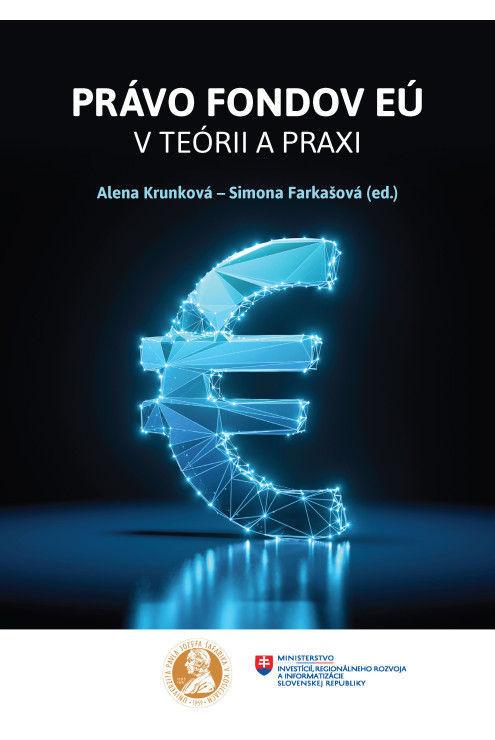
Právo fondov EÚ v teórii a praxi

E-book

Alena KrunkováSimona Farkašová

Proceedings of the International Scientific Conference on EU Funds Law in Theory and Practice held on October 3, 2019, in Košice.

The conference was attended by representatives from the academic sphere, educators from the Faculty of Law at UPJŠ in Košice, who created the subject and continue to participate in its teaching. The participants included professionals from practice, such as those from the Office of the Deputy Prime Minister of the Slovak Republic for Investments and Informatization, the Office for Public Procurement of the Slovak Republic, the Supreme Audit Office of the Slovak Republic, and the Ministry of Labor, Social Affairs, and Family of the Slovak Republic. Valuable information was also shared at the conference by representatives from the Ministry of Regional Development of the Czech Republic, OECD representatives, and representatives from the European Commission's Representation in Slovakia. The presented contributions reflected current issues in a highly professional manner, identified problematic areas, and outlined suitable solutions for contentious issues.

From the individual presentations of the conference participants, it was possible to compile a work that, while not extensive in scope, is very remarkable in value. It connects theory and practice in an outstanding manner and thus expands knowledge in the still complex issue of the legal regulation of European Union funds.

Download the e-book for free (pdf)

Quantity

978-80-8152-953-5

Data sheet

Method of publication:
E-book (pdf)
Editors:
Alena Krunková - Simona Farkašová
Document type:
Proceedings
Number of pages:
97
Available from:
23.12.2020
Year of publication:
2020
Edition:
1st edition
Publication language:
Slovak
Faculty:
Faculty of Law
Note:
Zborník bol vydaný v spolupráci s Ministerstvom investícií, regionálneho rozvoja a informatizácie Slovenskej republiky
- Free for download

16 other products in the same category:

Zákon o národnostiach a Rada vlády Slovenskej...

E-book

E-book

Jana Šutajová

From January 1, 1969, the Constitutional Act on the Status of Nationalities in the Czechoslovak Socialist Republic (ČSSR) and the Constitutional Act on the Federation came into effect. The Constitutional Act on the Status of Nationalities represented at least a formal significant step forward in the legal regulation of minority rights. However, this law was intended to serve as a foundation for further legal adjustments. It was declared that additional steps and negotiations for the adoption of implementing regulations would follow and that further laws would be enacted at both the federal and national levels. Nevertheless, no additional law or government regulation related to the constitutional act on the status of nationalities in the ČSSR was ever issued.

During the normalization period, issues concerning further legislation related to national minorities were not addressed. However, in the brief period following the adoption of the constitutional act in 1968 until the end of 1969, some institutions attempted to prepare and promote such legal norms. One of these institutions was the Government Council of the Slovak Socialist Republic (SSR) for Nationalities (hereafter referred to as the Council or the Government Council for Nationalities). The monograph provides an insight into the development of additional legal norms arising from the constitutional act on the status of nationalities in the Slovak Socialist Republic, prepared by the Government Council of SSR for Nationalities. This council was one of the institutions established in Slovakia after the formation of the Czechoslovak federation and dealt with nationality issues.

In addressing further legal norms stemming from the constitutional act on nationalities in ČSSR, it was necessary to consider prior developments. Therefore, the first part of the monograph examines the status of minorities in Czechoslovakia before adopting the constitutional act, activities of nationalities preceding its adoption, and its enactment itself. Subsequent sections focus on institutional changes in SSR following federalization, the establishment of the Government Council of SSR for Nationalities, and specific actions taken by this Council and its expert bodies in drafting proposals for laws concerning nationalities in the Slovak Socialist Republic.

The motivation for writing this monograph stemmed from the fact that this topic has so far received attention only in a few studies in Slovakia, which primarily focused on the Hungarian minority during either the Prague Spring or normalization periods.

Download the e-book for free (pdf)

Hranice zmluvnej slobody v pracovnom práve

E-book

E-book

Marcel Dolobáč

The author's ambition is to build on the current and at the same time to stimulate further discussion of the anchoring of labour law in the system of private law sectors and to contribute to the variation of views in relation to freedom of contract and its limits in labour law. The broad contractual freedom of civil law does not apply to the field of labour law, and thus the penetration of standard civil law institutes into labour law relations is not always self-evident.

The above constitutes the main theses of the present monograph. The issue of freedom of contract in labour law can be grasped in several ways. The author has chosen a content structure that is built on three basic pillars. In the first part, the author assesses the position of labour law in the system of law, which is determined primarily by the actual subject of legal regulation - dependent labour and the specific method of legal regulation through cogent and relatively cogent norms. In this context, the author would like to note at the outset that the much-discussed dispositive nature of labour law norms appears to be merely presumptive. Labour law is built on minima and maxima, with relative mandatory norms being the building blocks of fixed boundaries, a fact that distinguishes labour law from other branches of private law. These considerations are followed by the author's view of autonomy of will in labour law. The limits of contractual freedom (not only) in the theoretical sense form the second pillar of the author's ideas.

Finally, the third part of the thesis is to be the one that translates the theoretical-legal considerations of the interconnection of civil law and labour law into the interpretation of selected civil law institutes and the possibility of their application and implementation in labour law relations.

Download he e-book for free (pdf)

Starostlivosť o zdravie zamestnancov

E-book

E-book

Marcel DolobáčMonika Seilerová (eds.)

The Proceedings presents papers from international scientific conference The Employees health care held on 6th and 8th June 2018 in High Tatras and is published as a partial outcome of the implementation of the project APVV-16- 0002 - Mental Health in the Workplace and Employee Health Assessment.

Pri hodnotení informačného veku sa ťažko uhýba streľbe fráz. Moderné technológie, internet, smartfóny, komunikačná technológia, či sociálne siete zmenili rytmus života na nepoznanie a svojim dosahom prekvapili aj samotných tvorcov. Možno takéto strohé hodnotenie znie až priveľmi povedome, snáď ako mnohokrát vyslovená fráza, ale je vskutku pravdivé. Rýchlo, obratom, hneď. ASAP. Heslá dnešnej doby. Pracovný život nevynímajúc. Namiesto uľahčenia práce a možnosti zosúladenia pracovného a rodinného života, čo je stále nenaplneným snom modelu flexikurity, moderné technológie prepletajú voľný čas s tým pracovným a nedokážu ich od seba oddeliť. Zamestnávateľ prostredníctvom emailu kladie požiadavky na neustálu online zapojenosť, z jeho pohľadu odpoveď možno zaberie iba pár minút, ale pripravený máme byť takmer vždy. Výsledkom je nezdravý, nadmerný, ba neustály stres. Stres sa stal takým fenoménom nového pracovného sveta, že mladí uchádzači o prácu sa vzájomne predbiehajú v tom, že práve oni vedia pracovať pod stresom, bez obáv zvládajú stresové situácie, dokonca majú stres radi, vyhľadávajú ho a túžia v stresovom prostredí pracovať. Nuž, nevedia, nezvládajú a netúžia ... ak, iba dočasne.

Nové stresové faktory sú predmetom skúmania nielen prírodných vied, najmä medicíny, ale aj humanitných vedných odborov, vrátane psychológie a práva. Autor tohto predhovoru s potešením konštatuje, že viacerí odborníci z týchto tieto zdanlivo vzdialených odborov sa stretli na spoločnej konferencii pod gesciou grantovej úlohy APVV-16-0002 Duševné zdravie na pracovisku a posudzovanie zdravotnej spôsobilosti zamestnanca a vzájomne si vymieňali poznatky a myšlienky. Vzájomná interdisciplinárna interakcia sa stáva základom pre nové poňatie problematiky a inšpiratívne metódy skúmania.

Zborník predstavuje výsledky prednesov prezentovaných na spoločnej konferencii s názvom Starostlivosť o zdravie zamestnancov, ktorá sa konala v dňoch 6. až 8. júna 2018 v Hornom Smokovci, vo Vysokých Tatrách. Veríme, že jeho obsah zaujme a podnieti i vás, čitateľov.

JUDr. Marcel Dolobáč, PhD.

Download the e-book for free (pdf)

Public Administration and Society 1/2024

E-book

E-journal

Michal Jesenko (editor) - Eva MihalíkováDarina Koreňová

Public Administration and Society is a scientific journal publishing scientific academic articles, contributions to discussion and reviews having the content orientation on the theory and practice of Public Administration. The mission of the Journal is to publish significant results of the scientific scholarly researches regarding the area of public administration and related disciplines which are connected with the study profile and scientific bias of our Faculty. The Scientific Journal is issued in electronic version.

Download the e-book for free (pdf)

Aktuálne otázky migrácie z pohľadu...

E-book

E-book

Adam Giertl (ed.)

Collection of Papers from the 9th Annual Student Symposium on International and European Law held on April 22, 2016 at the Faculty of Law, Pavol Jozef Šafárik University in Košice

As indicated by the very title of the 9th Annual Student Symposium on International and European Law, “Current Issues of Migration from the Perspective of International Law with Special Regard to the Charter of Fundamental Rights of the European Union,” the participants focused on the highly topical subject of European migration, which they examined from various aspects of both international and Union law (a total of 9 contributions).

In assessing the role of individual actors primarily involved in addressing the problems arising from migration to Europe, particular emphasis was placed on the role of international specialized organizations, which often provide direct assistance to migrants “in the field” through humanitarian or medical aid. However, this is not the only response of the international community, as it is complemented by the activities of the concerned states as well as various non-governmental organizations and volunteers. Regarding the evaluation of the European Union’s activities, the symposium participants agreed that the mass migration wave caught the EU relatively unprepared—institutionally, legislatively, and technically—accompanied by a lack of clarity in adopting a fundamental approach to this reality.

It was also emphasized that these shortcomings occurred despite the fact that developments in the preceding period clearly signaled the possibility of gradual migration to the European Union escalating into a mass phenomenon. According to the participants, additional ex post and sometimes delayed measures adopted in response to the ongoing migration process contributed to an overall increase in political tension within the EU and divided its member states into opposing camps.

Download the e-book for free (pdf)

Kúpna zmluva – história a súčasnosť I.

E-book

E-book

Erik Štenpien (ed.)

Proceedings of the International Scientific Conference held on September 27, 2013, at the Faculty of Law of UPJŠ in Košice

The Civil Code is one of the fundamental legal codifications of our time. Paradoxically, in the Slovak Republic, the 1964 Code still applies today, albeit with certain modifications brought by the modern era. Currently, recodification efforts are underway, with the goal of adopting a new Civil Code.

However, it is not possible to build something new without knowledge of the old. It is therefore a positive sign when legal historians and civil law experts come together at a conference to exchange views and insights. The Department of State and Legal History at the Faculty of Law in Košice is in its first year of working on the scientific grant project VEGA: The Historical-Legal Development of the Institute of the Sales Contract and Trends in Its Current Recodification in the Slovak Republic - No. 1/0131/13.

This project was acquired as a historical-legal initiative, but the Department of Civil Law is also participating, as Assoc. Prof. JUDr. K. Kirstová, CSc., is the deputy head of the project. Aware that this represents a completely unique connection between legal history and practice, our department organized the international scientific conference The Sales Contract - History and Present I. on September 27, 2013, which was a planned grant output but ultimately coincided with the 40th anniversary of the Faculty of Law in Košice.

This proceedings volume thus summarizes contributions from the grant project, as well as related presentations. It aims to significantly contribute to the understanding of the history and current recodification efforts of the sales contract institution both domestically and internationally.

Download the e-book for free (pdf)

Impact of the European Union on Criminal Law of...

E-book

E-book

Dominika Marčoková Becková (ed.)

Reviewed collection of papers of the international scientific conference is the output of the international scientific conference held on 7th October 2022 within the framework of the project APVV-18-0421 „European Public Prosecutor's Office in Connections of the Constitutional Order of the Slovak Republic as Strengthening of the European Integration through Law“.

Unlike other areas of activities of the European Union, the European Union did not begin to enter the area of criminal law and criminal policy until much later. The reason is that the sphere of criminal law has traditionally been associated with the sovereignty of the state, which is why the Member States of the European Union are very slow to allow the European Union into it. The issue of the European Union's influence on the criminal law of its Member States is therefore becoming actual and raises many questions and application problems. In their papers, the authors address the various problems posed by the European Union's influence in the area of criminal law. Among the scientific problems and issues that the authors paid attention to in their works are the following: reasons for competence of the European Union within the field of criminal law; Impact of the EU legislation on criminal law of EU Member States; proposals to improve existing legislation, whether at European Union or national level, cooperation of the Court of Justice of the European Union and national judges via preliminary proceedings within the field of criminal law; as well as the issue of the European Public Prosecutor's Office.

Download the e-book for free  (pdf)

Košické dni súkromného práva IV. Pocta...

E-book

E-book

Peter Molnár - Viktória Koľveková - Miroslava Kušníriková - Renáta Romanová - Lukáš Macko (eds.)

Recenzovaný zborník vedeckých prác z medzinárodnej vedeckej konferencie Košické dni súkromného práva IV., ktorá sa konala v dňoch 15. až 17. júna 2022, je čiastkovým výstupom riešenia grantovej úlohy projektu schváleného Vedeckou grantovou agentúrou Ministerstva školstva, vedy, výskumu a športu Slovenskej republiky a Slovenskej akadémie vied pod registračným číslom 1/0765/20 s názvom „Ochrana ľudských hodnôt v súkromnom práve v kontexte moderných trendov a prebiehajúcej rekodifikácie súkromného práva“.

Predkladaný zborník vedeckých prác je výstupom zo 4. ročníka medzinárodnej vedeckej konferencie Košické dni súkromného práva IV. organizovanej Katedrou občianskeho práva, Právnickej fakulty UPJŠ v Košiciach. Publikačné výstupy autorov sú tematicky orientované najmä na výskumný projekt VEGA č. 1/0765/20 "Ochrana ľudských hodnôt v súkromnom práve v kontexte moderných trendov a prebiehajúcej rekodifikácie súkromného práva" riešený organizátormi konferencie. Jednotlivé príspevky sú rozdelené do troch sekcií – občianske právo hmotné, civilné právo procesné, právo duševného vlastníctva. Rozdelenie sekcií reflektuje na jednotlivé výskumné oblasti vymedzené v rámci projektu.

Download the e-book for free (pdf)

Ochrana proti obmedzovaniu hospodárskej súťaže

E-book

E-book

Žofia Mrázová(ed.)

Proceedings from the VI. Student Symposium on Commercial Law Held on November 28, 2018, at the Faculty of Law, Pavol Jozef Šafárik University in Košice

The Department of Commercial and Economic Law at the Faculty of Law, Pavol Jozef Šafárik University in Košice, organized the sixth annual Student Symposium on Commercial Law on November 28, 2018. The event was part of the research project VEGA 1/0917/16 titled "Atypical and De Facto Relationships in Commercial Law." The symposium aims to provide a platform for discussion among students with the guidance of mentors from the department, including professors, researchers, and doctoral candidates.

This year’s symposium focused on protection against anti-competitive practices. Unchecked anti-competitive behavior could grant economic advantages to violators at the expense of other competitors and threaten the free-market system. Students explored various challenges related to competition law, analyzing Slovak and European legal frameworks as well as court rulings and decisions by other authorities. Through their research, students honed their analytical thinking, argumentation skills, and critical reasoning. The discussions generated new perspectives and encouraged active engagement among participants.

This proceedings volume presents the outcomes of students' work from this event.

Download the e-book for free(pdf)

20 YEARS IN THE EUROPEAN UNION IN TERMS OF LAW...

E-book

E-book

Ján Klučka - Ľuboslav Sisák - Laura Gazdagová (eds.)

This publication captures the conference proceedings of the international scientific conference "20 years in the European Union in terms of law and the era of sustainability". The conference took place on 3rd September 2024 at the Faculty of Law, Pavol Jozef Šafárik University in Košice, in hybrid form.

The first part of the conference proceedings includes contributions concerning EU law in proceedings before the Constitutional Court of the Slovak Republic with focus to current issues and challenges after 20 years of membership of the Slovak Republic in the EU, European law from the perspective of international constitutionalism in a green coat, the impact of the entry of the Baltic states into the European Union on the question of the nationality of natural persons, the single digital market in the context of the Slovak Republic, the impact of European Union law in the field of personal data protection on the territory of the Slovak Republic, the principle of environmental protection in economic competition and international jurisdiction for private law claims for compensation for damage caused to the environment.

The second part of the conference proceedings includes contributions concerning the process of enshrining human right to environment in international law and European law, the development of biodiversity protection in the EU, NATO´s role in climate change response to meet the sustainability and suing tort damages from the Dieselgate emissions scandal.

Download the e-book for free (pdf)

Informačná spoločnosť a medzinárodné právo

E-book

E-book

Adam Giertl - Ľubica Gregová Širicová (eds.)

Proceedings from the 5th Student Symposium held on April 21-22, 2013

The French delegate to the Commission on Human Rights, while discussing the inclusion of the term "media" in the article on freedom of expression in the draft of the International Covenant on Civil and Political Rights, wisely urged other members of the commission to be forward-looking regarding the information media of the future.

The discussion took place in 1950, when delegates could not yet foresee the impact of the internet on social relations. Given that it is now clear that information technologies significantly influence law, including international law, the organizers of the student symposium decided to dedicate its sixth edition to the theme "Information Society and International Law."

Students of the Faculty of Law, after registering for the symposium, first focused on preparing their contributions, with each participant having access to a consultant if needed. This year, the list of consultants, in addition to members of the Institute of European Law and the Department of International Law, was expanded to include an expert in intellectual property law, Mgr. Martin Husovec, a graduate of our Faculty of Law and currently an IMPRS-CI doctoral student at the Max Planck Institute for Intellectual Property and Competition Law. We also take this opportunity to thank him for dedicating his time to the students and providing them with valuable advice in preparing their contributions. After the preparatory phase, the symposium itself took place, with the aim of presenting the prepared contributions and discussing them.

The presented contributions reflected a wide range of intersections between international law and the information society.

Download the e-book for free (pdf)

Zelené ambície v podmienkach európskeho a...

E-book

E-book

Juraj Panigaj (ed.)

Collection of Contributions from the XVth Student Symposium on International Law and European Law, held on April 22, 2022, in a hybrid format, with the participation of students from the Faculty of Law of Pavol Jozef Šafárik University in Košice and the Faculty of Law of Trnava University in Trnava.

The jubilee XV. year of student symposium from international and European law took place at the University of Pavol Jozef Šafárik, faculty of law, on April 22, 2022, symbolically on Day Earth. This year's event was dedicated to the increasingly pressing issue of environmental protection. The topic "Green ambitions in the light of European and international law" appealed to many students, resulting in several interesting contributions, falling under both European Union law and international law. European law currently brings great challenges, but also expectations through the European Green Deal. This is also why several student contributions dealt with topics falling under the European Green Deal, either from the point of view of its individual initiatives in general, or more specifically, in the intentions of Agenda 2030, or the implementation of the so-called green diplomacy.

The other part of contributions dealt with environmental protection within international law. Students addressed issues of an environmental nature in the areas of climate change, international maritime law, atmospheric protection, or the issue of so-called climate refugees. The publication itself is an output of the APVV project APVV-20-0576 "Green ambitions for sustainable development (European Green Deal in the context of international and national law)".

Download e-book for free (pdf)

Zamestnanec v digitálnom prostredí

E-book

E-book

Monika MinčičováMarcel DolobáčJana Žuľová

The presented proceedings of papers is the result of the international scientific conference "Employee in the digital environment", which was organized as part of the research project VEGA 1/0790/20 Employee protection in the context of the Industrial Revolution 5.0 - starting points, opportunities and risks. The online scientific conference took place on the 5th of November 2021 under the auspices of the Department of Labour Law and Social Security Law, Faculty of Law, P. J. Šafárik University in Košice. The proceedings includes a variety of scientific papers focused on the study of current issues caused by the digital transformation of society.Authors respond to partial legal problems of labour law and social security law at the theoretical-legal and application level and reflect on the consequences of ongoing phenomena for the labour market and labour law legislation.

Download e-book for free(pdf)

Diverzné a inkluzívne pracoviská - legislatívne...

E-book

E-book

Jana ŽuľováDenisa Rudžiková

In the environment of Slovak employers, an active approach to diversity and inclusion in the workplace is coming to the fore. Targeted diversity and inclusion programs help make employers more attractive on the labor market and attract more job seekers. Proactively, better working conditions are created for employees with responsibilities to the family (in most cases still in relation to mothers), groups of people who have been on the fringes of interest until now are also employed (elderly, disabled, LGBT groups, minorities, graduates of secondary and higher education schools).

The presented collection of abstracts responds to the outlined facts, which is a grouping of the starting motives and conclusions of the contributions presented at the scientific conference Diverse and inclusive workplaces - legislative starting points organized by the department of labor law and social security law of the Faculty of Law of the P. J. Šafárik University in Košice, which took place on September 29, 2023 in a hybrid form.

With their abstracts, the authors point to a range of problematic areas that are not only a reflection of academic considerations, but also those legal questions that have to be dealt with in ordinary legal practice. The goal is to use analysis and explanation to define the existing labor law measures/tools applicable to the implementation of diversity and inclusion in the workplace according to the current Slovak legal framework and the EU legal framework and thus emphasize the starting point of any effort to build diversity and the implementation of inclusion in the workplace.

Download e-book for free (pdf)

Správne právo hmotné - Všeobecná časť

€19.05
Availability: 25 In Stock

Tibor Seman - Radomír Jakab - Jozef Tekeli

The presented textbook on the general part of substantive administrative law offers a comprehensive collection of knowledge, principles, doctrines, institutions, and legal norms that form the foundation for the existence and functioning of public administration. It serves as a prerequisite for mastering the special part of substantive administrative law and administrative procedural law. This updated version of the first edition of the textbook reflects the current development of public administration, the state of administrative law, and educational needs. The textbook introduces key institutions of the general part of administrative law, which are essential for understanding how public administration operates in Slovakia. It includes the characteristics and internal structure of administrative law, its sources, and its relationships with other branches of law. Covered topics include subjects of administrative law, the organization of public administration, methods and forms of its activities, guarantees of legality in public administration, administrative liability, civil service, and work performed in the public interest. It will be useful not only to students but also to anyone interested in the theory and practice of such a dynamic branch of law as administrative law undoubtedly is.

10 rokov v EÚ: Vzťahy, otázky, problémy

E-book

E-book

Ján Klučka(ed.)

Collection of Papers from the International Scientific Conference Held on May 29–30, 2014 at the Faculty of Law, Pavol Jozef Šafárik University in Košice.

In the first half of this year, a scientific conference entitled “10 Years in the EU: Relations, Questions, Issues” was held in Košice, and the contributions from this event constitute the content of the present collection bearing the same name.

The aim of the organizers—namely, the Slovak Association of European Law, the Representation of the European Commission in the Slovak Republic, and the Institute of European Law together with the Department of International Law of the Faculty of Law at Pavol Jozef Šafárik University—was not only (even if loosely) to follow up on the previous 2009 conference “Community Law in Slovakia – Five Years ‘After’”, but, after another five years, to continue its main objective: to provide participants from both the academic and non-academic community with a space for further analysis and exchange of views on legal issues related to the membership of the Slovak Republic in the European Union and various current issues of the Union’s legal order.

From this perspective, a shift in the overall focus of the conference contributions in 2009 and 2014 can be observed. While the contributions from the first conference focused primarily on various aspects of the application of Union law in the Slovak legal system and related application problems, especially before courts and other authorities, the basic orientation of the contributions from the second conference is already different. The present collection also confirms that the contributions focus primarily on current issues of the European legal order and on certain aspects of the Union’s external policy, while the relationship of Union law to the Slovak legal system is no longer given primary attention.

Several contributions focus on areas characterized by a certain overlap or “cohabitation” of Union law with public international law, private international law, or, more broadly, international relations.

Download the e-book for free (pdf)

This website uses cookies to ensure you get the best experience on our website