Filter By

Categories

Categories

Year of publication:

Year of publication:

Publication language:

Publication language:

Faculty:

Faculty:

Method of publication:

Method of publication:

Active filters

  • Year of publication:: 2019
  • Year of publication:: 2019
  • Year of publication:: 2019
  • Year of publication:: 2019
  • Year of publication:: 2019
  • Year of publication:: 2019
  • Year of publication:: 2019
  • Year of publication:: 2019
  • Year of publication:: 2019
  • Year of publication:: 2019
  • Year of publication:: 2019
  • Year of publication:: 2019
  • Year of publication:: 2019
  • Year of publication:: 2023
  • Year of publication:: 2023
  • Year of publication:: 2023
  • Year of publication:: 2023
  • Year of publication:: 2025
  • Year of publication:: 2025
  • Year of publication:: 2025
  • Year of publication:: 2025
  • Year of publication:: 2025
  • Year of publication:: 2025
  • Year of publication:: 2025
  • Faculty:: Faculty of Arts
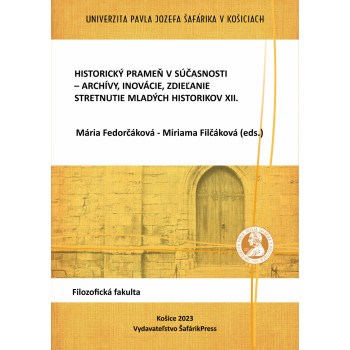
Historický prameň v súčasnosti – archívy, inovácie, zdieľanie. Stretnutie mladých historikov XII.

Historický prameň v súčasnosti – archívy,...

E-book

E-book

Mária FedorčákováMiriama Filčáková (eds.)

Proceedings of the 12th Scientific Conference of Young Historians, organized by the Department of History of the Faculty of Arts at Pavol Jozef Šafárik University in Košice in cooperation with the State Archive in Košice and the Slovak Historical Society at the Slovak Academy of Sciences on October 12, 2022

The theme of the conference proceedings is the issue of sources, their interpretation and use of current digital technologies in their research and access. The proceedings constit of 7 papers by authors working in Slovak and Czech universities.

The digitisation of seals is the subject of the paper by Barbora Borůvková. Michael Dudzik deals with the problem of building the road network in modern France and written and cartographic sources. Trends of digitization in Slovak archives and their perception by researchers are elaborated by in Miriama Fialkovičová´s study. Miriama Filčáková dealt with sources on the history of tertiary education in Košice in connection with the establishment of the UPJŠ. The possibilities of researching sources on the electrification of Slovakia are dealt with in the study by Dominik Hrtus. Ondrej Šály in his paper treated the letters of serfs in the 18th century as a source for economic history. Vavrinec Žeňuch discusses the possibilities of researching the eclesiastical history of the Uh county in the modern period.

Download e-book for free (pdf)
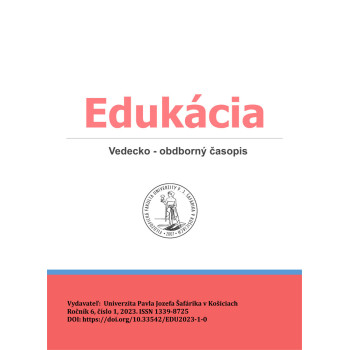
Edukácia, roč. 6, č. 1/2023

Edukácia, roč. 6, č. 1/2023

E-book

E-journal

Renáta Orosová (executive editor)

The scientific-professional journal Edukácia focuses on issues of education and upbringing in the fields of primary, secondary, and higher education. It emphasizes the current state and perspectives of educational practice, contemporary aspects of pre-service teacher training, social pedagogy, special pedagogy, as well as pedagogical and psychological aspects of upbringing in basic educational institutions from the perspective of the broader educational community.

It is intended for researchers, young university lecturers, doctoral students, and professional and pedagogical staff, with the aim of presenting trends in education and stimulating discussion on current issues in the presented areas of upbringing and education.

DOWNLOAD THE E-journal FOR FREE (pdf)

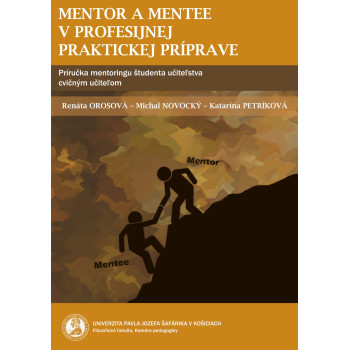
Mentor a mentee v profesijnej praktickej príprave /Príručka mentoringu študenta učiteľstva cvičným učiteľom

Mentor a mentee v profesijnej praktickej...

E-book

E-book

Renáta Orosová - Michal Novocký - Katarína Petríková

An integral part of the process of becoming a teacher is the mentoring of student teachers by mentor teachers, serving as guidance and support for future teachers. Developing mentoring skills and fostering reflective mentoring practices are means of enhancing the practical training of student teachers, their professional development, and improving the quality of their future educational practice.

The foundation of the mentoring relationship between the mentor teacher as a mentor and the student teacher as a mentee is not to evaluate the student, but to analyse their learning and teaching and contemplate ways to enhance these processes. The university textbook represents a creative textual tool focused on innovations in strategies for supporting the development of mentoring abilities in mentors and mentees during professional practical training. This university textbook, intended for student teachers in the role of mentees and mentor teachers in the role of mentors, systematizes the theoretical foundations of mentoring, provides guidance and directives for mentoring in professional practical training. Furthermore, it offers the university teacher, in the role of supervising the student's teaching practice, an overview of techniques and methods pertaining to the mentoring relationship between mentor and mentee. It is applicable as a university textbook for student teachers, students pursuing supplementary pedagogical studies or advanced studies, as well as for mentor teachers in primary and secondary schools, and university educators involved in professional practical training.

Its English version provides opportunities for utilization during study stays of student teachers abroad and for foreign students in Slovakia.

Download the e-book for free  (pdf)

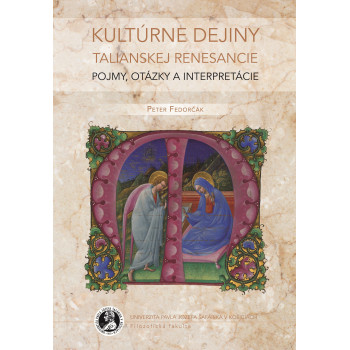
Kultúrne dejiny talianskej renesancie: Pojmy, otázky a interpretácie

Kultúrne dejiny talianskej renesancie: Pojmy,...

E-book

E-bool

Peter Fedorčák

When studying the Renaissance, researchers utilize various critical and core terms and concepts which it is necessary to characterize.

However, many such points, notably the following, are problematic: The relationship between the Renaissance and the antiquity; The connection with the Middle Ages; The transformation to Mannerism and Baroque; Realism and Secularism in Renaissance art; The individualism of the Renaissance artist; The reasons for the creation of Renaissance art in Italy, its determinants and stimulators; Distinguishing between the analysis of the genesis of the Renaissance and the analysis of the creation of the period’s art generally; Regional differences in Italy and their impact on the art; Chronological limits of the Renaissance and its milestones; The terms “Medieval Ages” and “Early Modern Period”; The impact, and its extent, of the artistic influences of the Byzantine, Gothic and Romanesque arts on the Renaissance. The term “Renaissance” itself, its content and existence, are also the subject of the discussion with students, alongside learning how such terms and definitions came about and continue to evolve, how they attain their content, how this content morphs in the historical discourse, what academical pluralism and freedom of thinking look like in the discourse led by historians, what the differences are between scientists and schools of thought on the same subject and how it is possible that they are so numerous.

The students will come to recognize the leading scholars in the field, and follow their arguments and methodological approaches. They shall be invited to closely trace and scrutinize the logic which those historians use in building their argumentation. It shall be seen that the freedom to create terms, concepts and new definitions cannot stand on an ignorance of the (historical) facts, as becomes clear with expanding knowledge of those historical facts, the variability of their interpretation growing in tandem. This approach, actually used across the whole range of seminars and lectures, shall drive discussion on the topics covered, students being invited to formulate their own theses and antitheses.

Download the e-book for free  (pdf)

Doktorandské miscelaneá 8

Doktorandské miscelaneá 8

E-book

Lukáš Šutor

Currently, the eighth issue of the Doctoral Miscellanea consists of thirteen contributions from four study programs. The publication of these contributions is traditionally associated with the Autumn School for Doctoral Students at the Faculty of Arts of UPJŠ in Košice, where third-cycle students have the opportunity to first try out the conference format of presenting their research results and subsequently expand them into full studies.

Unlike last year, when the proceedings were non-conference due to the pandemic situation, we consider the return to plenary dialogue beneficial. A distinctive feature of our proceedings is its multidisciplinary nature, encompassing humanities and social science fields. Despite this diversity, interesting connections often emerge among the topics, relating to generational reassessments of regularly recurring issues as well as research on highly current phenomena.

Download the e-book for free (pdf)

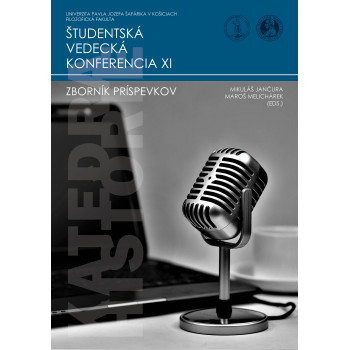
Študentská vedecká konferencia XI.

Študentská vedecká konferencia XI.

E-book

E-book

Mikuláš Jančura - Maroš Melichárek (eds.)

The textbook is derived from the outcomes of the eleventh annual student scientific conference, which took place in December 2022.

The student scientific conference is an integral component of the curriculum within the Department of History at the Faculty of Arts, UPJŠ, and has been implemented since 2011. Its primary objective is to provide a platform for Bachelor's and Master's degree students to present segments of their original research as part of their thesis development.

The purpose of this textbook extends beyond the mere publication of these diverse thematic texts. It also strives to emphasize the significance of exceptional pedagogical initiatives and the added value of university education for students, manifested through the dissemination of their scholarly output.

Download the e-book for free  (pdf)

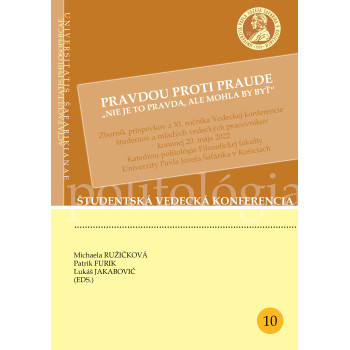
Truth vs. Post-Truth. „It is not true, but it could be.”

Truth vs. Post-Truth. „It is not true, but it...

E-book

E-book

Michaela Ružičková - Patrik Furik - Lukáš Jakabovič (eds.)

The collection of articles from the XI. International Scientific Conference for Students and Young Scientists, organized by the Department of Political Science of the Faculty of Arts of the Pavol Jozef Šafárik University in Košice, in cooperation with the Res Publica Civic Association, the Department of Security Studies of the Faculty of Political Science and International Relations of the Matej Bel University in Banská Bystrica, Institute of Political Sciences and Administration, Faculty of Political Science and Journalism, Marie Curie-Sklodowska University in Lublin, Institute of Social Studies, Faculty of Regional Development and International Studies, Mendel University in Brno, and the Department of Political Science, Faculty of Arts, University of Miskolc, held on 20 May 2022 in Košice.

The aim of this publication, entitled Truth vs. Post-Truth. „It is not true, but it could be.”, is to highlight the threats arising from the issue of the spread of disinformation, conspiracies and hoaxes today, reflecting not only on the national context, but also on the impact of these elements in the international environment.

The proceedings consist of 12 articles written in Slovak and English. The individual contributions deal with selected topics and aspects of the spread of disinformation, conspiracy theories or hoaxes, among others in the context of elections, media landscape and politics.

The topics of the contributions are the limits of freedom of expression, media freedom and regulation in the media space, the issue of propaganda or information warfare. The present volume also includes papers focusing on issues in the field of political ideologies or the issue of false narratives about the COVID-19 disease.

Download the e-book for free  (pdf)

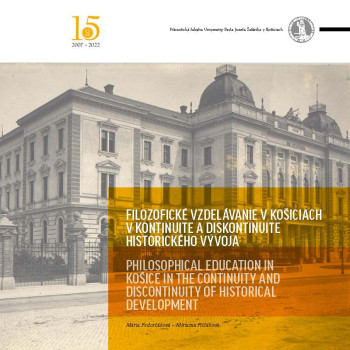
Philosophical Education in Košice in the Continuity and Discontinuity of Historical Development

Philosophical Education in Košice in the...

E-book

E-book

Mária Fedorčáková - Miriama Filčáková

Current publication is dealing with the history of philosophical education in Košice since the beginning to the foundation of the Faculty of Arts at Pavol Jozef Šafárik University in Košice in 2007. Beginnings of philosophical education in Košice are connected to the fundation of the University of Košice in 1657, which was originally founded as Jesuit university with two faculties – Faculty of Theology and Faculy of Arts.

The publication is dealing with the philosophy teaching in the Faculty of Arts and examines the philosophy teachers and students. Another interest is given to decline of philosophy teaching caused by transformation of the University into the Royal Academy and the Academy of Law at the end of the 18 and during 19 century. The second part of the publication is dealing with the history of higher education after the second world war and the foundation of the University of Pavol Jozef Šafárik in Košice.

The authoress focuses on circumstances of the foundation of the Faculty of Arts in Prešov and its history and later development after 1989, which included also division of the university in 1997. The last part of publication presents the history of the university buildings, in which the Faculty of Arts is situated.

Download the e-book for free  (pdf)

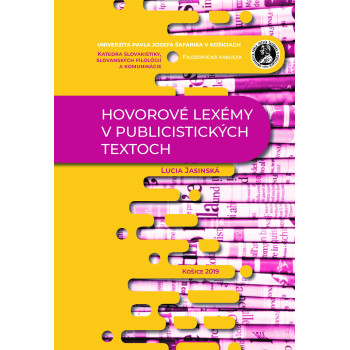
Hovorové lexémy v publicistických textoch

Hovorové lexémy v publicistických textoch

E-book

E-book

Lucia Jasinská

The submitted monograph, "Colloquial Lexemes in Journalistic Texts," presents an original perspective on the analysis and description of lexical and grammatical expressive means in the examined communication field.

The main research problem is the colloquialization of expressive means as a marked feature in publicly published journalistic texts. The starting point of the research itself was the search for lexical units with the stylistic qualifier of colloquiality in the "Short Dictionary of the Slovak Language." Their presence and frequency, as well as any potential shifts in meaning, were verified in publicly accessible media communications.

Since this is research into "living language," the source material consists of journalistic texts in the Slovak National Corpus database.

Download the e-book for free (pdf)

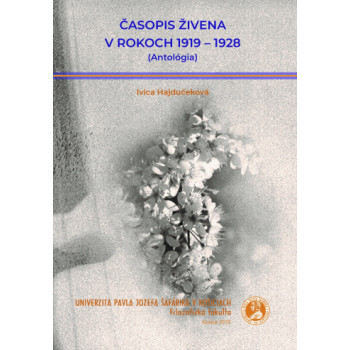
Časopis ŽIVENA v rokoch 1919 – 1928

Časopis ŽIVENA v rokoch 1919 – 1928

E-book

E-book

Ivica Hajdučeková

The anthology was created based on the study of archival volumes of Živena preserved in the Slovak National Library in Martin and the selection of material representing samples of texts that reflect the spirit of the times and contribute to the image of the contemporary modern woman.

The selection of articles from 1919 to 1928 uncovers the cultural atmosphere at the beginning of the 20th century when, thanks to emancipation efforts, doors were opening for women into public and professional life. Students from the 3rd and 4th years of the School of Applied Arts in Košice, under the guidance of teachers in photographic design and Slovak language and literature, were involved in preparing the illustrative component of the anthology, whose artistic interpretations are part of the publication. Their contribution meets the criteria for combining science and practice with a focus on popularizing research results.

Download e-book for free (pdf)
Literárny príbeh ako nástroj mravnej výchovy

Literárny príbeh ako nástroj mravnej výchovy

E-book

E-book

Adriana Jesenková

The textbook "Literary Story as a Tool for Moral Education" aims to contribute to the preparation of future teachers of ethical education, as well as students from other fields, particularly in the humanities. It focuses on an area that remains trivialized and marginalized—gender-sensitive education and training. The author operates under the assumption that applying a gender-sensitive approach in education requires an understanding of what a gender perspective entails.

Experience from interdisciplinary and transdisciplinary research, along with teaching experiences where ethical questions and themes—such as those related to gender, gender equality, gender justice, and gender relations—are presented, taught, and explored through various media or texts (not only traditional scientific and professional ones but also artistic, especially literary), inspired the author to present such an approach in a relatively coherent form.

This includes summarizing existing knowledge and experiences on the topic so that they can serve as a suitable starting point for enhancing the competencies of future teachers (not only) in ethical education when applying a gender-sensitive approach in education and teaching issues related to gender and gender relations in the context of applied ethics and ethical education.

Autor

Download the e-book for free (pdf)
GENDER PERSPECTIVES IN SLOVAK LITERATURE OF THE LATE 19th AND EARLY 20th CENTURIES (Interpretation Studies)

GENDER PERSPECTIVES IN SLOVAK LITERATURE OF THE...

E-book

E-book

Ivica Hajdučeková

The second (supplemented and expanded) edition of the bilingual textbook Rodový aspekt v slovenskej literatúre na prelome 19. a 20. storočia (Interpretačné etudy) / Gender Perspectives in the Slovak Literature of the Late 19th and Early 20th Centuries (Interpretation Studies) offers to a wider range of recipients – students of Teaching of Academic Subjects and teachers in practice – a didactic transformation of current research issues (supported by e-literacy using online approaches and QR codes), which was developed in cooperation with the School of Applied Arts in Košice (since 2019/20 the so-called School of Art Industry) ) in the academic year 2018/2019.

Professional cooperation within the KEGA project No. 008UPJŠ-4/2017 – Science Without Barriers (Interdisciplinary Inspirations of Contemporary Literary Scholarship and Linguistics in Educational Practice at University) with teacher of Slovak Language and Literature, PaedDr. Jana Valicová, and Mgr. Renáta Novotná Markovičová of ŠUP took place in project teaching. It yielded results in two interdisciplinary outcomes:

1. Creation of the Literary Lounge in the Student Café Minerva in the premises of the UPJŠ Faculty of Arts;

2. Illustrations of the 2nd edition of the textbook Gender Aspect in the Slovak Literature at the Turn of the 19th and the 20th Centuries (2019).

Download the e-book for free (pdf)
Jazyková kultúra nielen pre lingvistov (vybrané javy)

Jazyková kultúra nielen pre lingvistov (vybrané...

E-book

E-book

Iveta BónováLucia Jasinská

Language culture is not only for linguists; it is a professional publication suitable as a textbook, in which we attempt to describe and explain the most frequent phenomena of speech practice in an innovative way.

These phenomena are observed not only in the media environment but also in the academic sphere, which, with regard to the communication sphere (mass media communication, scientific research), are often used incorrectly and thus subconsciously penetrate the language awareness of all language users.

This includes those for whom language is a working tool with a primarily representative function (teachers at all levels of schools or radio and television workers).

Download the e-book for free (pdf)
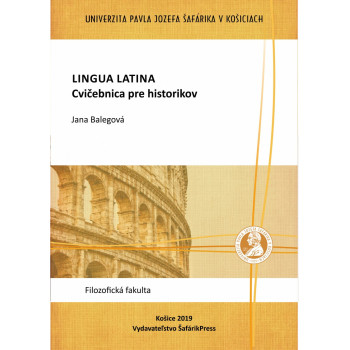
Lingua Latina – cvičebnica pre historikov

Lingua Latina – cvičebnica pre historikov

E-book

E-book

Jana Balegová

University textbook Lingua Latina – Exercise Book for Historians is a parallel study material to the textbook Lingua Latina – Cursus Communis. It is designed for practicing grammar at home. The content of the exercises corresponds to the focus of the individual lessons in the mentioned textbook, both in terms of the covered grammatical phenomena and vocabulary. For this reason, only vocabulary not covered in the textbook's lessons is included in the exercises.

The Latin-Slovak dictionary at the end of the exercise book contains all the vocabulary from both the exercise book and the textbook. The Slovak-Latin dictionary includes the vocabulary from exercises that require translation into Latin. The vocabulary in this exercise book is oriented towards the needs of history students and, given the selection of source materials, also includes non-classical lexicon or non-classical meanings of classical words (this lexicon is marked with the symbol *).

The exercise book includes a key that allows students to directly verify the correctness of their work. The textbook Lingua Latina – Exercise Book for Historians is available electronically in PDF format. As part of the teaching program, online tests available on the KKF FF UPJŠ website (https://www.upjs.sk/filozoficka-fakulta/katedra-klasickejfilologie/katedra/) also serve to practice the covered material.

Download the e-book for free (pdf)
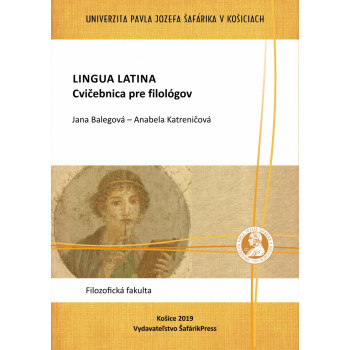
Lingua Latina – cvičebnica pre filológov

Lingua Latina – cvičebnica pre filológov

E-book

E-book

Jana BalegováAnabela Katreničová

The university textbook Lingua Latina – a workbook for philologists is a parallel study material to the textbook Lingua Latina – cursus communis. It is designed for practicing grammatical material at home. The content of the exercises corresponds to the focus of individual lessons in the mentioned textbook, both in terms of the covered grammatical phenomena and vocabulary. For this reason, only vocabulary that was not part of the lessons covered in the textbook is included in the exercises.

A Latin-Slovak dictionary at the end of the workbook contains the entire vocabulary from both the workbook and the textbook. A Slovak-Latin dictionary includes the vocabulary from exercises that require translation into Latin. The vocabulary of this workbook is oriented towards the needs of students specializing in philology and, with regard to the selection of source materials, also includes non-classical lexicon or non-classical meanings of classical words (this lexicon is marked with an asterisk). The workbook includes a key that allows students to directly verify the correctness of their work.

The textbook Lingua Latina – a workbook for philologists is available electronically in PDF format. As part of the educational program, online tests available on the KKF FF UPJŠ website (https://www.upjs.sk/filozoficka-fakulta/katedra-klasickejfilologie/katedra/) also serve to practice the covered material.

Download the e-book for free (pdf)
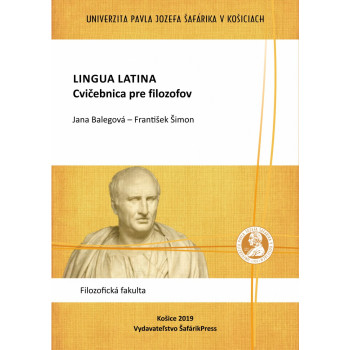
Lingua Latina – cvičebnica pre filozofov

Lingua Latina – cvičebnica pre filozofov

E-book

E-book

Jana BalegováFrantišek Šimon

The university textbook "Lingua Latina – Exercise Book for Philosophers" is a parallel study material to the textbook "Lingua Latina – Cursus Communis." It is designed for practicing grammatical lessons at home. The content of the exercises corresponds to the focus of each lesson in the mentioned textbook, both in terms of the covered grammatical phenomena and vocabulary. For this reason, only vocabulary not included in the lessons of the textbook is presented in the exercises.

The Latin-Slovak dictionary at the end of the exercise book contains the entire vocabulary from both the exercise book and the textbook, while the Slovak-Latin dictionary includes the vocabulary from exercises that require translation into Latin. The vocabulary in this exercise book is oriented towards the needs of philosophy students and, with regard to the selection of source materials, also includes non-classical lexicon or non-classical meanings of classical words (this lexicon is marked with an asterisk *).

The exercise book includes a key that allows students to directly verify the correctness of their work. The textbook "Lingua Latina – Exercise Book for Philosophers" is available electronically in PDF format. As part of the educational program, online tests available on the website of the Department of Classical Philology at the Faculty of Arts, UPJŠ (https://www.upjs.sk/filozoficka-fakulta/katedra-klasickejfilologie/katedra/) also serve to practice the covered material.

Download the e-book for free (pdf)
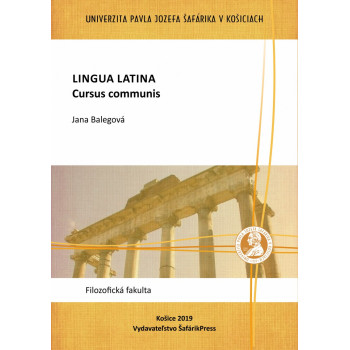
Lingua Latina – cursus communis

Lingua Latina – cursus communis

E-book

E-book

Jana Balegová

The university textbook Lingua Latina – cursus communis is designed for students of all study programs at the Faculty of Arts, where Latin is included as a subject related to the main field of study or specialization (history, philosophy, philological specializations, etc.).

The textbook contains Latin grammar, exercise sentences intended for practicing the grammatical phenomena covered in seminars under the guidance of an instructor, and a Latin-Slovak dictionary. To practice Latin grammar at home, parallel workbooks are available, which are tailored to meet the needs of students from specific study fields and specializations (e.g., Lingua Latina – workbook for historians, Lingua Latina – workbook for philosophers, Lingua Latina – workbook for philologists).

The textbook Lingua Latina – cursus communis is accessible electronically in PDF format. As part of the educational program, online tests available on the KKF FF UPJŠ website serve to reinforce the learned material. This textbook is a product of the grant project KEGA 010UPJŠ-4/2017.

Download the e-book for free (pdf)
Veda bez bariér

Veda bez bariér

E-book

E-book

Iveta BónováIvica HajdučekováLucia Jasinská (eds.)

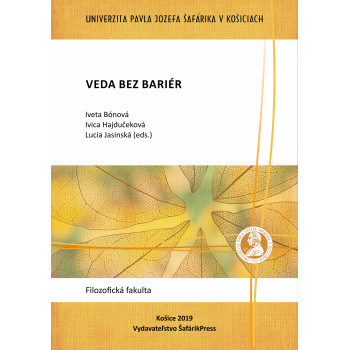
The proceedings maps three significant events organised in 2018 – 2019 within the project KEGA No. 008UPJŠ-4/2017 Science without barriers (Interdisciplinary inspirations of contemporary literary scholarship and linguistics in university educational practice; principal investigator prof. PhDr. J. Gbúr, CSc.) at the Department of Slovak Studies, Slavonic Philologies and Communication, Faculty of Arts, Pavol Jozef Šafárik University in Košice.

The first activity was a scholarly and artistic symposium Science without barriers held in March 6 – 8, 2019 on the occassion of the 80th birthday of Dr. h. c. prof. PhDr. Ján Sabol, DrSc. It brought extended abstracts of participants in two sections (Slovak studies and literary scholarship in interdisciplinary contexts) as its outcome. The next two parts describe artistically oriented events: Interpretational afternoon (a competition for the best interpretation of Ján Sabol´s book of verse Love in Blue) with the winning works added, and the vernissage Literature through an objective lens with the share of students of the School of Industrial Visual Arts in Košice.

Download the e-book for free (pdf)
Základy metodológie pedagogicko-psychologického výskumu. Sprievodca pre študentov učiteľstva

Základy metodológie pedagogicko-psychologického...

E-book

E-book

Mária BačíkováAnna JanovskáOľga Orosová

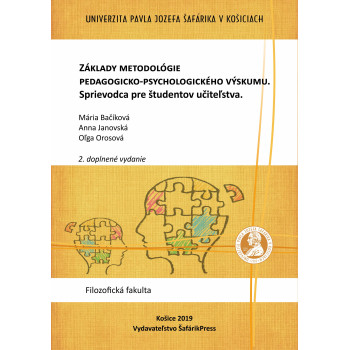
The textbook is primarily intended for students of teaching academic subjects, but it will enrich anyone who needs to familiarize themselves with research methodology focusing on psychological and educational sciences. In the textbook, students become acquainted with the basic principles of conducting research, the process of research implementation, and the basic methods of quantitative or qualitative approaches.

The examples used in the textbook are mostly focused on research conducted in a school environment. By acquiring the basic knowledge presented in the textbook, the reader will be able to conduct simple research in school conditions. At the same time, understanding the principles of research methodology helps with the critical evaluation of information from various sources.

The second, expanded edition has been extended by three chapters, focusing on conducting research directly during the teaching process in the form of teacher action research, on the possibilities of evaluating preventive programs, and the final chapter deals with the possibilities of publishing research.

Download the e-book for free  (pdf)
Edukácia, roč. 3, č. 2/2019

Edukácia, roč. 3, č. 2/2019

E-book

E-book

Renáta Orosová (executive editor)

Stránka časopisu >>>

The scientific and professional journal Edukácia focuses on issues of education and upbringing in primary, secondary, and higher education. It emphasizes the current state and future perspectives of educational practice, the latest aspects of pre-service teacher training, social pedagogy, special pedagogy, as well as pedagogical and psychological aspects of upbringing in basic educational institutions from the perspective of the broader pedagogical community. It is intended for researchers, young university lecturers, doctoral students, as well as professional and pedagogical staff, with the aim of presenting trends in education and sparking discussions on current issues in the areas of education and upbringing covered.

Download the e-book for free (pdf)
Základy filozofickej antropológie I.

Základy filozofickej antropológie I.

E-book

E-book

Kristína Bosáková

The textbook for the course of Philosophical Anthropology should help the students of philosophy in major subject as much as of philosophy as minor in combination with other study programs in social sciences and STEM disciplines, to develop their own ideas and opinions about the question of human being in the philosophy. Its aim is to make a short introduction into the field of philosophical anthropology and to educate the students in the most important topics of the discipline.

Every chapter consist of the theoretical part and of the practical analysis of the text, which is followed by three questions at the end of each chapter. Students, who will later become the philosophy teachers, shall learn how to discuss and teach several topics from the philosophical anthropology in their future classes. Therefore, the textbook is suitable as much for the pedagogical as for the non-pedagogical study programs.

Download the e-book for free (pdf)
Slovensko - Európa - Svet

Slovensko - Európa - Svet

E-book

E-book

Tomáš DvorskýLucia LaczkóKatarína Lörincová (eds.)

The collection of articles from the VIII. International Scientific Conference for Students and Young Scientists, organized by the Department of Political Science of the Faculty of Arts of the Pavol Jozef Šafárik University in Košice, in cooperation with the Res Publica Civic Association the Faculty of Social Sciences of the University of Saints Cyril and Methodius in Trnava, held on 16 May 2019 in Košice.

The aim of this publication, entitled Slovakia-Europe-World, is to point out a complex of diverse topics that are actual in the world, in Europe and in the Slovak republic.

The publication consists of 15 articles, which are primarily written in Slovak. The individual contributions deal with selected topics and aspects of national and foreign policy.

The topics of the articles are human rights, freedom of expression, the rise of religiously motivated nationalism, the issue of unemployment, parliamentary elections and election research. The publication also contains contributions focused on topics in the field of environmental policy, cultural policy or migration policy.

Download the e-book for free  (pdf)
Doktorandské miscelaneá 5

Doktorandské miscelaneá 5

E-book

E-book

Lukáš Šutor (ed.)

The fifth volume of Doctoral Miscellanea was created as a conference proceedings, returning to the original idea of the entire project: to establish a publication space for contributions from emerging scientists.

The first two issues of Doctoral Miscellanea consisted of outputs from departmental seminars, which involved internal discussions. Compared to direct publication, it proved more beneficial for doctoral students to verify their initial research results in multiple stages and present them in diverse ways (reaching more listeners and readers). The length of the texts in the first two issues was adapted to the duration of the presentations, but this practice was slightly disrupted by the omission of seminars in previous issues. In the current issue, the scope of the studies is somewhat more uniform.

An added value of the fifth volume was the meeting of all contributors at a joint conference, the Autumn School for Doctoral Students of the Faculty of Arts at UPJŠ in Košice, which took place on October 17, 2018, and October 18, 2018, in Danišovce.

We believe that this unique experience—often the first for many—of actively presenting at a scientific event could contribute to a better final version of the submitted contributions. At the same time, it allowed doctoral students to broaden their horizons within the humanities and social sciences, at least within the scope of the currently addressed dissertation research.

Lukáš Šutor

Download the e-book for free  (pdf)
Nová ekológia morálno-filozofickej reflexie techniky

Nová ekológia morálno-filozofickej reflexie...

E-book

E-book

Ľubov Vladyková

Reflection of technics  is about as old as philosophy. In the presented monograph the author reflects technology and technology as a medium of everyday life.

Every technical change is reflected in countless levels of our lives: environmental, economic, political, cultural and personal. The moral-philosophical reflection of technics and  technology aims to understand the complex relationships and effects of technology on the environment, society, culture and our existence. Knowledge (whose scientific knowledge is a special type) is part of the social and technical domains. If we perceive social and technical domains as separate, we deny their functioning as an integral part of our existence.

Speaking of 'new ecology of technology and technology'  the term ecology symbolizes the new existing disorder and 'cross-border' in the field of technology and technology reflection as a result of their revolutionary and far-reaching changes, and social change is unpredictable - all the more because technics and technology is the medium of everyday life and determines the future of the human species.

Download the e-book for free (pdf)
Vybrané kapitoly z Manažérskej etiky

Vybrané kapitoly z Manažérskej etiky

E-book

E-book

Marián Bednár

University textbook Selected Chapters from Managerial Ethics presents selected topics from the current issue of Managerial Ethics.

The historical context of Managerial Ethics and its formation on the background of business ethics, up to the form of independent inter and trans discipline, is presented at the introduction. Being one of the subdisciplines of applied ethics, it is inherently normative and interdisciplinary. It represents an overlapping institutional aspect - management ethics and individual aspect - manager ethics. The issue of social responsibility in economics and business, or the moral profile of a manager as a key player of this applied ethics is mentioned.

Institutionalization and implementation of ethics in corporate culture and the tools that are used in this so complex and interdisciplinary process are also a necessary step. Established ethical management systems, which complement the modularity of institutionalization, are also important. The main question is, of course, ethics in decision-making and management of people, as it is where ethical dilemmas and tensions are born. Also, the issue of ethics in leadership, as another qualitative and developmental stage in Managerial Ethics, is the contribution.

The attached moral dilemmas are meant to reflect, self-test moral intelligence and to be resolved.

Download the e-book for free (pdf)

Psychológia rodičovskej kontroly v dospievaní

Psychológia rodičovskej kontroly v dospievaní

E-book

E-book

Mária Bačíková

The primary aim of the presented monograph is to introduce Slovak readers to the current state of knowledge in the field of parental control psychology and its consequences for various aspects of adolescent development. Additionally, it seeks to present research findings obtained from a representative sample of Slovak adolescents in early adolescence. The topic of parental control has been marginally addressed in the Slovak context, primarily as part of studies on parenting styles, but a detailed analysis of its forms and consequences within the Slovak environment is lacking.

The monograph is divided into nine chapters, with the first seven being theoretical in nature: Chapter 1 focuses on specific aspects of the parent-adolescent relationship and describes changes that occur during adolescence. Chapter 2 introduces the construct of parental control, situating it within several social-personality theories and general parenting styles. Chapter 3 examines two fundamental forms of control: behavioral and psychological, as well as their interplay. Chapter 4 defines the concept of structure as one form of parental control. Chapter 5 summarizes current knowledge about gender differences in the application of parental control. Chapter 6 presents factors related to the application of control, including child-related, parent-related, and contextual factors. Chapter 7, concluding the theoretical section, discusses discrepancies in perceptions of control between adolescents and their parents.

Download the e-book for free  (pdf)

Sociálne riziká v spoločnosti XXI. storočia

Sociálne riziká v spoločnosti XXI. storočia

E-book

E-book

Lucia TóthováKatarína Šiňanská (eds.)

Proceedings of the scientific conference with international participation held on November 30, 2018, in Košice

Current social work addresses the serious development problems of society such as poverty, unemployment, chronic diseases, socially vulnerable groups and others. We must not forget that enough attention must be paid to the discovery of causes and a detailed analysis of these problems. The thing is that social problems have been around for a long time, they just changed their shape, old forms of social risks were replaced by the new ones that need to be explored and analyzed in order to be able to perform measures and remove the causes of social risks of the 21st century. Proceedings of the scientific conference with international participation entitled Social Risks in the Society of the XXI. Century is therefore devoted to various perspectives related to social risks of modern society in the variety of contributions, indicating the broad-spectrum not only of the proceedings, but also the social work itself.

Download the e-book for free (pdf)

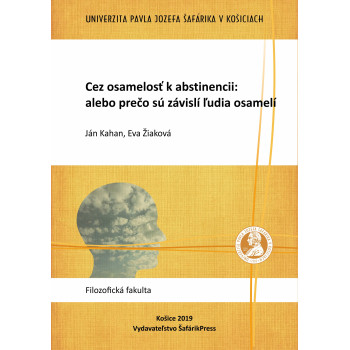
Cez osamelosť k abstinencii: alebo prečo sú závislí ľudia osamelí

Cez osamelosť k abstinencii: alebo prečo sú...

E-book

E-book

Ján KahanEva Žiaková

The monograph focuses on the issue of loneliness among substance-addicted people in the context of abstinence prospects and re/lapse prevention. In the monograph these phenomena, several theories were integrated and applied in the context of the ecosystem meta-framework of social work and practical contexts. The ecosystem meta-theory serves as a meta-construct with the ability to encompass the complexity of social phenomena as well as that of human beings within the structure of their living and social environment, formal and informal networks, and close intimate relationships.

In this monograph are presented research sample consisted of 235 respondents – hospitalised addicts undergoing urgent treatment, abstaining A-club members as well as members of psychotherapy and self-help groups. The research showed that abstainers were statistically less lonely than the hospitalised respondents. Quantitative data of research are complemented by qualitative data collected in four case studies; two of them focused on two long-term abstainers from alcohol and drugs, while the other two case studies dealt with two respondents in post-hoc treatment undergoing the resocialization process. The research also showed that respondents who broke abstinence felt lonelier than their successfully abstaining counterparts.

The results were supported also by the fact that a statistically significant inversely proportional relationship was identified between the duration of abstinence and loneliness rate. Gender differences were found between the hospitalised addicts in all loneliness dimensions. Naturally, the combined research was limited in certain aspects, mainly in terms of the size and proportional distribution of the research sample and its subgroups, test battery extent, and general nature of the population studied. Triangulation among quantitative and qualitative with the theoretical starting points confirmed the existence of a relationship among loneliness, addiction, and prospect of abstinence.

Download the e-book for free (pdf)

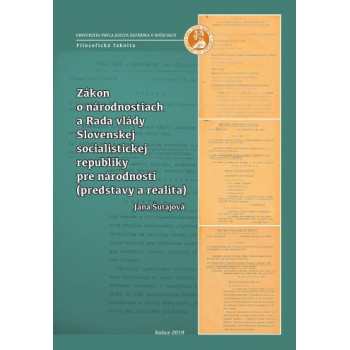
Zákon o národnostiach a Rada vlády Slovenskej socialistickej republiky pre národnosti (predstavy a realita)

Zákon o národnostiach a Rada vlády Slovenskej...

E-book

E-book

Jana Šutajová

From January 1, 1969, the Constitutional Act on the Status of Nationalities in the Czechoslovak Socialist Republic (ČSSR) and the Constitutional Act on the Federation came into effect. The Constitutional Act on the Status of Nationalities represented at least a formal significant step forward in the legal regulation of minority rights. However, this law was intended to serve as a foundation for further legal adjustments. It was declared that additional steps and negotiations for the adoption of implementing regulations would follow and that further laws would be enacted at both the federal and national levels. Nevertheless, no additional law or government regulation related to the constitutional act on the status of nationalities in the ČSSR was ever issued.

During the normalization period, issues concerning further legislation related to national minorities were not addressed. However, in the brief period following the adoption of the constitutional act in 1968 until the end of 1969, some institutions attempted to prepare and promote such legal norms. One of these institutions was the Government Council of the Slovak Socialist Republic (SSR) for Nationalities (hereafter referred to as the Council or the Government Council for Nationalities). The monograph provides an insight into the development of additional legal norms arising from the constitutional act on the status of nationalities in the Slovak Socialist Republic, prepared by the Government Council of SSR for Nationalities. This council was one of the institutions established in Slovakia after the formation of the Czechoslovak federation and dealt with nationality issues.

In addressing further legal norms stemming from the constitutional act on nationalities in ČSSR, it was necessary to consider prior developments. Therefore, the first part of the monograph examines the status of minorities in Czechoslovakia before adopting the constitutional act, activities of nationalities preceding its adoption, and its enactment itself. Subsequent sections focus on institutional changes in SSR following federalization, the establishment of the Government Council of SSR for Nationalities, and specific actions taken by this Council and its expert bodies in drafting proposals for laws concerning nationalities in the Slovak Socialist Republic.

The motivation for writing this monograph stemmed from the fact that this topic has so far received attention only in a few studies in Slovakia, which primarily focused on the Hungarian minority during either the Prague Spring or normalization periods.

Download the e-book for free (pdf)

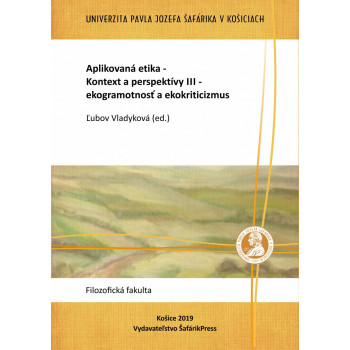
Aplikovaná etika – Kontext a perspektívy III – ekogramotnosť a ekokriticizmus
  • Out-of-Stock

Aplikovaná etika – Kontext a perspektívy III –...

E-book

Ľubov Vladyková (ed.)

In the present text, opinions on environmental literacy are integrated. The most important discoveries of the 21th century exist not in the realm of science, medicine, or technology, but rather in the dawning awareness of the earth's limits and how those limits will affect human evolution. Humanity has reached a crossroad where various ecological catastrophes meet what some call sustainable development. While a great deal of attention has been given to what governments, corporations, utilities, international agencies, and private citizens can do to help in the transition to sustainability, little thought has been given to what schools, colleges, and universities can do. As the health of our planet continues to deteriorate, it is vital to educate and raise ecoliterate citizens.

Download the e-book for free (pdf)

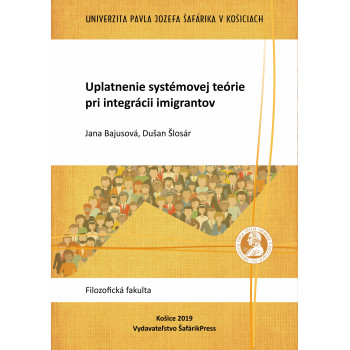
Uplatnenie systémovej teórie pri integrácii imigrantov

Uplatnenie systémovej teórie pri integrácii...

E-book

E-book

Jana BajusováDušan Šlosár

The integration of immigrants into society is currently of interest to many professionals and to the general public. Immigration is a consequence of a variety of factors, mainly due to political, social, economic or security conditions in the countries of origin. Immigration is subsequently linked to the process of integrating immigrants into the host country. The integration of immigrants into society or integration, as this process is called in the monograph, is a complex phenomenon that extends to many spheres of everyday life for the citizens of the receiving country, and at the same time is often difficult for immigrants. Many governmental and non-governmental organizations are involved in the process of social integration of immigrants, who develop different strategies and mechanisms to streamline the outcome of this process.

In relation to immigrants, the Slovak Republic is bound to provide social and legal protection and therefore it is necessary to deal with the issue of social services, which could potentially significantly contribute to their social integration into Slovak society. From the legislative point of view, however, these services are unified and do not take into account the differences of immigrants resulting from their culture, religion, social, ethical or other characteristics. That is why the monograph focuses on social integration of immigrants in Slovakia in the context of provided social services.

Download the e-book for free (pdf)

This website uses cookies to ensure you get the best experience on our website