Slovenčina



E-book
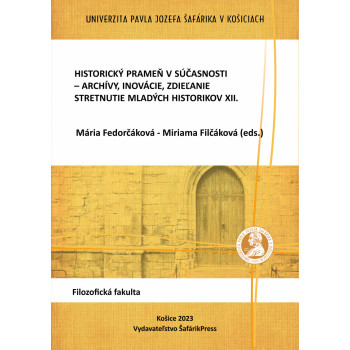
Mária Fedorčáková - Miriama Filčáková (eds.)
Proceedings of the 12th Scientific Conference of Young Historians, organized by the Department of History of the Faculty of Arts at Pavol Jozef Šafárik University in Košice in cooperation with the State Archive in Košice and the Slovak Historical Society at the Slovak Academy of Sciences on October 12, 2022
The theme of the conference proceedings is the issue of sources, their interpretation and use of current digital technologies in their research and access. The proceedings constit of 7 papers by authors working in Slovak and Czech universities.
The digitisation of seals is the subject of the paper by Barbora Borůvková. Michael Dudzik deals with the problem of building the road network in modern France and written and cartographic sources. Trends of digitization in Slovak archives and their perception by researchers are elaborated by in Miriama Fialkovičová´s study. Miriama Filčáková dealt with sources on the history of tertiary education in Košice in connection with the establishment of the UPJŠ. The possibilities of researching sources on the electrification of Slovakia are dealt with in the study by Dominik Hrtus. Ondrej Šály in his paper treated the letters of serfs in the 18th century as a source for economic history. Vavrinec Žeňuch discusses the possibilities of researching the eclesiastical history of the Uh county in the modern period.
Download e-book for free (pdf)
Data sheet
E-book
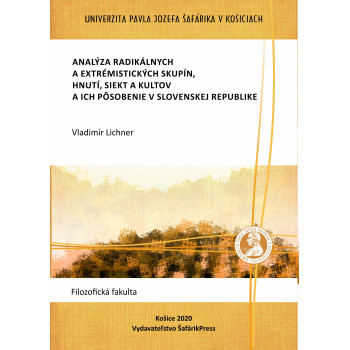
The scientific monograph focuses on the analysis of radical and extremist groups, movements, sects and cults and their activities in the Slovak Republic.
It provides a theoretical insight into the issues of specific organizations and movements that have been characterized in the past, or are currently characterized by belonging to ideologies that we might call anti-social.
It does not focus unilaterally on one type of violent extremism, but focuses on the issue of both right-wing and left-wing religious groups. In the final part it offers a brief suggestion of prevention procedures, which could significantly influence the increase of extremist manifestations especially in young people.
E-book
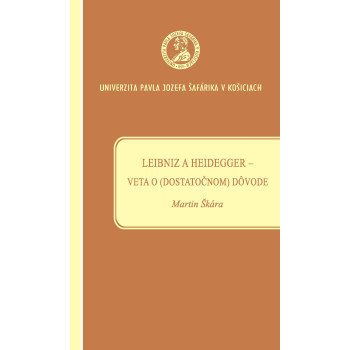
Philosophy is interwoven throughout its history with several principles that bring light and order to this kind of thinking, whether it is a systematic or a non-systematic form of philosophizing.
Each of the principles represents in its own way the origin (ἀρχή) of all deductive reasoning, but not all philosophical statements and conceptions are obliged to proceed in the same way, for not all philosophical statements and conceptions are calculus. Actually, such a form of rationalist philosophizing is really a minority in the history of philosophy. But in spite of its minority presence, it will always attract attention to some extent, whether by becoming a pillar of thought itself and finding a permanent place in its foundations, or by becoming an indispensable mainstay of philosophical reasoning. In fact, there are not many principles in the history of philosophical thought.
The state of affairs is primarily due to the heterogeneous and in many cases irrationalist nature of philosophical thinking.
E-book
Iveta Bónová - Marián Gladiš (eds.)
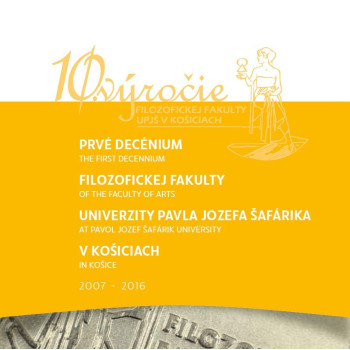
The Foundation of the Faculty is a major “thing” created and developed by many personalities. The collected information, opinions, and critical judgements have led me to the conclusion that there exist among us plenty of narratives on the formation of this Faculty.
What is appealing about this fact is that from each party concerned, specifically teachers of Philosophy, Psychology and Education at the UPJŠ Faculty of Science, teachers of Psychology at the UPJŠ Faculty of Public Administration in Košice, teachers of the Department of Foreign Languages at UPJŠ, teachers at Prešov University who were approached with a bid to create the conditions of and opportunities for the development of their study branches at the new UPJŠ Faculty of Arts in Košice, there is a significant clue reflected in the inception of the new Faculty of this University.
It is necessary to say that it is a justifiable reflection, because without this, it would not be possible to develop exploration and offer the students courses in the field of Humanities, in social and behavioural sciences, educational sciences, and in the field of History and Ethnology.
E-book
Patrik Furik - Michaela Ružičková - Dávid Gajdoščík - Peter Dubóczi - Barbora Linhartová - Lucia Grieger
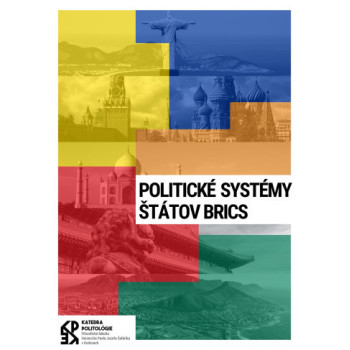
The textbook entitled Political Systems of the BRICS States is published as an output of the KEGA 014UPJŠ-4/2020 Innovative Model of Education Leading to Active Citizenship as a Prevention of the Rise of Political Extremism among Students. The aim of the given publication is to present the basic principles of the political systems of the BRICS bloc states and to provide the reader with the nature and character of the bloc's functioning.
The textbook consists of an introduction and five further chapters. All sections are written in Slovak. The individual chapters focus primarily on characterizing the historical development of the BRICS states, the evolution of their constitutionalism, public administration, and on defining the legislative, executive, and judicial branches of power
The individual chapters describe the political systems of the states: Brazil, the Russian Federation, India, China, and South Africa. The introductory chapter of the textbook contains the characteristics of the development and formation of the bloc, as well as information on the cooperation among the BRICS members.