Slovenčina


E-book
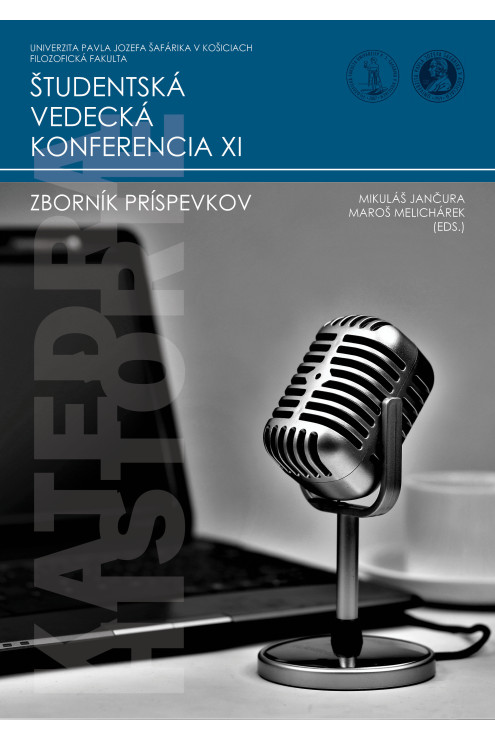
Mikuláš Jančura - Maroš Melichárek (eds.)
The textbook is derived from the outcomes of the eleventh annual student scientific conference, which took place in December 2022.
The student scientific conference is an integral component of the curriculum within the Department of History at the Faculty of Arts, UPJŠ, and has been implemented since 2011. Its primary objective is to provide a platform for Bachelor's and Master's degree students to present segments of their original research as part of their thesis development.
The purpose of this textbook extends beyond the mere publication of these diverse thematic texts. It also strives to emphasize the significance of exceptional pedagogical initiatives and the added value of university education for students, manifested through the dissemination of their scholarly output.

Data sheet
E-book
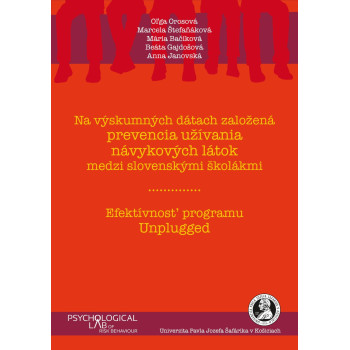
Oľga Orosová - Marcela Štefaňáková - Mária Bačíková - Beáta Gajdošová - Anna Janovská
The research monograph is focused on studying the effectiveness of the Unplugged prevention program conducted at primary schools across Slovakia.
Using two large datasets with repeated measures, the monograph contributes to research knowledge about substance use prevention. The authors studied protective and risk factors, developmental trends of smoking and alcohol consumption as well as the effectiveness of the Unplugged prevention program – its effect on psychological and behavioural indicators of health-related behaviour.
Considering the complexity of the analyses on two datasets with 5 waves of data, each chapter is presented as a separate research study. The findings serve as a basis for recommendations for parents and teachers and also for school management at primary schools that support effective school policy aimed at the prevention and promotion of the health in schoolchildren.
E-book
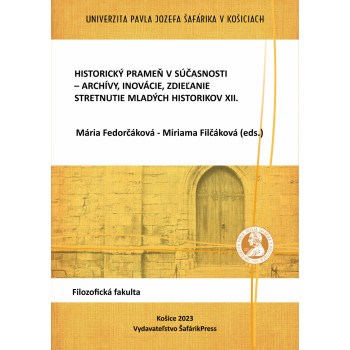
Mária Fedorčáková - Miriama Filčáková (eds.)
Proceedings of the 12th Scientific Conference of Young Historians, organized by the Department of History of the Faculty of Arts at Pavol Jozef Šafárik University in Košice in cooperation with the State Archive in Košice and the Slovak Historical Society at the Slovak Academy of Sciences on October 12, 2022
The theme of the conference proceedings is the issue of sources, their interpretation and use of current digital technologies in their research and access. The proceedings constit of 7 papers by authors working in Slovak and Czech universities.
The digitisation of seals is the subject of the paper by Barbora Borůvková. Michael Dudzik deals with the problem of building the road network in modern France and written and cartographic sources. Trends of digitization in Slovak archives and their perception by researchers are elaborated by in Miriama Fialkovičová´s study. Miriama Filčáková dealt with sources on the history of tertiary education in Košice in connection with the establishment of the UPJŠ. The possibilities of researching sources on the electrification of Slovakia are dealt with in the study by Dominik Hrtus. Ondrej Šály in his paper treated the letters of serfs in the 18th century as a source for economic history. Vavrinec Žeňuch discusses the possibilities of researching the eclesiastical history of the Uh county in the modern period.
Download e-book for free (pdf)
E-book
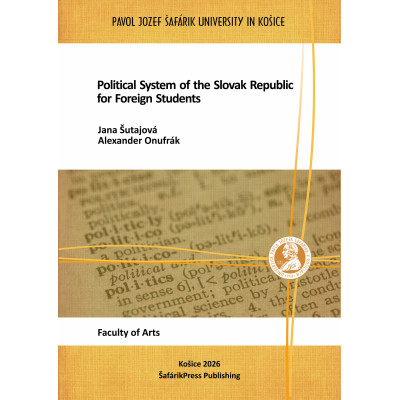
Jana Šutajová Alexander Onufrák
This university textbook, „Political System of the Slovak Republic for Foreign Students“, is designed to introduce Erasmus students and other international students to basic information regarding the historical and political development of Slovakia and the political system of the Slovak Republic. It focuses on political developments since 1918.
It introduces foreign students to pivotal historical events that influenced political developments in Slovakia (the establishment of the First Czechoslovak Republic, the Munich Agreement and the Vienna Arbitration, the Slovak State, postwar developments and the Košice Government Program, the 1946 elections, February 1948, the Prague Spring of 1968, normalization, the Velvet Revolution of 1989, the dissolution of the Czechoslovak Federal Republic, the establishment of the Slovak Republic, and its integration into the European Union and the North Atlantic Treaty Organization) and with the political system of the Slovak Republic (constitutional institutions, the party system, the electoral system).
E-book
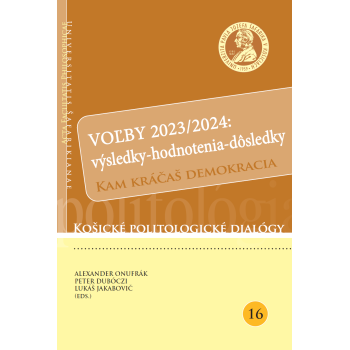
Alexander Onufrák, Peter Dubóczi, Lukáš Jakabovič
The submitted publication entitled Voľby 2023/2024: výsledky – hodnotenia – dôsledky reflects a wide range of topics related to the electoral processes that took place in 2023 and 2024 in Slovakia and abroad. The publication deals with both the evaluation of the currently valid electoral legislation, including proposals for its further improvement, and the broader socio-political consequences of the elections in connection with democratization and integration processes. The submitted publication is published as an output of the VEGA project No. 1/0474/24 Audit of Slovak electoral and referendum legislation, the project leader of which is prof. JUDr. Ladislav Orosz, CSc. from the Faculty of Law of the Pavol Jozef Šafárik University in Košice and in which the Department of Political Science of the Faculty of Arts of the Pavol Jozef Šafárik University in Košice also participates. The authors of the individual contributions analyze all types of elections, from municipal and regional, through parliamentary and presidential, to elections to the European Parliament. While some authors focused primarily on the local or regional level, others chose an approach focused on the national or supranational level, and the geographical scope of the cases examined was extremely diverse.
Download the e-book for free (pdf.)