Slovenčina


E-book
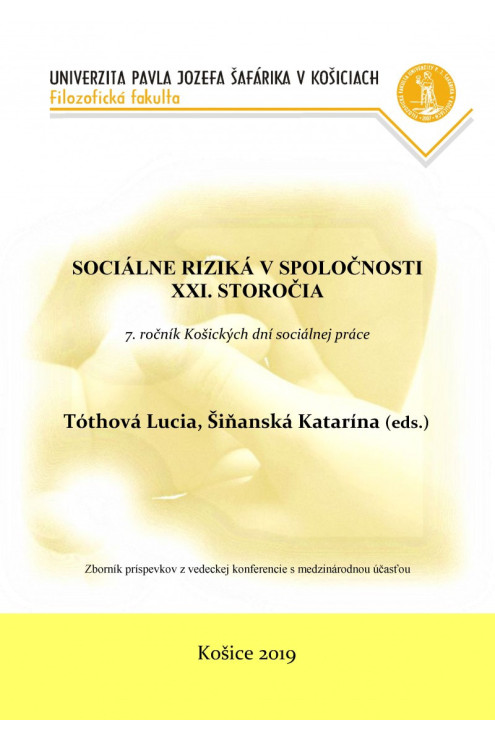
Lucia Tóthová - Katarína Šiňanská (eds.)
Proceedings of the scientific conference with international participation held on November 30, 2018, in Košice
Current social work addresses the serious development problems of society such as poverty, unemployment, chronic diseases, socially vulnerable groups and others. We must not forget that enough attention must be paid to the discovery of causes and a detailed analysis of these problems. The thing is that social problems have been around for a long time, they just changed their shape, old forms of social risks were replaced by the new ones that need to be explored and analyzed in order to be able to perform measures and remove the causes of social risks of the 21st century. Proceedings of the scientific conference with international participation entitled Social Risks in the Society of the XXI. Century is therefore devoted to various perspectives related to social risks of modern society in the variety of contributions, indicating the broad-spectrum not only of the proceedings, but also the social work itself.

Data sheet
E-book
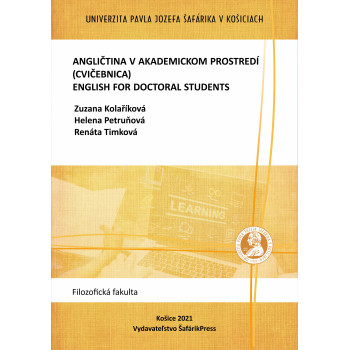
Zuzana Kolaříková - Helena Petruňová - Renáta Timková
The publication contributes to an active acquisition and development of language skills in the area of academic English.
Individual lessons include tasks in which the user will find a lot of useful vocabulary in the form of collocations, phrases and sentences which can be applied in practice. The tasks are focused on the area of English pronunciation, grammar, word formation, vocabulary, improving communicative competence in written and verbal communication, improvement of professional skills of presentation, academic writing, etc.
The publication provides space for complementing and creating own database of vocabulary (topic pages).
E-book
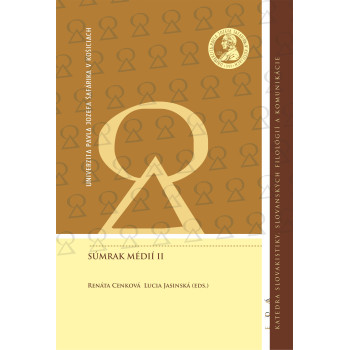
Renáta Cenková - Lucia Jasinská(eds.)
Proceedings of the International Scientific Conference held on October 23 and 24, 2013 at Pavol Jozef Šafárik University in Košice
The presented proceedings, which are the outcome of the second edition of the international scientific conference "The Twilight of Media," organized by the Department of Mass Media Studies at the Department of Slovak Studies, Slavic Philologies and Communication, Faculty of Arts, Pavol Jozef Šafárik University in Košice, examine current issues in the media landscape from several perspectives.
They offer a representative overview by experts in media from Slovakia and abroad on the current state, primarily of electronic but also partially print media, and on upcoming trends in their development. The proceedings are thematically diverse and address questions from the fields of media, aesthetics, value aspects of media messages, media effects, and, for example, the influence of specific genres and their representative texts on the recipient.
At the same time, they cover the area of current media law as well as ethical standards and requirements placed on the text by its author or other professional media workers.
Editors
Súbor na stiahnutie (pdf)
E-book
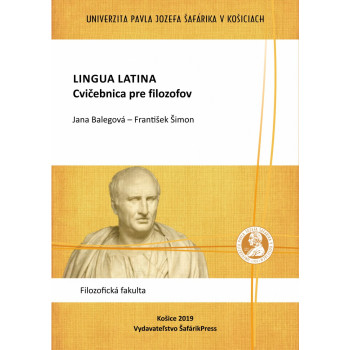
Jana Balegová - František Šimon
The university textbook "Lingua Latina – Exercise Book for Philosophers" is a parallel study material to the textbook "Lingua Latina – Cursus Communis." It is designed for practicing grammatical lessons at home. The content of the exercises corresponds to the focus of each lesson in the mentioned textbook, both in terms of the covered grammatical phenomena and vocabulary. For this reason, only vocabulary not included in the lessons of the textbook is presented in the exercises.
The Latin-Slovak dictionary at the end of the exercise book contains the entire vocabulary from both the exercise book and the textbook, while the Slovak-Latin dictionary includes the vocabulary from exercises that require translation into Latin. The vocabulary in this exercise book is oriented towards the needs of philosophy students and, with regard to the selection of source materials, also includes non-classical lexicon or non-classical meanings of classical words (this lexicon is marked with an asterisk *).
The exercise book includes a key that allows students to directly verify the correctness of their work. The textbook "Lingua Latina – Exercise Book for Philosophers" is available electronically in PDF format. As part of the educational program, online tests available on the website of the Department of Classical Philology at the Faculty of Arts, UPJŠ (https://www.upjs.sk/filozoficka-fakulta/katedra-klasickejfilologie/katedra/) also serve to practice the covered material.
E-kniha
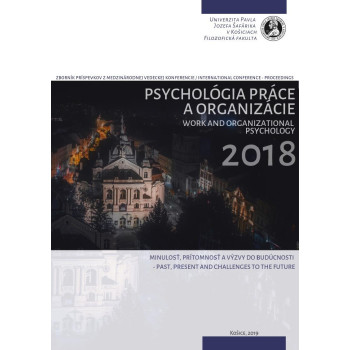
Pavol Kačmár - Jozef Bavoľár - Ladislav Lovaš (eds.)
This publication introduces a body of papers presented at scientific conference Work And Organizational Psychology that took place on May 23 and 24 in Košice. The theme of the conference was Past, Present, and Challenges to the Future. All papers were peer-reviewed.