Slovenčina


E-book
University textbook Selected Chapters from Managerial Ethics presents selected topics from the current issue of Managerial Ethics.
The historical context of Managerial Ethics and its formation on the background of business ethics, up to the form of independent inter and trans discipline, is presented at the introduction. Being one of the subdisciplines of applied ethics, it is inherently normative and interdisciplinary. It represents an overlapping institutional aspect - management ethics and individual aspect - manager ethics. The issue of social responsibility in economics and business, or the moral profile of a manager as a key player of this applied ethics is mentioned.
Institutionalization and implementation of ethics in corporate culture and the tools that are used in this so complex and interdisciplinary process are also a necessary step. Established ethical management systems, which complement the modularity of institutionalization, are also important. The main question is, of course, ethics in decision-making and management of people, as it is where ethical dilemmas and tensions are born. Also, the issue of ethics in leadership, as another qualitative and developmental stage in Managerial Ethics, is the contribution.
The attached moral dilemmas are meant to reflect, self-test moral intelligence and to be resolved.

Data sheet
E-book
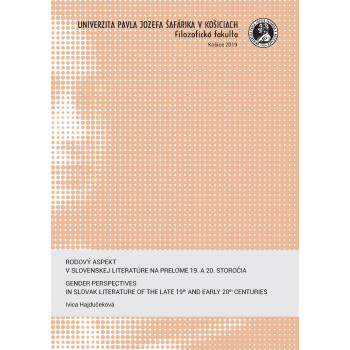
The second (supplemented and expanded) edition of the bilingual textbook Rodový aspekt v slovenskej literatúre na prelome 19. a 20. storočia (Interpretačné etudy) / Gender Perspectives in the Slovak Literature of the Late 19th and Early 20th Centuries (Interpretation Studies) offers to a wider range of recipients – students of Teaching of Academic Subjects and teachers in practice – a didactic transformation of current research issues (supported by e-literacy using online approaches and QR codes), which was developed in cooperation with the School of Applied Arts in Košice (since 2019/20 the so-called School of Art Industry) ) in the academic year 2018/2019.
Professional cooperation within the KEGA project No. 008UPJŠ-4/2017 – Science Without Barriers (Interdisciplinary Inspirations of Contemporary Literary Scholarship and Linguistics in Educational Practice at University) with teacher of Slovak Language and Literature, PaedDr. Jana Valicová, and Mgr. Renáta Novotná Markovičová of ŠUP took place in project teaching. It yielded results in two interdisciplinary outcomes:
1. Creation of the Literary Lounge in the Student Café Minerva in the premises of the UPJŠ Faculty of Arts;
2. Illustrations of the 2nd edition of the textbook Gender Aspect in the Slovak Literature at the Turn of the 19th and the 20th Centuries (2019).
E-book
Bernadeta Fabová - MikulአJančura (eds.)
Collection of Studies from the 2nd Scientific Conference of Young Historians (Doctoral Students and Researchers), organized by the Department of History of the Faculty of Arts at Pavol Jozef Šafárik University in Košice, in cooperation with the Faculty of Arts at Masaryk University in Brno, the Faculty of Arts and Sciences at Silesian University in Opava, and the Faculty of Arts at the University of Miskolc, held on October 29-30, 2012 in Košice.
The collection is the output of the second annual scientific conference of young historians (doctoral students and researchers), organized at Pavol Jozef Šafárik University in Košice. The central theme of the event was the focus on intersections of shared history. The ten studies map various intersections of the history of the V4 countries, as well as the broader Central European region, in the time span from the 13th to the 20th century. The individual studies cover a wide range of areas from the medieval road network, military and urban history, through economy, education, issues of national identity, the relationship between the state and the church, to demographic questions.
E-book
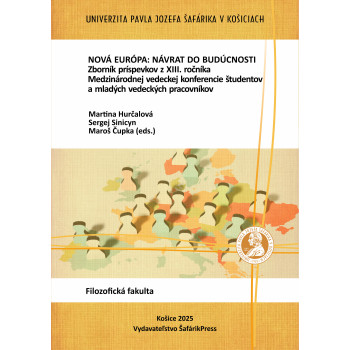
Martina Hurčalová - Sergej Sinicyn - Maroš Čupka (eds.)
Proceedings from the 13th International Scientific Conference of Students and Young Researchers, organized on May 16, 2024, by the Department of Political Science of the Faculty of Arts at Pavol Jozef Šafárik University in Košice, the Institute of Political Science and Public Administration of the Faculty of Political Science and Journalism at Maria Curie-Skłodowska University in Lublin, the Department of Political Science of the Faculty of Arts at the University of Miskolc, the Institute of Social Studies of the Faculty of Regional Development and International Studies at Mendel University in Brno, the Faculty of Political Science and Diplomacy at Vytautas Magnus University in Kaunas, and the civic association Respublica.
The aim of the translated publication NEW EUROPE: Back to the Future is to reflect on the challenges in the fields of international security, the fight against climate change, and environmental protection, and to highlight selected global phenomena.
The proceedings consist of 12 contributions in Slovak, English, and Czech. The authors primarily addressed selected current issues from the international environment in the context of deteriorating international relations and global security.
The topics of the contributions mainly include questions of international security (for example, in Germany or Hungary), environmental issues and the fight against the climate crisis. Furthermore, the proceedings include topics such as the European Parliament elections, selected narratives related to the war in Ukraine, migration to Europe and its security aspects, self-reflection of the European political system, and public space and public discourse. The proceedings also include a part of an upcoming utopian novel.
E-book
Vladimír Leško, Róbert Stojka a kol.
Kolektívna monografia Leško, V. – Róbert Stojka a kol.: Heidegger, metafyzika a Gréci (Košice: UPJŠ 2016, 695 s.) je prvým historicko-filozofickým pokusom na Slovensku, ale aj v širších zahraničných kontextoch, vysporiadať sa s takto zvolenou ústrednou témou Heideggerovho diela. Práca je členená do troch základných časti. V prvej, ktorá je nazvaná od Augustína k Aristotelovi, autori jednotlivých kapitol skúmajú genézu Heideggerovho vzťahu ku gréckej filozofii a skúmanie hlavnej Heideggerovej otázky – otázky bytia - od jeho prvých prednáškových kurzov k Aristotelovej filozofii z rokov 1921/1922 až do roku 1929, keď mu vychádza práca k Aristotelovej Metafyzike. Naše skúmanie jednoznačne potvrdzuje skutočnosť, že v týchto Heideggerových raných textov (prednáškových cyklov) sa postupne rodia všetky dôležité filozofické pozície, ktoré mali svoje zavŕšenie v práci Bytie a čas.