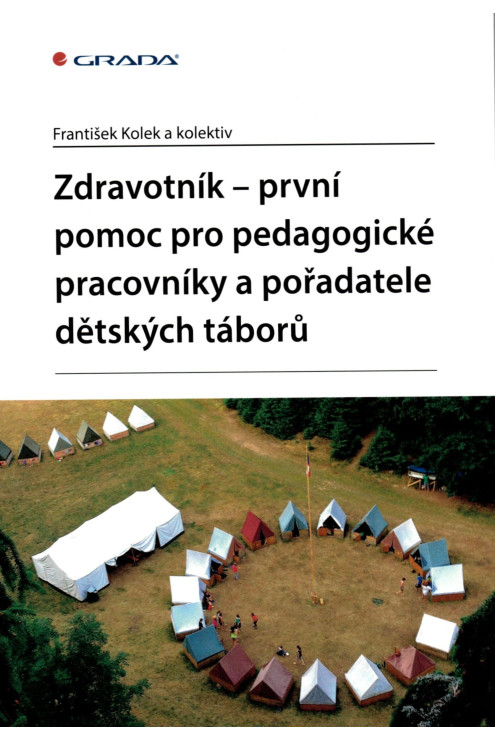
František Kolek a kolektív
Čtenář by měl po přečtení knihy umět přivolat pomoc v krizové situaci, znát základy technické první pomoci, zejména u dopravní nehody. Měl by umět poskytnout předlékařskou první pomoc do příjezdu zdravotnické záchranné služby u život ohrožujících stavů, jak improvizovaně bez pomůcek, tak s běžné dostupným materiálem – automatický externí defibrilátor, obsah autolékárničky, resuscitační maska.
Dále bude čtenář schopen u úrazů a běžných onemocnění schopen rozhodnout, zda zvolit domácí léčbu, navštívit lékaře, či zda musí volat záchrannou službu. Pokud zvolí domácí léčbu, bude vědět jak na ni. Čtenář se dozví, jak pečovat o dítě s častými chronickými onemocněními, jako je astma nebo cukrovka. Nechybí ani kapitola věnující se nebezpečím spojeným s koupáním a záchraně tonoucích. Samostatné kapitoly se věnují právní stránce poskytování první pomoci v ČR, lékům, základní znalosti o lidském těle nebo těhotenství a překotnému porodu.
Kniha je základní učebnicí pro rekvalifikační kurz zdravotník zotavovacích akcí, je určena táborovým zdravotníkům, medikům prvních ročníků v rámci předmětu první pomoc, profesím pracujícím s dětmi: učitelům, táborovým vedoucím, trenérům sportovních kroužků, skautským vedoucím, dále rodičům chtějícím umět poskytnout první pomoc svým dětem, členům organizací majících v náplni práce i první pomoc (například sbory dobrovolných hasičů) a široké laické veřejnosti, která se chce naučit první pomoc
Autor je lékař dětského resuscitačního oddělení Fakultní nemocnice Motol a lékař zdravotnické záchranné služby, odborný garant Kurzu zdravotník zotavovacích akcí Cukříček (pořádaný každoročně od roku 2016), skautský vůdce. Mezi spoluautory je i právník, farmaceut a zaměstnanec hasičského záchranného sboru.
Data sheet
Specific References
E-book
Daniela Lamačková-Renáta Orosová- Beáta Sakalová- Diana Repiščáková
Methodological guide for teachers for classroom lessons and civics Teaching law experientially? Is it even possible? The answers to these questions are provided by a methodological guide that uniquely links experiential learning methods with legal content. This methodological guide is a set of techniques based on the use of interactive and participatory learning methods, focusing on selected human rights and value-oriented topics, which also have the potential to develop other key competences of students, such as their communication skills, their ability to learn and educate independently, their ability to think critically, their ability to work with and analyse texts, their ability to discuss and express their opinions, and their ability to listen to each other. The methodological guide consists of a set of training activities - techniques, while each technique contains a precise description of the procedure for conducting a specific activity, the expected duration of the activity, aids, discussion topics and also a short pedagogical and legal commentary, precisely "tailored" to the specific legal topic. The legal topics are chosen to be generally applicable to both classroom and civics lessons, to raise questions about the functioning of rules and the need to respect them, mutual respect and tolerance, and to encourage reflection on the limits of individual rights and on responsibility in exercising one's rights. The techniques use training methods such as group work, brainstorming, role-playing, dealing with model situations, as well as a simulated court process. The methodological guide is intended for classroom teachers in the implementation of classroom lessons, and also for the purposes of the subject of civics, as well as for students of pedagogy at the Pavol Jozef Šafárik University in Košice.
Download e-book for free (pdf)
E-book
Veronika Vasiľová - Soňa Lovašová
The formation of social work as a scientific discipline is not a completed process because of with changes in society also change social problems that need to be identified and analyzed with the intention to develop methodological solutions aimed at preventing and interventing these social problems.For this reason, the field of social work as such is constantly expanding, as its dynamic nature makes it possible to respond to emerging social problems and react to the needs of society.
Social work in the school environment is a functioning science field abroad.In the conditions of the Slovak Republic, this area of social work is still missing.Therefore, the monograph deals with the possibilities of social work in the school environment in Slovakia.
The monograph is primarily intended for the professionals working in the field of social work and in the third sector with children and youth.
E-book
Oľga Orosová - Marcela Štefaňáková - Mária Bačíková - Beáta Gajdošová - Anna Janovská
The research monograph is focused on studying the effectiveness of the Unplugged prevention program conducted at primary schools across Slovakia.
Using two large datasets with repeated measures, the monograph contributes to research knowledge about substance use prevention. The authors studied protective and risk factors, developmental trends of smoking and alcohol consumption as well as the effectiveness of the Unplugged prevention program – its effect on psychological and behavioural indicators of health-related behaviour.
Considering the complexity of the analyses on two datasets with 5 waves of data, each chapter is presented as a separate research study. The findings serve as a basis for recommendations for parents and teachers and also for school management at primary schools that support effective school policy aimed at the prevention and promotion of the health in schoolchildren.
E-book
The aim of the monograph was to analyze the pedagogical possibilities of educational systems within children's and youth organizations, with an emphasis on those targeting the age group of children up to 15 years.
The starting point was an analysis of the current state of theory and practice in children's and youth organizations, with the intention of describing prevailing trends in their development and activities. This publication closely follows the previous monograph (Juščák, J. – Darák, M.: 2015), in which we processed, according to a unified methodology and using generally accepted pedagogical terminology, the collected available materials on the educational systems of selected (most representative) children's and youth organizations in Slovakia. Through a subsequent comparison of the obtained empirical data on educational systems, we aimed to identify their similar (identical) as well as specific (distinct) elements as a basis for establishing categorization criteria for their classification.
The culmination of our efforts was an attempt to characterize a children's organization as an educational institution, describing its characteristic features, functions, aims, content, principles, and educational methodology.
E-book
The current teaching of chemistry has its specific problems. On one hand, due to the shift of the focus of chemistry curriculum towards theoretical content, the difficulty of chemistry material has increased, and in connection with this, students' interest in chemistry has decreased.
The lack of student interest in chemistry is mostly supported by the opinion that it is precisely chemistry that significantly contributes to the deterioration of environmental quality. On the other hand, we live in an era where we encounter chemical products practically everywhere. It is necessary to learn the basics of chemistry as well as possible, which makes the question of increasing interest in chemistry education and improving its effectiveness very relevant. State educational programs have been introduced into Slovak schools as a foundation for the creation of school educational programs. These emphasize not only acquiring a certain amount of knowledge but also the development and enhancement of key and specific competencies of students, preparing them for lifelong learning and their application in life.
Therefore, increasing attention is being paid to one of the fundamental didactic tools for raising student activity in teaching, and thus improving the effectiveness of chemistry education – learning tasks. From both theory and practice of chemistry teaching, we know that learning tasks, questions, examples, exercises, etc., are among the important components of every teaching lesson. Learning tasks are applied in all phases of teaching – in the motivational phase, the phase of acquiring knowledge, the phase of consolidating knowledge, and the phase of checking the acquired knowledge. It is therefore clear that every teacher will sooner or later find themselves in a situation where they will have to select learning tasks from textbooks, workbooks, collections of problems and examples, or create them themselves.
This scientific monograph is intended for educational specialists and chemistry teachers, aiming to familiarize them with examples of various types and forms of learning tasks and the basics of their creation in chemistry. It can also be helpful for them in preparing certification works focused on test creation and their statistical evaluation.
E-book
Mária Bačíková - Anna Janovská
The textbook "Foundations of Methodology in Pedagogical-Psychological Research" is primarily intended for students of teaching academic subjects, but it will enrich anyone who needs to familiarize themselves with research methodology focusing on psychological and pedagogical sciences. In the textbook, students become acquainted with the basic principles of conducting research, the process of research implementation, and the basic methods of quantitative or qualitative approaches. The examples used in the textbook are mostly focused on research conducted in a school environment.
By mastering the basic knowledge presented in the textbook, the reader will be able to conduct simple research in school conditions. At the same time, understanding the principles of research methodology helps with the critical evaluation of information from various sources. In preparing the textbook, we utilized our long-term experience with teaching the subject of research methodology, as well as with implementing many research projects. We believe that the simple language of the textbook and the abundance of practical examples will help students understand the basics of such complex issues as research methodology.
We would like to take this opportunity to thank the students of the Faculty of Arts and Natural Sciences at P. J. Šafárik University in Košice who attended the course "Foundations of Methodology in Pedagogical-Psychological Research" in the previous academic year for their inspiration, constructive comments on previous versions of the text, and ideas (or mistakes) that we drew upon in the textbook. We also thank other students who allowed us to use examples from their final theses in the textbook. The conclusion of the work is open because, as it turns out, we do not have a common denominator for both concepts that could decide on the correctness of one or the other concept. It is precisely in this that the Socratic question remains a serious philosophical problem today.
E-book
Jitka Dobbersteinová - Silvia Horáková - Simona Hudecová & Zuzana Stožická
The textbook for Module 1 of the course "Introduction to Open Access." Upon completing this module, it is expected that you will be able to understand scholarly communication and open access, advocate for various forms of open access and distinguish between them, master the issues of rights management including copyright law, copyleft as a special use of copyright, and related intellectual property rights, and explain the significance of open access in the context of scholarly communication.
E-book
The aim of the monograph was to analyze and address the issue of educational systems within children's and youth organizations, with an emphasis on those focused on the age category of children up to 15 years.
The starting point was an analysis of the current state of the educational environment in terms of the systemic nature of education and the basic categories of the educational system. The collected available materials on the educational systems of selected (most representative) children's and youth organizations in the Slovak Republic were subsequently processed according to a unified methodology and using generally accepted pedagogical terminology.
Renáta Orosová (výkonný redaktor)
Vedecký recenzovaný časopis Edukácia je zameraný na problematiku vzdelávania a výchovy v oblasti základného, stredného a vysokého školstva. Zreteľ kladie na súčasný stav a perspektívy edukačnej praxe, aktuálne aspekty pregraduálnej prípravy učiteľov, sociálnej pedagogiky, špeciálnej pedagogiky, ako aj pedagogické a psychologické aspekty výchovy v základných výchovných inštitúciách z pohľadu širokej pedagogickej verejnosti. Je určený vedeckým pracovníkom, mladým vysokoškolským učiteľom, doktorandom, ako aj odborným a pedagogickým pracovníkom s cieľom prezentovať trendy v edukácii a vyvolať diskusiu k aktuálnym otázkam prezentovaných oblastí výchovy a vzdelávania.
Ciele vedeckého časopisu Edukácia:
E-book
Johann Berti et al.
The manual is part of the collection Path to Open Science by the French Ministry of Higher Education and Research. It is designed to guide postgraduate students at every step of their research, from planning the scientific approach to publishing the research results.
It provides a set of tools and best practices that can be directly implemented in research across any discipline.
We hope this manual will motivate doctoral students and equip them with the tools to realize their ambitions in open science through sharing findings and data with the broadest possible audience.
E-kniha
Renáta Orosová Michal Novocký Zuzana Vagaská
This publication provides a summary of knowledge about microteaching as a simulation strategy in the context of university teacher education. Readers will find theoretical foundations of simulation techniques, definitions and objectives of microteaching, the role of analysis as a tool for reflection, possibilities for implementation in both face-to-face and distance learning formats, and numerous examples of best practices. We believe that this text contributes to a deeper understanding of the importance of microteaching, a simulation strategy that systematically develops pedagogical skills and helps shape the professional competencies of future teachers.
E-book
Renáta Orosová - Zuzana Boberová - Emília Marcinová (eds.)
Proceedings of Abstracts from the International Scientific Conference, 12–13 September 2016
The international scientific conference is focused on issues of education and upbringing within primary, secondary, and higher education, as well as school institutions, from the perspective of the educator. Emphasis is placed on the current state and prospects of educators in educational practice, pedagogical and sociological aspects of upbringing in fundamental educational and upbringing institutions, as well as current aspects of pre-service teacher training.
The conference is intended for researchers, young university teachers, doctoral students, as well as professional and pedagogical staff, with the aim of presenting the educator-teacher, social pedagogue, and special pedagogue-from a contemporary perspective, highlighting their essential cooperation in relation to education, and stimulating discussion on current issues in the presented areas of upbringing and education within the context of the present situation in the school system.
E-journal
The scientific-professional journal Edukácia focuses on issues related to education and upbringing in the fields of primary, secondary, and higher education. It emphasizes the current state and prospects of educational practice, contemporary aspects of pre-service teacher training, social pedagogy, special pedagogy, as well as pedagogical and psychological aspects of upbringing in basic educational institutions from the perspective of the broader pedagogical community. It is intended for researchers, young university lecturers, doctoral candidates, as well as professional and teaching staff, with the aim of presenting trends in education and stimulating discussion on current issues in the presented areas of upbringing and education.
E-book
The educational system (schooling) is one of the most effective tools for shaping the young generation in any advanced society. Schools not only create the knowledge base necessary for fulfilling the demands of the economy and the social sphere, but they also shape the national and ideological identity of each member of society. The school plays a decisive role in forming positive values, but it can also become a breeding ground for xenophobia and racist attitudes. The school has an irreplaceable role in creating national consciousness, identification with one's own nation, its history, the heroic deeds of ancestors, and the meaning of its existence.
After the dissolution of Austria-Hungary, there were fundamental geopolitical changes in Central Europe. One of these was the creation of Czechoslovakia, a state founded on radically different principles than pre-war Hungary. The founders of the Czechoslovak Republic (CSR), the personalities who decisively determined the character of the political system in the newly established republic, did not belong to the privileged classes of the previous regime. Unlike Hungary, where political power was controlled almost without exception by the nobility, the elite in Czechoslovakia consisted of men who were radical critics of Austria-Hungary.
A fitting example was the most influential figure of interwar Czechoslovakia, President Tomáš Garrigue Masaryk. Despite his origins, Masaryk was perceived by both Czechs and Slovaks as the founder of the state, a legendary figure whose political and social influence far exceeded the powers of the presidential office.
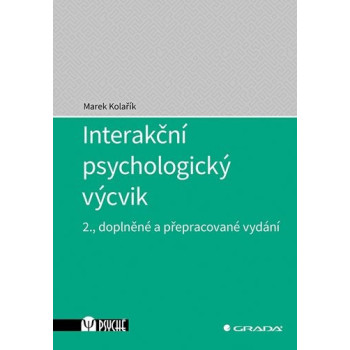
V přípravě pedagogů, psychologů a dalších příbuzných oborů má interakční psychologický výcvik nezastupitelné místo. Podílí se na rozvíjení sociálních dovedností i na prohlubování profesních kompetencí studentů. V rámci výuky na vysokých školách je většina času stále věnována spíše teoretické přípravě, která nemá vždy adekvátní praktický protipól. Stává se tak, že studenti odcházejí do praxe nedostatečně připraveni nejen na práci s lidmi, ale i se sebou samými. Přitom zlepšování komunikačních dovedností, poznávání vlastních hranic, možností a schopností, a především poznávání silných a slabých stránek u sebe i u druhých a jejich přijímání je nezbytnou součástí kvalitní práce s lidmi. Tato publikace bude díky své srozumitelné a přehledné formě pro studenty i odborníky v oboru velmi užitečnou pomůckou.
This website uses cookies to ensure you get the best experience on our website