Slovenčina



E-book
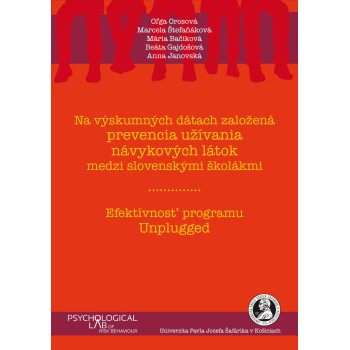
Oľga Orosová - Marcela Štefaňáková - Mária Bačíková - Beáta Gajdošová - Anna Janovská
The research monograph is focused on studying the effectiveness of the Unplugged prevention program conducted at primary schools across Slovakia.
Using two large datasets with repeated measures, the monograph contributes to research knowledge about substance use prevention. The authors studied protective and risk factors, developmental trends of smoking and alcohol consumption as well as the effectiveness of the Unplugged prevention program – its effect on psychological and behavioural indicators of health-related behaviour.
Considering the complexity of the analyses on two datasets with 5 waves of data, each chapter is presented as a separate research study. The findings serve as a basis for recommendations for parents and teachers and also for school management at primary schools that support effective school policy aimed at the prevention and promotion of the health in schoolchildren.
Data sheet
E-book
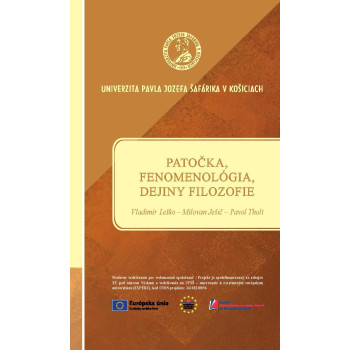
Vladimír Leško - Milovan Ješič - Pavol Tholt
The philosophical work of the most significant Czech philosopher of the 20th century, Jan Patočka (1907–1977), stands out for its unique intellectual originality.
Even at the time of its creation, it significantly transcended the narrow boundaries of the contemporary Czechoslovak spiritual space and uniquely connected our country with the most advanced philosophical teachings of Western thought, in which Husserl's phenomenology and Heidegger's fundamental ontology played a dominant role. Certainly, it would be a great mistake to reduce the decisive position of Patočka's philosophical work merely to the reception and critical-creative elaboration of Husserl's and Heidegger's philosophy.
In this context, we cannot overlook the decisive contribution of Eugen Fink, who introduced Patočka to the intricacies of Husserl's and Heidegger's philosophy. Both thinkers then continued in a lifelong creative philosophical dialogue. However, it is also necessary to mention Patočka's intense interest in the works of Scheler, Ingarden, Landgrebe, as well as Sartre and others.
E-book
Iveta Bónová - Marián Gladiš (eds.)
The Foundation of the Faculty is a major “thing” created and developed by many personalities. The collected information, opinions, and critical judgements have led me to the conclusion that there exist among us plenty of narratives on the formation of this Faculty.
What is appealing about this fact is that from each party concerned, specifically teachers of Philosophy, Psychology and Education at the UPJŠ Faculty of Science, teachers of Psychology at the UPJŠ Faculty of Public Administration in Košice, teachers of the Department of Foreign Languages at UPJŠ, teachers at Prešov University who were approached with a bid to create the conditions of and opportunities for the development of their study branches at the new UPJŠ Faculty of Arts in Košice, there is a significant clue reflected in the inception of the new Faculty of this University.
It is necessary to say that it is a justifiable reflection, because without this, it would not be possible to develop exploration and offer the students courses in the field of Humanities, in social and behavioural sciences, educational sciences, and in the field of History and Ethnology.
E-book
Despite the fact that a psychologist may have a good moral background, it is necessary for everyone to know and act in accordance with ethical professional principles in order not to harm the clients with whom they work in the course of psychological practice. There are many case studies in the professional literature that describe serious situations of violations of psychological ethics. On the one hand, they depict conscious professional misconduct or ignorance. On the other hand, they have contributed to the introduction of even legal standards for the ethical behavior of psychologists as professionals. Completion of a course or training in the topic of psychological ethics is required by several professional associations abroad, especially in the last years of undergraduate studies. Their goal is to supervise the quality and preparation of future psychologists. The university textbook Do I Have It or Not: Ethics in Psychological Practice provides a summary of essential information on the ethics of conducting psychological practice, the boundaries of the relationship with the client, and the rules of confidentiality. The goal is not for the student, as a future psychologist, to know ethical rules word for word, but for them to be sufficiently ethically sensitive.
E-book
The monograph entitled The first Slovak women’s magazines: Dennica, Živena, Slovenská žena (1898–1923) provides a general view of the initial stage of the formation of women’s magazine production in Slovakia, defined by a period of 25 years at the turn of the 19th and 20th centuries between 1898 and 1923, in the context of the historical and social development, to which the Slovak journalistic milieu inevitably responded.
The publication is a result of detailed material research of Slovak historical periodicals, implemented mainly from the perspective of the mediological methods and standards of research work.