Slovenčina



E-book
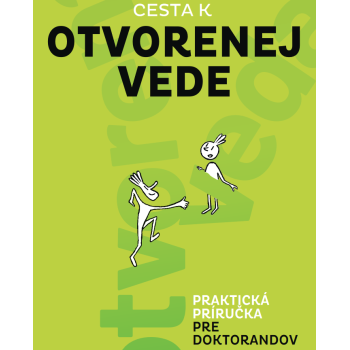
Johann Berti et al.
The manual is part of the collection Path to Open Science by the French Ministry of Higher Education and Research. It is designed to guide postgraduate students at every step of their research, from planning the scientific approach to publishing the research results.
It provides a set of tools and best practices that can be directly implemented in research across any discipline.
We hope this manual will motivate doctoral students and equip them with the tools to realize their ambitions in open science through sharing findings and data with the broadest possible audience.
Data sheet
E-book
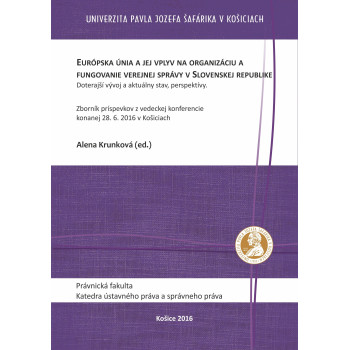
Alena Krunková (ed.)
Proceedings of the Scientific Conference Held on June 28, 2016 at the Faculty of Law of Pavol Jozef Šafárik University in Košice in connection with the implementation of the project “The European Union and Its Impact on the Organization and Functioning of Public Administration in the Slovak Republic” – approved under number MVZP – SK PRES/2016/134
The Slovak Republic, as a member state of the European Union, is undertaking a historic role associated with the Presidency of the Council of the European Union within the presidency trio. At the beginning of 2016, the Ministry of Foreign and European Affairs of the Slovak Republic announced a call for applications for grants for 2016 in the field of international relations and foreign policy, specifically focused on the Slovak Republic’s Presidency of the Council of the European Union. The Faculty of Law of Pavol Jozef Šafárik University in Košice responded to this call and obtained a project aimed at carrying out research activities through a series of events focused on regional self-government in the Slovak Republic in the context of its role within the European Union. The Faculty has long been engaged with issues of European Union law both in its teaching and in the scientific research activities of its individual faculty members. The project aims to enrich this portfolio with special activities targeting not only professionals, but also students and the general public.
The first activity of the project was a conference entitled “The European Union and Its Impact on the Organization and Functioning of Public Administration in the Slovak Republic – Development So Far, Current State, and Perspectives.” The conference was attended by invited public officials, representatives of academia, and representatives of local government, as one of the main goals of the project is to connect the academic community with the practical sphere and thus involve practitioners in the planned activities within the project.
E-book
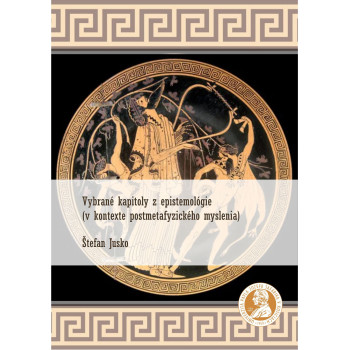
Selected Chapters in Epistemology" is a work resulting from the author's multi-year research and also represents a fulfillment of the requirements from pedagogical practice in this subject. The chapters, presented in this synthesized form, have not been published before, and I am convinced that precisely in this form they can gain higher value and greater real impact on our philosophy students.
The individual chapters focus on the problem of knowledge today, primarily on the problem of criticizing metaphysics and questions related to creating post-metaphysical thinking. It is no coincidence that Friedrich Nietzsche is a common denominator for the presented texts; he is a philosopher who has fundamentally influenced and continues to influence current philosophical discussions and intellectual movements. The chapters are written to lead our students or other readers toward reflection, i.e., critical thinking, personal growth, and professional independence.
To what extent I have succeeded in fulfilling my intentions and goals remains for the reader to decide.
Autor
E-book
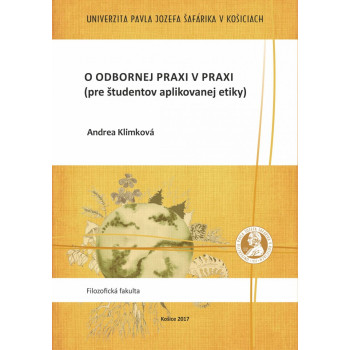
The current development of applied ethics globally suggests that applied ethics is entering a new, qualitatively distinct era of innovative application approaches, methodologies, and methods, as well as novel educational formats. The application levels in applied ethics (in bioethics, business ethics, technology ethics, professional ethics, etc.) are tied to critical reflection on previous strategies and methodologies in their teaching.
Combining ethical rationality with practical variability and implementing ethical policies and tools in concrete practice truly demands new competencies, new skills, and the ability to work in novel ways with empirical and normative frameworks. This requires working with ethical theory and moral practice inventively, heuristically, innovatively, and propedeutically.
The creation of useful and professionally constructed procedures and formats is part of the professional and academic preparation of applied ethicists at modern departments of applied ethics.
E-book
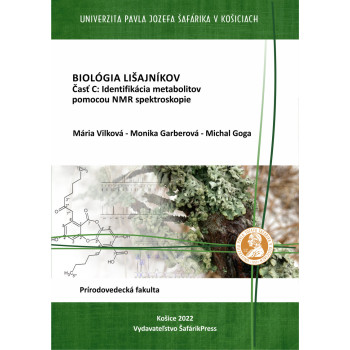
Mária Vilková - Monika Garberová - Michal Goga
Nuclear Magnetic Resonance (NMR) is currently a widely used analytical tool that finds application in many fields of science and technology. The broadening of its practical use brings with it the necessity to create educational texts appropriate to the given scientific discipline.
This university textbook is intended for students of biology and serves as a supplement to the study materials for the advanced master's course "Biology of Lichens." At the same time, it represents a useful resource for master's and doctoral students involved in research, helping them interpret NMR spectra and present basic theoretical concepts.
The textbook briefly describes the important aspects of each NMR spectroscopic technique without delving excessively into the physical principles of individual methods or complex mathematical analyses. In this edition, the structures of lichen metabolites have been included, which students will isolate, purify, and identify using various analytical methods during practical exercises. An entire chapter is dedicated to a detailed description of solving the NMR spectra of isolated metabolites, with each step in elucidating the structures of both known and unknown metabolites explained in detail. The solved tasks are followed by numerous unsolved examples, including high-resolution 1D and 2D NMR spectra of metabolites, intended to further develop the acquired knowledge and skills of students and doctoral candidates in structure elucidation using NMR spectroscopy.
Download e-book for free (pdf)