Slovenčina



E-book
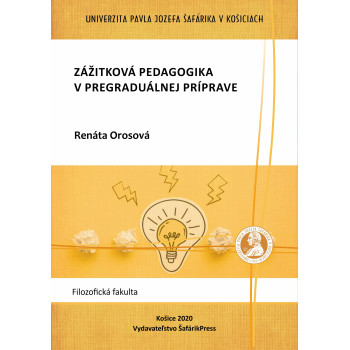
The issue of the effective and professional use of experiential pedagogy tools and their positive impact on classroom climate is the subject of a scientific monograph.
The monograph systematizes theoretical scientific knowledge about experiential pedagogy, classroom climate, and the current state of pre-graduate preparation of future teachers. Based on the implementation of research (a pedagogical experiment), it analyzes the importance of effective preparation of future teachers in relation to the professional use of experiential pedagogy tools and their impact on classroom climate.
Data sheet
E-book
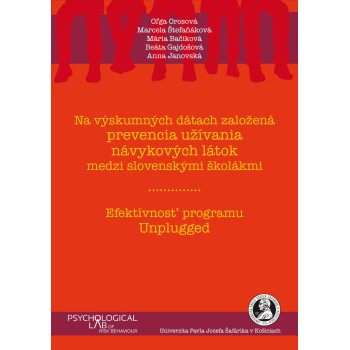
Oľga Orosová - Marcela Štefaňáková - Mária Bačíková - Beáta Gajdošová - Anna Janovská
The research monograph is focused on studying the effectiveness of the Unplugged prevention program conducted at primary schools across Slovakia.
Using two large datasets with repeated measures, the monograph contributes to research knowledge about substance use prevention. The authors studied protective and risk factors, developmental trends of smoking and alcohol consumption as well as the effectiveness of the Unplugged prevention program – its effect on psychological and behavioural indicators of health-related behaviour.
Considering the complexity of the analyses on two datasets with 5 waves of data, each chapter is presented as a separate research study. The findings serve as a basis for recommendations for parents and teachers and also for school management at primary schools that support effective school policy aimed at the prevention and promotion of the health in schoolchildren.
E-book
The presented monograph aims to critically map the understanding of the concept of possible worlds.
The first chapter describes the formation of the semantics of possible worlds, along with indicating some problems it brings, which were incisively revealed primarily by W. V. O. Quine. In the next two chapters, the work focuses on more modern views on the nature of possible worlds, with the main attention given to the dichotomy between the possibilist and actualist approach to the question of modalities, alongside which it is necessary to assess other distinctions (essentialism - anti-essentialism, realism - reductionism (or ersatzism or fictionalism), naturalism - non-naturalism, etc.). Increased attention in the work is specifically devoted to the possibilism of D. Lewis and the actualist concepts of S. Kripke, A. Plantinga, R. M. Adams, N. Rescher, D. Armstrong, and J. Hintikka.
An unconventional approach to the issue of possible worlds is captured in the fourth chapter. It is primarily dedicated to the significant concept of Jaakko Hintikka, which works with the notion of epistemic possible worlds and documents the inclination towards the modification and relativization of modal discourse. The conclusion provides an evaluation of the discussion that touches on the main problems associated with considerations of possible worlds.
In the presented monograph, some representative concepts of possible worlds, or possible individuals, are clarified, and the overall process is indicated from assessing possible worlds as ideal logical constructs through their relativization by separate domains of individuals for individual worlds and further through the relationship of attainability to financial, impossible, and non-standard possible worlds.
E-book
Gabriel Eštok - Mária Hrehová - Renáta Bzdilová (eds.)
Collection of contributions from II. year of the Student Scientific Conference held on May 17, 2013 by the Department of Political Science of the Faculty of Arts of the University of Pavel Jozef Šafárik in Košice
The collection was created on the basis of an event with a thematically defined and political science, perhaps the most frequently discussed issue of democracy. I would add that the event was also attended by doctoral students of other fields of study, who analyzed the topic of democracy from positions other than political science. I very much welcomed the fact that a contribution from the legal issues of the European Union appeared in the proceedings. Enriching the collection is also a contribution from international political issues, which sheds light on democratic rules applied in territory other than European. Other contributions focus on various aspects of the creation of a democratic political environment in Slovakia and the European Union, while several sympathetic attempts at non-traditional perspectives on the development of civil society, public and party politics appear in them.
E-book
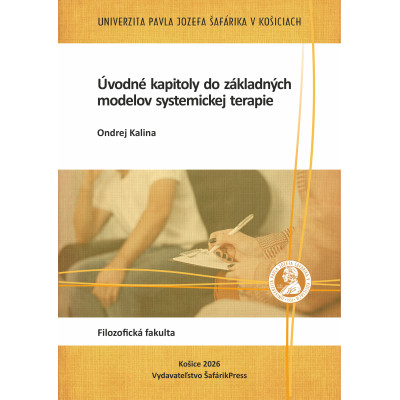
The publication provides a systematic overview of the core models of systemic therapy and its theoretical as well as practical foundations. The opening chapters of the textbook outline the historical development of psychotherapeutic approaches and the shift toward the systemic paradigm, which emphasizes the importance of relationships, context, and circularity in understanding psychological phenomena.
The core of the text focuses on the philosophical foundations of systemic therapy, particularly general systems theory, cybernetics, constructivism, and social constructionism, all of which have significantly shaped the understanding of reality, knowledge, and the therapeutic process. Subsequent chapters address biological and social foundations, including the concepts of autopoiesis, cognition, and communication, and their relevance to the functioning of social systems. The publication further elaborates on the practical implications of these theoretical frameworks, especially in relation to causality, language, and the construction of social reality. Systemic understanding of problems is presented as a dynamic and relational process maintained through interactional patterns within the system.