- New

Zavolajte nám:
+421 55 234 1635E-kniha
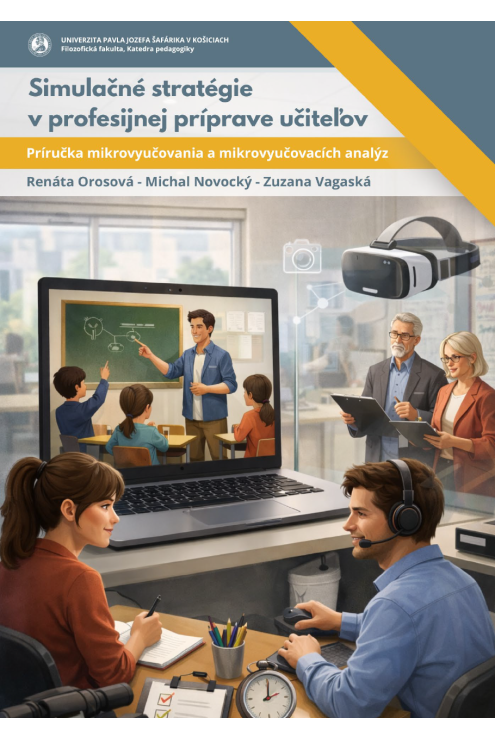
Renáta Orosová Michal Novocký Zuzana Vagaská
This publication provides a summary of knowledge about microteaching as a simulation strategy in the context of university teacher education. Readers will find theoretical foundations of simulation techniques, definitions and objectives of microteaching, the role of analysis as a tool for reflection, possibilities for implementation in both face-to-face and distance learning formats, and numerous examples of best practices. We believe that this text contributes to a deeper understanding of the importance of microteaching, a simulation strategy that systematically develops pedagogical skills and helps shape the professional competencies of future teachers.
Data sheet
E-book
The main goal of the monograph "Moving Towards Cognitive Adaptation Studies: Adaptation as Play" was to orient current research in adaptation studies towards the empirically responsible cognitive branch of non-radical constructivism.
This intention results from the rapid progressive differentiation of adaptation studies research, which has mainly manifested itself in this area in the last two decades. With the model of adaptation as play in a cognitive-scientific perspective, author provides the possibility of predicting the nature (also in a broader sense) of the experience of adaptation. Since the form of this experience significantly shapes the products of the adaptation process into their final form, the model of adaptation as play can be applied even in the interpretation of individual adaptations. In the monograph, the author synthesized the model of adaptation as play based on the knowledge of various disciplines. In the field of cognitive sciences, he saw help from the starting points of philosophy, linguistics, informatics, psychology, anthropology, biology and neuroscience – especially affective neuroscience, which also deals with the emotional dimension of the play.
In the intersection with the essential interdisciplinary components of adaptation research, he also used the knowledge of classical and cognitive variations of literary science, film science (also theatrology) and media studies to a large extent. Consistent with other similar results of cognitive sciences, it turns out that even seemingly serious adaptations, like in many aspects of our culture, have a ludic base.
E-journal
Juraj Schenk et al.
The scientific journal Sociálne a politické analýzy (Social and Political Analyses) serves as an interactive electronic platform for communication and the presentation (publication) of experts and their work in the fields of basic and applied research and analyses within sociological, psychological, political, and methodological contexts. It is a medium focused on intensively supporting research activities and analyses within an interdisciplinary framework, facilitating the exchange of experiences, fostering collaboration, and revitalizing the production of scientific work in this area.
The publication section of the journal offers space for works such as:
- Original sociological, psychological, and political studies and analyses in any areas of social life
- Methodological studies
- Research reports
- Studies from qualification theses Research and analysis projects
- Reviews
E-book
Renáta Cenková - Lucia Jasinská(eds.)
Proceedings of the International Scientific Conference held on October 23 and 24, 2013 at Pavol Jozef Šafárik University in Košice
The presented proceedings, which are the outcome of the second edition of the international scientific conference "The Twilight of Media," organized by the Department of Mass Media Studies at the Department of Slovak Studies, Slavic Philologies and Communication, Faculty of Arts, Pavol Jozef Šafárik University in Košice, examine current issues in the media landscape from several perspectives.
They offer a representative overview by experts in media from Slovakia and abroad on the current state, primarily of electronic but also partially print media, and on upcoming trends in their development. The proceedings are thematically diverse and address questions from the fields of media, aesthetics, value aspects of media messages, media effects, and, for example, the influence of specific genres and their representative texts on the recipient.
At the same time, they cover the area of current media law as well as ethical standards and requirements placed on the text by its author or other professional media workers.
Editors
Súbor na stiahnutie (pdf)
E-journal
Renáta Orosová (výkonný redaktor)
Vedecko-odborný časopis Edukácia je zameraný na problematiku vzdelávania a výchovy v oblasti základného, stredného a vysokého školstva. Zreteľ kladie na súčasný stav a perspektívy edukačnej praxe, aktuálne aspekty pregraduálnej prípravy učiteľov, sociálnej pedagogiky, špeciálnej pedagogiky, ako aj pedagogické a psychologické aspekty výchovy v základných výchovných inštitúciách z pohľadu širokej pedagogickej verejnosti. Je určený vedeckým pracovníkom, mladým vysokoškolským učiteľom, doktorandom, ako aj odborným a pedagogickým pracovníkom, s cieľom prezentovať trendy v edukácii a vyvolať diskusiu k aktuálnym otázkam prezentovaných oblastí výchovy a vzdelávania.
E-book
Vladimír Leško, Milan Sobotka a kol.
Filozofické dielo Martina Heideggera, ktorého hlavnou otázkou je otázka bytia, je v rozhodujúcej miere zviazané s pochopením filozo-fického reflektovania tejto otázky v gréckej a novovekej filozofii. Filozofický vývoj nemeckého mysliteľa túto dejinno-filozofickú sku-točnosť prezentuje v jedinečnej podobe od dvadsiatych rokov 20. storočia až do konca svojej tvorby. Problém Heideggerovej recepcie gréckej filozofie s jej chápaním metafyziky bol predmetom nášho skúmania v práci Heidegger, metafyzika a Gréci (Košice: UPJŠ 2016, 693 s.).
V uvedenej práci sme sa snažili predstaviť Heideggerovu recepciu gréckej filozofie ako metafyziky v troch základných častiach: 1. Od Augustína k Aristotelovi, 2. Od Aristotela k Parmenidovi a 3. Neskorý Heidegger a grécka filozofia. Skúmali sme Heideggerov filozofický vývoj a v jeho rámci tiež význam veľmi špecifického mysliteľského rozhovoru s gréckym filozofickým dedičstvom. V tejto našej snahe sme sa orientovali na všetky najvýznamnejšie Heideggerove prednášky či samostatné diela, ktoré sú už dnes takmer kompletne prístupné. Heideggerovo záverečné rozlišovanie medzi filozofiou, tzn. meta-fyzikou a myslením potom možno chápať ako svojráznu filozofickú rezignáciu. Heideggerovi sa nepochybne podarila veľmi úspešná deš-trukcia pojmovosti metafyziky v dejinách filozofie. Tá ukázala, že je potrebné opustiť grécku substančnú ontológiu, ktorá sa už definitív-ne filozoficky vyčerpala.
Predkladaná práca Heidegger a novoveká metafyzika ponúka čitateľovi myšlienkový vývoj riešenia otázky bytia nemeckého filozofa v konfrontácii s novovekou metafyzikou. Je rozdelená do troch častí – 1. Od Descarta ku Kantovi, 2. Nemecký idealizmus a Nietzsche a 3. Neskorý Heidegger a Hegel, v ktorých nám ide o syntetické zachytenie Heideggerovho filozofického riešenia otázky bytia v mysliteľskom rozhovore s vrcholnými predstaviteľmi novovekej filozofie: Descar-tom, Leibnizom, Kantom, Schellingom, Hegelom, Kierkegaardom a Nietzschem.
Download the e-book for free (pdf.)
E-book
This textbook has been designed as supporting material for the postgraduate course on modern trends in European literature. It focuses on the presentation of five modern literary modes of writing: the realistic mode which was brought to its prominence by the nineteenth-century Realist movement; the stream-of-consciousness and ‘absurdist’ modes which were developed in the context of modernism; and the magical realist and metafictional modes which are associated mainly with postmodernist literary trends. Each mode is represented by a well-known text which demonstrates the formal aspects of each mode and deals with the thematic concerns typical of the literary movement that influenced its production.
The textbook adopts an interdisciplinary approach, placing the chosen literary texts into the historical, philosophical and cultural contexts that shaped their characters, and thereby providing the background knowledge necessary for a deeper understanding of their formal and thematic aspects.
E-book
Jana Balegová-Erika Brodňanská (eds.)
It has been eleven years since the Department of Classical Philology of the Faculty of Arts of the University of Pavol Jozef Šafárik in Košice opened the gates of its imaginary colourful garden for the first time. At that time, the Hortus Graeco-Latinus Cassoviensis provided a space to present the results of work from all fields of the classical, Latin medieval, and Neo-Latin studies to colleagues from Slovakia. Five years later, the "garden" was enriched by colleagues from Bohemia and Moravia, and this time, at its fourth opening, colleagues from Greece and Germany also honoured it with their works. Variety remained its characteristic feature. Papers on ancient history, the linguistics of classical languages, ancient and medieval literature, ancient philosophy, the history of ancient medicine and Neo-Latin studies, as well as contributions on the teaching of classical languages, are presented in the proceedings. Moreover, the volume is published as an output of two seemingly disparate VEGA projects carried out at the department: No. 1/0109/21 Poemata de se ipso by Gregory of Nazianzus and No. 1/0255/22 Medicus poeta. Neo-Latin literature of medical authors associated with Slovakia. However, appearances are deceptive, because Gregor of Nazianzus, although a church father, also wrote poetry, his works contain numerous allusions to the medical milieu, and he had a brother who was a physician. His entire work is characterised by the variety of the themes he explores. References to the Bible are not uncommon in the works of medical poets. Just as the projects differ and simultaneously overlap with each other, the themes of the individual contributions also differ and overlap.
E-bool
When studying the Renaissance, researchers utilize various critical and core terms and concepts which it is necessary to characterize.
However, many such points, notably the following, are problematic: The relationship between the Renaissance and the antiquity; The connection with the Middle Ages; The transformation to Mannerism and Baroque; Realism and Secularism in Renaissance art; The individualism of the Renaissance artist; The reasons for the creation of Renaissance art in Italy, its determinants and stimulators; Distinguishing between the analysis of the genesis of the Renaissance and the analysis of the creation of the period’s art generally; Regional differences in Italy and their impact on the art; Chronological limits of the Renaissance and its milestones; The terms “Medieval Ages” and “Early Modern Period”; The impact, and its extent, of the artistic influences of the Byzantine, Gothic and Romanesque arts on the Renaissance. The term “Renaissance” itself, its content and existence, are also the subject of the discussion with students, alongside learning how such terms and definitions came about and continue to evolve, how they attain their content, how this content morphs in the historical discourse, what academical pluralism and freedom of thinking look like in the discourse led by historians, what the differences are between scientists and schools of thought on the same subject and how it is possible that they are so numerous.
The students will come to recognize the leading scholars in the field, and follow their arguments and methodological approaches. They shall be invited to closely trace and scrutinize the logic which those historians use in building their argumentation. It shall be seen that the freedom to create terms, concepts and new definitions cannot stand on an ignorance of the (historical) facts, as becomes clear with expanding knowledge of those historical facts, the variability of their interpretation growing in tandem. This approach, actually used across the whole range of seminars and lectures, shall drive discussion on the topics covered, students being invited to formulate their own theses and antitheses.
E-book
Ingrid Madárová -Lívia Barnišinová - Veronika Pálová
Táto príručka priamo prispieva k budovaniu inkluzívneho akademického prostredia, kde sa zahraniční študenti cítia vítaní a pochopení. Zároveň podporuje vzdelávacie a profesionálne zručnosti zamestnancov v oblasti interkultúrnej komunikácie, čo v konečnom dôsledku vedie k zvýšeniu kvality služieb poskytovaných univerzitou a k zlepšeniu medzinárodnej spolupráce.
E-book
Eastern Christianity, represented in Slovakia by the Greek Catholic and Orthodox Churches, has influenced the development of Slovak society over the centuries. Both the common history and the coexistence of the two churches in one geographical area have brought diverse experiences that both churches keep in mind.
The university textbook, which deals with their history, contains basic materials for study and focuses on important milestones in their history. It contains general information about the origin of Eastern Christianity and presents in chronological order knowledge of the history of the churches that represent it in Slovakia from the 9th to the 21st century.
E-book
Mikuláš Jančura - Maroš Melichárek
The Textbook is based on the output of the twelveth year of the student scientific conference held in December 2023. The student scientific conference is a study subject included in the study plans of the Department of History, Faculty of Arts, UPJŠ, implemented since 2011 and aims to offer space for Bc. and Mgr. degree students to present fragments of their primary research as part of the creation of their bachelor and master thesis. The aim of the presented Textbook is not only to publish these thematically broad-spectrum texts, but also to target the effort for above-standard pedagogical activities and the added value of university studies towards students in the form of publication output.This year's anthology contains 6 texts with a chronological framing from the Middle Ages to the history of the 20th century.
E-book
The textbook Lectiones grammaticae Latinae I is primarily intended for first-year students specializing in Latin Language and Literature at the Faculty of Arts, Pavol Jozef Šafárik University in Košice.
It was created out of the practical need to provide students with easy electronic access to the grammar material covered in the order in which it appears in the lessons of the Latin exercise book used in the course.
For this reason, it also includes grammatical topics that go beyond Latin morphology, which forms the main content of the grammar course in the first year of study. However, if necessary, it can also be used by students of other study programs that include Latin as part of their curriculum.
E-book
Ivica Hajdučeková - Peter Getlík (eds.)
Proceedings of Selected Lectures and Abstracts
Grant project VEGA No. 1/0736/15 Methodological Basis of Literary (re)interpretation in Slovak and World Literature (the head of the project: prof. PhDr. Ján Gbúr, CSc.), whose realization lasted for four years (2015 – 2018) at the Department of Slovak Studies, Slavonic Philologies and Communication of Faculty of Arts of Pavol Jozef Šafárik University in Košice, brought several lecture events with the participation of experts from Slovak and Czech academical space. The original and progressively accomplishing project goal was to continue the tradition of exactness and support its implementation into our everyday scientific thinking and literary-scientific exploration. Each of fourteen invited lectures was a unique, professionally inspiring and humanly enriching meeting.
On that account there is a nontraditional project output: the proceedings of selected lectures and abstracts (abstracts were translated into English language by Mgr. Dominika Petáková, internal postgraduate student of literary science at Department of Slovak Studies, Slavonic Philologies and Communication) titled Methodological Inspirations in the Research of Literary Science I., which is intended for academical and study purposes at universities. The topics of the lectures were completed successively according to interest and demands of research team and current scientific research of invited guests.
E-book
Helena Kuncová – Pavol Hric (eds.)
Zborník “Stretnutie mladých historikov XIV“ s témou Myslenie a spoločnosť v priebehu dejín prináša súbor vedeckých príspevkov, ktoré sa venujú vzťahu medzi myslením a spoločenskými zmenami v historickom vývoji. Doktorandi a doktorandky z rôznych univerzít a inštitúcií analyzujú, ako politické, ekonomické a sociálne premeny ovplyvňovali myslenie rôznych sociálnych skupín a naopak, ako tieto zmeny v myslení formovali dejinné procesy. Každý príspevok bol podrobený odbornému hodnoteniu dvoch garantov, ktorých pripomienky sú reflektované v predkladanej verzii zborníku. Témy príspevkov sú rozdelené do jednotlivých blokov, v ktorých boli prezentované na konferencii 15. a 16. októbra 2024 na Katedre histórie, FF UPJŠ v Košiciach. Zborník obsahuje príspevky nasledujúcich prezentujúcich: Mgr. Michal Pajer, Mgr. Helena Kuncová, Mgr. Barbora Mlyneková, PhDr. Patrik Beňuš, Mgr. Mária Rímešová, Mgr. Pavol Hric, Mgr. Monika Tresová, Mgr. Miriama Balvirčáková, Mgr. Monika Soukupová, PhDr. Ivan Chylák, Mgr. Dorota Tóthová, Mgr. Dominik Šípoš, Mgr. Martin Pastor a Mgr. Jaroslav Valent.
E-book
The aim of this university textbook is primarily to provide a comprehensive and systematic overview of the basic legislative documents related to pedagogical activities and the educational work of teachers in school practice. The textbook is primarily intended for students of academic teacher training programs, as well as recent graduates of teacher education who are beginning their teaching careers.
This publication is unique in that it does not focus on specific legislative documents and their descriptions, but rather presents the meaning and wording of various legislative documents in the context of key concepts of educational activities and typical school situations. The publication does not include the full text of cited paragraphs from laws, decrees, and ministerial guidelines, but only excerpts that are relevant to the focus and needs of the textbook.
In this way, we aim to help teacher training students and beginning teachers orient themselves regarding their rights and responsibilities as defined and delineated by school legislation, and especially to help them understand the basic legislative requirements placed on every teacher in school practice. This includes participation in the preparation of the school educational program, understanding the professional development of teachers, student assessment, approaches to students with special needs, as well as handling common school situations such as disciplinary measures, school accidents, ski training, or school events.
Given the scope of these areas, we have divided the topics into two publications according to their thematic focus.
E-book
Jana Balegová - František Šimon
The university textbook "Lingua Latina – Exercise Book for Philosophers" is a parallel study material to the textbook "Lingua Latina – Cursus Communis." It is designed for practicing grammatical lessons at home. The content of the exercises corresponds to the focus of each lesson in the mentioned textbook, both in terms of the covered grammatical phenomena and vocabulary. For this reason, only vocabulary not included in the lessons of the textbook is presented in the exercises.
The Latin-Slovak dictionary at the end of the exercise book contains the entire vocabulary from both the exercise book and the textbook, while the Slovak-Latin dictionary includes the vocabulary from exercises that require translation into Latin. The vocabulary in this exercise book is oriented towards the needs of philosophy students and, with regard to the selection of source materials, also includes non-classical lexicon or non-classical meanings of classical words (this lexicon is marked with an asterisk *).
The exercise book includes a key that allows students to directly verify the correctness of their work. The textbook "Lingua Latina – Exercise Book for Philosophers" is available electronically in PDF format. As part of the educational program, online tests available on the website of the Department of Classical Philology at the Faculty of Arts, UPJŠ (https://www.upjs.sk/filozoficka-fakulta/katedra-klasickejfilologie/katedra/) also serve to practice the covered material.
This website uses cookies to ensure you get the best experience on our website