Filter By

Year of publication:

Year of publication:

Publication language:

Publication language:

Faculty:

Faculty:

UPJŠ Unit

UPJŠ Unit

Active filters

  • Publication language:: Slovak
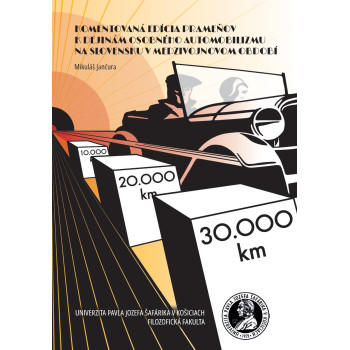
Komentovaná edícia prameňov k dejinám osobného automobilizmu na Slovensku v medzivojnovom období

Komentovaná edícia prameňov k dejinám osobného...

E-book

E-book

Mikuláš Jančura

The presented annotated source edition represents the first systematic attempt to process selected documents related to the history of personal automobilism in Slovakia during the interwar period. It addresses a notable research and publication gap in Slovak historiography, where the topic of automobilism has long remained marginal. Although research in this field has progressed over the last two decades, Slovak scholarship still lags behind Czech historiography. The main ambition of the edition is to present a broad selection of sources to highlight key thematic lines in the development of personal automobilism. The sources are divided into two main thematic groups: economic-legislative issues and cultural-social dimensions. Special attention is given to car accessibility, infrastructure, legal frameworks, visual advertising, and the activities of motoring associations. The typologically diverse corpus includes archival records, printed materials, visual sources, and photographs. The edition builds on a 2017 authorial monograph, expanding it with new insights and sources. It draws from collections housed in the National Archives in Prague, the Slovak National Archive, and various regional archives. The work also benefits from the application of modern methodological approaches, such as Business History and cultural history. The project was carried out under the scientific grant VVGS-2022-2431 at the Faculty of Arts, Pavol Jozef Šafárik University in Košice. Its results are closely linked to the teaching activities of the research team. The edition is the result of several stages – from heuristics, selection, and processing to peer review and publication. The publication contributes to a vivid understanding of the historical aspects of automobilism and expands knowledge of modernization processes in Slovakia. It also offers potential for use in educational practice and further academic research.
Download the e-book for free (pdf)

Študentská vedecká konferencia XIII.

Študentská vedecká konferencia XIII.

E-book

E-kniha

Mikuláš Jančura - Maroš Melichárek (eds.)

Predkladaný zborník je publikovaným výstupom zo Študentskej vedeckej konferencie, ktorá sa na pôde Katedry histórie FF UPJŠ uskutočnila dňa 02.12.2024. Bolo to už po trinásty krát. Zborník z tohto ročníka (už tretí v poradí) sa tak zaradil do tejto úspešnej série. Obsiahnuté príspevky, podobne ako aj v starších zborníkoch z tejto konferencie, približujú stav bádania korelujúci so záverečnými prácami študentov na bakalárskom a magisterskom stupni štúdia.

Stiahnite si e-knihu zadarmo (pdf)

Myslenie a spoločnosť v priebehu dejín. Stretnutie mladých historikov XIV.

Myslenie a spoločnosť v priebehu dejín....

E-book

E-book

Helena KuncováPavol Hric (eds.)

Zborník “Stretnutie mladých historikov XIV“ s témou Myslenie a spoločnosť v priebehu dejín prináša súbor vedeckých príspevkov, ktoré sa venujú vzťahu medzi myslením a spoločenskými zmenami v historickom vývoji. Doktorandi a doktorandky z rôznych univerzít a inštitúcií analyzujú, ako politické, ekonomické a sociálne premeny ovplyvňovali myslenie rôznych sociálnych skupín a naopak, ako tieto zmeny v myslení formovali dejinné procesy. Každý príspevok bol podrobený odbornému hodnoteniu dvoch garantov, ktorých pripomienky sú reflektované v predkladanej verzii zborníku. Témy príspevkov sú rozdelené do jednotlivých blokov, v ktorých boli prezentované na konferencii 15. a 16. októbra 2024 na Katedre histórie, FF UPJŠ v Košiciach. Zborník obsahuje príspevky nasledujúcich prezentujúcich: Mgr. Michal Pajer, Mgr. Helena Kuncová, Mgr. Barbora Mlyneková, PhDr. Patrik Beňuš, Mgr. Mária Rímešová, Mgr. Pavol Hric, Mgr. Monika Tresová, Mgr. Miriama Balvirčáková, Mgr. Monika Soukupová, PhDr. Ivan Chylák, Mgr. Dorota Tóthová, Mgr. Dominik Šípoš, Mgr. Martin Pastor a Mgr. Jaroslav Valent.

Download the e-book for free (pdf)

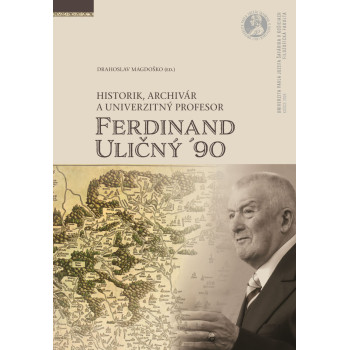
Historik, archivár a univerzitný profesor Ferdinand Uličný ´90

Historik, archivár a univerzitný profesor...

E-book

E-book

Drahoslav Magdoško (ed.)

Hlavný zámer zborníka, ktorý držíte v rukách, predstavuje práve vzdanie pocty historikovi, ktorý svojim úctyhodným vedeckým dielom výrazne prispel k utváraniu slovenskej historiografie, predovšetkým medievalistiky. Zároveň sa tu vyslovuje uznanie za rozsiahlu a v nemalej miere priekopnícku prácu archivára, ktorý pomáhal rozvíjať moderné archívnictvo na východe Slovenska. A v neposlednom rade ide o formu poďakovania za prácu vysokoškolského pedagóga, ktorého predmety absolvovali stovky študentov, a ktorý si svojim podnetným prístupom získal ich srdcia. Na všetkých týchto troch rovinách má cenné zásluhy prof. PhDr. Ferdinand Uličný, DrSc. (*18. 8. 1933, Ploštín), ktorý v lete roku 2023 oslávil životné jubileum 90. rokov.

Download the e-book for free (pdf)

Študentská vedecká konferencia XII.

Študentská vedecká konferencia XII.

E-book

E-book

Mikuláš Jančura - Maroš Melichárek

The Textbook is based on the output of the twelveth year of the student scientific conference held in December 2023. The student scientific conference is a study subject included in the study plans of the Department of History, Faculty of Arts, UPJŠ, implemented since 2011 and aims to offer space for Bc. and Mgr. degree students to present fragments of their primary research as part of the creation of their bachelor and master thesis. The aim of the presented Textbook is not only to publish these thematically broad-spectrum texts, but also to target the effort for above-standard pedagogical activities and the added value of university studies towards students in the form of publication output.This year's anthology contains 6 texts with a chronological framing from the Middle Ages to the history of the 20th century.

Download the e-book for free (pdf)

Moc v dejinách ľudskej spoločnosti. Stretnutie mladých historikov XIII.

Moc v dejinách ľudskej spoločnosti. Stretnutie...

E-book

E-book

Simona Bilecová-Monika Tresová

Proceedings of the 13th Scientific Conference of Young Historians, organized by the Department of History of the Faculty of Arts of the University of Pavol Jozef Šafárik in Košice in cooperation with the State Archives in Košice and the Slovak Historical Society at the Slovak Academy of Sciences on 24 October 2023 The central theme of the conference proceedings of the scientific conference of doctoral students is the issue of power as an instance that is an inherent part of human existence and has been present in society de facto since its beginning. Since power and the desire for power are present even today, perhaps more than at any other time in the history of human society, the proceedings provide adequate answers to the questions: where is power born and from what does it originate? How do social science disciplines view those social groups that do not hold power? The publication consists of eight contributions by authors working at Slovak and Czech universities. The volume opens with a paper by Dávid Nykodým on power in the city of silver in the era of Jiří of Poděbrady. The administration of estates in the hands of widows in the 17th century (on the example of Judith Balassa) was discussed by Sabina Danková. The issue of the role of the university grand master in the monopolization of education during the First Empire 1808-1815 in France was examined by Michael Dudzik. The period between the two world wars on the territory of Czechoslovakia was mapped in their contributions by two authors: Simona Bilecová, who characterized the emergence and creation of the political elite on the example of the Rožňava region, and Dominik Šípoš, who evaluated the power of the party as an ideological problem of the Czechoslovak National Democracy. This line was continued by Patrik Beňuš, who analysed in detail the crisis in railway transport in the southern territory of Slovakia after 1938. Monika Tresová dealt with the activities of Catholic associations in Košice and their disappearance under the pressure of the communist power after 1948. Miriama Balvirčáková dealt with the power and its legitimacy, judicial rehabilitation of the victims of the communist regime in Eastern Slovakia in 1968-1971.

Download e-book for free (pdf)

Historický prameň v súčasnosti – archívy, inovácie, zdieľanie. Stretnutie mladých historikov XII.

Historický prameň v súčasnosti – archívy,...

E-book

E-book

Mária FedorčákováMiriama Filčáková (eds.)

Proceedings of the 12th Scientific Conference of Young Historians, organized by the Department of History of the Faculty of Arts at Pavol Jozef Šafárik University in Košice in cooperation with the State Archive in Košice and the Slovak Historical Society at the Slovak Academy of Sciences on October 12, 2022

The theme of the conference proceedings is the issue of sources, their interpretation and use of current digital technologies in their research and access. The proceedings constit of 7 papers by authors working in Slovak and Czech universities.

The digitisation of seals is the subject of the paper by Barbora Borůvková. Michael Dudzik deals with the problem of building the road network in modern France and written and cartographic sources. Trends of digitization in Slovak archives and their perception by researchers are elaborated by in Miriama Fialkovičová´s study. Miriama Filčáková dealt with sources on the history of tertiary education in Košice in connection with the establishment of the UPJŠ. The possibilities of researching sources on the electrification of Slovakia are dealt with in the study by Dominik Hrtus. Ondrej Šály in his paper treated the letters of serfs in the 18th century as a source for economic history. Vavrinec Žeňuch discusses the possibilities of researching the eclesiastical history of the Uh county in the modern period.

Download e-book for free (pdf)

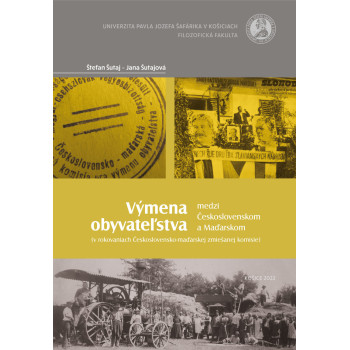
Výmena obyvateľstva medzi Československom a Maďarskom (v rokovaniach Československo-maďarskej zmiešanej komisie)

Výmena obyvateľstva medzi Československom a...

E-book

E-book

Štefan ŠutajJana Šutajová

The population exchange between Czechoslovakia and Hungary was carried out on the basis of the Agreement on the Exchange of Populations between Czechoslovakia and Hungary, which was signed on February 27, 1946. Its adoption was not only part of Czechoslovak solutions to the status of national minorities, but also part of the strategic concept of building a state of Czechs and Slovaks without Germans and Hungarians.

The agreement was part of the postwar resolution of mutual disputes and misunderstandings and was intended to be one of the solutions that, in the postwar period, would eliminate a factor which, according to Czechoslovak political leaders, had caused the war conflict.

The population exchange between Czechoslovakia and Hungary was therefore not an isolated historical event, but part of migratory movements that had begun in Europe already after the First World War, and can be seen as a continuation of previous developments as part of migration patterns in Europe.

Download e-book for free (pdf)

Študentská vedecká konferencia XI.

Študentská vedecká konferencia XI.

E-book

E-book

Mikuláš Jančura - Maroš Melichárek (eds.)

The textbook is derived from the outcomes of the eleventh annual student scientific conference, which took place in December 2022.

The student scientific conference is an integral component of the curriculum within the Department of History at the Faculty of Arts, UPJŠ, and has been implemented since 2011. Its primary objective is to provide a platform for Bachelor's and Master's degree students to present segments of their original research as part of their thesis development.

The purpose of this textbook extends beyond the mere publication of these diverse thematic texts. It also strives to emphasize the significance of exceptional pedagogical initiatives and the added value of university education for students, manifested through the dissemination of their scholarly output.

Download the e-book for free  (pdf)

Študentská vedecká konferencia X. Zborník príspevkov.

Študentská vedecká konferencia X. Zborník...

E-book

E-book

Mikuláš Jančura - Maroš Melichárek (eds.)

The Student Scientific Conference is defined as a compulsory elective subject within the accredited study programs of the Department of History at the Faculty of Arts, UPJŠ. It was organized for the first time at the department in 2011.

The primary goal of this already traditional event is the presentation of partial results of student-authored research, primarily linked to selected factual parts or theoretical foundations of bachelor’s and master’s theses. This also explains the broad thematic spectrum of the internal content of each conference. Besides awarding credits for participation, the conference offers students a range of added values, which can be understood as its secondary objectives.

On this basis, as organizers, we considered it beneficial to qualitatively elevate the “round” anniversary edition of the Student Scientific Conference and give students the opportunity to publish their contributions. Within the submitted proceedings, 7 texts are published, of which 4 are from the bachelor’s level and 3 from the master’s level of study. The contributions cover a wider spectrum, mainly cultural-historical topics spanning from the Early Middle Ages to the second half of the 20th century, which also demonstrates the wide range of thesis topics processed at the department.

As organizers of the event, we have the ambition for publishing the proceedings to become as much a tradition as the Student Scientific Conference itself, as we consider this meaningful in relation to our work with students. Last but not least, we would like to express our gratitude to our colleague and friend Mgr. Henrich Hrehor, PhD., who has been the long-term main organizer and the “spiritual father” of the entire event since 2011. Thanks are also due to the head of the department for annual support and to the colleagues who undertook the reviewing of contributions within the submitted proceedings.

Download the e-book for free (pdf)

Poznanie, spoločnosť, dejiny. Stretnutie mladých historikov XI.

Poznanie, spoločnosť, dejiny. Stretnutie...

E-book

E-book

Miriama Filčáková (ed.)

Proceedings of the 11th Scientific Conference of Young Historians, organized by the Department of History at the Faculty of Arts, Pavol Jozef Šafárik University in Košice, in cooperation with the Slovak Historical Society at the Slovak Academy of Sciences, on October 19-20, 2021.

Currently, these histories are often presented as an extension of the history of science. The history of knowledge not only expands the boundaries of the history of science but also explores the boundaries between different forms of knowledge and ignorance. Just as studies of historical memory have expanded and complemented their interest in researching forgetting, the history of knowledge includes studies of ignorance. They focus on the change that has occurred over the past decades: from the sacralization of science and respect for professional knowledge to the rejection of science and constant questioning of professional knowledge, to which the history of knowledge must also respond. Findings as a product form the basis of human interactions and have their own past. What was the significance of knowledge and cognition in different historical periods? How did state power influence the development of knowledge and cognition? What can be considered knowledge in a particular historical era or culture? Finally, is there any human activity that cannot be considered knowledge?

Currently, in the field of the history of knowledge, a significant surge in research, publishing, and the emergence of new institutions can be observed. The eleventh doctoral conference—Meeting of Young Historians XI, organized by the Department of History at Pavol Jozef Šafárik University in cooperation with the Slovak Historical Society at the Slovak Academy of Sciences—will contribute to expanding the perspective on the past of knowledge and cognition. The conference, intended for Slovak and foreign doctoral students, aims to provide a space for presenting the latest results of scientific research, professional discussion, establishing contacts, developing cooperation, and exchanging experiences among the broader historical community. The starting point for the conference is a peer-reviewed proceedings volume consisting of publication outputs from active participants.

Download the e-book for free  (pdf)

Na pomedzí Východu a Západu. Vybrané kapitoly z dejín východných kresťanov na Slovensku

Na pomedzí Východu a Západu. Vybrané kapitoly z...

E-book

E-book

Peter Borza

Eastern Christianity, represented in Slovakia by the Greek Catholic and Orthodox Churches, has influenced the development of Slovak society over the centuries. Both the common history and the coexistence of the two churches in one geographical area have brought diverse experiences that both churches keep in mind.

The university textbook, which deals with their history, contains basic materials for study and focuses on important milestones in their history. It contains general information about the origin of Eastern Christianity and presents in chronological order knowledge of the history of the churches that represent it in Slovakia from the 9th to the 21st century.

Download the e-book for free  (pdf)

Hranice v priestore a čase. Stretnutie mladých historikov X.

Hranice v priestore a čase. Stretnutie mladých...

E-book

E-book

Dana KušnírováPeter Pavonič

Collection of Contributions from the Scientific Conference. Košice, November 18-19, 2020

The collection titled Borders in Space and Time consists of twelve contributions presented at the tenth edition of the doctoral conference Meeting of Young Historians, which is organized annually by the Department of History at the Faculty of Arts, UPJŠ in Košice. In 2020, we commemorated the centenary of the signing of the Trianon Peace Treaty, which definitively established the borders of Hungary, including those with Czechoslovakia, after World War I; therefore, the theme of the conference was chosen to be the history of borders. The individual contributions focus on the development of borders in the 20th century, borders in thought and education, and borders in earlier historical periods.

Download e-book for free (pdf)

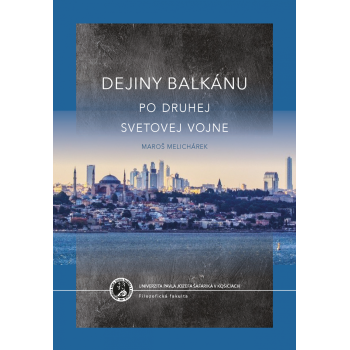
Dejiny Balkánu po druhej svetovej vojne

Dejiny Balkánu po druhej svetovej vojne

E-book

E-book

Maroš Melichárek

The history of the Balkans (not just in the 20th century) and its nations have had an irreplaceable place at the Department of History, Faculty of Arts, UPJŠ in Košice for several years. Therefore, this textbook is a logical culmination of this established trend. It represents the third publication focused on Southeastern Europe, as in 2015 a monograph titled International Relations in the 19th and 20th Centuries I (Nations of Southeastern Europe in International Politics, 1804 – 1856) was published, and in 2020 Nations of Southeastern Europe under International Politics from 1856 to 1913.

Logically then, this publication complements the literature portfolio (both thematically and chronologically) for students interested in this still turbulent region. Previous works are scientific monographs that can also be used during pedagogical processes; however, this work is directly aimed at students and their needs.

Download the e-book for free  (pdf)

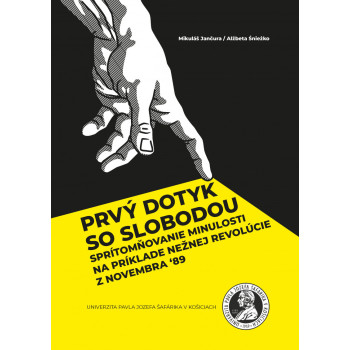
Prvý dotyk so slobodou. Sprítomňovanie minulosti na príklade Nežnej revolúcie z novembra ‘89

Prvý dotyk so slobodou. Sprítomňovanie...

E-book

E-book

Mikuláš JančuraAlžbeta Śnieżko   

In connection with the 30th anniversary of the Velvet Revolution, which was commemorated in the Czech Republic and Slovakia in 2019, an interactive exhibition titled "First Touch of Freedom" was organized under the auspices of Košice Self-Governing Region in collaboration with Ján Bocatius Public Library in Košice, Pavol Jozef Šafárik University in Košice, Nation's Memory Institute, and Slovak Radio and Television. The exhibition took place at Ján Bocatius Public Library and aimed to recall November's events from 1989 while emphasizing its cultural-social dimension and impact.

Conceptually, it focused on developing five dimensions of historical consciousness—a concept mainly developed in contemporary subject-specific didactics for history—namely identity, historicity, memory, spatial awareness, and temporal awareness.

Download the e-book for free (pdf)

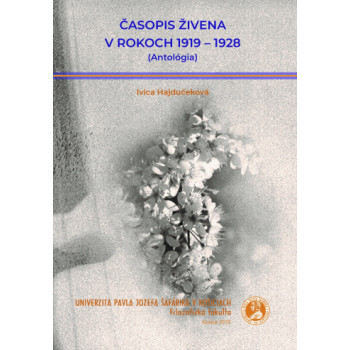
Časopis ŽIVENA v rokoch 1919 – 1928

Časopis ŽIVENA v rokoch 1919 – 1928

E-book

E-book

Ivica Hajdučeková

The anthology was created based on the study of archival volumes of Živena preserved in the Slovak National Library in Martin and the selection of material representing samples of texts that reflect the spirit of the times and contribute to the image of the contemporary modern woman.

The selection of articles from 1919 to 1928 uncovers the cultural atmosphere at the beginning of the 20th century when, thanks to emancipation efforts, doors were opening for women into public and professional life. Students from the 3rd and 4th years of the School of Applied Arts in Košice, under the guidance of teachers in photographic design and Slovak language and literature, were involved in preparing the illustrative component of the anthology, whose artistic interpretations are part of the publication. Their contribution meets the criteria for combining science and practice with a focus on popularizing research results.

Download e-book for free (pdf)

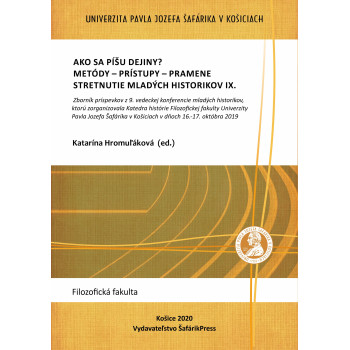
Ako sa píšu dejiny? Metódy – prístupy – pramene Stretnutie mladých historikov IX.

Ako sa píšu dejiny? Metódy – prístupy – pramene...

E-book

E-book

Katarína Hromuľáková (ed.)


Proceedings of the Scientific Conference. Košice, October 16-17, 2019

The proceedings titled "Ako sa píšu dejiny? Metódy – prístupy – pramene" present the contributions from the conference "Meeting of Young Historians IX," annually organized by the Department of History, Faculty of Arts, UPJŠ.

In the individual contributions, which span from the Middle Ages to the most recent history, the authors propose various theoretical and methodological research approaches to history, which currently represent fundamental prerequisites for historical research.

The ambition of the authors, as the next generation of historians, is not only to open up current questions of theoretical reflection in historiography but also to offer concrete examples supported by their own research.

Mgr. Katarína Hromuľáková

Download the e-book for free (pdf)

Prehľad dejín biológie, lekárstva a farmácie

Prehľad dejín biológie, lekárstva a farmácie

E-book

E-book

Martin BačkorMiriam Bačkorová

The proposed text focuses on the history of studying biology, medicine, and pharmacy as scientific disciplines from prehistoric times through antiquity, the Middle Ages, and the modern era. The text chronologically organizes the most significant figures in the history of biological scientific disciplines, outlines key characteristics of major historical discoveries, and reevaluates their significance from the perspective of 21st-century science.

The educational text is chronologically divided into the most significant periods of civilization development. The last two completed centuries—the 19th and 20th—are subdivided into major life science fields due to the unprecedented growth of biological disciplines and the resulting volume of acquired information.

Since it can sometimes be challenging in science to define what constitutes the past versus the present of a particular discipline, we have excluded significant biological discoveries from the early 21st century, which are typically regarded as the “present” of biology.

Download the e-book for free (pdf)

Prehodnotené dejiny. Historická pamäť – jej miesto a význam pre spoločnosť

Prehodnotené dejiny. Historická pamäť – jej...

E-book

E-book

Lukáš Katriňák (ed.)

Meeting of Young Historians VII.

Proceedings of contributions from the 7th scientific conference of young historians, organized by the Department of History at the Faculty of Arts of UPJŠ in Košice,

European Network Remembrance and Solidarity,

Centre of Social and Psychological Sciences SAS,

Historical Institute SAS,

and the Slovak Historical Society at SAS, held on October 25, 2017 in Košice.

Download the e-book for free (pdf)

Vybrané kapitoly z dejín Grécka a Ríma

Vybrané kapitoly z dejín Grécka a Ríma

E-book

E-book

Milan Olejník

The history of ancient Greece and Rome represents the culmination of achievements made by ancient civilizations in political, economic, and social spheres, as well as in understanding humanity and the world, and in art. The Greeks were the first in human history to establish a system where a certain part of society—full-fledged citizens—had the opportunity to freely participate in political decisions. They could vote, be elected to offices within the political system, and discuss issues affecting community life.

A high level of education and the pursuit of rational explanations for natural phenomena enabled the Greeks to reach a level of knowledge that European nations only achieved in the modern era. Greek accomplishments in sculpture, architecture, and literature remain an inspiration to this day.

Despite a gap of more than two millennia, their thinking and actions are relatable; their victories and defeats resonate with us, offering lessons even today.

Download the e-book for free (pdf)

Stretnutie mladých historikov II. Priesečníky spoločnej histórie krajín V4

Stretnutie mladých historikov II. Priesečníky...

E-book

E-book

Bernadeta Fabová - MikulአJančura (eds.)

Collection of Studies from the 2nd Scientific Conference of Young Historians (Doctoral Students and Researchers), organized by the Department of History of the Faculty of Arts at Pavol Jozef Šafárik University in Košice, in cooperation with the Faculty of Arts at Masaryk University in Brno, the Faculty of Arts and Sciences at Silesian University in Opava, and the Faculty of Arts at the University of Miskolc, held on October 29-30, 2012 in Košice.

The collection is the output of the second annual scientific conference of young historians (doctoral students and researchers), organized at Pavol Jozef Šafárik University in Košice. The central theme of the event was the focus on intersections of shared history. The ten studies map various intersections of the history of the V4 countries, as well as the broader Central European region, in the time span from the 13th to the 20th century. The individual studies cover a wide range of areas from the medieval road network, military and urban history, through economy, education, issues of national identity, the relationship between the state and the church, to demographic questions.

Download the e-book for free (pdf)

Rómovia v Abovskej, Šarišskej a Turnianskej stolici v druhej polovici 18. storočia

Rómovia v Abovskej, Šarišskej a Turnianskej...

E-book

E-book

Anna Tkáčová

The main topic of this publication is the Roma, their status, and life in Hungary, specifically in the Abov, Šariš, and Turnia counties in the second half of the 18th century, particularly according to the censuses conducted during the reign of Maria Theresa and Joseph II.

The work is divided into six chapters and fourteen subchapters. It contains three images, twenty-eight tables, and twenty-nine graphs. The introductory chapter deals with the state of research on the subject (i.e., the Roma in the second half of the 18th century) from 18th-century authors to contemporary authors who have dealt with or are still dealing with it.

In the first chapter, the author briefly mentions the Indian origin of the Roma, the social affiliation of the Roma ancestors, their departure from India, their migration until their arrival in Hungary, as well as the names given to the Roma by the surrounding world. It also mentions the first reports on the Roma in Hungary and in the territory of today's eastern Slovakia, as well as their status in Hungary until the first half of the 18th century. 

In the second chapter, the author touches on the life of the Roma in the Abov, Šariš, and Turnia counties in the light of archival materials from the second half of the 18th century and presents the administrative division of these counties during this period.

The third chapter discusses the royal decrees of the Enlightenment rulers Maria Theresa and Joseph II concerning the Roma and briefly describes the political situation and the resolution of socio-economic issues in Hungary in the second half of the 18th century.

The fourth chapter is devoted in detail to the censuses of the Roma in the Abov, Šariš, and Turnia counties during the reign of Maria Theresa and Joseph II, their objectives, characteristics, contributions, as well as their shortcomings, and presents the methodology of numerical and graphical processing of these censuses.

The fifth chapter contains a comprehensive graphical comparison and evaluation of the Roma censuses from all three counties. The overall findings about the life of the Roma in the Abov, Šariš, and Turnia counties are presented in the sixth, concluding chapter.

The main finding of this research is that the regulation of the Roma was carried out with only minimally successful (from the rulers' perspective) results, as the affected Roma families continued to roam both during and after the regulation. They practiced so-called "hidden roaming."

Download the e-book for free (pdf)

This website uses cookies to ensure you get the best experience on our website