Slovenčina


E-book
The history of ancient Greece and Rome represents the culmination of achievements made by ancient civilizations in political, economic, and social spheres, as well as in understanding humanity and the world, and in art. The Greeks were the first in human history to establish a system where a certain part of society—full-fledged citizens—had the opportunity to freely participate in political decisions. They could vote, be elected to offices within the political system, and discuss issues affecting community life.
A high level of education and the pursuit of rational explanations for natural phenomena enabled the Greeks to reach a level of knowledge that European nations only achieved in the modern era. Greek accomplishments in sculpture, architecture, and literature remain an inspiration to this day.
Despite a gap of more than two millennia, their thinking and actions are relatable; their victories and defeats resonate with us, offering lessons even today.

Data sheet
Renáta Orosová (výkonný redaktor)
Vedecký recenzovaný časopis Edukácia je zameraný na problematiku vzdelávania a výchovy v oblasti základného, stredného a vysokého školstva. Zreteľ kladie na súčasný stav a perspektívy edukačnej praxe, aktuálne aspekty pregraduálnej prípravy učiteľov, sociálnej pedagogiky, špeciálnej pedagogiky, ako aj pedagogické a psychologické aspekty výchovy v základných výchovných inštitúciách z pohľadu širokej pedagogickej verejnosti. Je určený vedeckým pracovníkom, mladým vysokoškolským učiteľom, doktorandom, ako aj odborným a pedagogickým pracovníkom s cieľom prezentovať trendy v edukácii a vyvolať diskusiu k aktuálnym otázkam prezentovaných oblastí výchovy a vzdelávania.
Ciele vedeckého časopisu Edukácia:
E-book
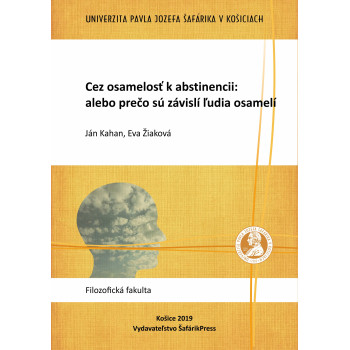
The monograph focuses on the issue of loneliness among substance-addicted people in the context of abstinence prospects and re/lapse prevention. In the monograph these phenomena, several theories were integrated and applied in the context of the ecosystem meta-framework of social work and practical contexts. The ecosystem meta-theory serves as a meta-construct with the ability to encompass the complexity of social phenomena as well as that of human beings within the structure of their living and social environment, formal and informal networks, and close intimate relationships.
In this monograph are presented research sample consisted of 235 respondents – hospitalised addicts undergoing urgent treatment, abstaining A-club members as well as members of psychotherapy and self-help groups. The research showed that abstainers were statistically less lonely than the hospitalised respondents. Quantitative data of research are complemented by qualitative data collected in four case studies; two of them focused on two long-term abstainers from alcohol and drugs, while the other two case studies dealt with two respondents in post-hoc treatment undergoing the resocialization process. The research also showed that respondents who broke abstinence felt lonelier than their successfully abstaining counterparts.
The results were supported also by the fact that a statistically significant inversely proportional relationship was identified between the duration of abstinence and loneliness rate. Gender differences were found between the hospitalised addicts in all loneliness dimensions. Naturally, the combined research was limited in certain aspects, mainly in terms of the size and proportional distribution of the research sample and its subgroups, test battery extent, and general nature of the population studied. Triangulation among quantitative and qualitative with the theoretical starting points confirmed the existence of a relationship among loneliness, addiction, and prospect of abstinence.
E-book
The stimulus for this monograph was my two studies on Heidegger’s interpretation of Nietzsche’s ideas of the will to power and eternal return of the same, published in Heidegger and Modern Metaphysics (supported by the Slovak Research and Development Agency, APVV-14-0706, under the leadership of V. Leška and M. Sobotka). In the submitted monograph, I present both studies in expanded (particularly “Will to Power as Art”) and refined versions (“Eternal Return of the Same”) and add a third chapter addressing the question of the meaning of interpreting philosophical texts, which themselves are interpretations of other texts.
In seeking an appropriate approach to the meaning of interpretation, I conclude that—generally—the purpose of interpretation is to uncover the productive dimension of the interpreted text, which can only be revealed if the interpreter enters the text openly and as neutrally as possible. If the interpreter does not open themselves to the text, allowing it to interpret them in turn, interpretation remains trapped. I believe that without mutual openness between interpreter and interpreted, interpretation has no meaning and typically becomes either rejection or misinterpretation—a form of violence.
In the third chapter, which I consider foundational, I attempt to “balance” the interpretive context of “Heidegger–Nietzsche” from the first two chapters through a reversible context of “Nietzsche–Heidegger,” albeit with the risk that my interpretation of Nietzsche’s thought—specifically his ideas of eternal return and will to power—may remain subjective, even if unintended as misinterpretation. Ultimately, the ambition of the third chapter is to explore intersections between the two philosophers, one of which—a rudimentary yet significant overlap—I identify as Heidegger’s concept of being-in-the-world, reinterpreted through Nietzsche’s lens. It is Nietzsche who challenges us to adopt a self-defined stance toward the world, to confront what it means to be in the world.
The challenge for me—and perhaps the reader—is to remain faithful to oneself, which is only possible by persisting in the context of mutual interpretation between interpreter and interpreted, regardless of who/what is interpreting or being interpreted. For the context of being-in-the-world is always co-created by both sides.
E-book
Silvia Kontírová a kol.
This revised and supplemented text aims to be a comprehensible and practical aid for students of the Master's degree in teaching academic subjects at the Faculty of Arts and the Faculty of Natural Sciences of the University of Applied Sciences in Košice taking compulsory courses in pedagogical practice.
Its general part deals with the mission, primary human factors, types and forms of pedagogical practice as one of the compulsory organizational forms of teacher studies and specifics of pedagogical practice in the conditions of UPJŠ.
The special part contains basic information and compulsory documentation of trainees on chronologically arranged types of pedagogical practice at UPJŠ. The authors would be grateful if you would point out any errors and shortcomings of the text to them via e-mail silvia.kontirova@upjs.sk.