Slovenčina



E-book
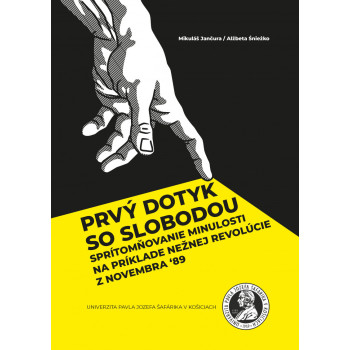
Mikuláš Jančura - Alžbeta Śnieżko
In connection with the 30th anniversary of the Velvet Revolution, which was commemorated in the Czech Republic and Slovakia in 2019, an interactive exhibition titled "First Touch of Freedom" was organized under the auspices of Košice Self-Governing Region in collaboration with Ján Bocatius Public Library in Košice, Pavol Jozef Šafárik University in Košice, Nation's Memory Institute, and Slovak Radio and Television. The exhibition took place at Ján Bocatius Public Library and aimed to recall November's events from 1989 while emphasizing its cultural-social dimension and impact.
Conceptually, it focused on developing five dimensions of historical consciousness—a concept mainly developed in contemporary subject-specific didactics for history—namely identity, historicity, memory, spatial awareness, and temporal awareness.
Data sheet
E-book
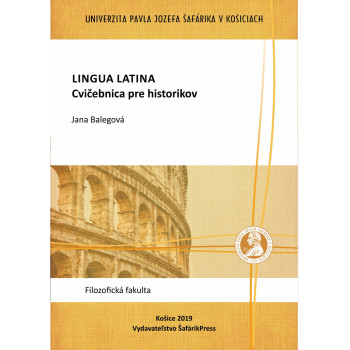
University textbook Lingua Latina – Exercise Book for Historians is a parallel study material to the textbook Lingua Latina – Cursus Communis. It is designed for practicing grammar at home. The content of the exercises corresponds to the focus of the individual lessons in the mentioned textbook, both in terms of the covered grammatical phenomena and vocabulary. For this reason, only vocabulary not covered in the textbook's lessons is included in the exercises.
The Latin-Slovak dictionary at the end of the exercise book contains all the vocabulary from both the exercise book and the textbook. The Slovak-Latin dictionary includes the vocabulary from exercises that require translation into Latin. The vocabulary in this exercise book is oriented towards the needs of history students and, given the selection of source materials, also includes non-classical lexicon or non-classical meanings of classical words (this lexicon is marked with the symbol *).
The exercise book includes a key that allows students to directly verify the correctness of their work. The textbook Lingua Latina – Exercise Book for Historians is available electronically in PDF format. As part of the teaching program, online tests available on the KKF FF UPJŠ website (https://www.upjs.sk/filozoficka-fakulta/katedra-klasickejfilologie/katedra/) also serve to practice the covered material.
E-book
The primary aim of the presented monograph is to introduce Slovak readers to the current state of knowledge in the field of parental control psychology and its consequences for various aspects of adolescent development. Additionally, it seeks to present research findings obtained from a representative sample of Slovak adolescents in early adolescence. The topic of parental control has been marginally addressed in the Slovak context, primarily as part of studies on parenting styles, but a detailed analysis of its forms and consequences within the Slovak environment is lacking.
The monograph is divided into nine chapters, with the first seven being theoretical in nature: Chapter 1 focuses on specific aspects of the parent-adolescent relationship and describes changes that occur during adolescence. Chapter 2 introduces the construct of parental control, situating it within several social-personality theories and general parenting styles. Chapter 3 examines two fundamental forms of control: behavioral and psychological, as well as their interplay. Chapter 4 defines the concept of structure as one form of parental control. Chapter 5 summarizes current knowledge about gender differences in the application of parental control. Chapter 6 presents factors related to the application of control, including child-related, parent-related, and contextual factors. Chapter 7, concluding the theoretical section, discusses discrepancies in perceptions of control between adolescents and their parents.
E-book
Marianna Sedláková - Marián Gladiš (eds.)
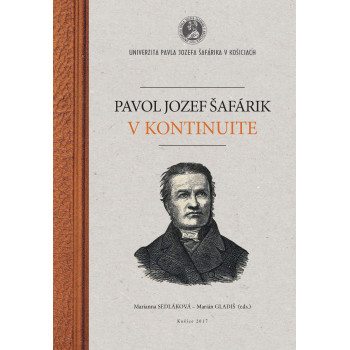
The content of the book publication Pavol Jozef Šafárik in Continuity consists of contributions from two events organized by the Department of Slovak Studies, Slavic Philologies, and Communication at the Faculty of Arts of Pavol Jozef Šafárik University in Košice during its short existence.
The first event was a scientific seminar held on the occasion of the 150th anniversary of the death of P. J. Šafárik, titled Pavol Jozef Šafárik – Scientist and Artist, which took place on January 27–28, 2012, in Košice and Kobeliarovo. The second event was an internal scientific seminar on the occasion of the 220th anniversary of Šafárik’s birth, held on December 15, 2015, under the title In the Quiet Home Circle. Symbolically—beginning with death and ending with birth (thus indicating the living continuity of Šafárik’s research legacy)—we aim to continue the study of Pavol Jozef Šafárik’s scientific work and increasingly involve the youngest generation of researchers (represented by doctoral students of the department in the field of literary studies). This is despite the fact that the literature on the life and work of this scholar and poet, who stood at the birth of Slavic studies, is very rich, and most of his works have already been scientifically analyzed. However, it appears that even seemingly outdated views of Šafárik still deserve scientific attention in the new context of humanities and natural sciences, as can be read in the contributions published in this volume.
Through the continuous publication of the Collected Works of Pavol Jozef Šafárik, both mentioned seminars, and the publication of this volume, the Faculty of Arts of Pavol Jozef Šafárik University in Košice has continued the activities of the Prešov Faculty of Arts from the time before its separation from the union of faculties of Pavol Jozef Šafárik University in Košice in 1997. The selection and arrangement of contributions in the volume symbolize the "passing of the baton" in research and publishing activities related to Pavol Jozef Šafárik—a scientific personality of global stature, who in 1959 gave his name to our university.
Compiled by the editors.
Soňa Lovašová - Katarína Šiňanská - Magdaléna Halachová - Vladimír Lichner (eds.)
The central theme of the conference is violence in social work. Violence in social work appears in various forms, whether it involves working with clients who are victims of different types of violence or dealing with aggressive clients where the social worker themselves becomes the victim. Violence in society is rapidly increasing, and social work is a science that must necessarily adapt to society; this is its essence. Therefore, managing aggressive situations in any form is an important part of a social worker's personal skill set.
Unfortunately, protecting social workers from violence will gradually become a necessity, and in the future, we may not avoid training in self-defense and reducing aggression as part of professional preparation or lifelong education.
The aim of this collection is to present the issue of violence in social work from various perspectives to both the professional and lay public. We hope that this serious problem will receive increasing attention and that the individual contributions will help readers understand the extent of the problem of violence in social work.