Slovenčina


E-book
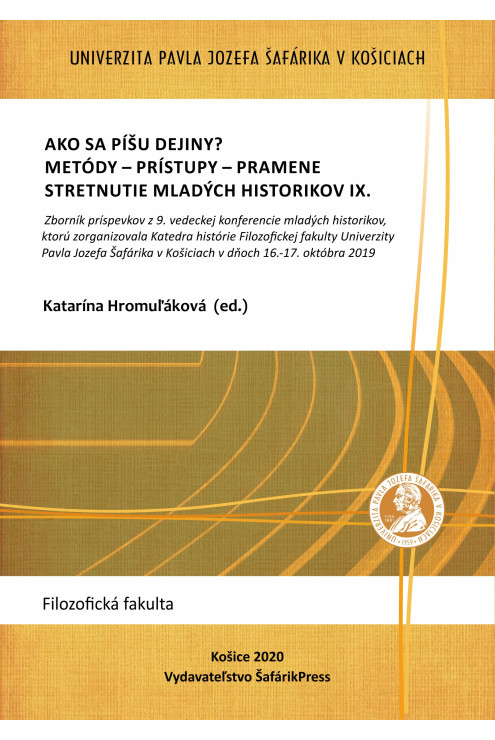
Katarína Hromuľáková (ed.)
Proceedings of the Scientific Conference. Košice, October 16-17, 2019
The proceedings titled "Ako sa píšu dejiny? Metódy – prístupy – pramene" present the contributions from the conference "Meeting of Young Historians IX," annually organized by the Department of History, Faculty of Arts, UPJŠ.
In the individual contributions, which span from the Middle Ages to the most recent history, the authors propose various theoretical and methodological research approaches to history, which currently represent fundamental prerequisites for historical research.
The ambition of the authors, as the next generation of historians, is not only to open up current questions of theoretical reflection in historiography but also to offer concrete examples supported by their own research.
Mgr. Katarína Hromuľáková

Data sheet
E-book
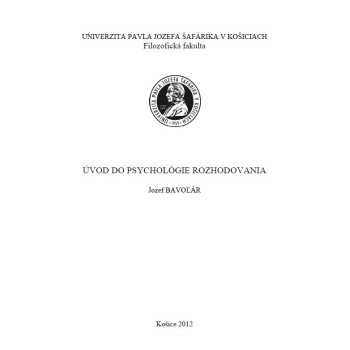
Decision-making is an everyday activity for us, whether it involves decisions about routine matters such as what to have for breakfast or more significant choices like selecting a career after finishing school. Due to the far-reaching consequences that a single decision can have on our entire lives, this area has received considerable attention in psychology. After all, the classic goals of psychology—describing, explaining, and predicting human behavior—are essentially attempts to understand decision-making and identify and describe the factors influencing it. Fundamental psychological disciplines such as the psychology of emotions and motivation, cognitive psychology, social psychology, and personality psychology all strive to achieve this understanding.
The presented text primarily adopts a cognitive approach, focusing on the processes of information processing and utilization. Since there are very few events in the future we can be completely certain about, key concepts include terms expressing uncertainty about the future, such as uncertainty, risk, objective probability, and subjective probability.
The central question thus lies in processing information from the environment and utilizing it in the decision-making process.
E-book
Lukáš Šutor (ed.)
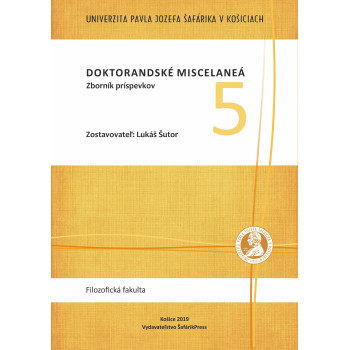
The fifth volume of Doctoral Miscellanea was created as a conference proceedings, returning to the original idea of the entire project: to establish a publication space for contributions from emerging scientists.
The first two issues of Doctoral Miscellanea consisted of outputs from departmental seminars, which involved internal discussions. Compared to direct publication, it proved more beneficial for doctoral students to verify their initial research results in multiple stages and present them in diverse ways (reaching more listeners and readers). The length of the texts in the first two issues was adapted to the duration of the presentations, but this practice was slightly disrupted by the omission of seminars in previous issues. In the current issue, the scope of the studies is somewhat more uniform.
An added value of the fifth volume was the meeting of all contributors at a joint conference, the Autumn School for Doctoral Students of the Faculty of Arts at UPJŠ in Košice, which took place on October 17, 2018, and October 18, 2018, in Danišovce.
We believe that this unique experience—often the first for many—of actively presenting at a scientific event could contribute to a better final version of the submitted contributions. At the same time, it allowed doctoral students to broaden their horizons within the humanities and social sciences, at least within the scope of the currently addressed dissertation research.
Lukáš Šutor
E-book
Eva Žiaková (ed.)
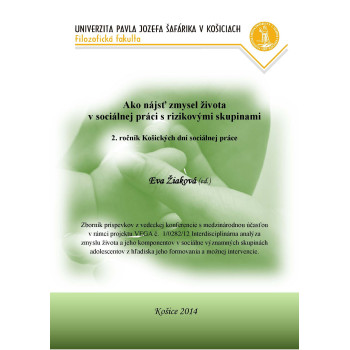
Proceedings of the Scientific Conference with International Participation within the VEGA Project No. 1/0282/12 Interdisciplinary Analysis of the Meaning of Life and Its Components in Socially Significant Groups of Adolescents in Terms of Its Formation and Possible Intervention.
The introductory word is a very good opportunity for us to jointly evaluate what we have managed to achieve in addressing our common scientific research task focused on the study of the meaning of life in socially at-risk groups of adolescents. First and foremost, we asked ourselves what we have discovered about the meaning of life so far, that is, what we know about it.
The second question we asked was: what surprised us about the results we have obtained so far. The third question was about what we want to do to resolve the discrepancy between what we have discovered and what we want to achieve.
The final question in evaluating the solution of the scientific research task was: what do we (not) know about the meaning of life of adolescents and want to know in the future, or what should we focus on to develop the most effective logotherapeutic and sociotherapeutic methods for social workers working with socially at-risk groups of adolescents.
E-book
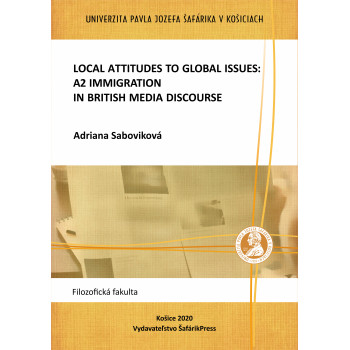
The monograph deals with the post-millennial media discourse in the UK and aims to popularize the currently used methodological framework in the form of a case study.
The theoretical basis is provided by the introductory chapters, which deal with the topic of migration and newspaper discourse in the UK. The methodological framework represents an increasingly popular combination of corpus linguistics and critical discourse analysis, which is introduced not only theoretically but also practically used in the presented case study. The case study compares the language used in the British newspapers before and after the lifting of labor market restrictions in the UK for Bulgarians and Romanians, specifically in 2013 and 2014.
The research is based on the identification of special language patterns used in the compiled corpus to characterize Bulgarians and Romanians, specifically paying attention to nouns, verbs and numerals. By doing such research, scholars can identify the role of media discourse in depicting social reality.