Slovenčina


E-book
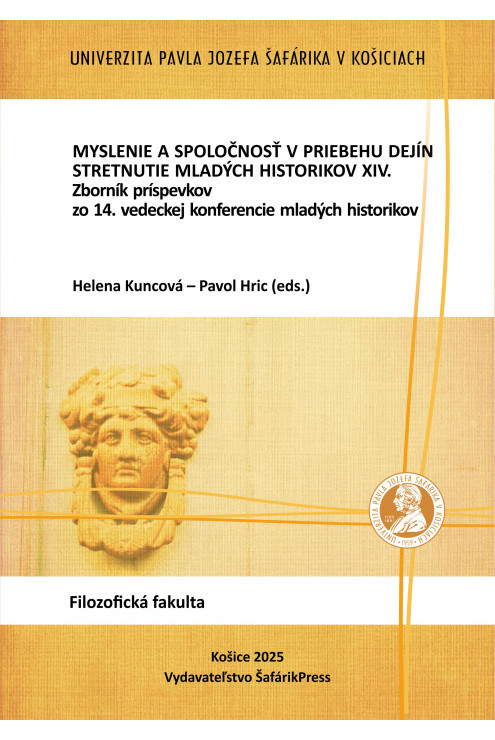
Helena Kuncová – Pavol Hric (eds.)
Zborník “Stretnutie mladých historikov XIV“ s témou Myslenie a spoločnosť v priebehu dejín prináša súbor vedeckých príspevkov, ktoré sa venujú vzťahu medzi myslením a spoločenskými zmenami v historickom vývoji. Doktorandi a doktorandky z rôznych univerzít a inštitúcií analyzujú, ako politické, ekonomické a sociálne premeny ovplyvňovali myslenie rôznych sociálnych skupín a naopak, ako tieto zmeny v myslení formovali dejinné procesy. Každý príspevok bol podrobený odbornému hodnoteniu dvoch garantov, ktorých pripomienky sú reflektované v predkladanej verzii zborníku. Témy príspevkov sú rozdelené do jednotlivých blokov, v ktorých boli prezentované na konferencii 15. a 16. októbra 2024 na Katedre histórie, FF UPJŠ v Košiciach. Zborník obsahuje príspevky nasledujúcich prezentujúcich: Mgr. Michal Pajer, Mgr. Helena Kuncová, Mgr. Barbora Mlyneková, PhDr. Patrik Beňuš, Mgr. Mária Rímešová, Mgr. Pavol Hric, Mgr. Monika Tresová, Mgr. Miriama Balvirčáková, Mgr. Monika Soukupová, PhDr. Ivan Chylák, Mgr. Dorota Tóthová, Mgr. Dominik Šípoš, Mgr. Martin Pastor a Mgr. Jaroslav Valent.

Data sheet
E-book
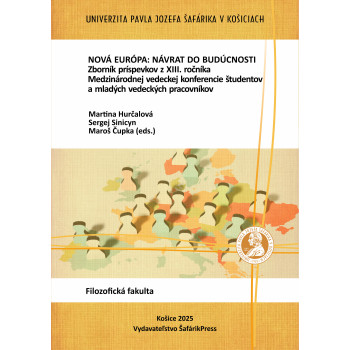
Martina Hurčalová - Sergej Sinicyn - Maroš Čupka (eds.)
Proceedings from the 13th International Scientific Conference of Students and Young Researchers, organized on May 16, 2024, by the Department of Political Science of the Faculty of Arts at Pavol Jozef Šafárik University in Košice, the Institute of Political Science and Public Administration of the Faculty of Political Science and Journalism at Maria Curie-Skłodowska University in Lublin, the Department of Political Science of the Faculty of Arts at the University of Miskolc, the Institute of Social Studies of the Faculty of Regional Development and International Studies at Mendel University in Brno, the Faculty of Political Science and Diplomacy at Vytautas Magnus University in Kaunas, and the civic association Respublica.
The aim of the translated publication NEW EUROPE: Back to the Future is to reflect on the challenges in the fields of international security, the fight against climate change, and environmental protection, and to highlight selected global phenomena.
The proceedings consist of 12 contributions in Slovak, English, and Czech. The authors primarily addressed selected current issues from the international environment in the context of deteriorating international relations and global security.
The topics of the contributions mainly include questions of international security (for example, in Germany or Hungary), environmental issues and the fight against the climate crisis. Furthermore, the proceedings include topics such as the European Parliament elections, selected narratives related to the war in Ukraine, migration to Europe and its security aspects, self-reflection of the European political system, and public space and public discourse. The proceedings also include a part of an upcoming utopian novel.
E-kniha
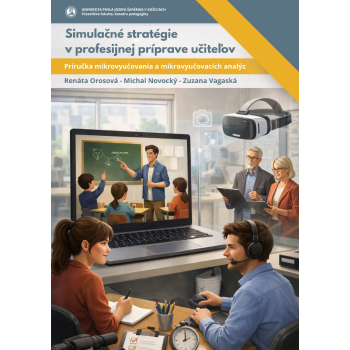
Renáta Orosová Michal Novocký Zuzana Vagaská
This publication provides a summary of knowledge about microteaching as a simulation strategy in the context of university teacher education. Readers will find theoretical foundations of simulation techniques, definitions and objectives of microteaching, the role of analysis as a tool for reflection, possibilities for implementation in both face-to-face and distance learning formats, and numerous examples of best practices. We believe that this text contributes to a deeper understanding of the importance of microteaching, a simulation strategy that systematically develops pedagogical skills and helps shape the professional competencies of future teachers.
E-book
The monograph deals with the post-millennial media discourse in the UK and aims to popularize the currently used methodological framework in the form of a case study.
The theoretical basis is provided by the introductory chapters, which deal with the topic of migration and newspaper discourse in the UK. The methodological framework represents an increasingly popular combination of corpus linguistics and critical discourse analysis, which is introduced not only theoretically but also practically used in the presented case study. The case study compares the language used in the British newspapers before and after the lifting of labor market restrictions in the UK for Bulgarians and Romanians, specifically in 2013 and 2014.
The research is based on the identification of special language patterns used in the compiled corpus to characterize Bulgarians and Romanians, specifically paying attention to nouns, verbs and numerals. By doing such research, scholars can identify the role of media discourse in depicting social reality.
E-book
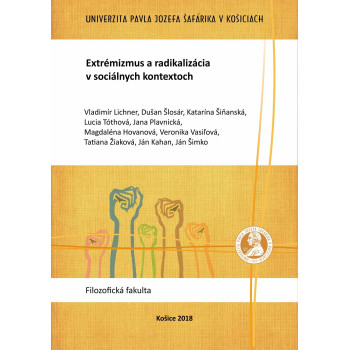
Vladimír Lichner - Dušan Šlosár et al.
It is very difficult to refer to any act of extremism or action having extremist characteristics, or to exclude it unambiguously. The boundary between extremism and accepted, conformal behavior is very broad and vaguely worded. Each company tends to set certain criteria to determine what can be considered as unwanted, violent, radical or extreme, or what signs of such a manifestation do not have. Therefore, when comparing the individual countries of the European Union in this area, we come across a different definition of what is or is not considered to be radical or extremist. In essence, the level of tolerance to some of the manifestations and the setting of indicators for the evaluation of the proceedings as extremist.
The presented monograph aims to present the basic social contexts of extremism and radicalization in the form of their philosophical and theoretical backgrounds, influencing the factors, the basic directions. In the author's work, the authors focus on the target group of adolescents, which they consider to be one of the most endangered groups in society in terms of development of the radicalization process. At the conclusion of the monograph is also offered the criminal level of these phenomena, which is not unavoidable in terms of complex analysis.