Slovenčina


E-book
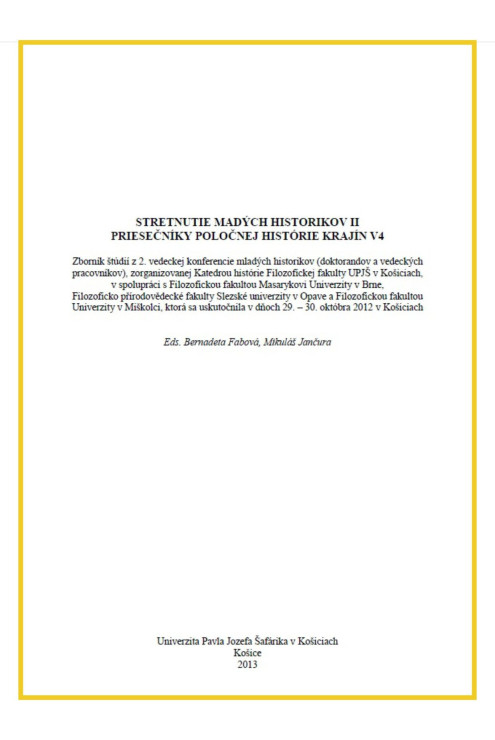
Bernadeta Fabová - MikulአJančura (eds.)
Collection of Studies from the 2nd Scientific Conference of Young Historians (Doctoral Students and Researchers), organized by the Department of History of the Faculty of Arts at Pavol Jozef Šafárik University in Košice, in cooperation with the Faculty of Arts at Masaryk University in Brno, the Faculty of Arts and Sciences at Silesian University in Opava, and the Faculty of Arts at the University of Miskolc, held on October 29-30, 2012 in Košice.
The collection is the output of the second annual scientific conference of young historians (doctoral students and researchers), organized at Pavol Jozef Šafárik University in Košice. The central theme of the event was the focus on intersections of shared history. The ten studies map various intersections of the history of the V4 countries, as well as the broader Central European region, in the time span from the 13th to the 20th century. The individual studies cover a wide range of areas from the medieval road network, military and urban history, through economy, education, issues of national identity, the relationship between the state and the church, to demographic questions.

Data sheet
E-book
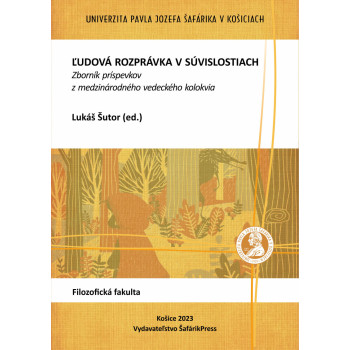
Proceedings from the International Scientific Colloquium "The Folk Tale in Contexts" (December 12, 2022, in Košice)
We present the proceedings "The Folk Tale in Contexts" to the professional public as the outcome of the eponymous international scientific colloquium, which took place on December 12, 2022. Our aim was, among other things, to open a discussion on verbal folklore in broader interpretative, transcultural, and ultimately also interdisciplinary contexts—a goal that was achieved especially in the latter respect. Although the contributors primarily work in the fields of folklore studies and literary science, their methodological approaches from other—sometimes even more distant—disciplines expand the current discourse to a remarkable breadth. This is proof that research on the folk tale remains vibrant and open to new challenges.
Download e-book for free (pdf)
E-book
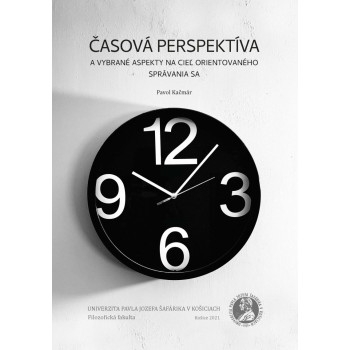
Overview of the Issue and Meta-Analysis of Conducted Research.
The publication focuses on two key constructs – time perspective and goal achievement. After describing both constructs, the authors focused on potential connections that can be found at multiple levels of analysis. For the purpose of empirical verification, they conducted a small-scale meta-analysis synthesizing results across eleven studies. The obtained results highlighted the role of time perspective in selected aspects of goal achievement. The publication is intended to serve as a catalyst for further consideration of the issue, thereby encouraging research aimed at verifying how the acquired knowledge can be expanded to improve the quality of our daily lives in the context of cultivating our approach to time.
Download e-book for free (pdf)
E-book
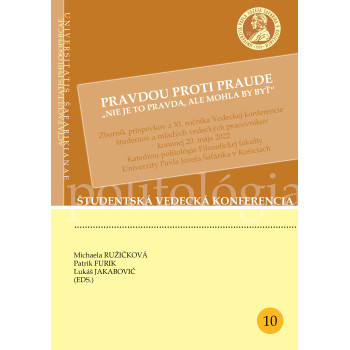
Michaela Ružičková - Patrik Furik - Lukáš Jakabovič (eds.)
The collection of articles from the XI. International Scientific Conference for Students and Young Scientists, organized by the Department of Political Science of the Faculty of Arts of the Pavol Jozef Šafárik University in Košice, in cooperation with the Res Publica Civic Association, the Department of Security Studies of the Faculty of Political Science and International Relations of the Matej Bel University in Banská Bystrica, Institute of Political Sciences and Administration, Faculty of Political Science and Journalism, Marie Curie-Sklodowska University in Lublin, Institute of Social Studies, Faculty of Regional Development and International Studies, Mendel University in Brno, and the Department of Political Science, Faculty of Arts, University of Miskolc, held on 20 May 2022 in Košice.
The aim of this publication, entitled Truth vs. Post-Truth. „It is not true, but it could be.”, is to highlight the threats arising from the issue of the spread of disinformation, conspiracies and hoaxes today, reflecting not only on the national context, but also on the impact of these elements in the international environment.
The proceedings consist of 12 articles written in Slovak and English. The individual contributions deal with selected topics and aspects of the spread of disinformation, conspiracy theories or hoaxes, among others in the context of elections, media landscape and politics.
The topics of the contributions are the limits of freedom of expression, media freedom and regulation in the media space, the issue of propaganda or information warfare. The present volume also includes papers focusing on issues in the field of political ideologies or the issue of false narratives about the COVID-19 disease.
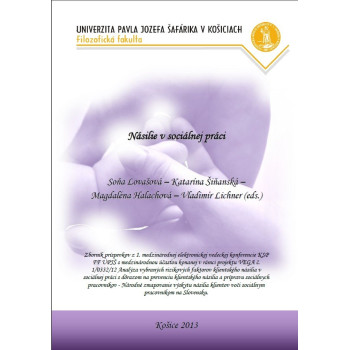
Soňa Lovašová - Katarína Šiňanská - Magdaléna Halachová - Vladimír Lichner (eds.)
The central theme of the conference is violence in social work. Violence in social work appears in various forms, whether it involves working with clients who are victims of different types of violence or dealing with aggressive clients where the social worker themselves becomes the victim. Violence in society is rapidly increasing, and social work is a science that must necessarily adapt to society; this is its essence. Therefore, managing aggressive situations in any form is an important part of a social worker's personal skill set.
Unfortunately, protecting social workers from violence will gradually become a necessity, and in the future, we may not avoid training in self-defense and reducing aggression as part of professional preparation or lifelong education.
The aim of this collection is to present the issue of violence in social work from various perspectives to both the professional and lay public. We hope that this serious problem will receive increasing attention and that the individual contributions will help readers understand the extent of the problem of violence in social work.