Filter By

Categories

Categories

Year of publication:

Year of publication:

Publication language:

Publication language:

Faculty:

Faculty:

Method of publication:

Method of publication:

Active filters

  • Categories: Law
  • Year of publication:: 2015
  • Year of publication:: 2016
  • Year of publication:: 2017
  • Year of publication:: 2017
  • Year of publication:: 2017
  • Year of publication:: 2017
Hranice zmluvnej slobody v pracovnom práve

Hranice zmluvnej slobody v pracovnom práve

E-book

E-book

Marcel Dolobáč

The author's ambition is to build on the current and at the same time to stimulate further discussion of the anchoring of labour law in the system of private law sectors and to contribute to the variation of views in relation to freedom of contract and its limits in labour law. The broad contractual freedom of civil law does not apply to the field of labour law, and thus the penetration of standard civil law institutes into labour law relations is not always self-evident.

The above constitutes the main theses of the present monograph. The issue of freedom of contract in labour law can be grasped in several ways. The author has chosen a content structure that is built on three basic pillars. In the first part, the author assesses the position of labour law in the system of law, which is determined primarily by the actual subject of legal regulation - dependent labour and the specific method of legal regulation through cogent and relatively cogent norms. In this context, the author would like to note at the outset that the much-discussed dispositive nature of labour law norms appears to be merely presumptive. Labour law is built on minima and maxima, with relative mandatory norms being the building blocks of fixed boundaries, a fact that distinguishes labour law from other branches of private law. These considerations are followed by the author's view of autonomy of will in labour law. The limits of contractual freedom (not only) in the theoretical sense form the second pillar of the author's ideas.

Finally, the third part of the thesis is to be the one that translates the theoretical-legal considerations of the interconnection of civil law and labour law into the interpretation of selected civil law institutes and the possibility of their application and implementation in labour law relations.
Download he e-book for free (pdf)

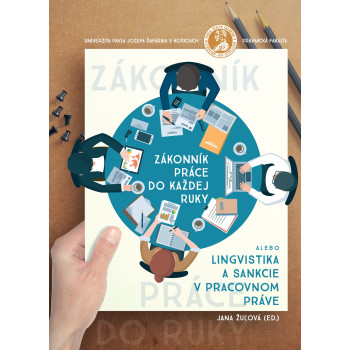
Zákonník práce do každej ruky alebo lingvistika a sankcie v pracovnom práve

Zákonník práce do každej ruky alebo lingvistika...

E-book

E-book

Jana Žuľová

Proceedings of the Second Annual Student Symposium on Labor Law held on May 12–13, 2017 in Danišovce

The presented proceedings are the result of scientific works by students of the Faculty of Law at Pavol Jozef Šafárik University in Košice and are systematically divided into two parts.

The first part presents interdisciplinary intersections of linguistics and labor law in its creation, interpretation, and application. The second part addresses the issue of targeting the addressees of labor law norms through various sanction mechanisms. The proceedings include a questionnaire compiled by the researchers of a grant project, aimed at determining whether and in which aspects the Labor Code diverges from its addressees in terms of linguistic and stylistic processing. Indeed, there is no other legal norm that is closer to the participants of labor relations, and whose understanding at the highest possible level is justified by its everyday use.

The presented proceedings thus serve as a means of expanding the horizons of our students beyond their regular studies and as a tool for popularizing scientific research. In case of interest, the completed questionnaire can be sent to: jana.zulova (@) upjs.sk.

Download the e-book for free (pdf)

Zborník príspevkov z X. ročníka študentského sympózia z medzinárodného a európskeho práva

Zborník príspevkov z X. ročníka študentského...

E-book

E-book

Adam Giertl (ed.)

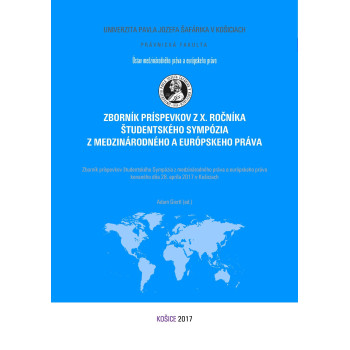
Proceedings of the Student Symposium on International Law and European Law held on April 28, 2017, at the Faculty of Law of Pavol Jozef Šafárik University in Košice

The Student Symposium is regularly organized by the Institute of International Law and European Law, and in 2017, it marked the jubilee tenth edition of the symposium, which over time expanded its focus to include European law.

The tradition of holding student symposia is also associated with the good practice of preparing proceedings from each event. Understandably, the tenth edition is no exception, and thus, the tenth edition of the symposium proceedings is now available to readers. In previous years, the symposium has always focused on specific areas of international and European law. Thus, the subjects of study for symposium participants have included migration issues (2016), the protection of cultural values (2015), and the challenges of cyberspace (2013).

This year, given that it is the jubilee tenth edition, the symposium organizers have chosen to approach the symposium's focus thematically and recall some significant milestones in the development of international law that occurred in years ending with the number seven.

Download the e-book for free (pdf)

Právne postavenie spoločníka v obchodnej spoločnosti

Právne postavenie spoločníka v obchodnej...

E-book

E-book

Žofia Šuleková (ed.)

Proceedings of the Contributions from the IV. Student Symposium on Corporate Law held on November 24-25, 2016, at the Training Facility of Pavol Jozef Šafárik University in Danišovce.

The Department of Commercial Law and Economic Law at the Faculty of Law of Pavol Jozef Šafárik University in Košice organized the fourth edition of the student symposium, this time focusing on corporate law.

The event took place on November 24-25, 2016, at the training facility of Pavol Jozef Šafárik University in Danišovce. The aim of the annually organized symposiums is to create a discussion platform for students with the participation of mentors from the department, including teachers, researchers, and doctoral students. This year’s symposium focused on problematic issues related to the legal status of a partner in a commercial company. The topics were assigned to allow students to demonstrate and develop their analytical and argumentative skills while improving their ability to present and formulate their own views and perspectives.

The presented proceedings are the outcome of the students' work from this event.

Download the e-book for free (pdf)

Pracovnoprávne elementy výkonu (závislej) práce. Kritika a deformácia práva.

Pracovnoprávne elementy výkonu (závislej)...

E-book

E-book

Jana Žuľová (ed.)

Collection of Scientific Works

Article 35 of the Constitution of the Slovak Republic guarantees everyone the right to freely choose their profession and receive training for it, as well as the right to engage in entrepreneurial or other gainful activity. Everyone has the right to freely decide whether to secure their livelihood through self-employment—with all the associated consequences and risks—or through employment within labor-law relationships by performing dependent work.

The framework and rules for exercising these rights are primarily regulated by labor, commercial, and tax legislation, each with its own set of rights and obligations applicable specifically to entrepreneurs and employees. Constant competitive pressure, along with the effects of economic crises, pushes employers to seek ways to extract the most from workers while optimizing for the lowest possible insurance, administrative, and tax costs. As a result, employment contracts are being terminated, and under the pressure of losing their income, individuals are "voluntarily" shifting to commercial-law relationships.

This situation, along with other distortions in the labor market, confronts those entitled to work with unfair practices by employers, thereby undermining their ability to freely exercise this fundamental right.

Download the e-book for free (pdf)

Orgány obchodných spoločností

Orgány obchodných spoločností

E-book

E-book

Kristián Csach - Dušan Rostáš (eds.)

Proceedings of the 2nd Student Symposium on Company Law In November 2014

The second annual Student Symposium on Commercial Law—more specifically, on Company Law—was held at the university’s facility in Danišovce. As in the previous year, the aim of the symposium was to provide students with a greater opportunity to articulate their own perspectives on current legal issues and to present the results of their individual work.

The theme of the second symposium focused on the governing bodies of commercial companies, aligning it thematically with the APVV research project being carried out by members of the Department of Commercial and Economic Law at our Faculty of Law. This overarching topic made it possible to assign a range of current legal issues, allowing students to explore problems they are likely to encounter in their future professional practice. The selected topics are not among those unanimously settled by legal doctrine or established case law.

On the contrary, they were deliberately chosen for their complexity and the lack of sufficient domestic literature. As a result, students had to go beyond standard textbook or commentary-based knowledge to thoroughly address their assigned topics.

Download the e-book for free (pdf)

Všeobecná teória práva

Všeobecná teória práva

€18.15
Availability: 3 In Stock

Miloš Večeřa a kolektív

Všeobecná teória práva poukazuje v teórií práva ako sa robí tvorba práva, v aplikácií právnych vzťahoch, taktiež právo europeizácie a globalizácie, obsahuje príklady aplikácie pre podmienky SR legislatívy. Publikácia sa snaží poskytnúť teóriu práva vo všeobecnej rovine ako sa interpretuje v praxi v právnej vede.

Regionalizmus a jeho prínos pre všeobecné medzinárodné právo

Regionalizmus a jeho prínos pre všeobecné...

E-book

E-book

Ján Klučka a kol.

The presented monograph, “Regionalism and Its Contribution to General International Law,” was prepared at the Institute of European Law and the Department of International Law of the Faculty of Law at Pavol Jozef Šafárik University in Košice as part of a project of the same name (APVV-0823-11) carried out in the years 2011–2015, and represents one of its final publication outputs.

The main reason for choosing this topic was the effort to evaluate regionalism in its various forms in relation to international law, and, conversely, to assess the place, significance, and role of international law in the creation and functioning of different forms of regional groupings. In fact, although regionalism is receiving increasing attention in doctrine, a more comprehensive assessment of its impact on international law and vice versa has so far been lacking.

This monograph attempts to partially fill this gap. Against the background of a brief historical development of regionalism, as well as its substantive and terminological components, the monograph examines in greater detail the individual types of regionalism—such as old and new regionalism, as well as contractual and institutional regionalism—their specific features, and their contribution to general international law.

Attention is also devoted to a specific phenomenon of contemporary regionalism, namely the influence of the European Union on its stabilization and development, both through practical measures and through a set of measures regulated by international treaties.

Download the e-book for free (pdf)

Regionalism and Its Contribution to General International Law

Regionalism and Its Contribution to General...

E-book

E-book

Ján KlučkaĽudmila Elbert

The present monograph "Regionalism and its Contribution to General International Law" was written at the Institute of European Law and Department of International Law, Faculty of Law, Pavol Jozef Safarik University in Kosice, as a part of the project (APVV-O823-11) carried out in 2011-2015, representing one of its final publication utputs. 

The main reason for choosing the topic was to evaluate regionalism in its various relationships and forms with respect to international law, and also to evaluate the place,importance and duties of international law in respect to the establishment and functioning of various forms of regionalgroups.

It is a fact that even though a lot of attention has been paid to regionalism, a more complex evaluation of the impact it has had on international law, and vice versa, is still lacking. The efforts of the present monograph are to partially eliminate this gap.

After giving a brief insight into how regionalism has developed, its content and terminology, the monograph studies in more details individual types of regionalism in the form of old and new regionalism, as well as treaty and institutional regionalism; its specifications and contributions to the international law.

Download the e-book for free (pdf)

Ochrana kultúrnych hodnôt prostriedkami medzinárodného a regionálneho práva

Ochrana kultúrnych hodnôt prostriedkami...

E-book

E-book

Adam GiertlĽudmila Elbert

Collection of Papers from the 8th Student Symposium held on April 20–21, 2015 in Danišovce

The capture of the historic Syrian city of Palmyra by fighters of the radical Islamic State caused shock among the global public. The main reason is the barbarism with which this organization proceeds, not only in relation to the treasures of the world’s cultural heritage. The situation in the Middle East, where cultural treasures of inestimable value are under direct threat, demonstrates how fragile the world’s cultural heritage is. The reaction of the international public and world leaders shows how sensitively the destruction of cultural heritage is perceived.

The quoted statement chosen by the editors relates to the threat posed by the Islamic State—however, the spirit of this statement can be applied to any cultural wealth that forms part of the world’s cultural heritage. The destruction or damage of these values primarily represents a loss for humanity as such. Each destroyed artifact of world cultural heritage signifies the disappearance of a unique legacy left by previous generations for the future. At the same time, cultural heritage must be understood as a broad spectrum of assets—both tangible and intangible. Their legal protection was the topic of this year’s symposium. As with any social interest, the protection of cultural heritage can be ensured through various mechanisms and under different forms of social organization.

These diverse approaches are unified by law as a normative system. The question for the 8th year of the symposium on international law was what role international law plays in the protection of cultural heritage. In the context of the European region, the role of the European Union as a regional organization was examined.

Download the e-book for free (pdf)

Rule of Law a medzinárodné právo

Rule of Law a medzinárodné právo

E-book

E-book

Ľudmila Elbert

The presented scientific monograph addresses the issue of the Rule of Law and its place, roles, and particularities at the level of international law. The Rule of Law is understood as a value that should govern communities, both domestic and international. It is thus compared to Kelsen’s basic norm, which should stand at the top of the legal order as the norm justifying the validity and existence of the norms of the legal order, both domestic and international.

Although the Rule of Law is studied at the international law level, it cannot be considered without understanding the Rule of Law in domestic law. Just as its development differs depending on whether it evolved within Anglo-American or continental law, its application and development also differ between domestic law and international law.

These differences are mainly caused by the roles and objectives that international Rule of Law is meant to secure, as well as by the distinct characteristics of domestic and international law.

Download the e-book for free (pdf)

Slovenské a české obchodné právo v roku 2015: Vybrané problémy

Slovenské a české obchodné právo v roku 2015:...

E-book

E-book

Jozef Čorba(ed.)

Collection of Contributions from the Conference

On June 11–12, 2015, the Department of Commercial Law and Economic Law at the Faculty of Law, P. J. Šafárik University in Košice, organized the 13th meeting of the departments of commercial law from the law faculties of Czech and Slovak universities. This event further demonstrates that the idea of an annual gathering of representatives from these departments, initiated by Professor Bejček of the Faculty of Law at Masaryk University in Brno, has taken root and is likely to continue. Not only to preserve the tradition but primarily for the benefit of such meetings and the interest of participants to meet regularly.

A traditional part of these meetings, besides the exchange of knowledge and information about the teaching process and experience sharing, is a scientific conference focused on current issues in commercial law. This year’s conference was held under the title Slovak and Czech Commercial Law in 2015 – Selected Problems. A total of 17 contributions from various departments were included in the conference proceedings, divided into three thematic areas. The first group of contributions addresses selected issues related to the legal regulation of commercial companies and its practical implementation. The second group focuses on arbitration and insolvency law.

The third group includes contributions on the interpretation of the amended regulation of interest on late payments in commercial obligations, problems related to the application of this regulation, and issues concerning the interpretation of legal acts contained in the new Czech Civil Code. An additional part features an informational contribution on the development of Slovenian commercial law and its current form.

Ján Husár, Kristián Csach

Download the e-book for free(pdf)

Územná samospráva a tvorba práva

Územná samospráva a tvorba práva

E-book

E-book

Michal Jesenko - Martina Kantorová(eds.)

Peer-reviewed proceedings of the scientific conference, which took place on 27.11.2015 at the Faculty of Public Administration, UPJŠ v Košice, Popradská 66, 041 32 Košice

Territorial self-government forms an integral part of a modern democratic and legal state. It is an expression of efforts to implement tasks to ensure the needs of the territorial community of citizens at the level that is closest to them.

One of the most important tools at the disposal of local self-government units in the performance of the tasks entrusted to them is the power to issue general binding regulations in matters of local self-government and to ensure the tasks arising for local self-government from the law. Law-making at the level of towns and municipalities or higher territorial units is thus an integral part of the exercise of territorial self-government and ultimately expresses its specific character as an essential part of public administration.

The aim of the scientific conference organized by the Department of Public Law Disciplines, Faculty of Public Administration, UPJŠ in Košice on 27 November 2015 was an effort to present the achieved results of scientific research activities in the field of law-making at the level of cities and municipalities, or higher territorial units. The conference provided a wide space for discussion on current issues of municipal standard-setting with the participation of representatives of the professional public, as well as representatives of local government and local self-government.

The scientific conference and the peer-reviewed proceedings of the conference were realized as a part of the solution of the VEGA grant project No. 1/0683/13 under the title "Normative Formation of Municipalities in the Matters of Local Self-Government. The present collection of papers from the scientific conference is an expression of the long-term efforts of the Department of Public Administration, Faculty of Public Administration, UPJŠ in Košice to address current issues of public administration with a special focus on the issue of local government.

Download the e-book for free (pdf)

Aktuálne otázky migrácie z pohľadu medzinárodného práva s osobitným zreteľom na Chartu práv Európskej únie

Aktuálne otázky migrácie z pohľadu...

E-book

E-book

Adam Giertl (ed.)

Collection of Papers from the 9th Annual Student Symposium on International and European Law held on April 22, 2016 at the Faculty of Law, Pavol Jozef Šafárik University in Košice

As indicated by the very title of the 9th Annual Student Symposium on International and European Law, “Current Issues of Migration from the Perspective of International Law with Special Regard to the Charter of Fundamental Rights of the European Union,” the participants focused on the highly topical subject of European migration, which they examined from various aspects of both international and Union law (a total of 9 contributions).

In assessing the role of individual actors primarily involved in addressing the problems arising from migration to Europe, particular emphasis was placed on the role of international specialized organizations, which often provide direct assistance to migrants “in the field” through humanitarian or medical aid. However, this is not the only response of the international community, as it is complemented by the activities of the concerned states as well as various non-governmental organizations and volunteers. Regarding the evaluation of the European Union’s activities, the symposium participants agreed that the mass migration wave caught the EU relatively unprepared—institutionally, legislatively, and technically—accompanied by a lack of clarity in adopting a fundamental approach to this reality.

It was also emphasized that these shortcomings occurred despite the fact that developments in the preceding period clearly signaled the possibility of gradual migration to the European Union escalating into a mass phenomenon. According to the participants, additional ex post and sometimes delayed measures adopted in response to the ongoing migration process contributed to an overall increase in political tension within the EU and divided its member states into opposing camps.

Download the e-book for free (pdf)

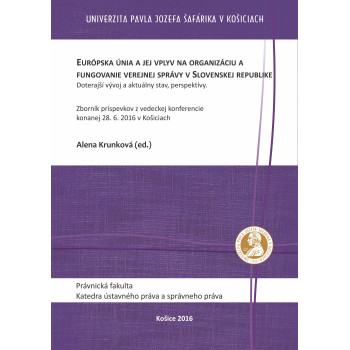
Európska únia a jej vplyv na organizáciu a fungovanie verejnej správy v Slovenskej republike

Európska únia a jej vplyv na organizáciu a...

E-book

E-book

Alena Krunková (ed.)

Proceedings of the Scientific Conference Held on June 28, 2016 at the Faculty of Law of Pavol Jozef Šafárik University in Košice in connection with the implementation of the project “The European Union and Its Impact on the Organization and Functioning of Public Administration in the Slovak Republic” – approved under number MVZP – SK PRES/2016/134

The Slovak Republic, as a member state of the European Union, is undertaking a historic role associated with the Presidency of the Council of the European Union within the presidency trio. At the beginning of 2016, the Ministry of Foreign and European Affairs of the Slovak Republic announced a call for applications for grants for 2016 in the field of international relations and foreign policy, specifically focused on the Slovak Republic’s Presidency of the Council of the European Union. The Faculty of Law of Pavol Jozef Šafárik University in Košice responded to this call and obtained a project aimed at carrying out research activities through a series of events focused on regional self-government in the Slovak Republic in the context of its role within the European Union. The Faculty has long been engaged with issues of European Union law both in its teaching and in the scientific research activities of its individual faculty members. The project aims to enrich this portfolio with special activities targeting not only professionals, but also students and the general public.

The first activity of the project was a conference entitled “The European Union and Its Impact on the Organization and Functioning of Public Administration in the Slovak Republic – Development So Far, Current State, and Perspectives.” The conference was attended by invited public officials, representatives of academia, and representatives of local government, as one of the main goals of the project is to connect the academic community with the practical sphere and thus involve practitioners in the planned activities within the project.

Download the e-book for free (pdf)

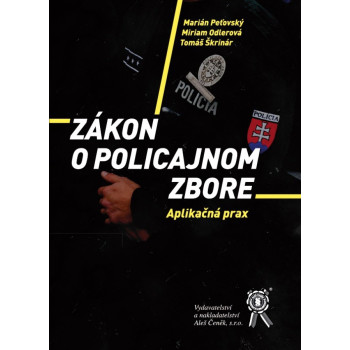
Zákon o policajnom zbore

Zákon o policajnom zbore

€27.86
Availability: 1 In Stock

Marián PeťovskýMiriam Odlerová - Tomáš Škrinár

Publikácia je komplexným zhrnutím doterajších teoretických poznatkov a praktických skúseností z oblasti činností Policajného zboru. Súčasná policajná prax pociťuje absenciu publikácie, ktorá by vo svojom obsahu vysvetlila postupy pri výkone policajných činností v rozsahu súčasného znenia zákona o Policajnom zbore. Publikácia sa preto sústreďuje najmä na praktickú činnosť policajta pri výkone služby, vykonávanie služobných zákrokov, používanie donucovacích prostriedkov, ale aj povinnosti a oprávnenia príslušníkov Policajného zboru. Okrem toho rozoberá úlohy, organizáciu a riadenie Policajného zboru, informačno-technické prostriedky a operatívno-pátraciu činnosť, spracúvanie informácií Policajným zborom, spôsoby a formy kooperácie Policajného zboru s inými subjektmi a náhradu škody. Publikácia má byť praktickou pomôckou policajta vo vzťahu ku kvalitnému a efektívnemu plneniu jeho úloh, povinností a oprávnení v priamom výkone služby. Autori chcú predmetnou publikáciou osloviť čitateľov z odbornej verejnosti, najmä príslušníkov Policajného zboru, zložiek Ministerstva vnútra Slovenskej republiky, bezpečnostných mimorezortných služieb, ale tiež aj laickej verejnosti, ktorá mnohokrát dochádza do bezprostredného kontaktu so zásahmi polície do ich práv a slobôd.

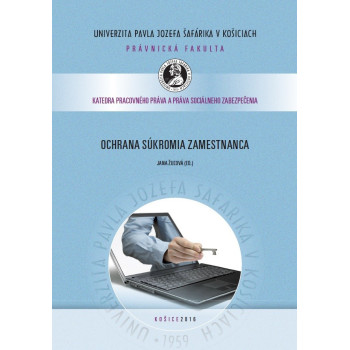
Ochrana súkromia zamestnanca

Ochrana súkromia zamestnanca

E-book

E-book

Jana Žuľová(ed.)

Proceedings from the 1st Annual Student Symposium on Labor Law held on April 8–9, 2016 in Danišovce

Discussions on the topic of privacy are currently very topical and interesting. The advancement and progress of technology have added a new dimension to individual privacy. With the use of modern electronic devices, terms such as precious commodity, chimera, or illusion are increasingly associated with privacy. Workplaces have not remained immune to modernization either. Machines are replacing human labor, programming and planning the production process, but also controlling, monitoring, and recording the fulfillment of assigned work tasks.

The availability of technology and its implementation in employers’ operations intrude upon the personal and private sphere of employees, which is an inherent part of every person’s life and does not remain left behind the doors of the workplace. Proper and correct use of monitoring mechanisms by employers means not only mastering their technical installation at the workplace and covering the associated financial costs, but also respecting the privacy of employees.

It cannot be overlooked that the right to privacy is among the fundamental human rights and freedoms, enjoying the corresponding characteristics (inalienability, non-transferability, irrevocability, etc.) and appropriate legal protection. And even though it is not absolute and may be suspended in favor of another right (especially the employer’s right to protect their property), every intervention—such as comprehensive camera surveillance, monitoring of phone calls, email correspondence, blocking certain websites, etc.—always has adverse consequences for the privacy of the employee.

Download the e-book for free (pdf)

Právo - obchod - ekonomika V.

Právo - obchod - ekonomika V.

E-book

E-book

Jozef Suchoža - Ján Husár - Regina Hučková (eds.)

Collection of Scientific Works

The scientific papers presented in this Collection are primarily the result of academic research conducted by experts working within the academic environment—particularly at Faculties of Law in the Slovak Republic and the Czech Republic, as well as by foreign experts, including those from Poland, the Russian Federation, Serbia, and others. In addition to academic contributions, this Collection also includes scientific and professional articles authored by legal practitioners, especially lawyers, notaries, and judges—not only from our own jurisdiction, but also judges from the General Court of the European Union. Contributions from professionals in the field of banking have also enriched this Collection. Moreover, the Collection provides space for aspiring scholars in the field of legal science, thereby combining timelessness with dynamism.

Given the diversity of the published contributions, it can be said that this Collection represents a connection between theory and practice, private and public law, as well as various branches of law. Nevertheless, the content of this Collection aligns with and reflects the central theme of the international symposium, namely: "CORPORATIONS – CONTRACTS – CODIFICATIONS – CONTEXTS." The individual sections of the Collection are interconnected and create a coherent whole, subsumed under a publication characterized by unity.

Download the e-book for free (pdf)

Obchodné záväzky: Všeobecná časť

Obchodné záväzky: Všeobecná časť

E-book

E-book

Dominika Zavadová(ed.)

Proceedings from the 3rd Student Symposium on Commercial Law

In November 2015, the third annual Student Symposium on Commercial Law took place at the university facility in Danišovce.

After two years of symposia focused on company law, the main topic of the third edition was the general part of commercial obligations law. This year as well, the goal of the student symposium remained to provide more space for students to formulate their own perspectives on current legal issues and to present the results of their own work.

The overarching topic made it possible to assign several current issues, allowing students to tackle problems they are likely to encounter in their future practice. The selected topics are not among those unanimously accepted by legal doctrine or established case law. On the contrary, the topics were deliberately chosen for the lack of sufficient domestic literary sources. As a result, processing the individual topics required more than just standard textbook or commentary knowledge.

The participating members of the department, both teachers and doctoral candidates, acted this year primarily as contact persons, rather than as consultants or supervisors of the students’ work. The primary purpose of the symposium at the faculty is to enable students interested in commercial law to develop their analytical and argumentative skills, as well as to express their personalities. We aim for students to develop not only professional knowledge but also personal skills-so-called soft skills-the art of presenting their own opinions and arguing persuasively.

Download the e-book for free (pdf)

Medzinárodné daňové úniky a metódy ich predchádzania

Medzinárodné daňové úniky a metódy ich...

E-book

E-book

Peter Huba - Jozef Sábo - Martin Štrkolec

The presented monograph aims to provide an in-depth overview of the issue of international tax evasion, both in terms of its conceptual foundations and with regard to specific methods and schemes used to carry out tax evasion.

The members of the authorial team have also addressed questions of tax evasion in their previous works: "International Tax Evasion and Tax Havens" (JUDr. Jozef Sábo) and "Legal Aspects of the Elimination of Double Taxation and Prevention of Tax Evasion" (JUDr. Peter Huba).

This monograph represents a synthesis of the relevant research activities of the authorial team, enriched by the interdisciplinary dimension of the tax evasion problem. At the same time, it highlights those shortcomings that appear to be the most serious from the perspective of the risk of international tax evasion and base erosion in Slovakia. In this respect, a comparative perspective on the issue is presented, drawing extensively from American sources, mainly due to the high quality and long-standing research on international tax evasion in the United States.

The authorial team believes that this monograph will help to bring the issue of corporate income tax evasion closer to the professional public, and that it will receive attention equal to that given to VAT fraud and other pressing issues of current tax legislation.

Download the e-book for free (pdf)

Medzinárodné právo súkromné

Medzinárodné právo súkromné

€19.80
Availability: 1 In Stock

Natália Štefanková - Mária Sumková

Medzinárodné právo súkromné už neodmysliteľne patrí k právnym odvetviam, ktorých znalosť je nevyhnutným predpokladom pre plnohodnotné profesionálne vzdelanie právnika v modernej dobe. Táto publikácia je prejavom snahy o sprístupnenie kompletného obrazu slovenského medzinárodného práva súkromného s ohľadom na aktuálny právny stav nielen na úrovni slovenského právneho poriadku, ale aj na úrovni európskeho a medzinárodného práva. Otvára priestor pre objasnenie všetkých relevantných teoretických a praktických otázok, ktoré sa objavujú pri riešení súkromnoprávnych vzťahov s cudzím prvkom. Snahou autoriek bolo pripraviť odborný materiál, ktorý by bol adekvátnym sprievodcom určeným nielen študentom právnických fakúlt, ale aj odborníkom a profesionálom zaoberajúcim sa širokým spektrom otázok medzinárodnej súkromnoprávnej povahy v praxi. Publikácia vychádza z tradičného členenia slovenského medzinárodného práva súkromného na časť všeobecnú a osobitnú. Kniha ako prvá na Slovensku spracováva európske normy aplikovateľné od roku 2017.

Teória štátu a práva pre študijný program „Európska verejná správa“

Teória štátu a práva pre študijný program...

€11.98
Availability: 52 In Stock

 Igor Palúš  Mária Hencovská 

Predložené učebné texty obsahujú vybrané témy z teórie štátu, štátovedy, ústavného práva a teórie práva, v takom rozsahu a skladbe, aby poskytovali dostatok informácii študentom pre absolvovanie povinného študijného predmetu Teória štátu a práva, a súčasne vytvorili solídny základ propedeutického charakteru pre nadväzujúce právne študijné predmety.
Autori pri tvorbe učebných textov rešpektovali zaradenie študijného programu „európska verejná správa“ do študijného odboru verejná politika a verejná správa, čo znamená, že ide o neprávnický študijný program a študijný predmet, pre ktorý je učebný text určený, je zaradený do prvého semestra. Študijný program európska verejná správa je naviac špecifický tým, že nadväzujúce právne študijné predmety sa zameriavajú najmä na poznávanie inštitucionálneho fungovania Európskej únie, jej jednotlivých orgánov a práva Európskej únie. Predkladané učebné texty by mali možnú absenciu poznatkov zo slovenského právneho poriadku v nevyhnutnej miere doplniť.

Autori

This website uses cookies to ensure you get the best experience on our website