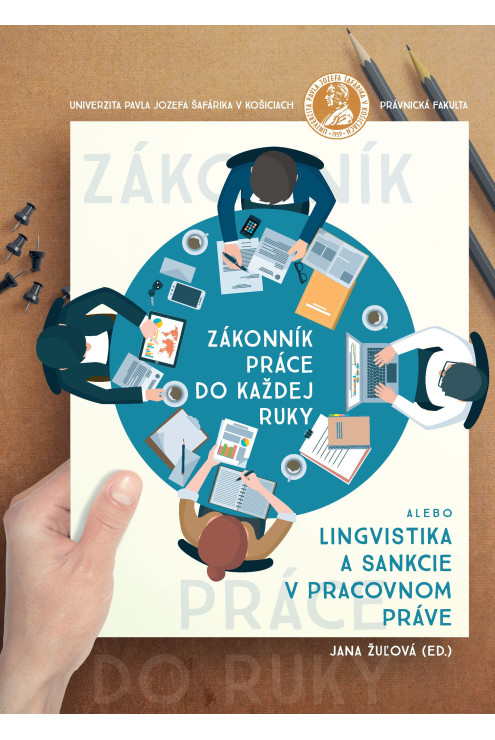
Zákonník práce do každej ruky alebo lingvistika a sankcie v pracovnom práve

E-book

Jana Žuľová

Proceedings of the Second Annual Student Symposium on Labor Law held on May 12–13, 2017 in Danišovce

The presented proceedings are the result of scientific works by students of the Faculty of Law at Pavol Jozef Šafárik University in Košice and are systematically divided into two parts.

The first part presents interdisciplinary intersections of linguistics and labor law in its creation, interpretation, and application. The second part addresses the issue of targeting the addressees of labor law norms through various sanction mechanisms. The proceedings include a questionnaire compiled by the researchers of a grant project, aimed at determining whether and in which aspects the Labor Code diverges from its addressees in terms of linguistic and stylistic processing. Indeed, there is no other legal norm that is closer to the participants of labor relations, and whose understanding at the highest possible level is justified by its everyday use.

The presented proceedings thus serve as a means of expanding the horizons of our students beyond their regular studies and as a tool for popularizing scientific research. In case of interest, the completed questionnaire can be sent to: jana.zulova (@) upjs.sk.

Download the e-book for free (pdf)

Quantity

978-80-8152-519-3

Data sheet

Method of publication:
E-book (pdf)
Editor:
Jana Žuľová
Document type:
Proceedings
Number of pages:
184
Available from:
20.07.2017
Year of publication:
2017
Edition:
1st edition
Publication language:
Slovak
Faculty:
Faculty of Law
Note:
Zborník študentských príspevkov bol vydaný v rámci riešenia výskumného projektu VEGA č. 1/0526/17 „Lingvistické a sankčné mechanizmy pri tvorbe a pôsobení noriem pracovného práva.“
- Free for download

16 other products in the same category:

Volené orgány kapitálových spoločností. Vybrané...

E-book

E-book

Žofia MrázováJán HusárJaroslav Dolný a kol.

The publication "Volené orgány kapitálových spoločností. Vybrané otázky" focuses on the assessment of legal aspects of the performance of corporate boards members and on solving application problems regarding relations arising between members of the board of directors and supervisory board and the company itself.

The first part of the publication deals with the basic conceptual preconditions to become members of elected corporate boards, including conditions for their appointment and removal. Among the issues addressed is also the required standard of performance of corporate boards members in relation to the concept of professional care and duty of loyalty. Remuneration of elected board members as well as the possibility of opposing the contract for performance are also analysed.

The application problems partly extend to bankruptcy law when examining the obligations of board of directors after the bankruptcy of a company, specifically in matters of the emergence of special liability of the board of directors as well as their performance even after the bankruptcy.

Download the e-book for free  (pdf)

Demokracia, dôstojnosť, diverzita: Zborník z...

E-book

E-book

Alexander BröstlMarta Breichová Lapčáková (eds.)

Under the auspices of the Institute of Legal Theory of Gustav Radbruch and the Slovak Section of the International Association for Philosophy of Law and Social Philosophy (IVR), a 3D flash conference was held on May 16, 2019, at the Faculty of Law of UPJŠ in Košice. This event was primarily dedicated to the upcoming 29th World Congress of IVR in Lucerne, Switzerland. In line with the main theme of the congress, the conference focused on "Dignity, Democracy, Diversity." At the time of the conference, it was clear that the number of participants at the world congress would significantly exceed 1,000, with discussions taking place in 151 special workshops and 28 working groups.

During the congress, a round table was also announced featuring Professor Brian Tamanaha, recipient of the IVR award for best book for "Realistic Theory of Law" (Cambridge 2017), a meeting regarding the IVR Encyclopedia, a panel on academic freedom issues, and a gathering of chairs from national sections of IVR.

Download the e-book for free (pdf)

Regionalizmus a jeho prínos pre všeobecné...

E-book

E-book

Ján Klučka a kol.

The presented monograph, “Regionalism and Its Contribution to General International Law,” was prepared at the Institute of European Law and the Department of International Law of the Faculty of Law at Pavol Jozef Šafárik University in Košice as part of a project of the same name (APVV-0823-11) carried out in the years 2011–2015, and represents one of its final publication outputs.

The main reason for choosing this topic was the effort to evaluate regionalism in its various forms in relation to international law, and, conversely, to assess the place, significance, and role of international law in the creation and functioning of different forms of regional groupings. In fact, although regionalism is receiving increasing attention in doctrine, a more comprehensive assessment of its impact on international law and vice versa has so far been lacking.

This monograph attempts to partially fill this gap. Against the background of a brief historical development of regionalism, as well as its substantive and terminological components, the monograph examines in greater detail the individual types of regionalism—such as old and new regionalism, as well as contractual and institutional regionalism—their specific features, and their contribution to general international law.

Attention is also devoted to a specific phenomenon of contemporary regionalism, namely the influence of the European Union on its stabilization and development, both through practical measures and through a set of measures regulated by international treaties.

Download the e-book for free (pdf)

Európska únia a jej vplyv na organizáciu a...

E-book

E-book

Alena Krunková (ed.)

Proceedings of the Scientific Conference Held on June 28, 2016 at the Faculty of Law of Pavol Jozef Šafárik University in Košice in connection with the implementation of the project “The European Union and Its Impact on the Organization and Functioning of Public Administration in the Slovak Republic” – approved under number MVZP – SK PRES/2016/134

The Slovak Republic, as a member state of the European Union, is undertaking a historic role associated with the Presidency of the Council of the European Union within the presidency trio. At the beginning of 2016, the Ministry of Foreign and European Affairs of the Slovak Republic announced a call for applications for grants for 2016 in the field of international relations and foreign policy, specifically focused on the Slovak Republic’s Presidency of the Council of the European Union. The Faculty of Law of Pavol Jozef Šafárik University in Košice responded to this call and obtained a project aimed at carrying out research activities through a series of events focused on regional self-government in the Slovak Republic in the context of its role within the European Union. The Faculty has long been engaged with issues of European Union law both in its teaching and in the scientific research activities of its individual faculty members. The project aims to enrich this portfolio with special activities targeting not only professionals, but also students and the general public.

The first activity of the project was a conference entitled “The European Union and Its Impact on the Organization and Functioning of Public Administration in the Slovak Republic – Development So Far, Current State, and Perspectives.” The conference was attended by invited public officials, representatives of academia, and representatives of local government, as one of the main goals of the project is to connect the academic community with the practical sphere and thus involve practitioners in the planned activities within the project.

Download the e-book for free (pdf)

Condition and perspectives of financial law and...

E-book

E-book

Adrián PopovičJozef SáboAnna Vartašová (eds.)

The International Scientific Conference on the topic Condition and perspectives of public finances in the EU was held 2nd – 3rd June 2022in Košice focused on the topics of the EU Budget and Real Estate in taxation. On this occasion, a student symposium on the topic: "Condition and perspectives of financial law and tax law" was organized for students of the Pavol Jozef Šafárik University Faculty of Law in Košice on 1st June 2022. The focus of the symposium was chosen due to the content of the grant project VEGA no. 1/0485/21: „Simultaneity and possibilities of reforming the system of own resources of the EU budget (legal and economic aspects also in the context of the consequences of the COVID-19 pandemic)“, of the grant project VEGA no. 1/0214/21: „Taxation of real property – legal status and potential“ and of the grant project APVV-19-0124 entitled "Tax law and new phenomena in the economy (digital services, shared economy, virtual currencies)", which are currently being addressed at the Department of Financial Law, Tax Law and Economy, Faculty of Law, Pavol Jozef Šafárik University in Košice.

The output of this symposium is a reviewed proceeding of papers, in which students focus on examining the current challenges of financial law and tax law. In this context, students examine not only the issue of current challenges in the field of real estate tax and the introduction of taxation based on their market value of real estate and the institute of remedies in tax procedural law, but also the current issue of EU budget law with a focus on the revenue side of the EU budget.

The authors also assess in detail the current situation in the research area, and they also present de lege ferenda proposals that could contribute to the development and improvement of several aspects of taxation, which is a benefit not only for legal science but also for application practice.

Download the e-book for free  (pdf)

Ownership rights protection in Polish and...

E-book

E-book

Milan Sudzina, Renata Świrgoń-Skok, Wojciech J. Kosior

Given the importance of the ownership right, the aim of this monograph is to provide an analysis, a clear systematic interpretation and an evaluation of the above issue, not only from the theoretical point of view, but also from the point of view of legal practice. The protection of ownership relations is ensured in various ways. It is judicial protection, protection provided by local self-government authorities, self-help, public registration of real property and other instruments of administrative and criminal law. In connection with the transformation of legislation in Slovakia and Poland after the fall of the socialist regime, there have been many changes in the legislation of both countries concerning the protection of ownership rights. A number of private law institutions related to the ownership of real property, the use of which was impossible or limited during the socialist period, have been restored. Legislation has also been adopted to alleviate the consequences of certain property and other injustices caused by the deprivation of ownership of real property during the socialist period. The adoption of restitution legislation was the basis for restoring the ownership rights of the original owners, who were allowed to get back their real property that had been used by socialist organisations. After the end of the socialist regime, the various forms of ownership, which until then had favoured the state ownership, were abolished. Changes were made to ensure that the ownership rights of all owners had the same content and enjoyed the same legal protection. The monograph is structured in such a way as to enable a comparison of individual institutions of rights in rem under Polish and Slovak law. The monograph also analyses the relevant decision-making practice of the supreme judicial authorities. The scientific methods applied enabled the authors not only to analyse and evaluate the historical context and the current legal regulation of ownership rights in Poland and Slovakia, but also to point out possible gaps and shortcomings and to elaborate de lege ferenda proposals that can be used in future legislative activity.

Download e-book for free (pdf)

Hranice Československej republiky optikou...

E-book

E-book

Dominika Kováčová- Lucia Pištejová- Ivan Vaňa

The present monograph deals with the post-war settlement of relations and peace negotiations related to the settlement of the borders of the newly established Czechoslovak Republic. The work discusses in detail the negotiation processes related to the preparation and signing of the Versailles and Saint-Germain Peace Treaties. Similarly, it then discusses in detail the peripeties related to the drafting of the Treaty of Trianon dealing with the border with Hungary and its subsequent delineation in the field. Last but not least, the thesis captures the settling of Czechoslovakia's international relations with Poland and their common border, with a particular focus on the arbitration settlement on the territory of Orava and Spiš.

Download e-book for free (pdf)

Ochrana kultúrnych hodnôt prostriedkami...

E-book

E-book

Adam GiertlĽudmila Elbert

Collection of Papers from the 8th Student Symposium held on April 20–21, 2015 in Danišovce

The capture of the historic Syrian city of Palmyra by fighters of the radical Islamic State caused shock among the global public. The main reason is the barbarism with which this organization proceeds, not only in relation to the treasures of the world’s cultural heritage. The situation in the Middle East, where cultural treasures of inestimable value are under direct threat, demonstrates how fragile the world’s cultural heritage is. The reaction of the international public and world leaders shows how sensitively the destruction of cultural heritage is perceived.

The quoted statement chosen by the editors relates to the threat posed by the Islamic State—however, the spirit of this statement can be applied to any cultural wealth that forms part of the world’s cultural heritage. The destruction or damage of these values primarily represents a loss for humanity as such. Each destroyed artifact of world cultural heritage signifies the disappearance of a unique legacy left by previous generations for the future. At the same time, cultural heritage must be understood as a broad spectrum of assets—both tangible and intangible. Their legal protection was the topic of this year’s symposium. As with any social interest, the protection of cultural heritage can be ensured through various mechanisms and under different forms of social organization.

These diverse approaches are unified by law as a normative system. The question for the 8th year of the symposium on international law was what role international law plays in the protection of cultural heritage. In the context of the European region, the role of the European Union as a regional organization was examined.

Download the e-book for free (pdf)

Spravodlivosť, spoločenstvo, sloboda

E-book

E-book

Alexander BröstlMarta Breichová Lapčáková (eds.)

The presented Collection Volume is dedicated to three framework areas, namely justice, community and freedom. These are the thematic areas of the 30th IVR World Congress, on the occasion of which a meeting of its Slovak section was held. The published contributions focus on the main topic of the congress, which is also the central topic of legal and social sciences. Thus, in the Collection we will find reflections on the freedom of the individual in society, its various shades of meaning and forms. The question of the organization of social relations in the form of the degree of participation of citizens in state power in the context of the democratic form of government and its current challenges should not be neglected either. Thus, the institutions of direct and indirect democracy, the dangers of the lures of the so-called totalitarian democracy, or the question of identities in a postmodern pluralistic society. The question of justice in procedural law is not avoided either.

The collection thus provides the reader with a wide area of research from legal-philosophical questions, through questions of the theory of the constitutional state, to their application in legal practice. Geographically, it maps the events in the Central European and wider European area with an impact on their global dimension. The publication can thus become a useful source of knowledge and current developments in jurisprudence and its main topics with the aim of a better understanding of social reality.

Download the e-book for free  (pdf)

Diverzné a inkluzívne pracoviská - legislatívne...

E-book

E-book

Jana ŽuľováDenisa Rudžiková

In the environment of Slovak employers, an active approach to diversity and inclusion in the workplace is coming to the fore. Targeted diversity and inclusion programs help make employers more attractive on the labor market and attract more job seekers. Proactively, better working conditions are created for employees with responsibilities to the family (in most cases still in relation to mothers), groups of people who have been on the fringes of interest until now are also employed (elderly, disabled, LGBT groups, minorities, graduates of secondary and higher education schools).

The presented collection of abstracts responds to the outlined facts, which is a grouping of the starting motives and conclusions of the contributions presented at the scientific conference Diverse and inclusive workplaces - legislative starting points organized by the department of labor law and social security law of the Faculty of Law of the P. J. Šafárik University in Košice, which took place on September 29, 2023 in a hybrid form.

With their abstracts, the authors point to a range of problematic areas that are not only a reflection of academic considerations, but also those legal questions that have to be dealt with in ordinary legal practice. The goal is to use analysis and explanation to define the existing labor law measures/tools applicable to the implementation of diversity and inclusion in the workplace according to the current Slovak legal framework and the EU legal framework and thus emphasize the starting point of any effort to build diversity and the implementation of inclusion in the workplace.

Download e-book for free (pdf)

Medzinárodné právo súkromné

E-book

E-book

Kristián Csach - Ľubica Širicová

Private international law has undergone dramatic changes in recent periods. The fully operational process of communitarization of this legal field has not yet – and perhaps could not have been – effectively reflected by domestic legislators. Under the current legal status, it is not uncommon for legal issues to intertwine regulations of community origin and domestic legislation (embodied primarily by Act No. 97/1963 Coll. on Private International Law and Procedure).

Questions about the obsolescence of some provisions of this, until recently, universal codified regulation of private international law arise mainly (but not exclusively) from the conflict rules contained in the so-called "Rome I" Regulation on the law applicable to contractual obligations, the "Rome II" Regulation on the law applicable to non-contractual obligations, and most recently in Council Regulation (EC) No. 4/2009 of 18 December 2008 on jurisdiction, applicable law, recognition, and enforcement of decisions and cooperation in matters relating to maintenance obligations.

Respecting the principle of the primacy of generally binding acts of the Community over domestic law, the correct application of normative texts cannot be achieved without the ability to quickly navigate through the norms and subsequently compare them.

Students and anyone else are therefore confronted with a multitude of legal regulations of substantial scope and detailed regulation. Currently, apart from systematically arranged references on the websites of the Ministry of Justice, we do not find a comprehensive material that would offer an overview of legal regulations in the field of private international law and procedure.

Download the e-book for free (pdf)

Právo fondov EÚ v teórii a praxi

E-book

E-book

Alena KrunkováSimona Farkašová

Proceedings of the International Scientific Conference on EU Funds Law in Theory and Practice held on October 3, 2019, in Košice.

The conference was attended by representatives from the academic sphere, educators from the Faculty of Law at UPJŠ in Košice, who created the subject and continue to participate in its teaching. The participants included professionals from practice, such as those from the Office of the Deputy Prime Minister of the Slovak Republic for Investments and Informatization, the Office for Public Procurement of the Slovak Republic, the Supreme Audit Office of the Slovak Republic, and the Ministry of Labor, Social Affairs, and Family of the Slovak Republic. Valuable information was also shared at the conference by representatives from the Ministry of Regional Development of the Czech Republic, OECD representatives, and representatives from the European Commission's Representation in Slovakia. The presented contributions reflected current issues in a highly professional manner, identified problematic areas, and outlined suitable solutions for contentious issues.

From the individual presentations of the conference participants, it was possible to compile a work that, while not extensive in scope, is very remarkable in value. It connects theory and practice in an outstanding manner and thus expands knowledge in the still complex issue of the legal regulation of European Union funds.

Download the e-book for free (pdf)

Informačná spoločnosť a medzinárodné právo

E-book

E-book

Adam Giertl - Ľubica Gregová Širicová (eds.)

Proceedings from the 5th Student Symposium held on April 21-22, 2013

The French delegate to the Commission on Human Rights, while discussing the inclusion of the term "media" in the article on freedom of expression in the draft of the International Covenant on Civil and Political Rights, wisely urged other members of the commission to be forward-looking regarding the information media of the future.

The discussion took place in 1950, when delegates could not yet foresee the impact of the internet on social relations. Given that it is now clear that information technologies significantly influence law, including international law, the organizers of the student symposium decided to dedicate its sixth edition to the theme "Information Society and International Law."

Students of the Faculty of Law, after registering for the symposium, first focused on preparing their contributions, with each participant having access to a consultant if needed. This year, the list of consultants, in addition to members of the Institute of European Law and the Department of International Law, was expanded to include an expert in intellectual property law, Mgr. Martin Husovec, a graduate of our Faculty of Law and currently an IMPRS-CI doctoral student at the Max Planck Institute for Intellectual Property and Competition Law. We also take this opportunity to thank him for dedicating his time to the students and providing them with valuable advice in preparing their contributions. After the preparatory phase, the symposium itself took place, with the aim of presenting the prepared contributions and discussing them.

The presented contributions reflected a wide range of intersections between international law and the information society.

Download the e-book for free (pdf)

Implementácia iniciatív EÚ v oblasti...

E-book

E-book

Karin Cakoci et al.

The authors in the monograph focused on describing the genesis and current state of the legal regulation of consumption taxes in the Slovak Republic in interaction with the harmonization process, as well as identifying the mutual dependence of the legal regulation and revenues from consumption taxation on the effect on the state budget of the Slovak Republic.

Given the importance and justification of the researched issue, particularly in relation to the future functioning of the European Union, as well as the impact on the performance of the economies of individual member states, with an emphasis on the development and quality functioning of the single internal market, the authors, through the publication of the monograph, attempt to provoke a broader professional discussion about their own summarized presented results, which were obtained during the entire period of solving the scientific project, concerning current trends as well as perspectives in the field of EU tax policy and its influence on domestic tax legislation in the Slovak Republic in the area of consumption taxes in interaction with budgetary impacts.

The overall goal of the monograph is to present existing and own acquired knowledge related to the issue of consumption taxes in Slovakia, with an emphasis on the development of EU initiatives in this area, as well as a critical evaluation of their impact on the state budget of the Slovak Republic, and presenting possible future developments.

Download the e-book for free  (pdf)

This website uses cookies to ensure you get the best experience on our website