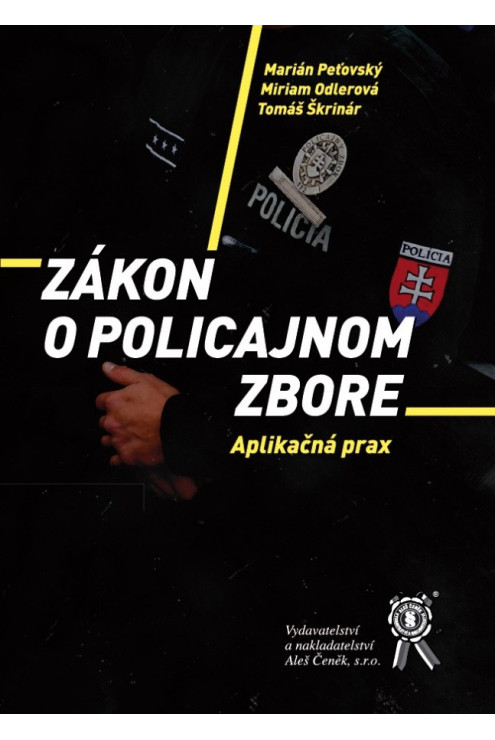
Zákon o policajnom zbore

€27.86
Tax included

Marián PeťovskýMiriam Odlerová - Tomáš Škrinár

Publikácia je komplexným zhrnutím doterajších teoretických poznatkov a praktických skúseností z oblasti činností Policajného zboru. Súčasná policajná prax pociťuje absenciu publikácie, ktorá by vo svojom obsahu vysvetlila postupy pri výkone policajných činností v rozsahu súčasného znenia zákona o Policajnom zbore. Publikácia sa preto sústreďuje najmä na praktickú činnosť policajta pri výkone služby, vykonávanie služobných zákrokov, používanie donucovacích prostriedkov, ale aj povinnosti a oprávnenia príslušníkov Policajného zboru. Okrem toho rozoberá úlohy, organizáciu a riadenie Policajného zboru, informačno-technické prostriedky a operatívno-pátraciu činnosť, spracúvanie informácií Policajným zborom, spôsoby a formy kooperácie Policajného zboru s inými subjektmi a náhradu škody. Publikácia má byť praktickou pomôckou policajta vo vzťahu ku kvalitnému a efektívnemu plneniu jeho úloh, povinností a oprávnení v priamom výkone služby. Autori chcú predmetnou publikáciou osloviť čitateľov z odbornej verejnosti, najmä príslušníkov Policajného zboru, zložiek Ministerstva vnútra Slovenskej republiky, bezpečnostných mimorezortných služieb, ale tiež aj laickej verejnosti, ktorá mnohokrát dochádza do bezprostredného kontaktu so zásahmi polície do ich práv a slobôd.

Quantity
Last items in stock

978-80-7380-682-8

Data sheet

Method of publication:
Printed publication
Authors:
Marián Peťovský - Miriam Odlerová - Tomáš Škrinár
Document type:
Monograph
Number of pages:
354
Year of publication:
2017
Edition:
1st edition
Publication language:
Slovak
License:
Copyright

Specific References

MPN
302016

16 other products in the same category:

Európska prokuratúra v Slovenskej republike

E-book

E-book

Martina Jánošíková -  Dominika Marčoková Becková (eds.)

The peer-reviewed Proceeding of Scientific Papers is dedicated to the issue of the European Public Prosecutor's Office and is the result of a scientific project APVV-18-0421 European Public Prosecutor's Office in Connections of the Constitutional Order of the Slovak Republic as Strengthening of the European Integration through Law.

In their works, the authors of scientific papers, dealt with the issue of the European Public Prosecutor's Office in the context of European Union law and criminal law, as well as the relation of the European Public Prosecutor's Office with the national prosecutor's office and law enforcement authorities. The scientific works published in the proceeding dealt with the topics of the reasons for the establishment of the European Public Prosecutor's Office, the position of the European Public Prosecutor's Office in the institutional system of the EU and the Slovak Republic, relations of cooperation and coordination between the European Public Prosecutor's Office and the Public Prosecutor's Office of the Slovak Republic, the protection of the constitutionality and legality of the procedures and decisions of the European Public Prosecutor's Office, with special attention to the protection of fundamental rights, as well as the first result and evaluation of the operation of the European Public Prosecutor's Office in the Slovak Republic.

Thanks to the content of scientific papers, the reader can get a more comprehensive idea of this new body of the European Union, which operates in an area traditionally associated with state sovereignty and represents another step forward in the integration processes represented by the European Union.

Download the e-book for free (pdf)

KOŠICKÉ DNI TRESTNÉHO PRÁVA 2025, IX. ročník...

E-book

E-publication

Sergej Romža-Lukáš Michaľov-Michaela Ema Mauerová
Proceedings of scientific contributions with the main section: "Artíficíal intellígence - a challenge for crímínal law" and subsections: "Extremism from the perspective of criminology, victimology, and criminalistics" and "Creation and tools of criminal policy" is the result of a nationwide interdisciplinary scientific conference with intemational particípation, organízed by the Department of Criminal Law of the Faculty of Law at UPJŠ in Košice. The publication retlects current challenges in criminal law in the context of dynamic technological, security, and social changes. The main section, "Artificial Intelligence - A Challenge for Criminal Law," presents contributions analyzing legal, ethical, and practical issues related to the use of artificial intelligence in the field of criminal law. The authors address autonomous responsibility, algorithmic transparency, the possibilities of using Al in the prevention, detection, and prosecution of crimes, as well as the risks to the protection of fundamental rights and fair tria!. The subsection "Extremism from the perspective of criminology, victimology, and criminalistics" provides an overview of current fonns of extremism, mechanisms of radicalization, risk factors, impacts on victims, and criminalistic aspects of its detection. Its interdisciplinary nature allows for the interconnection of legal, sociological, and psychological contexts. In the subsection "Criminal Policy Creation and Tools," the authors focus on the fonnation of modem criminal policy in the context of changing crime, the evaluation of thc effectiveness of criminal law tools, and the challenges posed by new technological and social phenomena. Legislatíve trends, comparativc findings, and practical implications for legal practice are discussed. The aim is to provide a comprehensive view of selected issues in contemporary criminal law theory and practice and to contribute to the professional dialogue on the future of criminal law and its ability to respond to the challengcs of the 21st century.
Download the e-book for free

Kúpna zmluva – história a súčasnosť I.

E-book

E-book

Erik Štenpien (ed.)

Proceedings of the International Scientific Conference held on September 27, 2013, at the Faculty of Law of UPJŠ in Košice

The Civil Code is one of the fundamental legal codifications of our time. Paradoxically, in the Slovak Republic, the 1964 Code still applies today, albeit with certain modifications brought by the modern era. Currently, recodification efforts are underway, with the goal of adopting a new Civil Code.

However, it is not possible to build something new without knowledge of the old. It is therefore a positive sign when legal historians and civil law experts come together at a conference to exchange views and insights. The Department of State and Legal History at the Faculty of Law in Košice is in its first year of working on the scientific grant project VEGA: The Historical-Legal Development of the Institute of the Sales Contract and Trends in Its Current Recodification in the Slovak Republic - No. 1/0131/13.

This project was acquired as a historical-legal initiative, but the Department of Civil Law is also participating, as Assoc. Prof. JUDr. K. Kirstová, CSc., is the deputy head of the project. Aware that this represents a completely unique connection between legal history and practice, our department organized the international scientific conference The Sales Contract - History and Present I. on September 27, 2013, which was a planned grant output but ultimately coincided with the 40th anniversary of the Faculty of Law in Košice.

This proceedings volume thus summarizes contributions from the grant project, as well as related presentations. It aims to significantly contribute to the understanding of the history and current recodification efforts of the sales contract institution both domestically and internationally.

Download the e-book for free (pdf)

Informačná spoločnosť a medzinárodné právo

E-book

E-book

Adam Giertl - Ľubica Gregová Širicová (eds.)

Proceedings from the 5th Student Symposium held on April 21-22, 2013

The French delegate to the Commission on Human Rights, while discussing the inclusion of the term "media" in the article on freedom of expression in the draft of the International Covenant on Civil and Political Rights, wisely urged other members of the commission to be forward-looking regarding the information media of the future.

The discussion took place in 1950, when delegates could not yet foresee the impact of the internet on social relations. Given that it is now clear that information technologies significantly influence law, including international law, the organizers of the student symposium decided to dedicate its sixth edition to the theme "Information Society and International Law."

Students of the Faculty of Law, after registering for the symposium, first focused on preparing their contributions, with each participant having access to a consultant if needed. This year, the list of consultants, in addition to members of the Institute of European Law and the Department of International Law, was expanded to include an expert in intellectual property law, Mgr. Martin Husovec, a graduate of our Faculty of Law and currently an IMPRS-CI doctoral student at the Max Planck Institute for Intellectual Property and Competition Law. We also take this opportunity to thank him for dedicating his time to the students and providing them with valuable advice in preparing their contributions. After the preparatory phase, the symposium itself took place, with the aim of presenting the prepared contributions and discussing them.

The presented contributions reflected a wide range of intersections between international law and the information society.

Download the e-book for free (pdf)

Kúpna zmluva – história a súčasnosť II.

E-book

E-book

Erik Štenpien (ed.)

Proceedings from the international scientific conference held on September 26-27, 2014 at the Faculty of Law, UPJŠ in Košice

Nowadays, in the modern 21st century, we have a much more complex society than the ancient one. It requires legal regulation of various types of purchase contracts, where although the basic feature remains, it needs to be specified further, and the simple sentence 'I sell, you buy' needs to be supplemented with conditions 'how, where, when, under what conditions?' This is the task of modern civil law. The current recodification of civil law has already taken place in some European countries, and it is currently underway in our country. Therefore, it is important to meet at conferences with colleagues from these countries and exchange knowledge, to discuss their experiences, avoid the bad, and accept or adjust the good according to our conditions.

This proceedings is the output publication from the conference held on September 26-27, 2014 in Košice. It was the second conference with the participation of the most prominent legal Romanists, legal historians, and civilists from home and abroad. The proceedings is the result of unique cooperation among experts from various fields of legal science. I believe that the published outputs will help to understand the institute of purchase contracts from all its aspects and will become an inspiration for both experts and laypeople.

Download the e-book for free (pdf)

Regionalism and Its Contribution to General...

E-book

E-book

Ján KlučkaĽudmila Elbert

The present monograph "Regionalism and its Contribution to General International Law" was written at the Institute of European Law and Department of International Law, Faculty of Law, Pavol Jozef Safarik University in Kosice, as a part of the project (APVV-O823-11) carried out in 2011-2015, representing one of its final publication utputs. 

The main reason for choosing the topic was to evaluate regionalism in its various relationships and forms with respect to international law, and also to evaluate the place,importance and duties of international law in respect to the establishment and functioning of various forms of regionalgroups.

It is a fact that even though a lot of attention has been paid to regionalism, a more complex evaluation of the impact it has had on international law, and vice versa, is still lacking. The efforts of the present monograph are to partially eliminate this gap.

After giving a brief insight into how regionalism has developed, its content and terminology, the monograph studies in more details individual types of regionalism in the form of old and new regionalism, as well as treaty and institutional regionalism; its specifications and contributions to the international law.

Download the e-book for free (pdf)

Praktické prípady z rímskeho práva

€20.35
Availability: 2 In Stock

Herbert Hausmaninger - Peter Blaho -  Veronika Kleňová

Kniha obsahuje konkrétne prípady z oblasti rímskeho civilného procesu, rodinného, vecného, záväzkového a dedičského práva, ktoré sa odohrali v antickom Ríme a jeho provinciách. Vybrané boli prípady s osobitným významom pre vývoj civilného práva kontinentálnej Európy. Prostredníctvom týchto prípadov zbierka umožňuje rekonštruovať skutkový stav a právnické odôvodnenia rozhodnutí rímskych právnikov. Vnútorná štruktúra každého prípadu je viac-menej konštantná. V záhlaví je uvedená inskripcia právneho prameňa; nasleduje úplný latinský text a jeho preklad. Každý prípad sa končí položenými otázkami, odkazmi na najdôležitejšie občianske zákonníky a na literatúru. Otázky sú zväčša formulované stručne, s cieľom povzbudiť čitateľa pri hľadaní vlastnej cesty k prameňom. Osobitný dôraz sa kladie na odôvodnenie príslušného rozhodnutia, pričom sa prihliada na spôsob argumentácie rímskych právnikov. Poznámka na občianske zákonníky má nielen ukázať na pretrvávanie rímskeho práva v moderných súkromnoprávnych poriadkoch, ale aj podporiť diskusiu k rímskemu riešeniu právnych problémov.

Rule of Law a medzinárodné právo

E-book

E-book

Ľudmila Elbert

The presented scientific monograph addresses the issue of the Rule of Law and its place, roles, and particularities at the level of international law. The Rule of Law is understood as a value that should govern communities, both domestic and international. It is thus compared to Kelsen’s basic norm, which should stand at the top of the legal order as the norm justifying the validity and existence of the norms of the legal order, both domestic and international.

Although the Rule of Law is studied at the international law level, it cannot be considered without understanding the Rule of Law in domestic law. Just as its development differs depending on whether it evolved within Anglo-American or continental law, its application and development also differ between domestic law and international law.

These differences are mainly caused by the roles and objectives that international Rule of Law is meant to secure, as well as by the distinct characteristics of domestic and international law.

Download the e-book for free (pdf)

Politické systémy štátov BRICS

E-book

E-book

Patrik Furik Michaela RužičkováDávid GajdoščíkPeter DubócziBarbora LinhartováLucia Grieger

The textbook entitled Political Systems of the BRICS States is published as an output of the KEGA 014UPJŠ-4/2020 Innovative Model of Education Leading to Active Citizenship as a Prevention of the Rise of Political Extremism among Students. The aim of the given publication is to present the basic principles of the political systems of the BRICS bloc states and to provide the reader with the nature and character of the bloc's functioning.

The textbook consists of an introduction and five further chapters. All sections are written in Slovak. The individual chapters focus primarily on characterizing the historical development of the BRICS states, the evolution of their constitutionalism, public administration, and on defining the legislative, executive, and judicial branches of power

The individual chapters describe the political systems of the states: Brazil, the Russian Federation, India, China, and South Africa. The introductory chapter of the textbook contains the characteristics of the development and formation of the bloc, as well as information on the cooperation among the BRICS members.

Download the e-book for free (pdf)

Zákon o rodine, Zákon o mene a priezvisku,...

€5.50
Availability: 1 In Stock

Kolektív autorov

Publikácia obsahuje aktualizované úplné znenie zákonov s právnym stavom k 1. septembru 2025: Zákon č. 36/2005 Z.z. o rodine so zmenami poslednej novelizácie - zákona č. 157/2025?? Z.z. s účinnosťou k 1. augustu 2025; Zákon č. 300/1993 Z.z. o mene a priezvisku so zmenami poslednej novelizácie - zákona č. 408/2022 Z.z.; a Zákon č. 154/1994 Z.z. o matrikách so zmenami poslednej novelizácie - zákona č. 361/2024 Z.z.

Evaluation of Evidence in the Tax Law

E-book

E-book

Jozef Sábo

The monograph deals with two fundamental aspects concerning evaluation of evidence in the law. In the first part, the monograph addresses the question: „How it is possible to apply law in individual case, if human knowledge about past is objectively limited and flawed?“ (e.g. what is the nature of truth in the law?). The second part of the monograph identifies certain models of reasoning concerning factual questions which occur across different individual legal cases (especially tax cases and criminal cases). In that regard, the monograph draws from Anglo-American legal scholarship and deals with three main concepts concerning evaluation of evidence: argumentation, probability and narratives and their role in evaluation of evidence.

The monograph is the output of the grant project APVV no. 16-0160 which deals with the issue of tax evasion and tax avoidance (especially their motivating factors, emergence, and elimination). The author believes that better understanding of evaluation of evidence may contribute to the improvement in effectiveness of tax administration.

Download the e-book for free  (pdf)

Trestné právo hmotné - Osobitná časť

€26.00
Availability: 1 In Stock

Jaroslav Klátik a kolektív

Vysokoškolská učebnica Trestné právo hmotné – osobitná časť, 3. aktualizované vydanie bezprostredne nadväzuje na učebnicu Trestné právo hmotné – všeobecnú časť. Autorský kolektív rozoberá skutkové podstaty trestných činov zahrnuté do dvanástich hláv. Autori si za cieľ stanovili poskytnúť čitateľom podrobný prehľad o jednotlivých trestných činoch a zároveň poskytnúť i čo najpodrobnejší výklad jednotlivých skutkových podstát těchto trestných činov, ako aj výklad pojmov v nich sa nachádzajúcich. Obsah jednotlivých kapitol vychádza zo systematiky osobitnej časti Trestného zákona, čím sa študenti ako aj ostatná právnická veřejnost môžu lepšie orientovať v základných trestno-hmotných inštitútoch. V jednotlivých kapitolách sú zrozumiteľne a jasne vymedzené jednotlivé obligatórne znaky skutkových podstát trestných činov a ich súvislosti. Tam, kde je to potrebné, autori uvádzajú na vysvetlenie svoje teoretické a praktické skúsenosti a tiež v prípade bližšieho vysvetlenia aj aktuálnu súdnu prax. V rámci každej hlavy je uvedená všeobecná charakteristika príslušnej hlavy a dielu, do ktorého sa subsumuje konkrétny trestný čin. Učebnica je určená predovšetkým poslucháčom právnických fakúlt a Akadémie Policajného zboru. Učebnicu však môžu využívať aj sudcovia, prokurátori, policajti, advokáti, vyšší súdni úradníci, čakatelia prokuratúry, advokátski koncipienti pri rozbore a zdôvodnení mnohých ustanovení osobitnej časti Trestného zákona. Táto učebnica je určená aj pre široký okruh záujemcov o trestné právo.

Ústavné právo Slovenskej republiky

€19.00
Availability: 1 In Stock

Klaudia Marczyová - Ivana Rubisová

Publikácia Ústavné právo Slovenskej republiky predstavuje ďalšiu vysokoškolskú učebnicu z danej oblasti. Vychádza z teoretického priblíženia kľúčových pojmov, poukazuje na základné etapy ústavného vývoja od roku 1918 a následne sústredí pozornosť na vznik Ústavy Slovenskej republiky, charakteristiku, princípy a jej jednotlivé inštitúty. Obsahom sú otázky základných práv a slobôd, systém ich ochrany, postavenie štátnych orgánov, ako aj územnej samosprávy, s dôrazom na možnosti jednotlivca participovať na moci. V snahe poskytnúť široký rozsah poznatkov sú v texte odkazy na viaceré relevantné zdroje, či odborné diela. Učebnica Ústavné právo Slovenskej republiky reflektuje požiadavky predovšetkým absolventa Akadémie Policajného zboru v Bratislave, absolventa policajnej univerzity, čo autorky zohľadnili a premietli do samotného obsahu publikácie. Vypúšťajú sa tak niektoré otázky štátovedy, ktoré sú prenechané predmetu Teória štátu a práva, zato osobitne a špecificky na niektorých miestach je venovaná pozornosť postaveniu Policajného zboru, úlohám polície a bezpečnosti. Na druhej strane však vychádzajúc z Ústavy Slovenskej republiky, z koncepcie ústavného systému je obsiahnutá každá oblasť, a tak má publikácia predpoklady vhodnej vzdelávacej pomôcky aj pre študentov ďalších vysokých škôl právneho, či neprávneho zamerania s výučbou právnych predmetov.

Municipálne zákonodarstvo Uhorska ako predobraz...

E-book

E-book

Erik Štenpien

The presented monograph is dedicated to the reforms of local administration in the middle of the 19th century, which led to the introduction of municipalism - the nationalization of local administration. The work is primarily devoted to the analysis of the differences between legal articles 42/1870 and 21/1884, the second of which has so far been considered by Slovak legal historians as an amendment. I will explain the differences in the text of both standards, as well as by pointing out the practice of applying both standards in local practice in Abov and Turňa, the legal article 21/1884 is applicable, it is recoded and after the thresholds of the Czechoslovakia it was received as an obligation of the local sparva in Slovakia and is valid even in the time of Conclusion The Trianon peace treaty.

Download the e-book for free (pdf)

This website uses cookies to ensure you get the best experience on our website