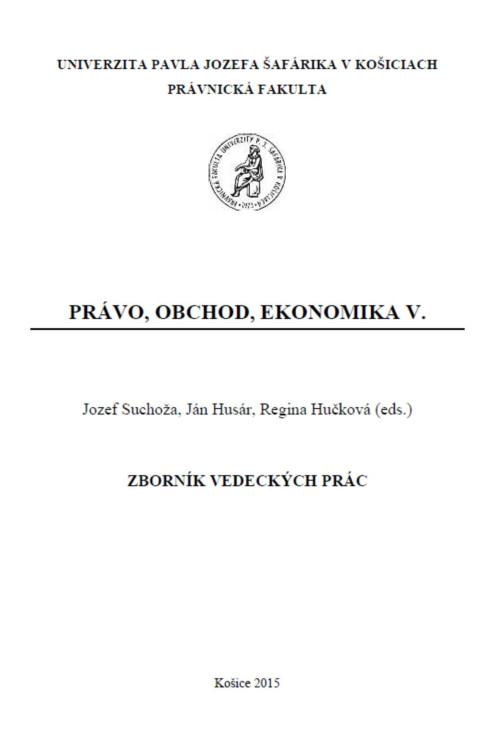
Právo - obchod - ekonomika V.

E-book

Jozef Suchoža - Ján Husár - Regina Hučková (eds.)

Collection of Scientific Works

The scientific papers presented in this Collection are primarily the result of academic research conducted by experts working within the academic environment—particularly at Faculties of Law in the Slovak Republic and the Czech Republic, as well as by foreign experts, including those from Poland, the Russian Federation, Serbia, and others. In addition to academic contributions, this Collection also includes scientific and professional articles authored by legal practitioners, especially lawyers, notaries, and judges—not only from our own jurisdiction, but also judges from the General Court of the European Union. Contributions from professionals in the field of banking have also enriched this Collection. Moreover, the Collection provides space for aspiring scholars in the field of legal science, thereby combining timelessness with dynamism.

Given the diversity of the published contributions, it can be said that this Collection represents a connection between theory and practice, private and public law, as well as various branches of law. Nevertheless, the content of this Collection aligns with and reflects the central theme of the international symposium, namely: "CORPORATIONS – CONTRACTS – CODIFICATIONS – CONTEXTS." The individual sections of the Collection are interconnected and create a coherent whole, subsumed under a publication characterized by unity.

Download the e-book for free (pdf)

Quantity

978-80-8152-394-6

Data sheet

Method of publication:
E-book (pdf)
Editors:
Jozef Suchoža - Ján Husár - Regina Hučková
Document type:
Proceedings of scientific works
Number of pages:
578
Available from:
15.12.2015
Year of publication:
2015
Edition:
1st edition
Publication language:
slovenčina, angličtina
Faculty:
Faculty of Law
Note:
Zborník bol vydaný v rámci riešenia grantovej úlohy č. APVV-14-0598 “Elektronizácia v podnikaní s akcentom na právne a technické aspekty”.
- Free for download

16 other products in the same category:

The loan or usury? Compulsory enforcement of...

E-book

E-book

Terézia HišemováDarina Kmecová (eds.)

Reviewed proceedings of scientific papers of Conference of Slovak and Czech law romanists, which take place at May, 10.-11.5.2018, at Faculty of Law, UPJŠ in Košice.

The submitted reviewed proceeding of scientific papers on „The loan or usury? Compulsory enforcement of roman - law basics and problems of application practice.”  is prepared within the solution of the grant project VEGA on: „The loan or usury? Compulsory enforcement of historical - law basics and problems of application practice.”, no. p. 1/0198/17.

The authors of papers are important personalities of Roman law working in the Slovak and Czech Republic, as well as PhD students and young scientists from Slovak and foreign universities who are active in the academic environment as well as in legal practice. The main goal of the editors is to help improve the current legal situation, which is assessed as unsatisfactory, and through a historical excursion of the development of the loan institute and then the forced execution of the decision, to create de lege ferenda proposals considering all areas of research.

The Proceedings trace the interrelationships between the substantive law institute in terms of the Roman law of contractus unilaterales - mutuum in its various types, often realized by the attachment of high interest rates, which bordered on the insurrection and the procedural law of individual lawsuits enforced in the legislative, formular and cognitive process. If there was no possibility to impose certain behaviour on the obligated person (the debtor, the sentenced person), then the declared general obligation to enforce the legal norms was only a legal term. It has always been the case that every internally well-organized state, whether antique or present, has to use power tools - often with the use of gross violence - but within the limits of the law, to promote what it has declared valid law. It must protect creditors on the one hand, but it must also prevent self-help and the use of illegal, unjustified and disproportionate violence.

The loan contract as a real contract has often become an integral part and relatively the most frequent reason leading to the compulsory enforcement, especially when contracting parties often agree on the connection of interest - sometimes within the legal limit, sometimes exceeding the legal framework - and in this way the potential future creditor (the plaintiff) significantly increased the insolvency risk of the debtor (the defendant, the sentenced) and of the subsequent execution. The pronounced and deepening social stratification of the Roman population and the secondary depreciation effort, the cancellation of the debts of the poor part of the population logically culminated in social unrest and revolt against the enforcement of the enforcement law.

The proceedings capture not only the rich scientific discussion of Slovak and Czech legal Romanists, but also the opinions, experience and knowledge of experts on contemporary law dealing with this type of issues. As a result, it provides a unique interdisciplinary view of the subject and raises many stimulus points for future research. This work proves that the problems encountered by the various representatives of the Roman jurisprudence and their legal and theoretical bases and solutions are undoubtedly useful and serve as a guideline also for solving legal issues in the field of modern enforcement proceedings.

Download the e-book for free (pdf)

Obchodná spoločnosť ako právnická osoba

E-book

E-book

Ján Husár - Kristián Csach (eds.)

The collection contains contributions presented at the international conference held on April 1st - 3rd 2014 in Smolenice, organized by Pavol Jozef Šafárik University in Košice in cooperation with the Institute of State and Law of the Slovak Academy of Sciences and the Institute of State and Law of the Czech Academy of Sciences. Authors are high-profile Slovak and Czech scholars in the field of private law and company law, as well as representatives of new generation of young researchers. Contributions focus on contemporary issues in the field of company law, in particular theoretical basis of corporations, groups of companies, doctrine of abuse of rights, reflective loss and new tendencies in corporate law in foreign legal orders. The first part of the contributions presented at the conference have been already published in the special issue of the theoretical magazine Právny Obzor n. 4/2014. 

Download the e-book for free (pdf)

Ochrana zamestnanca perspektívou priemyselnej...

E-book

E-book

Milena Barinková (ed.)

Proceedings from the IV Annual Student Symposium on Labor Law held on April 5–6, 2019, in Danišovce

The term "Industrial Revolution 4.0" is currently widely used, yet remains mysterious and its content unfamiliar to many. While we do not claim omniscience, through the educational process at the Faculty of Law of Pavol Jozef Šafárik University in Košice and the scientific research of the Department of Labor Law and Social Security Law, we have delved into examining the accompanying features and anticipated phenomena of this modern industrial revolution.

It can be stated with great certainty that this revolution already affects—and will continue to affect—production processes, including radical changes in their structure, the emergence of groundbreaking technological and communication tools, and, undoubtedly, labor relations. The rise of new forms and methods of work based on automation and digitalization, applied within new models of labor relations, is beginning to threaten jobs in certain sectors of the economy. There is an increasing demand for specialized qualifications and skills, particularly in information technology, with an emphasis on process digitalization, data processing, and the creation of communication networks connecting objects and people. This intelligent industry inevitably disqualifies many existing jobs from their current structures, leading to job losses for numerous employees. Analysts openly predict that by 2030, robots will replace up to 20 million industrial jobs worldwide.

The vision of which occupations or working conditions will be impacted is becoming increasingly concrete. Radical changes will require radical solutions as well as previously unknown movements and new elements or measures in the labor market.

Download the e-book for free  (pdf)

Zákon o národnostiach a Rada vlády Slovenskej...

E-book

E-book

Jana Šutajová

From January 1, 1969, the Constitutional Act on the Status of Nationalities in the Czechoslovak Socialist Republic (ČSSR) and the Constitutional Act on the Federation came into effect. The Constitutional Act on the Status of Nationalities represented at least a formal significant step forward in the legal regulation of minority rights. However, this law was intended to serve as a foundation for further legal adjustments. It was declared that additional steps and negotiations for the adoption of implementing regulations would follow and that further laws would be enacted at both the federal and national levels. Nevertheless, no additional law or government regulation related to the constitutional act on the status of nationalities in the ČSSR was ever issued.

During the normalization period, issues concerning further legislation related to national minorities were not addressed. However, in the brief period following the adoption of the constitutional act in 1968 until the end of 1969, some institutions attempted to prepare and promote such legal norms. One of these institutions was the Government Council of the Slovak Socialist Republic (SSR) for Nationalities (hereafter referred to as the Council or the Government Council for Nationalities). The monograph provides an insight into the development of additional legal norms arising from the constitutional act on the status of nationalities in the Slovak Socialist Republic, prepared by the Government Council of SSR for Nationalities. This council was one of the institutions established in Slovakia after the formation of the Czechoslovak federation and dealt with nationality issues.

In addressing further legal norms stemming from the constitutional act on nationalities in ČSSR, it was necessary to consider prior developments. Therefore, the first part of the monograph examines the status of minorities in Czechoslovakia before adopting the constitutional act, activities of nationalities preceding its adoption, and its enactment itself. Subsequent sections focus on institutional changes in SSR following federalization, the establishment of the Government Council of SSR for Nationalities, and specific actions taken by this Council and its expert bodies in drafting proposals for laws concerning nationalities in the Slovak Socialist Republic.

The motivation for writing this monograph stemmed from the fact that this topic has so far received attention only in a few studies in Slovakia, which primarily focused on the Hungarian minority during either the Prague Spring or normalization periods.

Download the e-book for free (pdf)

Ako správne pracovať s prameňmi práva Európskej...

E-book

E-book

Dominika BeckováRadoslav BenkoValéria Ružičková

Studies of the European Union law may hardly be possible without making use of its sources. Lots of types of legal rules, several forms of judicial decisions as well as a wide spectrum of criteria used while searching among legal acts of the European Union and case-law of its courts in search engines on the official websites of the European Union may, however, appear confusing, thereby making the work with sources of the European Union law more complicated and prolonging it.

Methodology Guide „How to Work Correctly with the Sources of the European Union Law“ aims to help students to understand the system of sources of the European Union law as well as the sources themselves, offer them tips and advice useful during their search and thus contribute to the adoption of fundamental procedures for working with them.

Download the e-book for free (pdf)

Správne právo hmotné - Všeobecná časť

€20.00
Availability: 23 In Stock

Tibor Seman - Radomír Jakab - Jozef Tekeli

The presented textbook on the general part of substantive administrative law offers a comprehensive collection of knowledge, principles, doctrines, institutions, and legal norms that form the foundation for the existence and functioning of public administration. It serves as a prerequisite for mastering the special part of substantive administrative law and administrative procedural law. This updated version of the first edition of the textbook reflects the current development of public administration, the state of administrative law, and educational needs. The textbook introduces key institutions of the general part of administrative law, which are essential for understanding how public administration operates in Slovakia. It includes the characteristics and internal structure of administrative law, its sources, and its relationships with other branches of law. Covered topics include subjects of administrative law, the organization of public administration, methods and forms of its activities, guarantees of legality in public administration, administrative liability, civil service, and work performed in the public interest. It will be useful not only to students but also to anyone interested in the theory and practice of such a dynamic branch of law as administrative law undoubtedly is.

20 YEARS IN THE EUROPEAN UNION IN TERMS OF LAW...

E-book

E-book

Ján Klučka - Ľuboslav Sisák - Laura Gazdagová (eds.)

This publication captures the conference proceedings of the international scientific conference "20 years in the European Union in terms of law and the era of sustainability". The conference took place on 3rd September 2024 at the Faculty of Law, Pavol Jozef Šafárik University in Košice, in hybrid form.

The first part of the conference proceedings includes contributions concerning EU law in proceedings before the Constitutional Court of the Slovak Republic with focus to current issues and challenges after 20 years of membership of the Slovak Republic in the EU, European law from the perspective of international constitutionalism in a green coat, the impact of the entry of the Baltic states into the European Union on the question of the nationality of natural persons, the single digital market in the context of the Slovak Republic, the impact of European Union law in the field of personal data protection on the territory of the Slovak Republic, the principle of environmental protection in economic competition and international jurisdiction for private law claims for compensation for damage caused to the environment.

The second part of the conference proceedings includes contributions concerning the process of enshrining human right to environment in international law and European law, the development of biodiversity protection in the EU, NATO´s role in climate change response to meet the sustainability and suing tort damages from the Dieselgate emissions scandal.

Download the e-book for free (pdf)

Právo na spravodlivý proces podľa Dohovoru a...

E-book

E-book

Lukáš Jančát

The Convention on the Protection of Human Rights and Fundamental Freedoms and the case-law of the ECtHR represent a decisive legal instrument for the evolution of the right to a fair trial in the member states of the Council of Europe and the European Union, including the Slovak Republic, which affects the minimum level of procedural guarantees for individuals in judicial and administrative proceedings.

The primary purpose of the textbook is to fill the gap consisting in the absence of a comprehensive study text for undergraduate students at Pavol Jozef Šafarik University in Košice, Faculty of Law for the planned subject Right to a fair trial in administrative issues, and doctoral students at this faculty for the subject Protection of fundamental rights and freedoms in criminal matters according to the case-law of the ECtHR.

However, this textbook is also intended as a supplementary study aid for bachelor students in order to deepen their knowledge of the subject Administrative Law II, the result of which is to acquire knowledge about procedural administrative law in the Slovak Republic, as well as the subject of European Administrative Law, the result of which is the acquisition of knowledge about the influence of Council of Europe law on the national administrative law of the Slovak Republic.

Download the e-book for free(pdf)

Informačná spoločnosť a medzinárodné právo

E-book

E-book

Adam Giertl - Ľubica Gregová Širicová (eds.)

Proceedings from the 5th Student Symposium held on April 21-22, 2013

The French delegate to the Commission on Human Rights, while discussing the inclusion of the term "media" in the article on freedom of expression in the draft of the International Covenant on Civil and Political Rights, wisely urged other members of the commission to be forward-looking regarding the information media of the future.

The discussion took place in 1950, when delegates could not yet foresee the impact of the internet on social relations. Given that it is now clear that information technologies significantly influence law, including international law, the organizers of the student symposium decided to dedicate its sixth edition to the theme "Information Society and International Law."

Students of the Faculty of Law, after registering for the symposium, first focused on preparing their contributions, with each participant having access to a consultant if needed. This year, the list of consultants, in addition to members of the Institute of European Law and the Department of International Law, was expanded to include an expert in intellectual property law, Mgr. Martin Husovec, a graduate of our Faculty of Law and currently an IMPRS-CI doctoral student at the Max Planck Institute for Intellectual Property and Competition Law. We also take this opportunity to thank him for dedicating his time to the students and providing them with valuable advice in preparing their contributions. After the preparatory phase, the symposium itself took place, with the aim of presenting the prepared contributions and discussing them.

The presented contributions reflected a wide range of intersections between international law and the information society.

Download the e-book for free (pdf)

V.SLOVENSKO-ČESKÉ DNI DAŇOVÉHO PRÁVA

E-book

E-book

Miroslav Štrkolec - Filip Baláži - Natália Priateľová - Anna Vartašová

Tax Law and New Phenomena in the Economy. This collection of scientific papers presents contributions from the international scientific conference “V. SLOVAK-CZECH DAYS OF TAX LAW: Tax Law and New Phenomena in the Economy,” which took place on June 5 and 6, 2023, at the Faculty of Law of Pavol Jozef Šafárik University in Košice and was supported by the Scientific and Grant Agency within the project APVV-19-0124 “Tax Law and New Phenomena in the Economy (digital services, shared economy, virtual currencies).”

The individual contributions focus on addressing current issues of tax law in the context of new phenomena in the economy. The authors in their contributions mainly deal with digitalization and the resulting challenges for tax law, especially specific problems related to crypto-assets, digital tax, and technologies, as well as the shared economy and its tax impacts.

Attention is also given to selected extraordinary measures adopted in the financial sector in response to the COVID-19 pandemic and application problems that have arisen or may arise in their implementation in practice.

Download e-book for free (pdf)

Zdravie pri práci v spektre teórie a praxe

E-book

E-book

Jana Žuľová  - Monika Minčičová - Marcel Dolobáč (eds.)

The legal regulation of occupational health and the process of assessing the health capacity is one of the manifestations of fulfilling the protective function of labour law.

Due to the importance of pursuing the interest in protecting the life and health of the individual during his working life, as well as the consequences of damage to the employee's health for further work and continuance of employment relationship, research in this area finds its irreplaceable place in legal science. Its topicality is also highlighted by the emerging risks of work and the working environment. Technological progress associated with a change in the way of performing work, as well as the pandemic situation, have opened a number of new challenges for labour law that require attention.

The presented proceedings of abstracts responds to the outlined facts. It is a group of initial motives and conclusions of lectures presented at the scientific online conference "Health at Work in the Spectrum of Theory and Practice" organized by the Department of Labour Law and Social Security Law of the Faculty of Law, P. J. Šafárik University in Košice on16th April 2021. Authors point to a variety of problematic areas that are not only a reflection of academic considerations, but also of those legal issues that need to be addressed in ordinary legal practice.

Download the e-book for free (pdf)

Current Challenges of Financial law and Tax law

E-book

E-publication

Karin Cakoci-Ladislav Hrabčák

The proceedings of student papers from the V. Annual Student Symposium represent a collection of analytical and comparative studies in the fields of tax policy, public finance, and financial law, reflecting the current challenges of the Slovak and European economies. The authors (students) focus on a wide range of topics – from considerations regarding the reintroduction of inheritance tax in Slovakia, through issues of tax evasion and abuse of law in taxation, to measures aimed at public finance consolidation. The authors (students) in their contributions also analyse practical aspects of tax administration, such as tax enforcement proceedings, case law concerning the burden of proof, and the financing of civic associations through tax assignation mechanisms. Particular attention is paid to modern challenges of tax policy, including the taxation of digital giants, financial transaction tax, and the regulation of crypto-asset service provision in the V4 countries. The proceedings also highlight the connection between tax instruments, the financing of cultural institutions, and the broader social context of public expenditures. The publication thus offers a comprehensive overview of current trends and perspectives in the field of taxation and public finance within the conditions of the Slovak Republic and the European Union.
Download the e-book for free

Zelené ambície v podmienkach európskeho a...

E-book

E-book

Juraj Panigaj (ed.)

Collection of Contributions from the XVth Student Symposium on International Law and European Law, held on April 22, 2022, in a hybrid format, with the participation of students from the Faculty of Law of Pavol Jozef Šafárik University in Košice and the Faculty of Law of Trnava University in Trnava.

The jubilee XV. year of student symposium from international and European law took place at the University of Pavol Jozef Šafárik, faculty of law, on April 22, 2022, symbolically on Day Earth. This year's event was dedicated to the increasingly pressing issue of environmental protection. The topic "Green ambitions in the light of European and international law" appealed to many students, resulting in several interesting contributions, falling under both European Union law and international law. European law currently brings great challenges, but also expectations through the European Green Deal. This is also why several student contributions dealt with topics falling under the European Green Deal, either from the point of view of its individual initiatives in general, or more specifically, in the intentions of Agenda 2030, or the implementation of the so-called green diplomacy.

The other part of contributions dealt with environmental protection within international law. Students addressed issues of an environmental nature in the areas of climate change, international maritime law, atmospheric protection, or the issue of so-called climate refugees. The publication itself is an output of the APVV project APVV-20-0576 "Green ambitions for sustainable development (European Green Deal in the context of international and national law)".

Download e-book for free (pdf)

Základné zásady v rozhodovacej činnosti súdnej...

E-book

E-book

Alexander Bröstl - Marta Breichová Lapčáková - Martin Štrkolec (eds.)

Collection of scientific papers by doctoral students.

Thematically, the contributions are diverse: they feature fundamental principles in public law (basic principles of criminal proceedings, the principle of contradiction, basic principles of constitutional court proceedings, basic principles in private law and procedural law (superficies solo cedit), the principle of civil court proceedings in deciding labor disputes, equality of participants and the duty to instruct, objection of bias in light of the right to an impartial court, the principle of speed and the principle of economy in the decision-making activities of general courts, basic principles in legal theory and international law (general legal principles recognized by civilized nations), coexistence of the principle of equality and the principle of non-discrimination in the legal order of the European Union, argumentation through the principle of rule of law in the decision-making activities of courts, the impact of fundamental principles on the interpretation of legal norms.

It is important that the authors, i.e., doctoral students from law faculties in the Czech Republic and the Slovak Republic, almost unanimously examine these principles in the process of application (interpretation) of law, from the perspective of how legal (primarily judicial) practice deals with them. This should be fundamentally welcomed and appreciated.

Download the e-book for free (pdf)

KOŠICKÉ DNI TRESTNÉHO PRÁVA 2025, IX. ročník...

E-book

E-publication

Sergej Romža-Lukáš Michaľov-Michaela Ema Mauerová

Proceedings of scientific contributions with the main section: "Artíficíal intellígence - a challenge for crímínal law" and subsections: "Extremism from the perspective of criminology, victimology, and criminalistics" and "Creation and tools of criminal policy" is the result of a nationwide interdisciplinary scientific conference with intemational particípation, organízed by the Department of Criminal Law of the Faculty of Law at UPJŠ in Košice. The publication retlects current challenges in criminal law in the context of dynamic technological, security, and social changes. The main section, "Artificial Intelligence - A Challenge for Criminal Law," presents contributions analyzing legal, ethical, and practical issues related to the use of artificial intelligence in the field of criminal law. The authors address autonomous responsibility, algorithmic transparency, the possibilities of using Al in the prevention, detection, and prosecution of crimes, as well as the risks to the protection of fundamental rights and fair tria!.

Download the e-PUBLICATION for free (pdf)

ODKAZ 105. VÝROČIA PARÍŽSKEJ MIEROVEJ KONFERENCIE

E-book

E-book

Laura Gazdagová (ed.)

The topic that the students focused on in The proceedings of the XVIIIth edition of the Student Symposium on International and European Law held on November 15, 2024 was centered around the legacy of the 105th anniversary of the Paris Peace Conference. The proceedings, which contain the students' contributions, reflect the pivotal role of this conference in shaping post-war geopolitical stability and redefining relations between states. The expert analyses included in the proceedings focus on the conditions that were intended to ensure lasting peace, yet also created controversial aspects that led to disputes and laid the foundation for future tensions. The students also addressed the impact of the conference's decisions on political and social structures that significantly influenced global development in the 20th century. In addition to the declared outcomes, the students also expressed, in written form within the proceedings, the need to strengthen international cooperation and establish institutions for the prevention of military conflicts, a need that remains relevant today, as these decisions continue to shape the dynamics of contemporary international relations.

Download the e-book for free (pdf)

This website uses cookies to ensure you get the best experience on our website