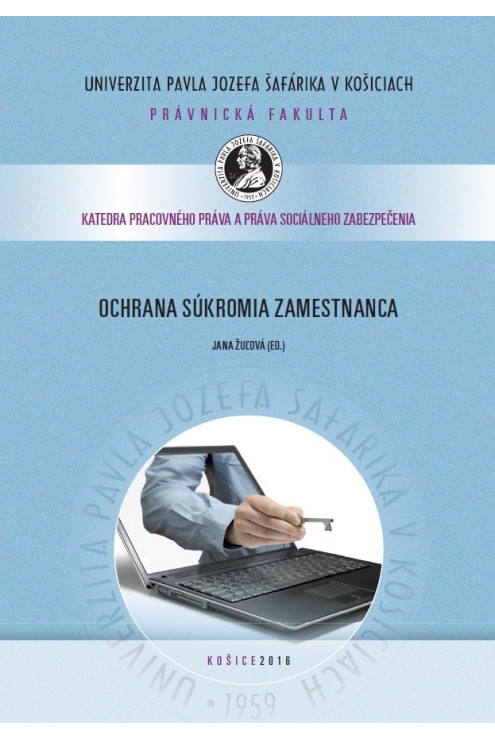
Ochrana súkromia zamestnanca

E-book

Jana Žuľová(ed.)

Proceedings from the 1st Annual Student Symposium on Labor Law held on April 8–9, 2016 in Danišovce

Discussions on the topic of privacy are currently very topical and interesting. The advancement and progress of technology have added a new dimension to individual privacy. With the use of modern electronic devices, terms such as precious commodity, chimera, or illusion are increasingly associated with privacy. Workplaces have not remained immune to modernization either. Machines are replacing human labor, programming and planning the production process, but also controlling, monitoring, and recording the fulfillment of assigned work tasks.

The availability of technology and its implementation in employers’ operations intrude upon the personal and private sphere of employees, which is an inherent part of every person’s life and does not remain left behind the doors of the workplace. Proper and correct use of monitoring mechanisms by employers means not only mastering their technical installation at the workplace and covering the associated financial costs, but also respecting the privacy of employees.

It cannot be overlooked that the right to privacy is among the fundamental human rights and freedoms, enjoying the corresponding characteristics (inalienability, non-transferability, irrevocability, etc.) and appropriate legal protection. And even though it is not absolute and may be suspended in favor of another right (especially the employer’s right to protect their property), every intervention—such as comprehensive camera surveillance, monitoring of phone calls, email correspondence, blocking certain websites, etc.—always has adverse consequences for the privacy of the employee.

Download the e-book for free (pdf)

Quantity

978-80-8152-409-7

Data sheet

Method of publication:
E-book (pdf)
Editor:
Jana Žuľová
Document type:
Proceedings
Number of pages:
140
Available from:
15.06.2016
Year of publication:
2016
Edition:
1st edition
Publication language:
Slovak
Faculty:
Faculty of Law
Note:
Zborník študentských príspevkov bol vydaný ako výsledok riešenia výskumného projektu APVV č. 14-0598: „Elektronizácia v podnikaní s akcentom na právne a technické aspekty.“
- Free for download

16 other products in the same category:

Zákonník práce do každej ruky alebo lingvistika a sankcie v pracovnom práve

Zákonník práce do každej ruky alebo lingvistika...

E-book

E-book

Jana Žuľová

Proceedings of the Second Annual Student Symposium on Labor Law held on May 12–13, 2017 in Danišovce

The presented proceedings are the result of scientific works by students of the Faculty of Law at Pavol Jozef Šafárik University in Košice and are systematically divided into two parts.

The first part presents interdisciplinary intersections of linguistics and labor law in its creation, interpretation, and application. The second part addresses the issue of targeting the addressees of labor law norms through various sanction mechanisms. The proceedings include a questionnaire compiled by the researchers of a grant project, aimed at determining whether and in which aspects the Labor Code diverges from its addressees in terms of linguistic and stylistic processing. Indeed, there is no other legal norm that is closer to the participants of labor relations, and whose understanding at the highest possible level is justified by its everyday use.

The presented proceedings thus serve as a means of expanding the horizons of our students beyond their regular studies and as a tool for popularizing scientific research. In case of interest, the completed questionnaire can be sent to: jana.zulova (@) upjs.sk.

Download the e-book for free (pdf)

Právny štát, spravodlivosť a budúcnosť demokracie

Právny štát, spravodlivosť a budúcnosť demokracie

E-book

E-book

Alexander Bröstl - Marta Breichová Lapčáková (eds.)

Collection of papers from session of the slovak section of the IVR

In accordance with its name, the collection is devoted to three framework areas consisting of the rule of law, justice and the future of democracy, reflecting the focus of the 31st World Congress of the International Association for the Philosophy of Law and Social Philosophy (IVR). Published contributions of the slovak section of the IVR are devoted to the present questions of the rule of law in relation to the democratic legal state. Principles of the rule of law and present questions connected to the democratic character of the Slovak republic, including the democratic procedures on the local level, are juxtaposed with shifts on the international and global scene. Individual contributions are thus devoted to the technical and biotechnological challenges of contemporary democracy, the manifestation of game theory in the search for consensus in collegial judicial bodies, or to the concept of loyal opposition in the ongoing judicial dialogue surrounding the application of law in the european legal space. Space is also devoted to the universal questions of the nature of legal science, and to the present and future of the rule of law. The collection thus goes beyond the borders of the slovak legal space and aims to understand current trends in a broader context.

Download the e-book for free (pdf)

Oslava právneho štátu (Právny štát z pohľadu teórie štátu a práva a medzinárodného práva)

Oslava právneho štátu (Právny štát z pohľadu...

E-book

E-book

Ľudmila Pošiváková Zuzana Antošová - Milan Kočan (eds.)

Proceedings from the Student Debate held on April 24, 2013, at the Faculty of Law of Pavol Jozef Šafárik University in Košice.

In the current period, the rule of law is widely debated both at the academic and political levels. This debate is not only related to the effort to establish the Rule of Law in states that have transitioned from socialist to democratic systems but also in states experiencing various unrests, whether political or religious.

However, it is not just a debate about certain characteristics of the Rule of Law that are missing in domestic law or at the level of international law, but also a debate about the very definition and meaning of the Rule of Law. The rule of law can be likened to an ideal that almost every state strives to achieve. Even in the case of the establishment of the independent Slovak Republic, the framers decided to include among the introductory provisions, which should form the core of the constitution, that the Slovak Republic is a state governed by the rule of law.

However, to achieve the ideal of the rule of law, it is necessary not only to declare it but also to adopt measures essential for an independent judiciary, democracy, the effective enforcement of human rights, the separation of powers, and many other elements that characterize a state governed by the rule of law.

Download the e-book for free (pdf)

Ochrana, prevencia a zodpovednosť v právnych vzťahoch

Ochrana, prevencia a zodpovednosť v právnych...

E-book

E-book

Ivan KundrátKatarína SkolodováMonika Minčičová (eds.)

Peer-reviewed conference proceedings

The continuation of the tradition of an international scientific conference of doctoral students and young researchers have not been exception this year. The Department of Labour Law and Social Security Law, Faculty of Law, Pavol Jozef Šafarik University in Košice, as the organizer of this year's international scientific conference, has chosen a topic entitled "Protection, Prevention and Legal Liability."

Because of the unfavorable epidemiological situation and the cancellation of scientific, professional and other mass events, the conference was transferred to a virtual form. The electronic platform of the conference via online discussion was realized from 3rd to 17th April 2020. The protective function of law, preventive obligations, but also the emerging responsibilities are a vast source of ideas for scientific research, asking questions and finding answers to a range of theoretical and application-law problems in every area of public and private law. Evidence of a generously understood topic is the presented proceedings of scientific papers.

The proceedings, created within the solution of the grant task APVV-16-0002 -Mental Health in the Workplace and Employee Health Assessment, includes various aspects of legal regulation, from academic authors and authors from legal practice. Despite the diversity of the scientific focus, the papers are characterized by a unifying line corresponding to the central theme of the conference and show the interconnectedness of the different areas of law.

Download the e-book for free  (pdf)

Zborník príspevkov z X. ročníka študentského sympózia z medzinárodného a európskeho práva

Zborník príspevkov z X. ročníka študentského...

E-book

E-book

Adam Giertl (ed.)

Proceedings of the Student Symposium on International Law and European Law held on April 28, 2017, at the Faculty of Law of Pavol Jozef Šafárik University in Košice

The Student Symposium is regularly organized by the Institute of International Law and European Law, and in 2017, it marked the jubilee tenth edition of the symposium, which over time expanded its focus to include European law.

The tradition of holding student symposia is also associated with the good practice of preparing proceedings from each event. Understandably, the tenth edition is no exception, and thus, the tenth edition of the symposium proceedings is now available to readers. In previous years, the symposium has always focused on specific areas of international and European law. Thus, the subjects of study for symposium participants have included migration issues (2016), the protection of cultural values (2015), and the challenges of cyberspace (2013).

This year, given that it is the jubilee tenth edition, the symposium organizers have chosen to approach the symposium's focus thematically and recall some significant milestones in the development of international law that occurred in years ending with the number seven.

Download the e-book for free (pdf)

Rule of Law a medzinárodné právo

Rule of Law a medzinárodné právo

E-book

E-book

Ľudmila Elbert

The presented scientific monograph addresses the issue of the Rule of Law and its place, roles, and particularities at the level of international law. The Rule of Law is understood as a value that should govern communities, both domestic and international. It is thus compared to Kelsen’s basic norm, which should stand at the top of the legal order as the norm justifying the validity and existence of the norms of the legal order, both domestic and international.

Although the Rule of Law is studied at the international law level, it cannot be considered without understanding the Rule of Law in domestic law. Just as its development differs depending on whether it evolved within Anglo-American or continental law, its application and development also differ between domestic law and international law.

These differences are mainly caused by the roles and objectives that international Rule of Law is meant to secure, as well as by the distinct characteristics of domestic and international law.

Download the e-book for free (pdf)

Diverzné a inkluzívne pracoviská - legislatívne východiská

Diverzné a inkluzívne pracoviská - legislatívne...

E-book

E-book

Jana ŽuľováDenisa Rudžiková

In the environment of Slovak employers, an active approach to diversity and inclusion in the workplace is coming to the fore. Targeted diversity and inclusion programs help make employers more attractive on the labor market and attract more job seekers. Proactively, better working conditions are created for employees with responsibilities to the family (in most cases still in relation to mothers), groups of people who have been on the fringes of interest until now are also employed (elderly, disabled, LGBT groups, minorities, graduates of secondary and higher education schools).

The presented collection of abstracts responds to the outlined facts, which is a grouping of the starting motives and conclusions of the contributions presented at the scientific conference Diverse and inclusive workplaces - legislative starting points organized by the department of labor law and social security law of the Faculty of Law of the P. J. Šafárik University in Košice, which took place on September 29, 2023 in a hybrid form.

With their abstracts, the authors point to a range of problematic areas that are not only a reflection of academic considerations, but also those legal questions that have to be dealt with in ordinary legal practice. The goal is to use analysis and explanation to define the existing labor law measures/tools applicable to the implementation of diversity and inclusion in the workplace according to the current Slovak legal framework and the EU legal framework and thus emphasize the starting point of any effort to build diversity and the implementation of inclusion in the workplace.

Download e-book for free (pdf)

Súdna moc v ére globalizácie, umelej inteligencie a ďalších trendov v spoločnosti

Súdna moc v ére globalizácie, umelej...

E-book

E-publication
Veronika Lenhardtová-Radoslav Pavlinský-Dominik Urban

The collection Judicial Power in the Era of Globalization, Artificial Intelligence and Other Trends in Society provides a comprehensive and up-to-date perspective on the transformation of the judiciary amid rapid technological and social change. It contains 25 contributions primarily focused on the introduction and use of artificial intelligence tools in law. The authors examine not only the technical and institutional aspects of this transformation but also issues of judicial legitimacy and public trust in an independent justice system. The publication also offers a critical reflection on potential risks, limitations, and ethical dilemmas associated with the automation and digitalization of judicial processes. Several contributions compare national and supranational legal frameworks, offering valuable insights into differences in regulatory approaches around the world. All texts are united by a common question concerning the future of judicial power in a changing world. The contributions are written in an accessible manner, making the collection suitable for both legal experts and the broader public.
Download the e-book for free

The Impact of industrial and technological Changes on state social Policy and social Structure ...

The Impact of industrial and technological...

E-book

E-book

bolya Katalin Koncz

The exploration of the interplay between innovation and society elucidates fundamental connections between human advancement and societal transformation. Technological development and its dissemination profoundly influence both the economy and social structures, often restructuring them while presenting new challenges and opportunities. This monograph delves into the theme of "Innovation and Society", focusing specifically on how technological advancements impact various facets of society ‒ from the realm of work to social policies and the evolution of gender roles. These areas are approached through a novel lens, examining them from the perspective of legislative reforms enacted and endorsed by the state. The monograph examines the characteristics and legal framework of 20th-century Hungarian society using diverse laws, regulations, and statistical data. Through analyses and documented evidence, it offers a comprehensive understanding of societal structure and operations, encompassing aspects such as the labor market, female employment, the status of industry and commerce, and shifts in legal frameworks. Detailed statistical insights into population dynamics, labor market trends, and economic sectors further deepen our comprehension of social processes. The documents scrutinize the employment distribution and conditions across different sectors, including food processing and milling, while also providing specific details on the roles, distribution, and wages of women in the workforce, with particular emphasis on occupations where women are prominently engaged. The analysis of legislative provisions delineates the historical backdrop and measures enacted for fostering social and economic transformations, covering issues such as patent legislation, guardianship laws, and family law. This compilation offers an exhaustive overview of 20th-century Hungarian society and its legal underpinnings, enriching scholarly inquiries into historical and sociological dimensions within this domain.

Download e-book for free (pdf)

100 rokov Trianonskej zmluvy - diplomacia, štát a právo na prelome storočí

100 rokov Trianonskej zmluvy - diplomacia, štát...

E-book

E-book

Erik ŠtenpienIvan Svatuška (eds.)

The Collection of scientific Contributions of the International scientific conference: 100 Years of Treaty of Trianon – Diplomacy, State and Law on the Turn of the Century.

The presented publication is the first of a series of proceedings published within the solution of the grant APVV-19-0419. The conference took place from 14 to 15 October 2021 with the participation of experts from Slovakia, Hungary and Poland. The ambition of the research team, composed of legal historians and positive lawyers from three countries, is to provide a comprehensive, unbiased view of the peace negotiations that resulted in the Treaty of Trianon with Hungary. The conference, the result of which is the presented collection, was devoted to the causes of possible disputes in Europe - focusing on diplomacy and constitutional development of Central European countries at the turn of the 19th and 20th centuries, ie in the period immediately preceding the outbreak of World War I.

Download the e-book for free  (pdf)

Liber Amicorum Ján Klučka

Liber Amicorum Ján Klučka

E-book

E-book

Dominika Becková (ed.)

This Liber Amicorum presents a collection of contributions in Honour of Professor Ján Klučka. This Liber Amicorum was written by his colleagues from universities, collaborators from the judiciary, former colleagues from the Constitutional Court of the Slovak republic and the Court of Justice of the European Union, current colleagues from the Faculty of Law and his former PhD. students. Their contributions elaborate the knowledge their gained from the work they conducted together with Professor Ján Klučka and are interspersed with references to memories associated with Professor Ján Klučka.

Download e-book for free (pdf)

Public Administration and Society 1/2024

Public Administration and Society 1/2024

E-book

E-journal

Michal Jesenko (editor) - Eva MihalíkováDarina Koreňová

Public Administration and Society is a scientific journal publishing scientific academic articles, contributions to discussion and reviews having the content orientation on the theory and practice of Public Administration. The mission of the Journal is to publish significant results of the scientific scholarly researches regarding the area of public administration and related disciplines which are connected with the study profile and scientific bias of our Faculty. The Scientific Journal is issued in electronic version.

Download the e-book for free (pdf)

Slovenské a české obchodné právo v roku 2015: Vybrané problémy

Slovenské a české obchodné právo v roku 2015:...

E-book

E-book

Jozef Čorba(ed.)

Collection of Contributions from the Conference

On June 11–12, 2015, the Department of Commercial Law and Economic Law at the Faculty of Law, P. J. Šafárik University in Košice, organized the 13th meeting of the departments of commercial law from the law faculties of Czech and Slovak universities. This event further demonstrates that the idea of an annual gathering of representatives from these departments, initiated by Professor Bejček of the Faculty of Law at Masaryk University in Brno, has taken root and is likely to continue. Not only to preserve the tradition but primarily for the benefit of such meetings and the interest of participants to meet regularly.

A traditional part of these meetings, besides the exchange of knowledge and information about the teaching process and experience sharing, is a scientific conference focused on current issues in commercial law. This year’s conference was held under the title Slovak and Czech Commercial Law in 2015 – Selected Problems. A total of 17 contributions from various departments were included in the conference proceedings, divided into three thematic areas. The first group of contributions addresses selected issues related to the legal regulation of commercial companies and its practical implementation. The second group focuses on arbitration and insolvency law.

The third group includes contributions on the interpretation of the amended regulation of interest on late payments in commercial obligations, problems related to the application of this regulation, and issues concerning the interpretation of legal acts contained in the new Czech Civil Code. An additional part features an informational contribution on the development of Slovenian commercial law and its current form.

Ján Husár, Kristián Csach

Download the e-book for free(pdf)

Demokracia, dôstojnosť, diverzita: Zborník z prezentácií slovenskej sekcie pred 29. svetovým kongresom IVR 2019

Demokracia, dôstojnosť, diverzita: Zborník z...

E-book

E-book

Alexander BröstlMarta Breichová Lapčáková (eds.)

Under the auspices of the Institute of Legal Theory of Gustav Radbruch and the Slovak Section of the International Association for Philosophy of Law and Social Philosophy (IVR), a 3D flash conference was held on May 16, 2019, at the Faculty of Law of UPJŠ in Košice. This event was primarily dedicated to the upcoming 29th World Congress of IVR in Lucerne, Switzerland. In line with the main theme of the congress, the conference focused on "Dignity, Democracy, Diversity." At the time of the conference, it was clear that the number of participants at the world congress would significantly exceed 1,000, with discussions taking place in 151 special workshops and 28 working groups.

During the congress, a round table was also announced featuring Professor Brian Tamanaha, recipient of the IVR award for best book for "Realistic Theory of Law" (Cambridge 2017), a meeting regarding the IVR Encyclopedia, a panel on academic freedom issues, and a gathering of chairs from national sections of IVR.

Download the e-book for free (pdf)

INNOVATIVE LAW & INNOVATIONS IN LAW

INNOVATIVE LAW & INNOVATIONS IN LAW

E-book

E-book

Dominika Cukerová - Andrej Oriňak - Kateřina Hrabánková (eds.)

The proceedings offers contributions from the international scientific conference of doctoral students and young researchers held on 25 April 2024 at the Faculty of Law, UPJŠ in Košice, which was thematically oriented on Innovative Law and Innovations in Law. The authors of the papers confirmed that innovation in law can take many forms. The first part of the papers, which pays attention to how law can respond to innovations, is a manifestation of this. These are the papers by Jana Cihanová, Andrej Oriňák, Denisa Rudžiková and Matej Biroš, who presented the use of deepfake technology, artificial intelligence and software tools in legal practice in the context of their legal regulation. Looking at familiar things differently can also be a source of innovation. In this vein, Dominik Mizerski, Juraj Valentovič, Lucián Török and Kateřina Hrabánková presented interpretive and application innovations in the field of private law. The third part of the papers by Michaela Szittyaiová, Natália Priateľová, Filip Baláži, Elena Lazoríková and Laura Gazdagová offers a preview of the innovations that the public law section is facing today. Finally, the fourth and last group of papers specifically explains innovations against the background of criminal law regulation. These are contributions by Michal Novák, Miroslav Srholec, Vladimír Petrila and Martina Makaturová. The variety of topics covered in this proceedings shows that each area of legal regulation can be characterised by specific innovations and, in this context, by the dynamics with which they permeate legal regulation.

Download the e-book for free (pdf)

Ochrana (duševného) zdravia zamestnanca

Ochrana (duševného) zdravia zamestnanca

E-book

E-book

Milena Barinková (ed.)

The complex of legal norms protecting work, ensuring safety and health protection at work, is very broad in scope, extending beyond the Labour Code to include other specific legal regulations, collective agreements, executive legal regulations, and internal corporate normative acts.

Health protection of employees from hazardous workplace influences is a central requirement stemming from fundamental human rights guaranteed by the Constitution of the Slovak Republic. To ensure its universal enforcement across all employers in both private and public sectors, strict regulation through cogent norms is fully justified. The European Commission’s Communication to the European Parliament, Council, European Economic and Social Committee, and Committee of the Regions on the EU Strategic Framework on Health and Safety at Work 2014–2020 (COM(2014) 332 final) addresses the need to account for labor market changes arising from demographic shifts, aging populations, and technological advancements.

Work pace demands are intensifying, and all age categories of employees must adapt to new technologies, organizational changes, and evolving job structures. This increases requirements for maintaining health fitness throughout entire professional careers. Mental health fitness, which receives insufficient specific attention, is an inherent part of health fitness requirements. Prevention plays a critical role in mental health protection.

Download the e-book for free (pdf)

This website uses cookies to ensure you get the best experience on our website