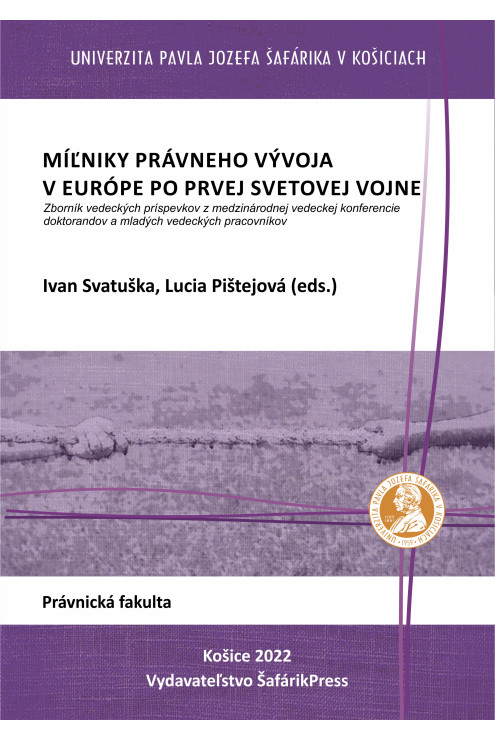
Míľniky právneho vývoja v Európe po prvej svetovej vojne

E-book

Ivan SvatuškaLucia Pištejová (eds.)

Collection of Scientific Contributions from the International Scientific Conference of PhD Students and Young Researchers held on April 22, 2022, organized by the Department of State and Law History of the Faculty of Law, Pavol Jozef Šafárik University in Košice.

We recommend this collection to the attention not only of PhD students and young researchers but also to all experts working in the fields of general history and legal science. At the same time, we bring it to the attention of all lay enthusiasts interested in the issues of legal development after the First World War. After all, as one of the world-renowned foreign legal historians likes to say: "Law is the most beautiful science in the world, because everyone can find an area that interests them in it."

Download the e-book for free (pdf)

Quantity

978-80-574-0099-8

Data sheet

Method of publication:
E-book (pdf)
Editors:
Ivan Svatuška - Lucia Pištejová
Document type:
Proceedings
Number of pages:
227
Available from:
24.05.2022
Year of publication:
2022
Edition:
1st edition
Publication language:
Slovak
Faculty:
Faculty of Law
Note:
Zborník vznikol s podporou a je výstupom riešenia výskumného projektu APVV-19-0419 "100 rokov Trianonskej zmluvy.“
- Free for download

16 other products in the same category:

Prípadové štúdie zo správneho práva

Prípadové štúdie zo správneho práva

€20.00
Availability: 23 In Stock

Jozef Tekeli a kolektív

The work "Case Studies in Administrative Law" is an extensive and practice-oriented publication primarily intended for students of law faculties and universities with a focus on public administration. Its main objective is to deepen the reader’s knowledge in various areas of administrative law through specific case studies, with an emphasis on the application of legal norms in real-life situations. The publication consists of 20 thematically organized chapters that cover a wide range of administrative agendas, such as internal administration, trade licensing, environmental protection, healthcare, transportation, education, justice, and national defense.

Each chapter contains multiple casuistic cases, in which the reader encounters practical problems and must assess the legality of administrative procedures, the substantive and territorial jurisdiction of public authorities, and the application of relevant legal regulations. The case studies are presented systematically—beginning with a factual scenario, followed by a legal analysis based on applicable legislation.

The work is exceptional for its comprehensiveness, up-to-date content, and emphasis on interdisciplinary connections within administrative law. The final chapter includes cross-sectional exercises involving multiple areas of administration through complex scenarios, encouraging the development of synthetic legal thinking. The publication thus serves not only as a valuable study resource but also as an excellent tool for seminar work, exam preparation, and practical training in legal reasoning and decision-making.

Diverzné a inkluzívne pracoviská - legislatívne východiská

Diverzné a inkluzívne pracoviská - legislatívne...

E-book

E-book

Jana ŽuľováDenisa Rudžiková

In the environment of Slovak employers, an active approach to diversity and inclusion in the workplace is coming to the fore. Targeted diversity and inclusion programs help make employers more attractive on the labor market and attract more job seekers. Proactively, better working conditions are created for employees with responsibilities to the family (in most cases still in relation to mothers), groups of people who have been on the fringes of interest until now are also employed (elderly, disabled, LGBT groups, minorities, graduates of secondary and higher education schools).

The presented collection of abstracts responds to the outlined facts, which is a grouping of the starting motives and conclusions of the contributions presented at the scientific conference Diverse and inclusive workplaces - legislative starting points organized by the department of labor law and social security law of the Faculty of Law of the P. J. Šafárik University in Košice, which took place on September 29, 2023 in a hybrid form.

With their abstracts, the authors point to a range of problematic areas that are not only a reflection of academic considerations, but also those legal questions that have to be dealt with in ordinary legal practice. The goal is to use analysis and explanation to define the existing labor law measures/tools applicable to the implementation of diversity and inclusion in the workplace according to the current Slovak legal framework and the EU legal framework and thus emphasize the starting point of any effort to build diversity and the implementation of inclusion in the workplace.

Download e-book for free (pdf)

Prípady z medzinárodného práva verejného

Prípady z medzinárodného práva verejného

E-book

E-book

Ľudmila ElbertĽubica Gregová Širicová (eds.)

In addition to acquiring theoretical knowledge, it is necessary to study and analyze the decisions of international judicial and arbitration bodies in order to fully understand the subject of the Public International Law or disciplines closely related to it.

Since the Slovak literature in the field of Public International Law does not contain any electronic textbook of selected decisions of international judicial and arbitration bodies, the authors of the submitted publication aim to eliminate this gap by elaborating the “Public International Law Casebook”, which will primarily be intended for undergraduate students of the law faculties in the Slovak republic and the Czech republic.

The proposed publication seeks to make the study of international law more attractive through a publication that will make students familiar with the decisions translated into the Slovak language in a popular electronic form.

Download the e-book for free (pdf)

KOŠICKÉ DNI TRESTNÉHO PRÁVA 2025, IX. ročník (2025)

KOŠICKÉ DNI TRESTNÉHO PRÁVA 2025, IX. ročník...

E-book

E-publication

Sergej Romža-Lukáš Michaľov-Michaela Ema Mauerová

Proceedings of scientific contributions with the main section: "Artíficíal intellígence - a challenge for crímínal law" and subsections: "Extremism from the perspective of criminology, victimology, and criminalistics" and "Creation and tools of criminal policy" is the result of a nationwide interdisciplinary scientific conference with intemational particípation, organízed by the Department of Criminal Law of the Faculty of Law at UPJŠ in Košice. The publication retlects current challenges in criminal law in the context of dynamic technological, security, and social changes. The main section, "Artificial Intelligence - A Challenge for Criminal Law," presents contributions analyzing legal, ethical, and practical issues related to the use of artificial intelligence in the field of criminal law. The authors address autonomous responsibility, algorithmic transparency, the possibilities of using Al in the prevention, detection, and prosecution of crimes, as well as the risks to the protection of fundamental rights and fair tria!.

Download the e-PUBLICATION for free (pdf)

Spracúvanie osobných údajov zamestnanca podľa GDPR

Spracúvanie osobných údajov zamestnanca podľa GDPR

E-book

E-book

Jana Žuľová a kol.

The presented publication is intended for employers, managers, and HR professionals who process employees' personal data for various employment-related purposes and need to conduct an audit of their processing in compliance with the GDPR and the new Personal Data Protection Act. The publication will also be useful for new employers who are encountering data protection for the first time and need to establish internal data protection rules, essentially starting from scratch.

The reader has the opportunity to gain a comprehensive understanding of the data protection rules applicable in the employment sector, the obligations of the employer, and the rights of the data subject, i.e., job applicants, employees, and former employees.

Download the e-book for free (pdf)

Ochrana, prevencia a zodpovednosť v právnych vzťahoch

Ochrana, prevencia a zodpovednosť v právnych...

E-book

E-book

Ivan KundrátKatarína SkolodováMonika Minčičová (eds.)

Peer-reviewed conference proceedings

The continuation of the tradition of an international scientific conference of doctoral students and young researchers have not been exception this year. The Department of Labour Law and Social Security Law, Faculty of Law, Pavol Jozef Šafarik University in Košice, as the organizer of this year's international scientific conference, has chosen a topic entitled "Protection, Prevention and Legal Liability."

Because of the unfavorable epidemiological situation and the cancellation of scientific, professional and other mass events, the conference was transferred to a virtual form. The electronic platform of the conference via online discussion was realized from 3rd to 17th April 2020. The protective function of law, preventive obligations, but also the emerging responsibilities are a vast source of ideas for scientific research, asking questions and finding answers to a range of theoretical and application-law problems in every area of public and private law. Evidence of a generously understood topic is the presented proceedings of scientific papers.

The proceedings, created within the solution of the grant task APVV-16-0002 -Mental Health in the Workplace and Employee Health Assessment, includes various aspects of legal regulation, from academic authors and authors from legal practice. Despite the diversity of the scientific focus, the papers are characterized by a unifying line corresponding to the central theme of the conference and show the interconnectedness of the different areas of law.

Download the e-book for free  (pdf)

KOŠICE CRIMINAL LAW DAYS 2024

KOŠICE CRIMINAL LAW DAYS 2024

E-book

Sergej Romža - Dávid Priščák - Matej Biroš (eds.)

Proceedings of scientific papers „ Elimination of racism, xenophobia and otherforms of intolerance by means of criminal law. Recodification of Criminal Codes - Current Challenges and Perspectives. " is the output of the national interdisciplinary scientific conference with intemational participation organized by the Department of Criminal Law ofthe Faculty ofLaw of the University of Applied Sciences in Košice. The proceedings contain contributions focused on the issues of elimination of racism, xenophobia and other forms of intolerance by means of criminal law and on the issues of recodification of criminal codes, their current challenges and perspectives, both in the field of substantíve and procedural law.
This is a highly topical issue, as the need to eliminate racism, xenophobia and other forms of intolerance by means of criminal law is an important topic with regard to the social situation. The recodification of the criminal codes in 2024 has significantly affected both the substantíve and procedural areas of criminal law, which is the means of ultima ratio. Considering the social developments and the recent amendments to the pena! codes, we consider the theme of the conference and the titlc of the proceedings to be highly topical, containing a significant scope for scientific research.
The participants of the national interdisciplinary scientific conference with international participation in their contributions also dealt with de lege ferenda considerations and at the same time offered solutions to application problems in the field.
The aim of the published proceedings is to continue to improve and develop new knowledge in the field of criminal law, while respecting human rights and freedoms, based on the existing professional knowledge.

Download the e-book for free (pdf)

Regionalizmus a jeho prínos pre všeobecné medzinárodné právo

Regionalizmus a jeho prínos pre všeobecné...

E-book

E-book

Ján Klučka a kol.

The presented monograph, “Regionalism and Its Contribution to General International Law,” was prepared at the Institute of European Law and the Department of International Law of the Faculty of Law at Pavol Jozef Šafárik University in Košice as part of a project of the same name (APVV-0823-11) carried out in the years 2011–2015, and represents one of its final publication outputs.

The main reason for choosing this topic was the effort to evaluate regionalism in its various forms in relation to international law, and, conversely, to assess the place, significance, and role of international law in the creation and functioning of different forms of regional groupings. In fact, although regionalism is receiving increasing attention in doctrine, a more comprehensive assessment of its impact on international law and vice versa has so far been lacking.

This monograph attempts to partially fill this gap. Against the background of a brief historical development of regionalism, as well as its substantive and terminological components, the monograph examines in greater detail the individual types of regionalism—such as old and new regionalism, as well as contractual and institutional regionalism—their specific features, and their contribution to general international law.

Attention is also devoted to a specific phenomenon of contemporary regionalism, namely the influence of the European Union on its stabilization and development, both through practical measures and through a set of measures regulated by international treaties.

Download the e-book for free (pdf)

Rozhodovacia prax súdnych autorít v súkromnom práve II
  • New

Rozhodovacia prax súdnych autorít v súkromnom...

E-book

E-book

Žofia Mrázová Natália Kalinák

On November 28, 2025, the Department of Commercial Law and Economic Law, in cooperation with the Department of Labor Law and Social Security Law of the Faculty of Law at UPJŠ in Košice, organized the 10th anniversary student symposium focused on commercial law, labor law, and IT law. The symposium, entitled "Decision-making practice of judicial authorities in private law II," built on the success of the previous year and once again provided students with an opportunity to showcase their analytical skills and legal creativity. The symposium was prepared as part of the APVV-23-0331 scientific project "Integration of the Capital Markets Union: Changes in Corporate Financing and the Rescue of Commercial Companies in Financial Difficulties."

Download the e-book for free (pdf)

Ochrana kultúrnych hodnôt prostriedkami medzinárodného a regionálneho práva

Ochrana kultúrnych hodnôt prostriedkami...

E-book

E-book

Adam GiertlĽudmila Elbert

Collection of Papers from the 8th Student Symposium held on April 20–21, 2015 in Danišovce

The capture of the historic Syrian city of Palmyra by fighters of the radical Islamic State caused shock among the global public. The main reason is the barbarism with which this organization proceeds, not only in relation to the treasures of the world’s cultural heritage. The situation in the Middle East, where cultural treasures of inestimable value are under direct threat, demonstrates how fragile the world’s cultural heritage is. The reaction of the international public and world leaders shows how sensitively the destruction of cultural heritage is perceived.

The quoted statement chosen by the editors relates to the threat posed by the Islamic State—however, the spirit of this statement can be applied to any cultural wealth that forms part of the world’s cultural heritage. The destruction or damage of these values primarily represents a loss for humanity as such. Each destroyed artifact of world cultural heritage signifies the disappearance of a unique legacy left by previous generations for the future. At the same time, cultural heritage must be understood as a broad spectrum of assets—both tangible and intangible. Their legal protection was the topic of this year’s symposium. As with any social interest, the protection of cultural heritage can be ensured through various mechanisms and under different forms of social organization.

These diverse approaches are unified by law as a normative system. The question for the 8th year of the symposium on international law was what role international law plays in the protection of cultural heritage. In the context of the European region, the role of the European Union as a regional organization was examined.

Download the e-book for free (pdf)

Zákon o národnostiach a Rada vlády Slovenskej socialistickej republiky pre národnosti (predstavy a realita)

Zákon o národnostiach a Rada vlády Slovenskej...

E-book

E-book

Jana Šutajová

From January 1, 1969, the Constitutional Act on the Status of Nationalities in the Czechoslovak Socialist Republic (ČSSR) and the Constitutional Act on the Federation came into effect. The Constitutional Act on the Status of Nationalities represented at least a formal significant step forward in the legal regulation of minority rights. However, this law was intended to serve as a foundation for further legal adjustments. It was declared that additional steps and negotiations for the adoption of implementing regulations would follow and that further laws would be enacted at both the federal and national levels. Nevertheless, no additional law or government regulation related to the constitutional act on the status of nationalities in the ČSSR was ever issued.

During the normalization period, issues concerning further legislation related to national minorities were not addressed. However, in the brief period following the adoption of the constitutional act in 1968 until the end of 1969, some institutions attempted to prepare and promote such legal norms. One of these institutions was the Government Council of the Slovak Socialist Republic (SSR) for Nationalities (hereafter referred to as the Council or the Government Council for Nationalities). The monograph provides an insight into the development of additional legal norms arising from the constitutional act on the status of nationalities in the Slovak Socialist Republic, prepared by the Government Council of SSR for Nationalities. This council was one of the institutions established in Slovakia after the formation of the Czechoslovak federation and dealt with nationality issues.

In addressing further legal norms stemming from the constitutional act on nationalities in ČSSR, it was necessary to consider prior developments. Therefore, the first part of the monograph examines the status of minorities in Czechoslovakia before adopting the constitutional act, activities of nationalities preceding its adoption, and its enactment itself. Subsequent sections focus on institutional changes in SSR following federalization, the establishment of the Government Council of SSR for Nationalities, and specific actions taken by this Council and its expert bodies in drafting proposals for laws concerning nationalities in the Slovak Socialist Republic.

The motivation for writing this monograph stemmed from the fact that this topic has so far received attention only in a few studies in Slovakia, which primarily focused on the Hungarian minority during either the Prague Spring or normalization periods.

Download the e-book for free (pdf)

Oslava právneho štátu (Právny štát z pohľadu teórie štátu a práva a medzinárodného práva)

Oslava právneho štátu (Právny štát z pohľadu...

E-book

E-book

Ľudmila Pošiváková Zuzana Antošová - Milan Kočan (eds.)

Proceedings from the Student Debate held on April 24, 2013, at the Faculty of Law of Pavol Jozef Šafárik University in Košice.

In the current period, the rule of law is widely debated both at the academic and political levels. This debate is not only related to the effort to establish the Rule of Law in states that have transitioned from socialist to democratic systems but also in states experiencing various unrests, whether political or religious.

However, it is not just a debate about certain characteristics of the Rule of Law that are missing in domestic law or at the level of international law, but also a debate about the very definition and meaning of the Rule of Law. The rule of law can be likened to an ideal that almost every state strives to achieve. Even in the case of the establishment of the independent Slovak Republic, the framers decided to include among the introductory provisions, which should form the core of the constitution, that the Slovak Republic is a state governed by the rule of law.

However, to achieve the ideal of the rule of law, it is necessary not only to declare it but also to adopt measures essential for an independent judiciary, democracy, the effective enforcement of human rights, the separation of powers, and many other elements that characterize a state governed by the rule of law.
Download the e-book for free (pdf)

Ako správne pracovať s prameňmi práva Európskej únie. Metodická príručka.

Ako správne pracovať s prameňmi práva Európskej...

E-book

E-book

Dominika BeckováRadoslav BenkoValéria Ružičková

Studies of the European Union law may hardly be possible without making use of its sources. Lots of types of legal rules, several forms of judicial decisions as well as a wide spectrum of criteria used while searching among legal acts of the European Union and case-law of its courts in search engines on the official websites of the European Union may, however, appear confusing, thereby making the work with sources of the European Union law more complicated and prolonging it.

Methodology Guide „How to Work Correctly with the Sources of the European Union Law“ aims to help students to understand the system of sources of the European Union law as well as the sources themselves, offer them tips and advice useful during their search and thus contribute to the adoption of fundamental procedures for working with them.

Download the e-book for free (pdf)

Ústava Slovenskej republiky a jej perspektívy

Ústava Slovenskej republiky a jej perspektívy

E-book

E-book

Ladislav OroszDiana HorňákováPatrik Mário Čerňanský

This scientific proceedings volume serves as the final joint publication output of essentially the entire research team of the aforementioned scientific project. It consists of contributions presented at the scientific seminar The Constitution of the Slovak Republic and Its Perspectives. Improving the Constitutional Text and Increasing the Authority of the Slovak Constitution – A Real Possibility or a Naive Illusion? held from November 23 to 25, 2022, at the training and educational facility of UPJŠ in Košice, Danišovce. The final form of the contributions emerged from the constructive scientific discourse that accompanied the entire course of this seminar.

The content of this scientific proceedings volume, which we offer not only to the broad (especially legal-political) professional public but also primarily to Slovak constitution makers, includes, alongside contributions from members of the research team and invited guests, the literary debut works of doctoral students from the organizing Department of Constitutional and Administrative Law of the Faculty of Law of UPJŠ and the Department of Public Law Disciplines of the Faculty of Public Administration of UPJŠ in Košice. These works thematically correspond to the tasks addressed within the aforementioned scientific project “Constitutional Activity of the National Council of the Slovak Republic (Legal-Political Analysis – Evaluation – Perspectives).”

Download e-book for free (pdf)

Obchodné a pracovné právo: Na spoločnej vlne

Obchodné a pracovné právo: Na spoločnej vlne

E-book

E-book

Natália Kalinák-Andrej Oriňak

The Department of Commercial Law and Economic Law together with the Department of Labour Law and Social Security Law of the Faculty of Law of UPJŠ in Košice organized the 8th annual student symposium, this time on commercial, labour and private international law, which took place at the Faculty of Law of UPJŠ in Košice on 1 December 2023. The student symposium under the title Commercial and Labour Law on a Common Wave was carried out as part of the research projects VEGA 1/0259/22 and VEGA č. 1/0291/23. The aim of the annual symposia is to create a discussion platform for students under the supervision of mentors from among the members of the department, namely teachers, researchers and PhD students. The theme of this year's symposium brought about discussion of interesting theoretical and practical legal issues thematically focused on the synergy of business law and labour law. The students addressed topical issues related to the status of entrepreneurs, the conduct of companies in labour law relations as well as the duties and responsibilities of employees. The topics of the sharing economy, gender quotas in corporate bodies and unfair bribery were not forgotten. While working on individual topics, students had the opportunity to improve their analytical thinking and argumentation skills, while they could practice writing a legal professional text, which in practice often increases the success of every lawyer. Students had the opportunity to develop their critical thinking and learn how to clearly formulate their own opinions on current legal issues. After the presentation of the papers, not only the team of lecturers and researchers, but also the students themselves engaged in a fruitful discussion, asking a number of original questions. Each student participant was awarded a certificate for their active participation in the symposium. The present proceedings are the outcome of the students' work from this event.

Download e-book for free (pdf)

Európska únia a jej vplyv na organizáciu a fungovanie verejnej správy v Slovenskej republike

Európska únia a jej vplyv na organizáciu a...

E-book

E-book

Alena Krunková (ed.)

Proceedings of the Scientific Conference Held on June 28, 2016 at the Faculty of Law of Pavol Jozef Šafárik University in Košice in connection with the implementation of the project “The European Union and Its Impact on the Organization and Functioning of Public Administration in the Slovak Republic” – approved under number MVZP – SK PRES/2016/134

The Slovak Republic, as a member state of the European Union, is undertaking a historic role associated with the Presidency of the Council of the European Union within the presidency trio. At the beginning of 2016, the Ministry of Foreign and European Affairs of the Slovak Republic announced a call for applications for grants for 2016 in the field of international relations and foreign policy, specifically focused on the Slovak Republic’s Presidency of the Council of the European Union. The Faculty of Law of Pavol Jozef Šafárik University in Košice responded to this call and obtained a project aimed at carrying out research activities through a series of events focused on regional self-government in the Slovak Republic in the context of its role within the European Union. The Faculty has long been engaged with issues of European Union law both in its teaching and in the scientific research activities of its individual faculty members. The project aims to enrich this portfolio with special activities targeting not only professionals, but also students and the general public.

The first activity of the project was a conference entitled “The European Union and Its Impact on the Organization and Functioning of Public Administration in the Slovak Republic – Development So Far, Current State, and Perspectives.” The conference was attended by invited public officials, representatives of academia, and representatives of local government, as one of the main goals of the project is to connect the academic community with the practical sphere and thus involve practitioners in the planned activities within the project.

Download the e-book for free (pdf)

This website uses cookies to ensure you get the best experience on our website