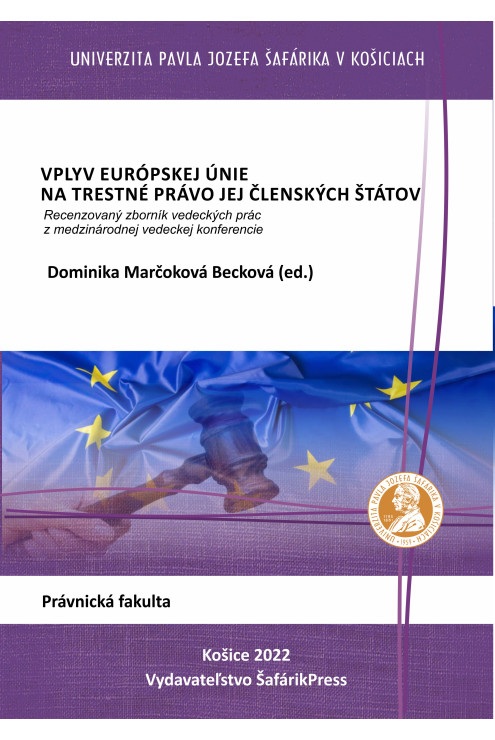
Impact of the European Union on Criminal Law of EU Member States

E-book

Dominika Marčoková Becková (ed.)

Reviewed collection of papers of the international scientific conference is the output of the international scientific conference held on 7th October 2022 within the framework of the project APVV-18-0421 „European Public Prosecutor's Office in Connections of the Constitutional Order of the Slovak Republic as Strengthening of the European Integration through Law“.

Unlike other areas of activities of the European Union, the European Union did not begin to enter the area of criminal law and criminal policy until much later. The reason is that the sphere of criminal law has traditionally been associated with the sovereignty of the state, which is why the Member States of the European Union are very slow to allow the European Union into it. The issue of the European Union's influence on the criminal law of its Member States is therefore becoming actual and raises many questions and application problems. In their papers, the authors address the various problems posed by the European Union's influence in the area of criminal law. Among the scientific problems and issues that the authors paid attention to in their works are the following: reasons for competence of the European Union within the field of criminal law; Impact of the EU legislation on criminal law of EU Member States; proposals to improve existing legislation, whether at European Union or national level, cooperation of the Court of Justice of the European Union and national judges via preliminary proceedings within the field of criminal law; as well as the issue of the European Public Prosecutor's Office.

Download the e-book for free  (pdf)

Quantity

978-80-574-0172-8

Data sheet

Method of publication:
E-book (pdf)
Editor:
Dominika Marčoková Becková
Document type:
Proceedings of scientific works
Number of pages:
136
Available from:
19.12.2022
Year of publication:
2022
Edition:
1st edition
Publication language:
slovenčina, angličtina
Faculty:
Faculty of Law
Note:
Zborník je čiastkový výstup z riešenia projektu APVV-18-0421 Európska prokuratúra v súradniciach ústavného poriadku Slovenskej republiky ako posilnenie európskej integrácie prostredníctvom práva.
License:
Creative Commons BY NC (Uveďte autora - Nepoužívajte komerčne)
DOI:
https://doi.org/10.33542/VEU-0172-8
- Free for download

16 other products in the same category:

Právne postavenie spoločníka v obchodnej...

E-book

E-book

Žofia Šuleková (ed.)

Proceedings of the Contributions from the IV. Student Symposium on Corporate Law held on November 24-25, 2016, at the Training Facility of Pavol Jozef Šafárik University in Danišovce.

The Department of Commercial Law and Economic Law at the Faculty of Law of Pavol Jozef Šafárik University in Košice organized the fourth edition of the student symposium, this time focusing on corporate law.

The event took place on November 24-25, 2016, at the training facility of Pavol Jozef Šafárik University in Danišovce. The aim of the annually organized symposiums is to create a discussion platform for students with the participation of mentors from the department, including teachers, researchers, and doctoral students. This year’s symposium focused on problematic issues related to the legal status of a partner in a commercial company. The topics were assigned to allow students to demonstrate and develop their analytical and argumentative skills while improving their ability to present and formulate their own views and perspectives.

The presented proceedings are the outcome of the students' work from this event.

Download the e-book for free (pdf)

Orgány obchodných spoločností

E-book

E-book

Kristián Csach - Dušan Rostáš (eds.)

Proceedings of the 2nd Student Symposium on Company Law In November 2014

The second annual Student Symposium on Commercial Law—more specifically, on Company Law—was held at the university’s facility in Danišovce. As in the previous year, the aim of the symposium was to provide students with a greater opportunity to articulate their own perspectives on current legal issues and to present the results of their individual work.

The theme of the second symposium focused on the governing bodies of commercial companies, aligning it thematically with the APVV research project being carried out by members of the Department of Commercial and Economic Law at our Faculty of Law. This overarching topic made it possible to assign a range of current legal issues, allowing students to explore problems they are likely to encounter in their future professional practice. The selected topics are not among those unanimously settled by legal doctrine or established case law.

On the contrary, they were deliberately chosen for their complexity and the lack of sufficient domestic literature. As a result, students had to go beyond standard textbook or commentary-based knowledge to thoroughly address their assigned topics.

Download the e-book for free (pdf)

Regionalizmus a jeho prínos pre všeobecné...

E-book

E-book

Ján Klučka a kol.

The presented monograph, “Regionalism and Its Contribution to General International Law,” was prepared at the Institute of European Law and the Department of International Law of the Faculty of Law at Pavol Jozef Šafárik University in Košice as part of a project of the same name (APVV-0823-11) carried out in the years 2011–2015, and represents one of its final publication outputs.

The main reason for choosing this topic was the effort to evaluate regionalism in its various forms in relation to international law, and, conversely, to assess the place, significance, and role of international law in the creation and functioning of different forms of regional groupings. In fact, although regionalism is receiving increasing attention in doctrine, a more comprehensive assessment of its impact on international law and vice versa has so far been lacking.

This monograph attempts to partially fill this gap. Against the background of a brief historical development of regionalism, as well as its substantive and terminological components, the monograph examines in greater detail the individual types of regionalism—such as old and new regionalism, as well as contractual and institutional regionalism—their specific features, and their contribution to general international law.

Attention is also devoted to a specific phenomenon of contemporary regionalism, namely the influence of the European Union on its stabilization and development, both through practical measures and through a set of measures regulated by international treaties.

Download the e-book for free (pdf)

Košické dni súkromného práva IV. Pocta...

E-book

E-book

Peter Molnár - Viktória Koľveková - Miroslava Kušníriková - Renáta Romanová - Lukáš Macko (eds.)

Recenzovaný zborník vedeckých prác z medzinárodnej vedeckej konferencie Košické dni súkromného práva IV., ktorá sa konala v dňoch 15. až 17. júna 2022, je čiastkovým výstupom riešenia grantovej úlohy projektu schváleného Vedeckou grantovou agentúrou Ministerstva školstva, vedy, výskumu a športu Slovenskej republiky a Slovenskej akadémie vied pod registračným číslom 1/0765/20 s názvom „Ochrana ľudských hodnôt v súkromnom práve v kontexte moderných trendov a prebiehajúcej rekodifikácie súkromného práva“.

Predkladaný zborník vedeckých prác je výstupom zo 4. ročníka medzinárodnej vedeckej konferencie Košické dni súkromného práva IV. organizovanej Katedrou občianskeho práva, Právnickej fakulty UPJŠ v Košiciach. Publikačné výstupy autorov sú tematicky orientované najmä na výskumný projekt VEGA č. 1/0765/20 "Ochrana ľudských hodnôt v súkromnom práve v kontexte moderných trendov a prebiehajúcej rekodifikácie súkromného práva" riešený organizátormi konferencie. Jednotlivé príspevky sú rozdelené do troch sekcií – občianske právo hmotné, civilné právo procesné, právo duševného vlastníctva. Rozdelenie sekcií reflektuje na jednotlivé výskumné oblasti vymedzené v rámci projektu.

Download the e-book for free (pdf)

Ochrana práv veriteľov v obchodných záväzkových...

E-book

E-book

Žofia Mrázová (ed.)

Proceedings of Contributions from the V. Student Symposium on Commercial Law

The proceedings are the result of student works presented at the fifth annual student symposium organized by the Department of Commercial Law and Economic Law, Faculty of Law, UPJŠ in Košice, which took place on November 30 – December 1, 2017, at the UPJŠ educational and training facility in Danišovce.

This year’s symposium focused on problematic issues related to creditor rights protection in commercial contractual relationships.

The purpose of these annually organized symposia is to provide students with a platform to present their own opinions and improve their analytical and argumentation skills.

Download the e-book for free (pdf)

Obchodné záväzky: Všeobecná časť

E-book

E-book

Dominika Zavadová(ed.)

Proceedings from the 3rd Student Symposium on Commercial Law

In November 2015, the third annual Student Symposium on Commercial Law took place at the university facility in Danišovce.

After two years of symposia focused on company law, the main topic of the third edition was the general part of commercial obligations law. This year as well, the goal of the student symposium remained to provide more space for students to formulate their own perspectives on current legal issues and to present the results of their own work.

The overarching topic made it possible to assign several current issues, allowing students to tackle problems they are likely to encounter in their future practice. The selected topics are not among those unanimously accepted by legal doctrine or established case law. On the contrary, the topics were deliberately chosen for the lack of sufficient domestic literary sources. As a result, processing the individual topics required more than just standard textbook or commentary knowledge.

The participating members of the department, both teachers and doctoral candidates, acted this year primarily as contact persons, rather than as consultants or supervisors of the students’ work. The primary purpose of the symposium at the faculty is to enable students interested in commercial law to develop their analytical and argumentative skills, as well as to express their personalities. We aim for students to develop not only professional knowledge but also personal skills-so-called soft skills-the art of presenting their own opinions and arguing persuasively.

Download the e-book for free (pdf)

Základné zásady v rozhodovacej činnosti súdnej...

E-book

E-book

Alexander Bröstl - Marta Breichová Lapčáková - Martin Štrkolec (eds.)

Collection of scientific papers by doctoral students.

Thematically, the contributions are diverse: they feature fundamental principles in public law (basic principles of criminal proceedings, the principle of contradiction, basic principles of constitutional court proceedings, basic principles in private law and procedural law (superficies solo cedit), the principle of civil court proceedings in deciding labor disputes, equality of participants and the duty to instruct, objection of bias in light of the right to an impartial court, the principle of speed and the principle of economy in the decision-making activities of general courts, basic principles in legal theory and international law (general legal principles recognized by civilized nations), coexistence of the principle of equality and the principle of non-discrimination in the legal order of the European Union, argumentation through the principle of rule of law in the decision-making activities of courts, the impact of fundamental principles on the interpretation of legal norms.

It is important that the authors, i.e., doctoral students from law faculties in the Czech Republic and the Slovak Republic, almost unanimously examine these principles in the process of application (interpretation) of law, from the perspective of how legal (primarily judicial) practice deals with them. This should be fundamentally welcomed and appreciated.

Download the e-book for free (pdf)

Kúpna zmluva – história a súčasnosť II.

E-book

E-book

Erik Štenpien (ed.)

Proceedings from the international scientific conference held on September 26-27, 2014 at the Faculty of Law, UPJŠ in Košice

Nowadays, in the modern 21st century, we have a much more complex society than the ancient one. It requires legal regulation of various types of purchase contracts, where although the basic feature remains, it needs to be specified further, and the simple sentence 'I sell, you buy' needs to be supplemented with conditions 'how, where, when, under what conditions?' This is the task of modern civil law. The current recodification of civil law has already taken place in some European countries, and it is currently underway in our country. Therefore, it is important to meet at conferences with colleagues from these countries and exchange knowledge, to discuss their experiences, avoid the bad, and accept or adjust the good according to our conditions.

This proceedings is the output publication from the conference held on September 26-27, 2014 in Košice. It was the second conference with the participation of the most prominent legal Romanists, legal historians, and civilists from home and abroad. The proceedings is the result of unique cooperation among experts from various fields of legal science. I believe that the published outputs will help to understand the institute of purchase contracts from all its aspects and will become an inspiration for both experts and laypeople.

Download the e-book for free (pdf)

The Impact of industrial and technological...

E-book

E-book

bolya Katalin Koncz

The exploration of the interplay between innovation and society elucidates fundamental connections between human advancement and societal transformation. Technological development and its dissemination profoundly influence both the economy and social structures, often restructuring them while presenting new challenges and opportunities. This monograph delves into the theme of "Innovation and Society", focusing specifically on how technological advancements impact various facets of society ‒ from the realm of work to social policies and the evolution of gender roles. These areas are approached through a novel lens, examining them from the perspective of legislative reforms enacted and endorsed by the state. The monograph examines the characteristics and legal framework of 20th-century Hungarian society using diverse laws, regulations, and statistical data. Through analyses and documented evidence, it offers a comprehensive understanding of societal structure and operations, encompassing aspects such as the labor market, female employment, the status of industry and commerce, and shifts in legal frameworks. Detailed statistical insights into population dynamics, labor market trends, and economic sectors further deepen our comprehension of social processes. The documents scrutinize the employment distribution and conditions across different sectors, including food processing and milling, while also providing specific details on the roles, distribution, and wages of women in the workforce, with particular emphasis on occupations where women are prominently engaged. The analysis of legislative provisions delineates the historical backdrop and measures enacted for fostering social and economic transformations, covering issues such as patent legislation, guardianship laws, and family law. This compilation offers an exhaustive overview of 20th-century Hungarian society and its legal underpinnings, enriching scholarly inquiries into historical and sociological dimensions within this domain.

Download e-book for free (pdf)

Pracovnoprávne elementy výkonu (závislej)...

E-book

E-book

Jana Žuľová (ed.)

Collection of Scientific Works

Article 35 of the Constitution of the Slovak Republic guarantees everyone the right to freely choose their profession and receive training for it, as well as the right to engage in entrepreneurial or other gainful activity. Everyone has the right to freely decide whether to secure their livelihood through self-employment—with all the associated consequences and risks—or through employment within labor-law relationships by performing dependent work.

The framework and rules for exercising these rights are primarily regulated by labor, commercial, and tax legislation, each with its own set of rights and obligations applicable specifically to entrepreneurs and employees. Constant competitive pressure, along with the effects of economic crises, pushes employers to seek ways to extract the most from workers while optimizing for the lowest possible insurance, administrative, and tax costs. As a result, employment contracts are being terminated, and under the pressure of losing their income, individuals are "voluntarily" shifting to commercial-law relationships.

This situation, along with other distortions in the labor market, confronts those entitled to work with unfair practices by employers, thereby undermining their ability to freely exercise this fundamental right.

Download the e-book for free (pdf)

Právny jazyk v aplikačnej praxi

E-book

E-book

Marcel Dolobáč - Ľuboš Dobrovič (eds.)

Reviewed Proceedings of Contributions from a Scientific Conference

This reviewed collection of contributions from the scientific e-conference Legal Language in Application Practice, held from December 3 to 21, 2018, presents various academic contributions.

Legal language, as expressed in legal norms, is specific and should ideally be unambiguous, concise, and resistant to multiple interpretations. Is this an ideal world that does not exist but is worth striving for? Interpretative challenges and ambiguities in legal language and terminology (especially in the Labour Code) led the Department of Labour Law and Social Security Law at UPJŠ in Košice to undertake the VEGA grant project No. 1/0526/17 titled Linguistic and Sanction Mechanisms in the Creation and Operation of Labour Law Norms.

As part of this grant project, the department organized an e-conference open not only to labor law specialists but also to experts from other legal fields. Unsurprisingly, interpretative issues extend beyond labor law. The contributions in this collection are thus somewhat interdisciplinary, though with a focus on labor law. We hope this collection serves as an introduction to broader research and deeper study of legal language by experts beyond legal theory. Additionally, we trust these contributions will inspire you, the readers.

Authors

Download the e-book for free  (pdf)

Všeobecná štátoveda

€24.00
Availability: 19 In Stock

Alexander Bröstl

Učebnica Všeobecnej štátovedy predstavuje tradičný obsah predmetu, ako sa rozvinul v európskej kontinentálnej podobe (altematívou štátovedy je dnes na viacerých univerzitách, aj mimo právnických fakúlt, politická veda). Medzi dvanástimi kapitolami  sa okrem viac-menej stabilne prítomných  (1. Jednotlivca spoločnosť; 2. Teórie o príčinách vzniku štátu a o účele štátu; 3. Znaky (prvky)štátu; 8. Politické strany a štát) nachádzajú aj kapitoly, ktoré spravidla nie sú, alebo doteraz neboli predmetom štandardného záujmu (5. Politický spor, zmena ústavy,  revolúcia,  právo  na  odpor;  6. Rozpadnuté  a stroskotané  štáty;  7. Štát a cirkev).Niektoré kapitoly predstavujú návrat k pôvodným štátovedným klasifikáciám (9. Funkcie štátu). V rámci prezentácie historických a aktuálnych otázok týkajúcich sa Formy štátu (najrozsiahlejšia 1O. kapitola)ide o pokus objasnit' nové aspekty problematiky(napríklad, podkapitoly ako Parlamentná opozícia, Ústavné súdnictvo). Záverečná časť učebnice sa venuje Modernému ústavnému štátu: právnemu štátu(12.kapitola)a možno ju považovat' za príspevok k analýze princípov právneho štátu a jeho viacerých teórií. Úmyslom autora bolo tiež prispieť k autentickému výkladu názorov niektorých myslitel'ov  predošlých období, návratom k pôvodným textom ich diel. Všeobecná štátoveda, adresovaná predovšetkým študentom, má za ciel' tvoriť úvod do právnického štúdia ako jeho osvedčená základňa, zdroj i východisko.

Základy zdaňovania (v interakcii ekonómie a práva)

E-book

E-book

Karolína ČervenáAnna Vartašová

The scientific textbook in the form of an electronic interactive publication is intended for university students who are interested in an interdisciplinary view of taxation in the context of linking the basic theoretical knowledge in the field of law and economics related to taxation with an emphasis on application practice. The content of the textbook primarily covers general theoretical knowledge in the field of taxation in terms of their historical creation and characteristics in the scope of the legal and economic framework of tax system in general, as well as that currently applied in the Slovak Republic.

The textbook also includes pictures and graphs (listed in the appendix), which interactively complement the text part, as well as a set of questions in (in the context of the scope of particular chapters), whose task is to contribute to the fulfilment of didactic goals of the textbook.

Download the e-book for free  (pdf)

Aktuálne otázky migrácie z pohľadu...

E-book

E-book

Adam Giertl (ed.)

Collection of Papers from the 9th Annual Student Symposium on International and European Law held on April 22, 2016 at the Faculty of Law, Pavol Jozef Šafárik University in Košice

As indicated by the very title of the 9th Annual Student Symposium on International and European Law, “Current Issues of Migration from the Perspective of International Law with Special Regard to the Charter of Fundamental Rights of the European Union,” the participants focused on the highly topical subject of European migration, which they examined from various aspects of both international and Union law (a total of 9 contributions).

In assessing the role of individual actors primarily involved in addressing the problems arising from migration to Europe, particular emphasis was placed on the role of international specialized organizations, which often provide direct assistance to migrants “in the field” through humanitarian or medical aid. However, this is not the only response of the international community, as it is complemented by the activities of the concerned states as well as various non-governmental organizations and volunteers. Regarding the evaluation of the European Union’s activities, the symposium participants agreed that the mass migration wave caught the EU relatively unprepared—institutionally, legislatively, and technically—accompanied by a lack of clarity in adopting a fundamental approach to this reality.

It was also emphasized that these shortcomings occurred despite the fact that developments in the preceding period clearly signaled the possibility of gradual migration to the European Union escalating into a mass phenomenon. According to the participants, additional ex post and sometimes delayed measures adopted in response to the ongoing migration process contributed to an overall increase in political tension within the EU and divided its member states into opposing camps.

Download the e-book for free (pdf)

This website uses cookies to ensure you get the best experience on our website