Slovenčina


E-book
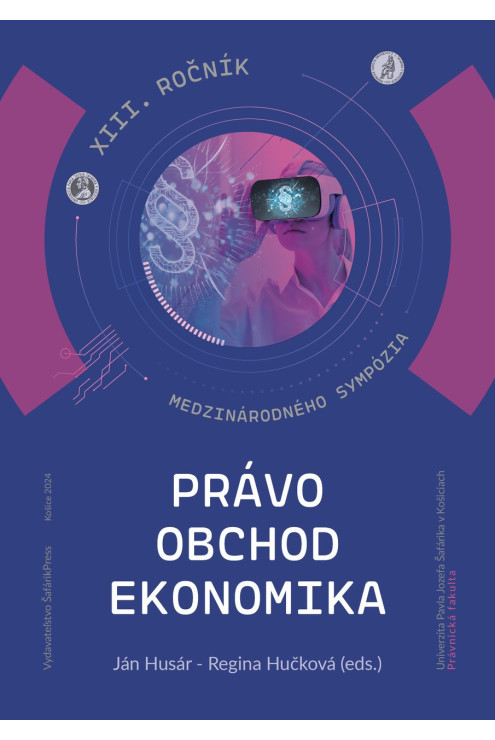
Ján Husár - Regina Hučková (eds.)
Publication Law Business Economy XIII. is collection of international scientific works which contains scientific contributions of wide variety of branches of law, as well as related fields of scientific expertise. Among areas of issues which were discussed in this publication are questions of civil, commercial, tax, custom, competition, intellectual proporty, arbitration and corporate law, as well as other partial areas, including scientific works dealing with economic regulation and business and IT law. Entire publication is significant with richness of scientific contributions from various jurisdictions, because of renowed authors from various countries. Apart from theoretical contribution and expansion of current state of the art in submitted interdisciplinary area, solutions to legal problems were formulated at de lege ferenda level.

Data sheet
E-book
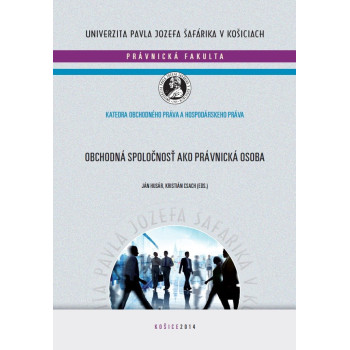
Ján Husár - Kristián Csach (eds.)
The collection contains contributions presented at the international conference held on April 1st - 3rd 2014 in Smolenice, organized by Pavol Jozef Šafárik University in Košice in cooperation with the Institute of State and Law of the Slovak Academy of Sciences and the Institute of State and Law of the Czech Academy of Sciences. Authors are high-profile Slovak and Czech scholars in the field of private law and company law, as well as representatives of new generation of young researchers. Contributions focus on contemporary issues in the field of company law, in particular theoretical basis of corporations, groups of companies, doctrine of abuse of rights, reflective loss and new tendencies in corporate law in foreign legal orders. The first part of the contributions presented at the conference have been already published in the special issue of the theoretical magazine Právny Obzor n. 4/2014.
E-book
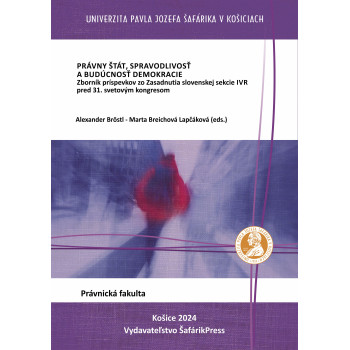
Alexander Bröstl - Marta Breichová Lapčáková (eds.)
Collection of papers from session of the slovak section of the IVR
In accordance with its name, the collection is devoted to three framework areas consisting of the rule of law, justice and the future of democracy, reflecting the focus of the 31st World Congress of the International Association for the Philosophy of Law and Social Philosophy (IVR). Published contributions of the slovak section of the IVR are devoted to the present questions of the rule of law in relation to the democratic legal state. Principles of the rule of law and present questions connected to the democratic character of the Slovak republic, including the democratic procedures on the local level, are juxtaposed with shifts on the international and global scene. Individual contributions are thus devoted to the technical and biotechnological challenges of contemporary democracy, the manifestation of game theory in the search for consensus in collegial judicial bodies, or to the concept of loyal opposition in the ongoing judicial dialogue surrounding the application of law in the european legal space. Space is also devoted to the universal questions of the nature of legal science, and to the present and future of the rule of law. The collection thus goes beyond the borders of the slovak legal space and aims to understand current trends in a broader context.
E-book
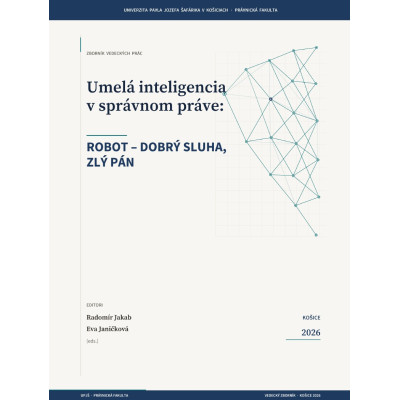
Radomír Jakab Eva Janičková (eds.)
This collection of scientific papers is a direct output of the 2nd Czechoslovak Symposium titled "AI in Administrative Law: ROBOT – GOOD SERVANT, BAD MASTER," held on October 2nd and 3rd, 2025, in the Tokaj region. The symposium was organized as part of the research project VEGA no. 1/0062/25, entitled "Automation of Decision-Making Processes in Public Administration".This proceeding provide a comprehensive presentation and professional confrontation of knowledge regarding the use of artificial intelligence within decision-making processes in public administration, at both the national and European levels.
Individual contributions examine the theoretical limits of national regulations, as well as practical impacts in sectoral areas, such as the digitalization of the labor market, alternative resolution of administrative disputes, prevention of illegal content, and the specific issue of liability for null and void decisions issued by artificial intelligence systems. The ultimate goal of these contributions is formulation of legislative recommendations aimed at streamlining administrative proceedings in the Slovak Republic, while simultaneously respecting the principles of the rule of law and the protection of fundamental human rights and freedoms.
E-book
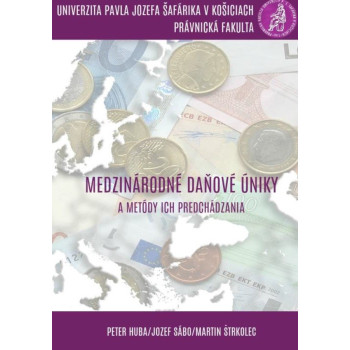
Peter Huba - Jozef Sábo - Martin Štrkolec
The presented monograph aims to provide an in-depth overview of the issue of international tax evasion, both in terms of its conceptual foundations and with regard to specific methods and schemes used to carry out tax evasion.
The members of the authorial team have also addressed questions of tax evasion in their previous works: "International Tax Evasion and Tax Havens" (JUDr. Jozef Sábo) and "Legal Aspects of the Elimination of Double Taxation and Prevention of Tax Evasion" (JUDr. Peter Huba).
This monograph represents a synthesis of the relevant research activities of the authorial team, enriched by the interdisciplinary dimension of the tax evasion problem. At the same time, it highlights those shortcomings that appear to be the most serious from the perspective of the risk of international tax evasion and base erosion in Slovakia. In this respect, a comparative perspective on the issue is presented, drawing extensively from American sources, mainly due to the high quality and long-standing research on international tax evasion in the United States.
The authorial team believes that this monograph will help to bring the issue of corporate income tax evasion closer to the professional public, and that it will receive attention equal to that given to VAT fraud and other pressing issues of current tax legislation.